
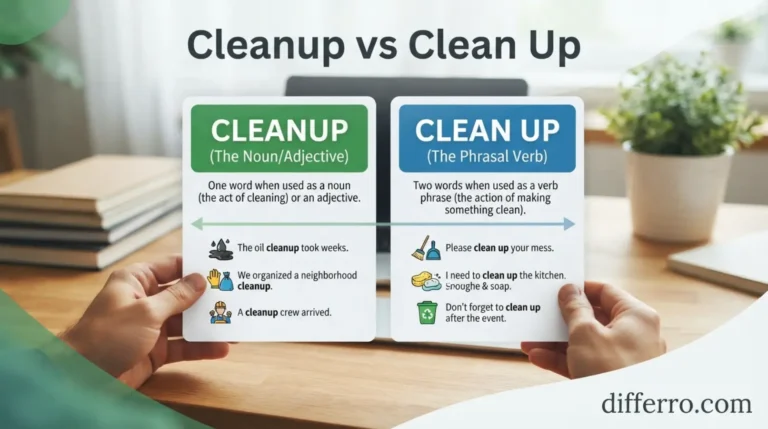
Cleanup vs Clean Up often confuses English learners because both forms relate to making something clean. However, they serve different grammatical purposes. Cleanup is a noun that describes the act or process of cleaning. Clean up is a phrasal verb that describes the action of removing dirt, mess, or clutter.
For example, you might say, “The cleanup took two hours.” You could also say, “Please clean up your room.” Both sentences are correct, but their grammar differs. Understanding this small difference helps you write clearer emails, school assignments, social media posts, and everyday messages.
This guide explains the meaning of cleanup and clean up, their grammatical roles, and their common uses. You will also learn easy memory tricks, practical examples, and frequent mistakes. By the end, you will know which form fits your sentence.
⭐ Quick Answer
Cleanup is a noun that means the process of cleaning. Clean up is a phrasal verb that means to remove dirt, mess, or clutter.
Example: “The cleanup starts at noon” uses the noun. “Please clean up the kitchen” uses the verb.
Meaning of Cleanup
Cleanup is a noun that refers to the process, activity, or result of cleaning a place or removing unwanted material.
People often use this word when discussing household chores, environmental projects, public spaces, and organized cleaning activities.
Examples of Cleanup
- The school organized a cleanup after the annual sports event.
- The beach cleanup removed plastic bottles and other waste.
Common Uses of Cleanup
- Household cleanup: The cleanup took an hour after dinner.
- Environmental cleanup: Volunteers joined a river cleanup.
- Workplace cleanup: The team scheduled a cleanup of the storage area.
- Digital cleanup: I completed a cleanup of unnecessary computer files.
In each example, cleanup names an activity or process.
Meaning of Clean Up
Clean up is a phrasal verb that means to make something clean, tidy, or free from unwanted material.
It usually describes an action involving a room, object, outdoor area, or collection of items. The phrase can also have figurative meanings, such as correcting mistakes or improving a situation.
Examples of Clean Up
- Please clean up your desk before leaving the office.
- The volunteers clean up the park every Saturday.
Common Uses of Clean Up
- Household chores: Clean up your bedroom before guests arrive.
- Outdoor cleaning: We need to clean up the garden.
- Workplace tasks: The staff will clean up the meeting room.
- Figurative meaning: The manager must clean up the company’s outdated records.
In these examples, clean up describes an action.
🔎 Cleanup vs Clean Up: Key Differences
| Feature | Cleanup | Clean Up |
|---|---|---|
| Meaning | The process or activity of cleaning | The action of making something clean |
| Part of speech | Noun | Phrasal verb |
| Tone | Neutral and straightforward | Neutral and action-oriented |
| Usage | Names an event, task, or process | Describes an action or instruction |
| Example | The cleanup starts tomorrow. | We will clean up tomorrow. |
| Popularity | Common in nouns and compound expressions | Common in everyday instructions and sentences |
| Sentence role | Often acts as the subject or object | Usually acts as the verb |
| Formal writing | Suitable for reports and descriptions | Suitable for instructions and descriptions |
Remember: Neither form is universally better. Your sentence’s grammatical structure determines the correct choice.
🕰️ Origin and History of Cleanup and Clean Up
The word clean has a long history in English and describes freedom from dirt or unwanted material. English speakers also use clean as a verb meaning to remove dirt.
The phrase clean up developed as a combination of the verb clean and the particle up. It describes completing a cleaning action or bringing something into a cleaner condition.
The closed compound cleanup functions as a noun. English commonly forms nouns from phrases or verbs, although spelling patterns vary.
Similar Word Examples
These examples show how English sometimes distinguishes a verb phrase from a related noun.
- Setup: The setup took ten minutes.
- Set up: Please set up the chairs.
- Makeup: Her makeup looked natural.
- Make up: They need to make up a story.
- Breakdown: The breakdown caused delays.
- Break down: Do not break down the equipment.
These pairs follow similar spelling patterns, but each expression has its own meanings and grammatical rules.
🇬🇧 British English vs American English Spelling
British and American English both use cleanup as a noun and clean up as a verb.
Neither variety requires a different spelling for these two forms.
Writers in both countries follow the same basic grammatical distinction.
British vs American English Comparison
| Feature | British English | American English |
|---|---|---|
| Noun | Cleanup | Cleanup |
| Verb | Clean up | Clean up |
| Example noun | The cleanup went well. | The cleanup went well. |
| Example verb | Please clean up the room. | Please clean up the room. |
| Spelling difference | None | None |
| Grammatical difference | Noun versus phrasal verb | Noun versus phrasal verb |
✍️ When to Use Cleanup
Use cleanup when you need a noun to name a cleaning activity, process, or organized effort.
It often appears after articles such as a or the. It can also modify another noun, as in cleanup operation or cleanup crew.
Examples of Cleanup in Sentences
- The cleanup after the party lasted two hours.
- Our neighborhood planned a weekend cleanup.
- The company announced a major environmental cleanup.
- The cleanup crew arrived early.
- The school needs a thorough cleanup before Monday.
How to Identify Cleanup
Ask yourself: Am I naming an activity or process?
If the answer is yes, cleanup may be the correct choice.
For example:
“The cleanup of the playground took all morning.”
Here, cleanup names the activity. It does not describe what someone is doing in the sentence.
🧹 When to Use Clean Up
Use clean up when someone performs the action of cleaning or removing a mess.
The phrase often follows a subject, such as I, you, they, or the workers. It can also appear as an instruction.
Examples of Clean Up in Sentences
- I clean up my desk every evening.
- Please clean up the spilled water.
- The children will clean up their toys.
- We need to clean up the backyard.
- Workers clean up the site after construction.
How to Identify Clean Up
Ask yourself: Is someone performing the action of cleaning?
If the answer is yes, use clean up.
For example:
“Please clean up the classroom before the next lesson.”
Here, clean up tells someone what action to perform.

⚠️ Common Mistakes With Cleanup and Clean Up
Mistake 1: Using Cleanup as a Verb
Incorrect: Please cleanup your bedroom.
Correct: Please clean up your bedroom.
Why: The sentence requires a verb phrase that describes an action.
Mistake 2: Using Clean Up as a Noun
Incorrect: The clean up starts at 9 a.m.
Correct: The cleanup starts at 9 a.m.
Why: The sentence names a scheduled activity, so the noun cleanup fits.
Mistake 3: Confusing Instructions With Activity Names
Incorrect: We need a clean up before the guests arrive.
Correct: We need a cleanup before the guests arrive.
Alternative: We need to clean up before the guests arrive.
Why: Use cleanup to name the activity or clean up to describe the action.
Mistake 4: Adding an Unnecessary Space in a Compound Noun
Incorrect: The cleanup crew arrived early for the clean up operation.
Correct: The cleanup crew arrived early for the cleanup operation.
Why: In standard usage, cleanup forms a single noun that can modify another noun.
Mistake 5: Assuming Both Forms Are Interchangeable
Incorrect: The workers will cleanup the building.
Correct: The workers will clean up the building.
Why: The sentence needs a verb phrase after will.
Mistake 6: Choosing the Form Without Checking Grammar
Incorrect: We finished the clean up yesterday.
Better: We finished the cleanup yesterday.
Alternative: We finished cleaning up yesterday.
Why: The noun cleanup names the activity. The phrase cleaning up also works as a gerund phrase.
🧠 Easy Trick to Remember Cleanup or Clean Up
Use this simple memory trick:
- Cleanup = one word, one thing. It names a cleaning activity.
- Clean up = two words, an action. It tells someone to clean something.
Try replacing the expression with another noun or verb.
Example 1: The cleanup was successful.
You can say, “The event was successful.” Both cleanup and event function as nouns.
Example 2: Please clean up the kitchen.
You can say, “Please tidy the kitchen.” Both phrases describe an action.
This trick works in most everyday situations.
🏡 Everyday-Life Examples of Cleanup vs Clean Up
1. Cleaning Your Bedroom
Cleanup: The bedroom cleanup took thirty minutes.
Clean up: I need to clean up my bedroom before school.
The first sentence names the activity. The second describes the action.
2. Cleaning After a Party
Cleanup: Everyone helped with the cleanup after the birthday party.
Clean up: We must clean up the house before going to bed.
Both forms fit naturally, but they serve different grammatical roles.
3. Organizing a School Event
Cleanup: The school scheduled a cleanup after the annual function.
Clean up: Students will clean up the playground after the function.
The noun identifies the planned activity. The verb describes what students will do.
4. Protecting the Environment
Cleanup: The river cleanup attracted hundreds of volunteers.
Clean up: Local volunteers clean up the riverbank every month.
These sentences show how both forms work in environmental discussions.
5. Cleaning an Office
Cleanup: The office cleanup begins after working hours.
Clean up: Employees should clean up their desks before leaving.
The first sentence names an activity. The second gives an instruction.
🌍 Google Trends and Usage Data: USA, UK, Australia, India, and Pakistan
Google Trends reports relative search interest rather than exact search counts. Without live comparisons, precise country rankings for these phrases cannot be verified.
- USA: Both forms fit everyday searches about cleaning, household chores, and grammar.
- UK: The same spelling and grammatical distinction apply in British English.
- Australia: Both forms work in household, workplace, and environmental contexts.
- India: English learners may search for the difference between the noun and phrasal verb.
- Pakistan: Educational searches may focus on correct spelling, sentence structure, and everyday usage.
SEO insight: Treat these points as general language-use guidance, not verified search-volume findings. Compare both phrases in Google Trends using the same time range and country filters before reporting regional popularity. Also compare related terms to discover additional search intent.
Comparison Table: Keyword Variations
| Keyword variation | Search intent | Recommended use |
|---|---|---|
| Cleanup vs Clean Up | Direct spelling and grammar comparison | Main title and introduction |
| Cleanup vs clean up | Understanding the difference | Key differences section |
| Cleanup meaning | Learning the noun’s definition | Meaning section |
| Clean up meaning | Learning the verb phrase | Meaning section |
| Is cleanup one word or two? | Spelling clarification | FAQ section |
| Cleanup noun or verb | Grammar clarification | Grammar section |
| Cleanup vs clean-up | Hyphenation question | Related keywords section |
❓ Frequently Asked Questions
1. Is cleanup or clean up correct?
Both forms are correct. Cleanup is a noun, while clean up is a phrasal verb. Choose the form that matches your sentence.
2. What is the difference between cleanup and clean up?
Cleanup names a cleaning activity or process. Clean up describes the action of removing dirt, mess, or clutter.
3. Which form is more common?
Both Cleanup vs Clean Up forms are common, but they appear in different grammatical contexts. Their frequency depends on the sentence, topic, and search context. Neither form replaces the other in every situation.
4. Should I use cleanup or clean up in formal writing?
Both forms work in formal writing. Use cleanup when naming an activity, such as an environmental cleanup. Use clean up when describing an action, such as cleaning a work area.
5. Why do people confuse cleanup and clean up?
The forms look and sound similar, and both Cleanup vs Clean Up relate to cleaning. However, English uses one word for the noun and two words for the phrasal verb. Their grammatical roles explain the difference.
✅ Final Verdict: Which Form Should You Use?
Choose cleanup when you need a noun that names a cleaning activity, process, or event. For example, “The cleanup begins tomorrow.”
Choose clean up when you need a verb phrase that describes an action. For example, “Please clean up the room.”
Neither form is more correct in every situation. The right choice depends on the sentence’s grammar and intended meaning. Remember that British and American English follow the same basic rule.
When editing your writing, identify whether you are naming an activity or describing an action. This simple check will help you avoid common spelling and grammar mistakes.
Conclusion
Understanding cleanup vs clean up becomes easy when you recognize their grammatical roles. Cleanup is a noun that names the process or activity of cleaning. Clean up is a phrasal verb that describes the action of making something clean or tidy.
For example, “The cleanup took an hour” uses the noun correctly. “Please clean up your room” uses the phrasal verb correctly. Both forms appear in everyday conversations, professional writing, school assignments, and environmental discussions.
British and American English use the same spellings for these expressions. You do not need to memorize separate regional rules. Simply ask whether your sentence names an activity or describes an action. With this easy trick, you can choose the correct form confidently and write clearer English.

Imran Lodhra is a comparison-focused content writer at Differro.com.
He specializes in creating clear, simple, and informative comparison articles.
His work helps readers understand key differences, pros and cons, and important details.
Imran focuses on accurate, practical, and easy-to-read content for everyday readers.
1 thought on “Cleanup vs Clean Up: Which Form Is Correct?”