
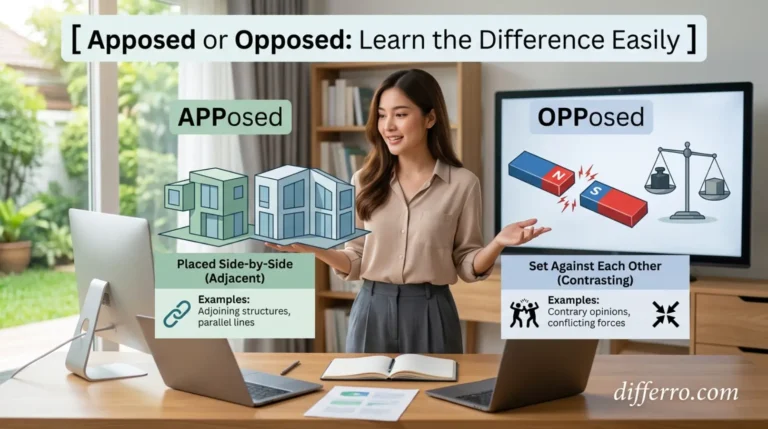
Apposed or Opposed can confuse writers because both words look and sound very similar. However, they have different meanings and uses in English. Apposed means placed next to, near, or alongside something. Opposed means against something, in disagreement, or in contrast with it.
Many people also make the spelling mistake “as apposed to.” The correct expression is “as opposed to.” Apposed is a real English word, but it has a specialized meaning. It often appears in medical, scientific, anatomical, and technical writing. Opposed is much more common in everyday English, academic writing, and general communication. This guide explains Apposed or Opposed with simple meanings, examples, common mistakes, and easy memory tips.
⭐ Quick Answer
Apposed means placed close to or alongside something, while opposed means against, resistant to, or different from something.
- The two surfaces were apposed. → The surgeon apposed the two surfaces.
- She was opposed to the new plan. → She opposed the new plan.
📘 Meaning of Apposed
Apposed is the past tense and past participle of appose. It means placing something next to, close to, or alongside another thing. Cambridge defines appose as placing something next to or close to something else.
The word commonly appears in technical fields where precise physical positioning matters.
Examples:
- The two surfaces were closely apposed.
- The wound edges were carefully apposed before treatment.
Merriam-Webster also defines appose as placing things in juxtaposition or proximity.
📗 Meaning of Opposed
Opposed is the past tense and past participle of oppose. It can describe disagreement, resistance, conflict, or contrasting positions.
It also appears in the common expression “as opposed to,” which means “rather than” or “in contrast with.”
Examples:
- The residents were opposed to the new proposal.
- Her opinion was completely opposed to mine.
🔍 Apposed or Opposed: Key Differences
| Feature | Apposed | Opposed |
|---|---|---|
| Meaning | Placed next to or close to something | Against, resistant, or contrary |
| Tone | Technical and formal | General and widely used |
| Usage | Medical, scientific, anatomical, technical | Everyday, academic, professional |
| Popularity | Uncommon | Very common |
| Main idea | Physical proximity | Disagreement or contrast |
| Common phrase | Apposed to | As opposed to |
| Example | The tissues were apposed. | They were opposed to the plan. |
The central difference is simple: apposed describes closeness, while opposed describes opposition or contrast.
📜 Origin and History
Both words have a connection with the Latin idea of placing something. Their prefixes helped create different meanings.
Appose developed with the sense of placing something near or beside another thing. Merriam-Webster records its first known use in English in 1593.
Oppose developed with the sense of setting something against another thing. The word opposed has appeared in English since the 15th century.
Similar Word Examples
- Appose — place beside or near.
- Apposition — a relationship involving placement beside something.
- Oppose — resist or act against.
- Opposition — resistance or disagreement.
- Opposite — something contrary or facing another thing.
Merriam-Webster also connects apposition with the act or state of apposing.
🇬🇧 British English vs American English Spelling
The spelling of apposed and opposed does not normally change between British and American English.
Pronunciation can differ slightly because of regional accents.
The meaning and standard spelling remain the same in both varieties.
British vs American English Comparison
| Word | British English | American English |
|---|---|---|
| Apposed | apposed | apposed |
| Opposed | opposed | opposed |
| Appose | appose | appose |
| Oppose | oppose | oppose |
| Meaning | Same | Same |
Cambridge lists regional pronunciation differences but keeps the same spellings.
✍️ When to Use Apposed
Use apposed when you position something next to, close to, or alongside another thing.
It works especially well in technical descriptions.
Examples:
- The two membranes remained apposed.
- The surgeon carefully apposed the tissue edges.
- During the examination, the team found the structures closely apposed.
- The two surfaces became apposed after adjustment.
Medical and scientific writing often uses this word because it describes physical relationships precisely.
✍️ When to Use Opposed
Use opposed when you mean against, resistant, disagreeing, or contrary.
It also works when comparing two different choices or ideas.
Examples:
- I oppose the proposal.Many residents opposed the decision.His views oppose hers.We chose tea instead of coffee.
Cambridge lists opposed for disagreement, contrast, and opposite positioning.
⚠️ Common Mistakes
Mistake 1: Writing “as apposed to”
❌ I prefer tea as apposed to coffee.
✅ I prefer tea as opposed to coffee.
The standard expression is as opposed to.
Mistake 2: Using apposed for disagreement
❌ She is apposed to the proposal.
✅ She is opposed to the proposal.
Disagreement requires opposed.
Mistake 3: Using opposed for physical closeness
❌ The two tissue edges were opposed together.
✅ The two tissue edges were apposed.
Physical positioning can require apposed in technical contexts.
Mistake 4: Assuming apposed is always incorrect
❌ “Apposed” is not a real English word.
✅ “Apposed” is a legitimate word with a specialized meaning.
Dictionaries recognize appose and its form apposed.
🧠 Easy Trick to Remember
Use this simple memory trick:
APPOSED = ALONGSIDE
Think of A in apposed as alongside.
OPPOSED = OPPOSITION
Think of O in opposed as opposition.
Ask yourself one question:
Are the things close together, or are they against each other?
- Close together → apposed
- Against or contrasting → opposed
For normal phrases like “as opposed to,” always choose opposed.
🌎 Apposed or Opposed: Everyday Life Examples
1. Choosing Between Two Drinks
- I prefer coffee as opposed to tea.
- The sentence compares two choices.
- Opposed is the correct word here.
2. Discussing a New Rule
- Several employees were opposed to the new rule.
- They disagreed with the proposal.
- Opposed clearly expresses resistance.
3. Describing Medical Structures
- The two tissue surfaces remained closely apposed.
- The sentence describes physical proximity.
- Apposed fits this technical context.
4. Comparing Two Ideas
- The article presents traditional views as opposed to modern ideas.
- The phrase highlights a contrast.
- Opposed is correct.
5. Describing Nearby Objects
- The two surfaces were carefully apposed during the procedure.
- The sentence focuses on physical placement.
- Apposed is appropriate in this technical setting.
📊 Google Trends & Usage Data: USA, UK, Australia, India, and Pakistan
Google Trends uses relative search interest rather than absolute search volume. Current language evidence strongly favors opposed over apposed in general English. Dictionary evidence also shows that opposed has broad everyday uses, while apposed has a narrower technical meaning.
Across USA, UK, Australia, India, and Pakistan, the useful SEO insight is the same: opposed has broader search intent and everyday usage. Apposed mainly attracts people checking spelling, definitions, or specialist terminology.
Exact Google Trends scores can change by date, location, and search settings. Therefore, fixed percentage claims should not be treated as permanent data.
Usage Insight by Country
| Country | Likely Search Intent | Stronger Keyword |
|---|---|---|
| USA | Grammar, writing, general English | Opposed |
| UK | Grammar, vocabulary, comparison | Opposed |
| Australia | General English and writing | Opposed |
| India | English learning and spelling | Opposed |
| Pakistan | English learning and spelling | Opposed |
The strongest SEO opportunity comes from explaining “as opposed to” because that phrase causes frequent spelling confusion.
📈 Comparison Table: Keyword Variations
| Keyword Variation | Intent | Popularity | Best Content Angle |
|---|---|---|---|
| Apposed or Opposed | Comparison | High | Meaning and difference |
| Apposed vs Opposed | Comparison | High | Side-by-side explanation |
| Apposed meaning | Definition | Medium | Dictionary-style answer |
| Opposed meaning | Definition | High | Definition and examples |
| As opposed to | Grammar | Very High | Correct phrase usage |
| Apposed to or opposed to | Spelling | High | Common mistake |
| Apposed definition | Definition | Medium | Technical meaning |
⚖️ Final Verdict: Apposed or Opposed?
Opposed is the better choice for most everyday English writing.
Use opposed when you mean against, disagreeing, resistant, opposite, or contrasting. It also belongs in the standard phrase “as opposed to.”
Use apposed when you mean placed next to, near, or alongside something. This word is legitimate but much less common. It often appears in medical, scientific, anatomical, and technical contexts.
The easiest rule is:
Apposed = placed alongside.
Opposed = against or contrasted.
If you are writing a normal sentence such as “I prefer X as opposed to Y,” use opposed.
❓ Frequently Asked Questions
Is “apposed” a correct word?
Yes. Apposed is a correct English word. It describes something placed next to, near, or alongside another thing.
What is the difference between apposed and opposed?
Apposed means placed close together. Opposed means against, resistant, contrary, or different.
Which is more common, apposed or opposed?
Opposed is far more common in general English. Apposed has a narrower, specialized use.
Is “apposed” formal?
Yes. Apposed is relatively formal and often appears in scientific, medical, anatomical, or technical writing.
Why does the confusion between apposed and opposed exist?
The words differ by only one letter and have similar pronunciation. Their related historical roots also contribute to the confusion. The phrase “as opposed to” creates another common spelling trap.
📝 Conclusion
Understanding Apposed or Opposed becomes simple once you focus on meaning. Apposed describes things positioned beside, near, or alongside each other. It is a legitimate word, but it mainly appears in technical and specialized writing. Opposed describes disagreement, resistance, conflict, or contrast. It is much more common in everyday English and professional communication.
Remember the easiest rule: apposed means alongside, while opposed means against or contrasted. Use opposed in the common phrase “as opposed to.” Use apposed when a technical context describes physical proximity. Checking the meaning before choosing the spelling will help you avoid one of the most common English word-choice mistakes.

Imran Lodhra is a comparison-focused content writer at Differro.com.
He specializes in creating clear, simple, and informative comparison articles.
His work helps readers understand key differences, pros and cons, and important details.
Imran focuses on accurate, practical, and easy-to-read content for everyday readers.
3 thoughts on “Apposed or Opposed: Learn the Difference Easily”