

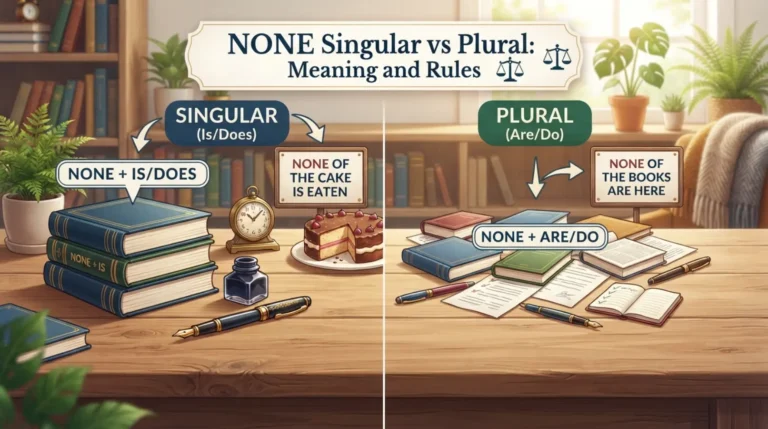
None singular vs plural is a common grammar question that confuses many English learners. People often wonder whether “none” takes a singular or plural verb. The answer depends on the meaning and context of the sentence. Traditionally, writers often used “none” with singular verbs. However, modern English also accepts plural verbs when “none” refers to multiple people or things.
Understanding this rule helps you write clearer sentences and avoid common grammar mistakes. You can use “none” to mean “not one” or “not any.” Both meanings affect how readers understand your sentence. This guide explains none singular vs plural with simple definitions, examples, and practical rules. You will also learn when to use singular or plural verbs confidently in everyday and formal writing.
⭐ Quick Answer
“None” can take either a singular or plural verb, depending on its meaning and context. Use a singular verb when it means “not one.” Use a plural verb when it means “not any” and refers to multiple items.
Example:
- Singular: None of the water is left.
- Plural: None of the students are absent.
📖 Meaning of None
“None” is an indefinite pronoun that means “not one” or “not any.” It refers to the absence of people, things, or amounts.
Writers use “none” when they want to say that nothing or nobody belongs to a particular group or situation.
Examples of None
Example 1: None of the money is missing.
This sentence uses a singular verb because “money” is an uncountable noun.
Example 2: None of the players are ready.
This sentence uses a plural verb because “players” refers to multiple people.
Common Uses of None
- None of the food is fresh.
- None of my friends are available.
- None of the information was useful.
- None of the answers are correct.
📚 Meaning of Singular and Plural
Singular refers to one person, animal, place, or thing. Plural refers to more than one person, animal, place, or thing.
In grammar, singular and plural forms also affect verb agreement.
Examples of Singular
Example 1: None of the milk is fresh.
The sentence uses “is” because milk is an uncountable noun.
Example 2: None of the students is ready.
This sentence uses a singular verb to emphasize “not one student.” However, the plural verb “are” is also natural in everyday English.
Examples of Plural
Example 1: None of the books are available.
The sentence uses “are” because books refers to multiple items.
Example 2: None of the workers have arrived.
The plural verb “have” agrees naturally with the plural meaning of workers.
🔍 None Singular vs Plural: Key Differences
The main difference involves the meaning of “none” and the noun in the following phrase.
| Feature | None With Singular Verb | None With Plural Verb |
|---|---|---|
| Meaning | Not one | Not any |
| Grammar | Singular verb | Plural verb |
| Usage | Emphasizes individual absence | Refers to multiple people or things |
| Example | None of the cake is left. | None of the cookies are left. |
| Tone | Can sound more formal or emphatic | Often sounds natural in everyday English |
| Common usage | Uncountable nouns and singular meanings | Plural countable nouns |
| Popularity | Common | Common |
Important: Modern English accepts both singular and plural verbs with “none” in many contexts. The intended meaning and the following noun help guide your choice.
🕰️ Origin and History of None
The word “none” comes from Old English nān, which means “not one.” It developed from the combination of words expressing negation and number.
Over time, English speakers began using “none” with both singular and plural meanings. Traditional grammar often favored singular agreement because of its connection with “not one.”
Modern English recognizes that “none” can also mean “not any.” This meaning naturally supports plural verbs when referring to multiple countable items.
Similar Grammar Examples
- Each: Each of the students is ready.
- Every: Every child needs attention.
- All: All of the students are present.
- Some: Some of the water is missing.
- Neither: Neither of the answers is correct.
These pronouns and determiners follow different agreement patterns. Understanding their meanings helps improve sentence structure.
🇬🇧 British English vs American English
The word “none” has the same spelling and basic meaning in British and American English.
Both varieties accept singular and plural verb agreement when the context supports it.
Some style preferences may differ, but the basic grammar rules remain the same.
British vs American English Comparison
| Feature | British English | American English |
|---|---|---|
| Spelling | None | None |
| Singular usage | Accepted | Accepted |
| Plural usage | Accepted | Accepted |
| Example | None of the books are missing. | None of the books are missing. |
| Meaning | Not one or not any | Not one or not any |
| Grammar rule | Context-based agreement | Context-based agreement |
✍️ When to Use None With a Singular Verb
Use a singular verb when “none” means “not one.” Singular verbs also work naturally with uncountable nouns.
This structure emphasizes the absence of a single person, item, or amount.
1. When None Means Not One
Use a singular verb when you want to emphasize that not even one person or item exists.
Examples:
- None of the students is ready.
- None of the answers is correct.
- None of the applicants has qualified.
2. When the Noun Is Uncountable
Uncountable nouns usually take singular verbs.
Examples:
- None of the water is clean.
- None of the furniture is damaged.
- None of the information is accurate.
3. In Formal or Careful Writing
Some writers prefer singular agreement when they want to emphasize “not one.”
Examples:
- None of the evidence is convincing.
- None of the equipment is available.
However, formal writing does not require a singular verb in every sentence containing “none.”
✍️ When to Use None With a Plural Verb
Use a plural verb when “none” means “not any” and refers to multiple countable people or things.
This structure is common in everyday English and sounds natural in many situations.
1. When Referring to Multiple People
Use a plural verb when the sentence refers to several people.
Examples:
- None of the teachers are absent.
- None of my friends have arrived.
- None of the players are injured.
2. When Referring to Multiple Objects
Plural verbs work naturally with plural countable nouns.
Examples:
- None of the books are available.
- None of the chairs are broken.
- None of the pictures are clear.
3. When Emphasizing a Group
Use plural agreement when the sentence focuses on a group of people or things.
Examples:
- None of the workers have finished the task.
- None of the children are sleeping.
- None of the shops are open.
⚠️ Common Mistakes With None Singular vs Plural
Many English learners struggle with subject-verb agreement when using “none.” Here are common mistakes and their corrections.
Mistake 1: Always Using a Singular Verb
Incorrect: None of the students is absent.
Correct: None of the students are absent.
Both forms can be correct. The plural form sounds natural when referring to students as a group.
Mistake 2: Using a Plural Verb With an Uncountable Noun
Incorrect: None of the water are clean.
Correct: None of the water is clean.
Water is uncountable, so it normally takes a singular verb.
Mistake 3: Thinking None Always Means Not One
Incorrect: None always requires a singular verb.
Correct: None can mean “not one” or “not any.” Choose the verb according to the intended meaning.
Mistake 4: Ignoring the Noun After Of
Incorrect: None of the books is available, because “none” always takes singular verbs.
Correct: None of the books are available.
The singular version is also grammatically possible, but the plural version sounds more natural here.
Mistake 5: Confusing None With No One
Incorrect: No one of the students are present.
Correct: None of the students are present.
“No one” generally takes a singular verb.
Mistake 6: Assuming Formal Writing Always Requires Singular Agreement
Incorrect: Formal English always requires “none is.”
Correct: Formal English accepts singular and plural agreement when the meaning supports it.
🧠 Easy Trick to Remember
Use this simple memory trick to remember the difference:
- None = Not one: Think singular.
- None = Not any: Think plural when referring to multiple countable items.
- Uncountable noun: Usually choose a singular verb.
Examples:
- None of the milk is left.
- None of the students are present.
- None of the money is missing.
Remember, context matters more than a fixed rule.
🌟 Everyday-Life Examples of None Singular vs Plural
1. At School
A teacher checks attendance before starting a lesson.
Example: None of the students are absent today.
The plural verb “are” sounds natural because students refers to several people.
2. At Home
A family checks the refrigerator before preparing dinner.
Example: None of the milk is left in the refrigerator.
The singular verb “is” agrees with the uncountable noun milk.
3. At the Office
A manager checks the employees’ completed assignments.
Example: None of the workers have submitted their reports.
The plural verb “have” refers to multiple workers.
4. At a Shopping Store
A customer looks for available shirts in a particular size.
Example: None of the shirts are available in medium.
The plural verb “are” refers to several shirts.
5. During an Examination
A student checks the answers after completing a test.
Example: None of the answers is correct.
The singular verb emphasizes that not one answer is correct. The plural form “are” is also acceptable in modern English.
🌍 Google Trends and Usage Insights: Five Countries
Google Trends measures relative search interest rather than exact search volume. The following observations are general SEO considerations, not verified live rankings.
- USA: Searchers may look for none singular or plural grammar rules and sentence examples.
- UK: Users may search for subject-verb agreement and traditional grammar explanations.
- Australia: English learners may compare singular and plural pronoun usage.
- India: Grammar learners may search for none is or none are with practical examples.
- Pakistan: Students may search for none singular vs plural to improve grammar and writing skills.
SEO insight: Compare “none singular or plural,” “none is or are,” and “none of them is or are” separately in Google Trends. Use the same date range and country settings to identify actual search interest.
Comparison Table: Keyword Variations
| Keyword variation | Search intent | Suggested content placement |
|---|---|---|
| None Singular vs Plural | Direct grammar comparison | H1 and introduction |
| Is None Singular or Plural | Grammar question | FAQ |
| None Is or None Are | Sentence confusion | Examples section |
| None of Them Is or Are | Subject-verb agreement | Grammar rules |
| None of the Students Is or Are | Practical usage | Everyday examples |
| None Grammar Rules | Informational | Meaning section |
| None Singular or Plural Examples | Learning and practice | Examples section |
❓ Frequently Asked Questions
1. Is “none” singular or plural?
“None” can be singular or plural, depending on its meaning. Use a singular verb when it means “not one.” Use a plural verb when it means “not any” and refers to multiple countable items.
2. What is the difference between “none is” and “none are”?
“None is” emphasizes “not one” or refers to an uncountable amount. “None are” commonly refers to multiple people or things. Both forms can be grammatically correct.
3. Which is more common, “none is” or “none are”?
Both forms are common in modern English. “None are” often sounds more natural with plural countable nouns. “None is” commonly appears with uncountable nouns and singular meanings.
4. Should I use “none is” or “none are” in formal writing?
Both forms are acceptable in formal writing when they match the intended meaning. Use “none is” for singular meanings and uncountable nouns. Use “none are” when referring to multiple countable items.
5. Why do people confuse none singular vs plural?
People confuse these forms because “none” has two meanings: “not one” and “not any.” Traditional grammar often favors singular agreement, while modern English also accepts plural agreement.

🏆 Final Verdict: None Singular vs Plural
The correct choice between “none is” and “none are” depends on the sentence’s meaning. Neither form is always better or more correct.
Use “none is” when “none” means “not one” or refers to an uncountable noun. Use “none are” when it means “not any” and refers to multiple countable people or things.
For example, “None of the water is clean” uses a singular verb. “None of the students are ready” uses a plural verb.
Both forms follow accepted modern English grammar. Focus on the intended meaning and the noun after “of.” This simple approach will help you choose the correct verb confidently.
Conclusion
Understanding none Singular vs plural helps you avoid common subject-verb agreement mistakes. The word “none” can mean “not one” or “not any.” Its meaning determines whether a singular or plural verb sounds appropriate.
Use “none is” with uncountable nouns or when emphasizing that not one item exists. Use “none are” when referring to multiple people or things. Both forms are acceptable in modern English.
Remember that context matters more than memorizing one fixed rule. Practice with simple sentences to improve your grammar skills. Once you understand these patterns, choosing between “none is” and “none are” becomes much easier.

