
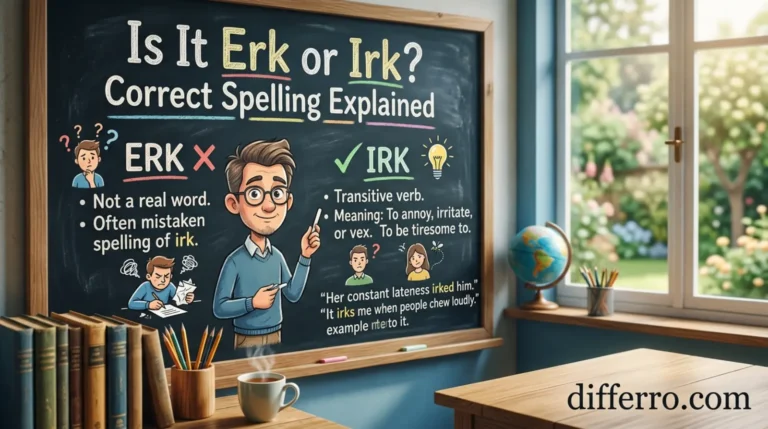
Erk or Irk can be confusing because both spellings look and sound similar. However, they do not have the same meaning or everyday use. Irk is the standard English verb meaning to annoy, irritate, or bother someone. Erk is also a dictionary word, but it has a rare historical meaning. It traditionally referred to a low-ranking member of the Royal Air Force or a naval rating. (Merriam-Webster)
Most people searching for Erk or Irk want to know how to spell the word meaning “annoy.” In that situation, irk is the correct choice. Cambridge and Oxford both define irk as a verb meaning to annoy someone. (Cambridge Dictionary)
Understanding this difference helps you avoid spelling mistakes in school, work, emails, and online writing.
⭐ Quick Answer
Irk is the correct spelling when you mean “to annoy, irritate, or bother.” Erk is a separate, uncommon word with historical British slang meanings.
Example: The constant noise really irked me.
Meaning of Irk
Irk is a verb that means to annoy, irritate, bother, or make someone feel weary. Cambridge lists it as a formal verb meaning “to annoy someone.” (Cambridge Dictionary)
The word can describe something that repeatedly bothers a person.
Examples of Irk
- His constant complaints irk everyone in the office.
- It really irked me when they arrived late.
Common forms include:
- irk
- irks
- irked
- irking
Collins confirms these forms and defines irk as something that irritates or annoys. (Collins Dictionary)
Meaning of Erk
Erk is a real English word, but it is uncommon in modern everyday writing.
Historically, British slang used erk for a low-ranking member of the Royal Air Force. Merriam-Webster defines it as a member of the lowest RAF rank, especially ground crew. (Merriam-Webster)
Collins also records erk as British slang for an aircraftman or naval rating. (Collins Dictionary)
Examples of Erk
- The historical novel mentioned an erk working on the aircraft.
- The old military account described him as an erk.
Therefore, erk should not normally replace irk when you mean “annoy.”
🔎 Key Differences Between Erk and Irk
| Feature | Irk | Erk |
|---|---|---|
| Meaning | To annoy or irritate | Historical British slang for a low-ranking serviceman |
| Tone | Formal or literary | Historical, slang, or specialized |
| Usage | Modern English | Rare and uncommon |
| Popularity | Much more common | Much less common |
| Part of speech | Mainly a verb | Mainly a noun |
| Example | The delay irked me. | He served as an erk. |
Oxford describes irk as formal or literary, while major dictionaries record erk mainly with historical British slang meanings. (Oxford Learner’s Dictionaries)
📚 Origin and History
The history of irk goes back to Middle English. Oxford connects it with an older sense meaning to be annoyed or disgusted. It may also be related to Old Norse yrkja. (Oxford Learner’s Dictionaries)
Dictionary.com gives an earlier meaning connected with becoming tired or weary. Over time, the word developed its modern sense of annoyance or irritation. (Dictionary.com)
Erk has a different history. Merriam-Webster traces it to a shortened form related to aircraftman. Its RAF slang meaning appeared in the early twentieth century. (Merriam-Webster)
Similar Word Examples
Words that can express a similar meaning to irk include:
- Annoy
- Irritate
- Bother
- Aggravate
- Provoke
- Vex
- Disturb
🇬🇧 British English vs 🇺🇸 American English Spelling
There is no standard British-versus-American spelling difference between irk and erk.
Irk remains the standard spelling for the verb in both varieties of English. British and American dictionaries give the same basic meaning. (Cambridge Dictionary)
Erk is not an American alternative spelling of irk. It is a separate word with specialized historical meanings.
British vs American English Comparison
| Variety | Standard word for “annoy” | Notes |
|---|---|---|
| British English | Irk | Formal or literary verb |
| American English | Irk | Same basic meaning |
| British historical slang | Erk | RAF or naval usage |
| American usage | Irk | Common choice for this meaning |
✍️ When to Use Irk
Use irk when something annoys, irritates, or bothers someone.
Examples
- It irks me when people interrupt.
- The unnecessary delay irked the passengers.
- Her rude attitude really irked him.
- Loud music can irk the neighbors.
- It irks her when meetings start late.
The word often appears in formal or polished writing. Cambridge and Oxford both recognize this meaning. (Cambridge Dictionary)
📝 When to Use Erk
Use erk only when its specific historical or specialized meaning is intended.
Examples
- The book described an RAF erk.
- The museum display mentioned an erk from the wartime period.
- The historical character worked as an erk on the ground crew.
Do not use erk simply because it sounds like irk.
If you want to say that something annoyed you, write:
It irked me.
Not:
It erked me.
⚠️ Common Mistakes
1. Writing “erked” instead of “irked”
❌ The noise erked me.
✅ The noise irked me.
The past tense of irk is irked.
2. Using “erk” to mean annoy
❌ His behavior erks me.
✅ His behavior irks me.
The correct verb is irk.
3. Treating erk as an alternative spelling
❌ Erk is another spelling of irk.
✅ Erk is a separate and uncommon word.
4. Assuming pronunciation changes the spelling
❌ I wrote erk because that is how it sounds.
✅ Use irk when you mean “annoy.”
The two words can sound similar, which contributes to the confusion. (Homophones)
5. Using erk in ordinary formal writing
❌ The manager was erked by the delay.
✅ The manager was irked by the delay.
Irked is the correct form for this meaning.
🧠 Easy Trick to Remember
Remember this simple rule:
IRK = Irritate
Both words start with IR.
Think:
I + R = Irritated → IRK
If something makes you annoyed, use irk.
Annoy → IRK
Historical RAF slang → ERK
This quick connection makes the spelling easier to remember.
🌟 Everyday Life Examples
1. Workplace Example
The repeated interruptions really irked the manager.
Here, irked means annoyed.
2. School Example
It irks students when the teacher changes the deadline suddenly.
The primary keyword is irk because the sentence describes annoyance.
3. Family Example
It can irk parents when children leave their rooms messy.
The related idea is irritation or frustration.
4. Online Example
It irks me when people spread false information online.
Here, irk means to bother or irritate.
5. Historical Example
The wartime book described an RAF erk working on the ground crew.
Here, erk has its historical military meaning.
📊 Google Trends and Usage Insight
Google Trends provides relative search interest rather than exact worldwide search counts, so country comparisons should be treated as directional.
For the USA, UK, Australia, India, and Pakistan, the practical search intent strongly favors irk when users mean “annoy.”
The historical word erk has limited modern everyday usage and mainly appears in dictionary, historical, or specialized contexts.
For SEO, Erk or Irk, Erk vs Irk, and Irked or Erked are useful confusion-based variations.
Country-Level Comparison
| Country | Preferred word for “annoy” | SEO insight |
|---|---|---|
| USA | Irk | Strong focus on modern English |
| UK | Irk | Erk may appear in historical British contexts |
| Australia | Irk | Modern usage favors irk |
| India | Irk | English learners may search the spelling contrast |
| Pakistan | Irk | Spelling confusion creates useful search intent |
Keyword Variations Comparison
| Keyword Variation | Search Intent | Best Target |
|---|---|---|
| Erk or Irk | Spelling confusion | Primary |
| Erk vs Irk | Comparison | Secondary |
| Is it Erk or Irk | Grammar question | Secondary |
| Irk meaning | Definition | Supporting |
| Erk meaning | Definition | Supporting |
| Irked or Erked | Past-tense confusion | Supporting |
| How to spell Irk | Spelling | Supporting |
⚖️ Final Verdict
Irk is the correct choice when you mean to annoy, irritate, or bother someone.
For example:
The constant noise irked me.
Erk is also a dictionary word, but its main documented English use is historical British slang for a low-ranking RAF member or similar military rating. (Merriam-Webster)
So, for normal modern writing, remember:
Annoy = IRK
Historical military slang = ERK
If you are writing an email, article, school assignment, or social media post about annoyance, irk is almost certainly the word you need.
❓ Frequently Asked Questions
Is “erk” or “irk” correct?
Both are real words, but they have different meanings. Irk is correct when you mean to annoy or irritate someone. Erk has uncommon historical and slang meanings. (Merriam-Webster)
What is the difference between erk and irk?
Irk is a verb meaning to annoy, bother, or irritate. Erk is mainly a historical British slang noun for a low-ranking RAF member or similar military rating. (Cambridge Dictionary)
Which is more common, erk or irk?
Irk is much more common in modern English. It appears in contemporary formal and literary writing. Erk is comparatively rare and usually appears in historical or specialized contexts.
Is “irk” formal?
Yes. Cambridge and Oxford identify irk as a formal or literary verb. In everyday conversation, people often use simpler words such as annoy, bother, or irritate. (Cambridge Dictionary)
Why does the confusion between erk and irk exist?
The confusion exists because the words look almost identical and can sound similar. People may also spell irk phonetically as erk. However, they have different dictionary meanings. (Homophones)
Conclusion
The confusion between Erk or Irk is easy to understand because the words look and sound similar. However, they have different meanings and uses. Irk is the standard modern English verb meaning to annoy, irritate, or bother someone. It is the spelling you should use in most everyday and formal writing. Erk is a real word, but it is uncommon. Its best-known dictionary meaning refers to historical British military slang for a low-ranking RAF member. (Merriam-Webster)
The easiest rule is simple: annoy means irk. If you write about a historical military role, erk may be appropriate. For modern spelling questions, irk is almost always the correct answer.

Imran Lodhra is a comparison-focused content writer at Differro.com.
He specializes in creating clear, simple, and informative comparison articles.
His work helps readers understand key differences, pros and cons, and important details.
Imran focuses on accurate, practical, and easy-to-read content for everyday readers.