
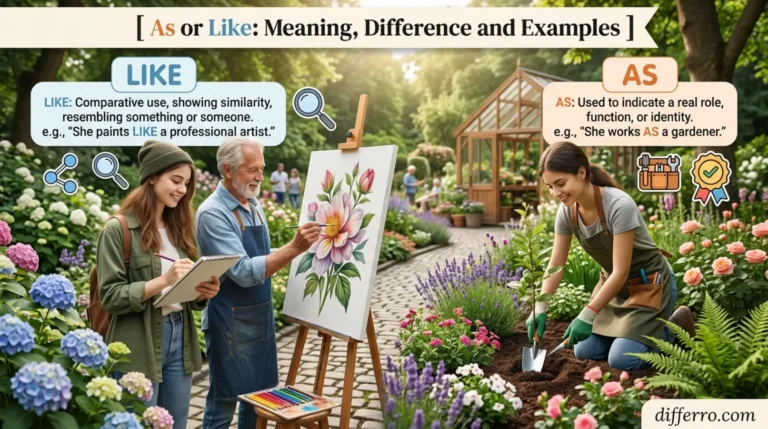
As or Like is a common English grammar confusion. Both words can show comparison, but they do not always work in the same way. Like usually shows similarity between people, things, or actions. As often shows a role, function, equality, or the way something happens.
Choosing the right word depends on the sentence structure and meaning. For example, “She looks like her mother” shows similarity. “She works as a teacher” describes her real job. English learners often confuse these words because their meanings can overlap. Informal speech also makes the difference less obvious. This guide explains as or like with simple rules, examples, mistakes, and practical usage. You will learn when to use each word in everyday and formal English.
⭐ Quick Answer
Use like when you mean “similar to.” Use as for a real role, function, equality, or a clause showing how something happens.
Example: She looks like her mother. She works as a doctor.
📖 Meaning of As
As has several important meanings in English. It can describe a role, function, equality, reason, or manner.
When as describes a job or role, it means “in the position of.”
Examples:
- She works as a teacher.
- He used the box as a table.
You can also use as in comparisons with structures such as “as tall as” or “as much as.”
Examples:
- My brother is as tall as me.
- She works as hard as her sister.
As can also connect a subject and verb.
- Do as I told you.
- Everything happened as we expected.
The British Council explains that as can also mean “because,” “while,” or “in the way that.”
📖 Meaning of Like
Like usually means “similar to” or “in a similar way.”
It commonly comes before a noun or pronoun.
Examples:
- She looks like her mother.
- He runs like a professional athlete.
You can also use like after sense verbs.
Common examples include:
- It looks like rain.
- It sounds like a bird.
- This tastes like honey.
- The fabric feels like silk.
Like can also introduce examples in everyday English.
- I enjoy sports like football and tennis.
- Cities like London attract many visitors.
The British Council identifies like + noun as a common structure for showing similarity.
🔍 Key Differences Between As and Like
| Feature | As | Like |
|---|---|---|
| Meaning | Role, function, equality, or manner | Similarity or resemblance |
| Tone | Often neutral or formal | Often natural and conversational |
| Usage | Jobs, functions, clauses, equal comparisons | Similarity, appearance, examples |
| Popularity | Very common | Very common |
| Common pattern | As + subject + verb | Like + noun or pronoun |
| Example | She works as a nurse. | She looks like her sister. |
The easiest rule is to examine what follows the word.
Like normally comes before a noun or pronoun when showing similarity. As often introduces a clause with a subject and verb.
📚 Origin and History of As and Like
As comes from older forms of English and has developed several grammatical functions. It can act as a conjunction, preposition, or part of fixed expressions.
Like has a long history as a word showing similarity. Its use as a preposition remains common in modern English.
Over time, everyday speech has made the boundary between as and like less strict. Informal speakers sometimes use like before a full clause.
For example:
- Formal: As I said, we need more time.
- Informal: Like I said, we need more time.
The informal form is widely understood. However, as remains the safer choice for formal writing.
Similar comparison words include:
- similar to
- just as
- such as
- as though
- as if
- in the same way
- resembling
These expressions can help you express comparison more precisely.
🇬🇧 British English vs American English
British and American English generally follow the same basic rules for as and like.
However, informal American English often uses like before a subject and verb.
For example, Americans may commonly say:
- Like I said, we should leave.
Formal English usually prefers:
- As I said, we should leave.
This informal use has also become familiar in British English. The distinction remains important in formal writing.
British vs American English Comparison
| Usage | British English | American English |
|---|---|---|
| Formal comparison | As I expected | As I expected |
| Informal speech | Like I said is common | Like I said is very common |
| Job or role | She works as a nurse | She works as a nurse |
| Similarity | She looks like her sister | She looks like her sister |
| Formal writing | Prefer as before clauses | Prefer as before clauses |
The core grammar remains similar across both varieties.
🟢 When to Use As
Use as when you describe a real job, position, function, or identity.
Examples:
- He works as an engineer.
- She served as the team leader.
- We used the room as an office.
- I speak as a parent.
Here, the person or thing actually has the stated role.
Use as in equal comparisons.
Examples:
- She is as strong as her brother.
- This book is as useful as that one.
Use as before a clause when it means “in the way that.”
Examples:
- Do as I asked.
- Everything happened as we planned.
Use as if or as though for an imagined comparison.
Examples:
- He acts as if he knows everything.
- She looked as though she had seen a ghost.
These patterns are especially useful in careful and formal writing.
🔵 When to Use Like
Use like when two people or things are similar.
Examples:
- He looks like his father.
- She sings like a professional.
Use like after sense verbs.
Common verbs include:
- look
- sound
- taste
- smell
- feel
Examples:
- It smells like fresh bread.
- That sounds like a good idea.
- The material feels like cotton.
Use like when giving informal examples.
Examples:
- I enjoy fruits like apples and oranges.
- Some sports, like cricket, need teamwork.
For more formal writing, such as can replace like when giving examples.
- Formal: Sports such as cricket are popular.
- Informal: Sports like cricket are popular.
Cambridge and the British Council both recognize like as a standard choice for similarity and examples.
⚠️ Common Mistakes With As and Like
Mistake 1: Using As for Simple Similarity
❌ She looks as her mother.
✅ She looks like her mother.
Use like when you mean that someone or something resembles another person or thing.
Mistake 2: Using Like for a Real Job
❌ She works like a doctor.
✅ She works as a doctor.
The first sentence suggests she behaves similarly to a doctor.
The second sentence says that being a doctor is her actual role.
Mistake 3: Using Like in Formal Clauses
❌ Like I said, the meeting starts at nine.
✅ As I said, the meeting starts at nine.
The informal version is common in speech. Formal writing normally prefers as.
Mistake 4: Confusing Equal Comparisons
❌ He is like tall like his brother.
✅ He is as tall as his brother.
The correct equality pattern is as + adjective + as.
Mistake 5: Using As Before a Simple Noun Comparison
❌ She looks as her sister.
✅ She looks like her sister.
Use like when the noun follows a comparison of similarity.
Mistake 6: Writing “As If” Incorrectly
❌ He talks like if he knows everything.
✅ He talks as if he knows everything.
Use as if or as though before an imagined situation.
🧠 Easy Trick to Remember As or Like
Use this simple memory trick:
LIKE = LOOKS SIMILAR
AS = ACTUAL ROLE OR ACTION
Think of these two examples:
★She looks like a doctor.
She may not be a doctor. She only looks similar to one.
★She works as a doctor.
She really has the job of a doctor.
Another quick rule can help:
Like + noun or pronoun
As + subject + verb
Examples:
- He runs like a tiger.
- He runs as his coach taught him.
This rule will solve many common as or like questions.
🌎 Everyday Life Examples of As or Like
1. Talking About Family
Family conversations often use like to show resemblance.
- You look like your father.
- She laughs like her mother.
Here, like means “similar to.”
2. Talking About Jobs
Use as when describing someone’s real occupation.
- My sister works as a nurse.
- He started working as a driver.
The word as identifies the person’s actual role.
3. Talking About Food
Use like when describing taste, smell, or appearance.
- This tastes like chocolate.
- The soup smells like fresh herbs.
These sentences describe similarity.
4. Giving Instructions
Use as when explaining how someone should perform an action.
- Do as I explained.
- Please arrange it as we discussed.
Here, as means “in the way that.”
5. Comparing People
Use like for ordinary similarity.
- He fights like a champion.
- She sings like an angel.
Use as when a full clause follows.
- He fights as his trainer taught him.
- She sings as her teacher instructed.
📊 Google Trends and Usage Insight
Search interest for as or like is mainly educational and grammar-focused across the five requested markets. The topic attracts English learners, students, teachers, and writers. Exact Google Trends values can change by date and search settings, so fixed numerical claims would be misleading.
| Country | Main Search Intent | Usage Insight |
|---|---|---|
| USA | Grammar and writing | Informal “like” usage is especially noticeable |
| UK | Grammar learning | Formal distinctions remain important |
| Australia | English usage | Both forms appear in everyday English |
| India | English learning | Comparison and exam grammar create strong interest |
| Pakistan | English learning | Students often search for simple grammar explanations |
The strongest practical insight is simple. Like is common for similarity, while as has broader grammatical functions. Informal speech can blur the difference, especially before clauses.
Comparison Table: Keyword Variations
| Keyword Variation | Search Intent | Best Content Angle |
|---|---|---|
| As or Like | Confusion | Main grammar guide |
| As vs Like | Comparison | Difference and examples |
| Difference between As and Like | Informational | Detailed explanation |
| When to use As or Like | Learning | Rules and examples |
| As and Like grammar | Educational | Grammar patterns |
| Like vs As examples | Examples | Everyday sentences |
| How to use As and Like | Learning | Practical guide |
⚖️ Final Verdict: As or Like
Neither word is always better. The correct choice depends on the meaning and sentence structure.
★Choose like when you mean similarity.
- She looks like her sister.
- He runs like a professional.
Choose as for a real role or function.
- She works as a teacher.
- He used the chair as a step.
★Choose as for equal comparisons.
- He is as tall as his brother.
Choose as before a formal clause.
- Do as I told you.
In casual speech, like can appear before a full clause. Formal writing should usually prefer as in that structure.
❓ FAQ About As or Like
Is “as or like” correct English?
Yes. Both as and like are correct English words. The correct choice depends on their function in a sentence. Use like for similarity and as for roles, functions, equal comparisons, and many clauses.
What is the difference between as and like?
Like generally means “similar to.” As can describe a real role, function, equality, or manner. For example, “He works as a teacher” describes his job. “He looks like a teacher” describes his appearance.
Which is more common, as or like?
Both words are extremely common. Their frequency depends on context because they have different grammatical functions. Like appears often in comparisons. As appears in many structures beyond comparison.
Is as or like better for formal writing?
As is usually safer before a full clause in formal writing. For example, “As I explained” is preferred over “Like I explained.” However, like remains correct for ordinary similarity.
Why does confusion between as and like exist?
The confusion exists because both words can express comparison. Informal speech also uses like in places where formal grammar traditionally uses as. This overlap makes the distinction harder for learners.
📝 Conclusion
Understanding as or like becomes easier when you focus on meaning. Use like when you compare people, things, appearances, sounds, or behavior. Use as when you describe a real role, function, equal comparison, or manner. Remember the simple rule: like usually shows similarity, while as often explains a role or relationship. In formal writing, as is usually the better choice before a full clause. Informal speech may use like in that position. Both forms are common in modern English. Learning their sentence patterns will help you avoid common grammar mistakes. With regular practice, choosing between as and like becomes natural and much easier.

Imran Lodhra is a comparison-focused content writer at Differro.com.
He specializes in creating clear, simple, and informative comparison articles.
His work helps readers understand key differences, pros and cons, and important details.
Imran focuses on accurate, practical, and easy-to-read content for everyday readers.