
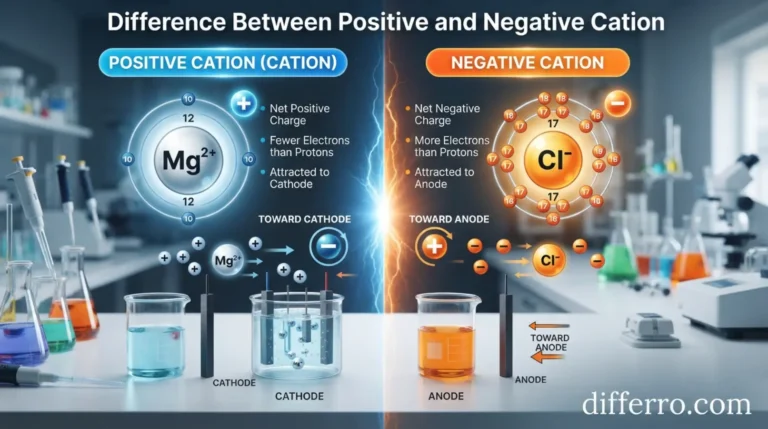
What is difference Between Positive or Negative Cation? A cation carries a positive electrical charge because it loses one or more electrons. This basic chemistry concept helps students understand ions, chemical reactions, and ionic compounds. However, many students confuse cations with anions because both are charged particles.
The main difference comes from how atoms gain or lose electrons. When an atom loses electrons, it becomes positively charged. When an atom gains electrons, it becomes negatively charged. Protons carry positive charges, while electrons carry negative charges. Therefore, losing negatively charged electrons leaves an atom with a positive charge.
Understanding cations and anions makes chemistry easier to learn. You can use simple examples, such as sodium and chloride ions, to remember their charges. This guide explains their meanings, differences, examples, common mistakes, and practical uses. It also includes an easy trick to help you remember which ion carries each charge.
⭐ Quick Answer
A cation is positive, while an anion is negative. A cation forms when an atom or group of atoms loses electrons. An anion forms when an atom or group of atoms gains electrons.
Example: Sodium loses one electron to form Na⁺, a positive cation. Chlorine gains one electron to form Cl⁻, a negative anion.
🔬 Meaning of Cation
A cation is an ion with a positive electrical charge. It forms when an atom or group of atoms loses electrons.
Electrons carry negative charges. When an atom loses electrons, it has more protons than electrons. This imbalance creates a positive charge.
Examples of Cations
Example 1: Sodium ion (Na⁺)
A sodium atom has 11 protons and 11 electrons. It loses one electron and forms Na⁺. The ion now has 11 protons and 10 electrons, giving it a positive charge.
Example 2: Magnesium ion (Mg²⁺)
A magnesium atom has 12 protons and 12 electrons. It loses two electrons and forms Mg²⁺. The ion now has 12 protons and 10 electrons, giving it a charge of +2.
Common Cations
- Potassium ion: K⁺
- Calcium ion: Ca²⁺
- Aluminum ion: Al³⁺
- Ammonium ion: NH₄⁺
- Iron(II) ion: Fe²⁺
Cations play important roles in salts, minerals, batteries, and biological processes.
⚛️ Meaning of Anion
An anion is an ion with a negative electrical charge. It forms when an atom or group of atoms gains electrons.
Gaining electrons increases the number of negative charges. The particle then has more electrons than protons, creating a negative charge.
Examples of Anions
Example 1: Chloride ion (Cl⁻)
A chlorine atom has 17 protons and 17 electrons. It gains one electron and forms Cl⁻. The ion now has 17 protons and 18 electrons, giving it a negative charge.
Example 2: Oxide ion (O²⁻)
An oxygen atom has eight protons and eight electrons. It gains two electrons and forms O²⁻. The ion now has eight protons and 10 electrons, giving it a charge of −2.
Common Anions
- Chloride ion: Cl⁻
- Fluoride ion: F⁻
- Oxide ion: O²⁻
- Sulfide ion: S²⁻
- Hydroxide ion: OH⁻
- Sulfate ion: SO₄²⁻
Anions help form ionic compounds and participate in many chemical reactions.
🔎 Difference Between Positive or Negative Cation? Key Differences
Cations and anions are both ions, but they carry opposite electrical charges.
| Feature | Cation | Anion |
|---|---|---|
| Meaning | Positively charged ion | Negatively charged ion |
| Electrical charge | Positive (+) | Negative (−) |
| Electron behavior during formation | Loses electrons | Gains electrons |
| Proton-to-electron balance | More protons than electrons | More electrons than protons |
| Example | Na⁺ | Cl⁻ |
| Another example | Ca²⁺ | O²⁻ |
| Electrolysis | Moves toward the cathode | Moves toward the anode |
| Common use | Forms positive parts of ionic compounds | Forms negative parts of ionic compounds |
Remember: A cation has a positive charge, and an anion has a negative charge. Both can contain one atom or multiple atoms.
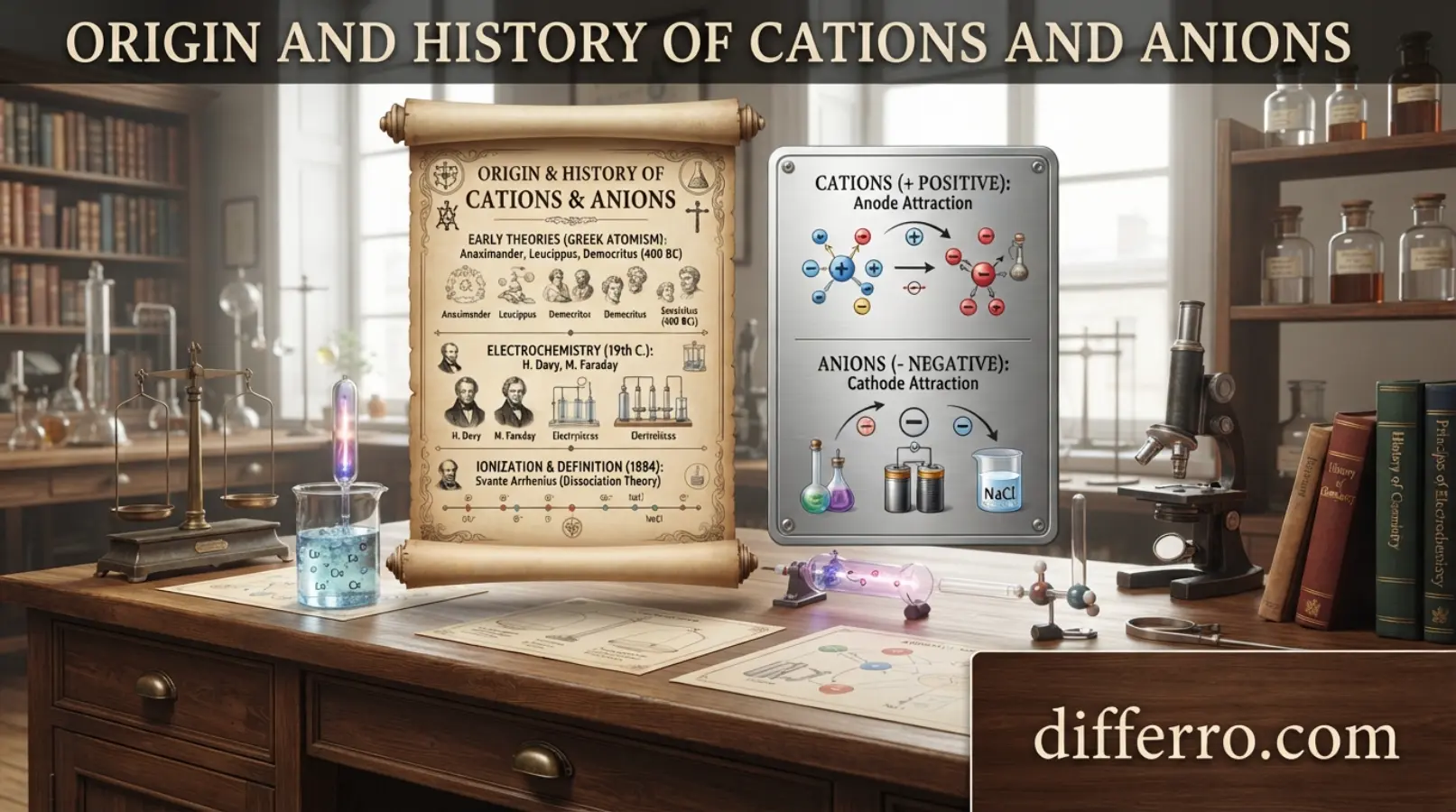
📚 Origin and History of Cations and Anions
The words cation and anion come from early scientific studies of electricity and electrolysis. British scientist Michael Faraday introduced these terms in the 1830s.
The word cation relates to movement toward the cathode during electrolysis. The word anion relates to movement toward the anode.
These terms describe how ions move in an electrolytic system. Their electrical charges also help explain their behavior in chemical reactions.
Similar Chemistry Terms
- Ion: An atom or group of atoms with an electrical charge.
- Cation: An ion with a positive charge.
- Anion: An ion with a negative charge.
- Atom: The smallest unit of an element that retains its chemical identity.
- Electron: A negatively charged subatomic particle.
- Proton: A positively charged subatomic particle.
- Isotope: A form of an element with a particular number of neutrons.
Learning these terms helps students understand atomic structure and ionic bonding.
🇬🇧 British English vs American English Spelling
The words cation and anion have the same spelling in British and American English. Their definitions and scientific meanings also remain unchanged.
Scientific textbooks in both countries use the same standard chemical symbols. Students can use these terms in chemistry exams regardless of their English variety.
British vs American English Comparison
| Feature | British English | American English |
|---|---|---|
| Cation | Cation | Cation |
| Anion | Anion | Anion |
| Meaning of cation | Positive ion | Positive ion |
| Meaning of anion | Negative ion | Negative ion |
| Scientific notation | Na⁺, Cl⁻ | Na⁺, Cl⁻ |
🧪 When to Use the Term Cation
Use cation when describing a positively charged ion in chemistry. The term applies to both single atoms and groups of atoms.
Example 1: Sodium in Table Salt
Sodium loses one electron and forms Na⁺. The resulting sodium ion acts as a cation in sodium chloride.
Example 2: Calcium in Bones
Calcium ions carry a positive charge of +2. They play an important role in bones, teeth, muscle function, and other biological processes.
Example 3: Magnesium in Chemistry
Magnesium loses two electrons to form Mg²⁺. Chemists identify it as a cation when discussing ionic compounds and reactions.
⚡ When to Use the Term Anion
Use anion when describing a negatively charged ion. Anions form when atoms or groups of atoms gain electrons.
Example 1: Chloride in Table Salt
Chlorine gains one electron and forms Cl⁻. This negative ion combines with Na⁺ in sodium chloride.
Example 2: Oxygen in Ionic Compounds
Oxygen can gain two electrons to form O²⁻. This oxide ion appears in compounds such as magnesium oxide.
Example 3: Hydroxide in Chemistry
The hydroxide ion, OH⁻, carries a negative charge. It appears in bases such as sodium hydroxide.
❌ Common Mistakes About Cations and Anions
Mistake 1: Thinking Cations Are Negative
Incorrect: A cation has a negative charge.
Correct: A cation has a positive charge because it loses electrons.
Mistake 2: Thinking Anions Are Positive
Incorrect: Anions carry positive electrical charges.
Correct: Anions carry negative charges because they gain electrons.
Mistake 3: Confusing Electron Gain and Electron Loss
Incorrect: An atom becomes positive when it gains electrons.
Correct: An atom usually becomes negative when it gains electrons. Losing electrons creates a positive charge.
Mistake 4: Confusing Cations With Protons
Incorrect: Every cation is a proton.
Correct: A cation is an atom or group of atoms with a net positive charge. A proton is a positively charged subatomic particle.
Mistake 5: Assuming Every Ion Has a Single Charge
Incorrect: All cations carry a +1 charge.
Correct: Cations can carry different charges, including +1, +2, and +3. For example, Na⁺, Mg²⁺, and Al³⁺ have different positive charges.
Mistake 6: Mixing Up Anode and Cathode
Incorrect: Cations always move toward the anode during electrolysis.
Correct: During electrolysis, cations move toward the cathode, while anions move toward the anode.
🧠 Easy Trick to Remember Cation and Anion
Use this simple memory trick:
- Cation = positive. Remember the plus sign in Na⁺.
- Anion = negative. Remember the minus sign in Cl⁻.
You can also remember what happens to electrons:
- Lose electrons → Positive cation
- Gain electrons → Negative anion
Electrons carry negative charges, so losing them leaves a particle relatively positive. Gaining them makes the particle relatively negative.
🌍 Everyday-Life Examples of Cations and Anions
1. Table Salt
Table salt contains sodium ions (Na⁺) and chloride ions (Cl⁻). Sodium acts as the positive cation, while chloride acts as the negative anion.
Primary keyword: Is cation positive or negative?
Secondary keyword: Sodium cation and chloride anion.
2. Batteries
Many batteries rely on the movement of ions during chemical reactions. Depending on the battery design, different cations and anions help carry charge through the electrolyte.
Primary keyword: Cation positive or negative.
Secondary keyword: Positive ions in batteries.
3. Sports Drinks
Sports drinks may contain sodium, potassium, chloride, and other dissolved ions. Sodium and potassium carry positive charges, while chloride carries a negative charge.
Primary keyword: Is cation positive or negative?
Secondary keyword: Electrolytes and ionic charges.
4. Fertilizers
Many fertilizers contain ammonium (NH₄⁺), potassium (K⁺), nitrate (NO₃⁻), or phosphate ions. These ions provide nutrients that plants need for growth.
Primary keyword: Cation versus anion.
Secondary keyword: Positive and negative ions in fertilizers.
5. Water Treatment
Water treatment systems may use ion exchange to remove certain dissolved ions. These systems can target positive cations, negative anions, or both.
Primary keyword: Is cation positive or negative?
Secondary keyword: Cation and anion exchange.
🌍 Google Trends and Usage Insights: Five Countries
Google Trends measures relative search interest rather than exact search counts. Country-specific rankings for this keyword require current data, so the following points describe likely educational search intent rather than verified trends.
- USA: Students may search for cation and anion definitions, chemistry homework, and ion charges.
- UK: Search intent may focus on ion formation, electron transfer, and school chemistry.
- Australia: Students may seek simple explanations of ionic charges and chemical bonding.
- India: Searches may relate to school exams, entrance tests, and basic chemistry concepts.
- Pakistan: Students may look for easy definitions, examples, and exam preparation notes.
SEO insight: This keyword has clear informational intent. A direct answer, a cation-versus-anion table, and simple chemical examples can address common student questions. Verify country-level search interest in Google Trends before publishing numerical comparisons.
Comparison Table: Keyword Variations
| Keyword variation | Search intent | Recommended content section |
|---|---|---|
| Is cation positive or negative | Direct answer | Title and quick answer |
| Cation vs anion | Compare ion types | Key differences |
| What is a cation | Definition | Cation meaning |
| What is an anion | Definition | Anion meaning |
| Does a cation gain or lose electrons | Understand ion formation | Electron behavior |
| Examples of positive and negative ions | Learn examples | Everyday examples |
| How to remember cations and anions | Study help | Memory trick |
❓ Frequently Asked Questions
1. Is a cation positive or negative?
A cation is positive. It forms when an atom or group of atoms loses electrons, leaving more protons than electrons.
2. What is the difference between a cation and an anion?
A cation carries a positive charge, while an anion carries a negative charge. Cations form through electron loss, while anions form through electron gain.
3. Which is more common, cations or anions?
Neither type is universally more common. Their abundance depends on the substance and chemical environment. Many ionic compounds contain both cations and anions.
4. Is the term cation used in formal chemistry?
Yes. Cation is a standard scientific term used in textbooks, laboratory reports, exams, and research papers.
5. Why do students confuse cations and anions?
Both terms describe electrically charged particles, and their names look similar. Remembering electron loss and gain helps distinguish them correctly.
🏆 Final Verdict: Is Cation Positive or Negative?
A cation is positive, while an anion is negative. This difference comes from how each ion gains or loses electrons.
When an atom loses electrons, it forms a positively charged cation. When an atom gains electrons, it forms a negatively charged anion. Sodium (Na⁺) and magnesium (Mg²⁺) are common cations. Chloride (Cl⁻) and oxide (O²⁻) are common anions.
Both terms are correct and essential in chemistry, but they describe opposite electrical charges. Use cation for positive ions and anion for negative ions. Remembering this distinction makes ionic bonding, chemical formulas, and electrolysis easier to understand.
Conclusion
Is cation positive or negative? A cation always carries a net positive Electrical charge. It forms when an atom or group of atoms loses electrons. An anion carries a negative charge because it gains Electrons.
For example, sodium forms Na⁺ by losing one electron, while chlorine forms Cl⁻ by gaining one electron. These ions combine to form sodium chloride, commonly known as table salt.
Remember the simple rule: electron loss creates a positive cation, while electron gain creates a negative anion. This concept helps explain ionic compounds, chemical reactions, batteries, and biological processes. Learn the difference, practice identifying ions, and use their chemical symbols to check their charges. With practice, you can answer this chemistry question confidently.

Imran Lodhra is a comparison-focused content writer at Differro.com.
He specializes in creating clear, simple, and informative comparison articles.
His work helps readers understand key differences, pros and cons, and important details.
Imran focuses on accurate, practical, and easy-to-read content for everyday readers.
1 thought on “Difference Between Positive or Negative Cation”