
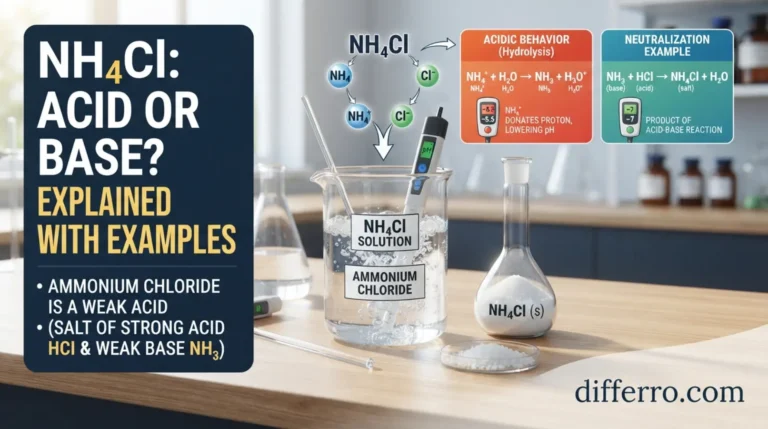
NH4Cl acid or base is a common Chemistry question for students learning about salts, acids, and bases. NH4Cl stands for ammonium chloride, a salt formed from ammonia and hydrochloric acid. Although NH4Cl is a salt, its aqueous solution is acidic rather than neutral. This happens because the ammonium ion reacts with water and produces hydronium ions.
Understanding this behavior helps explain why some salts make water acidic while others make it basic or neutral. The answer depends on the strengths of the acid and base that form the salt. In this guide, you will learn why ammonium chloride is acidic, how it affects pH, and how to identify similar salts. Simple equations and everyday examples will make the concept easier to remember. This explanation is useful for school chemistry, homework, laboratory questions, and exam preparation.
⭐ Quick Answer
NH4Cl (ammonium chloride) is an acidic salt. When it dissolves in water, its ammonium ions react with water and produce hydronium ions, making the solution acidic.
Example: An aqueous NH4Cl solution has a pH below 7 under ordinary conditions at 25°C.
🧪 Meaning of Acid
An acid is a substance that increases the hydronium ion concentration in water. Acids commonly have a pH below 7 at 25°C.
Acids can donate protons in chemical reactions. Their strength depends on how readily they donate protons or ionize in water.
Examples of Acids
Example 1: Hydrochloric acid (HCl)
HCl ionizes in water and produces hydronium ions and chloride ions. This makes its aqueous solution acidic.
Example 2: Acetic acid (CH3COOH)
Acetic acid occurs in vinegar. It partially ionizes in water and produces an acidic solution.
🧪 Meaning of Base
A base can accept protons or increase the hydroxide ion concentration in water. Many basic solutions have a pH above 7 at 25°C.
Bases react with acids in neutralization reactions. Some bases, such as ammonia, react with water to produce hydroxide ions.
Examples of Bases
Example 1: Sodium hydroxide (NaOH)
Sodium hydroxide separates into sodium and hydroxide ions in water. The hydroxide ions make the solution strongly basic.
Example 2: Ammonia (NH3)
Ammonia reacts with water and accepts a proton. This reaction produces ammonium ions and hydroxide ions.
🔎 NH4Cl Acid or Base: Key Differences
Ammonium chloride is a salt, but its aqueous solution is acidic. The table below compares the relevant chemical categories.
| Feature | Acid | Base | NH4Cl |
|---|---|---|---|
| Meaning | Donates protons or increases hydronium in water | Accepts protons or increases hydroxide in water | An ionic salt |
| Typical pH in water at 25°C | Below 7 | Above 7 | Below 7 |
| Common behavior | Can neutralize bases | Can neutralize acids | Produces an acidic solution |
| Example | HCl | NaOH | NH4Cl |
| Formation | May come from different chemical reactions | May come from different chemical reactions | Commonly formed from NH3 and HCl |
| Water behavior | Depends on acid strength and concentration | Depends on base strength and concentration | NH4+ reacts with water; Cl− has negligible basicity |
Important: NH4Cl itself is classified as a salt, not as a conventional acid or base. Its aqueous solution is acidic because of the ammonium ion.
📚 Origin and Chemistry of NH4Cl
NH4Cl is the chemical formula for ammonium chloride. It contains positively charged ammonium ions (NH4+) and negatively charged chloride ions (Cl−).
Ammonium chloride forms when ammonia reacts with hydrochloric acid:
[
\mathrm{NH_3 + HCl \rightarrow NH_4Cl}
]
Ammonia acts as a base by accepting a proton from hydrochloric acid. The resulting ammonium and chloride ions form the salt.
Why Does NH4Cl Produce an Acidic Solution?
When ammonium chloride dissolves in water, it separates into ions:
[
\mathrm{NH_4Cl \rightarrow NH_4^+ + Cl^-}
]
The ammonium ion reacts with water:
[
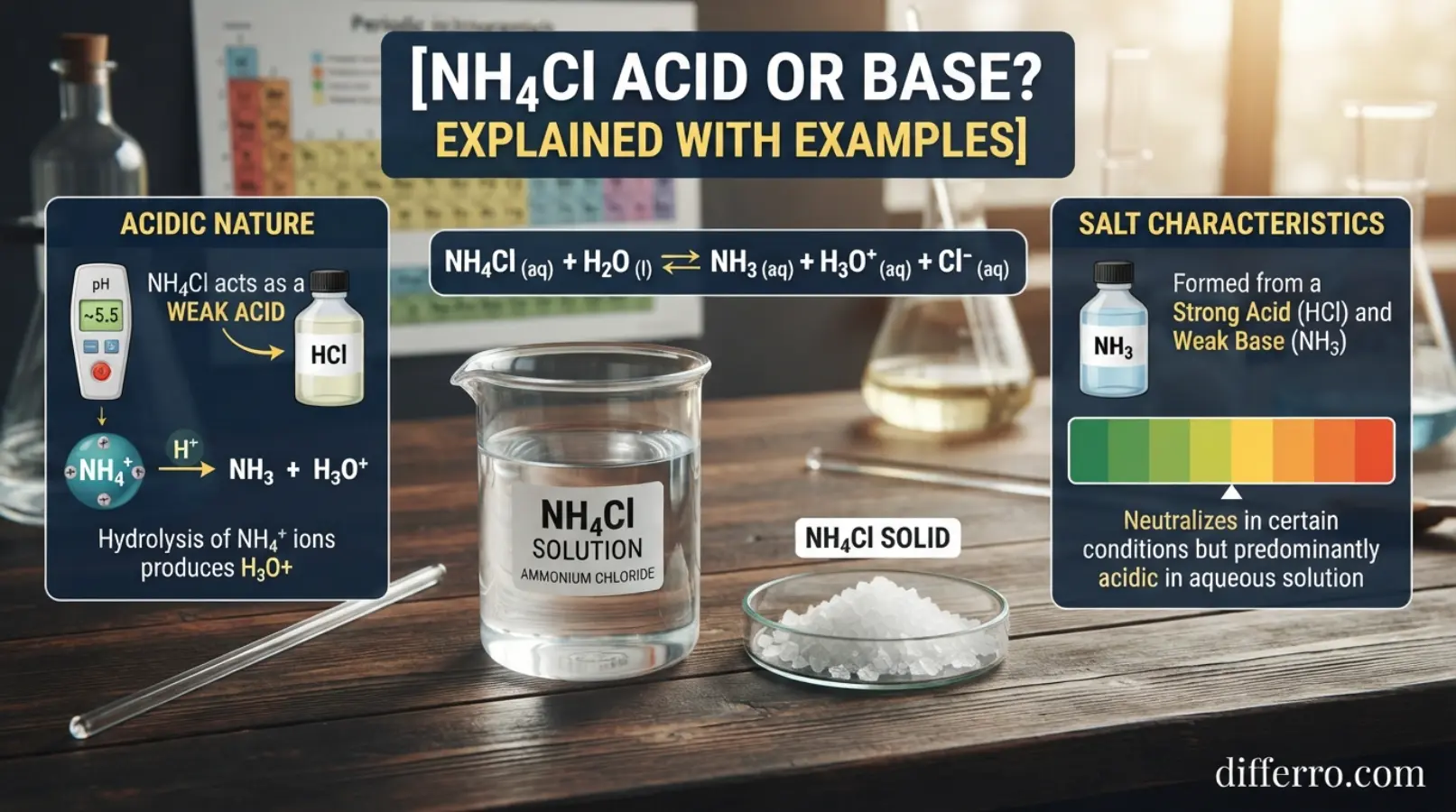
\mathrm{NH_4^+ + H_2O \rightleftharpoons NH_3 + H_3O^+}
]
This reaction produces hydronium ions (H3O+), which make the solution acidic.
The chloride ion comes from the strong acid HCl. It has negligible basicity in water, so it does not offset the acidity produced by ammonium ions.
Similar Salts and Their Solutions
- NH4Cl: Produces an acidic aqueous solution.
- NaCl: Usually produces a nearly neutral aqueous solution.
- CH3COONa: Usually produces a basic aqueous solution.
- NH4NO3: Produces an acidic aqueous solution.
- Na2CO3: Usually produces a basic aqueous solution.
These examples show why you must consider the ions in a salt instead of assuming every salt is neutral.
🇬🇧 British English vs American English
The chemical formula NH4Cl and the name ammonium chloride remain the same in British and American English.
Chemistry textbooks in both countries use the same standard chemical notation. Minor differences may appear in related words, such as ionisation in British English and ionization in American English.
British vs American English Comparison
| Feature | British English | American English |
|---|---|---|
| Chemical formula | NH4Cl | NH4Cl |
| Chemical name | Ammonium chloride | Ammonium chloride |
| Ionization spelling | Ionisation | Ionization |
| Chemical meaning | Same | Same |
| Classification | Acidic salt | Acidic salt |
⚗️ When to Classify NH4Cl as an Acidic Salt
Classify NH4Cl as an acidic salt when a question asks about its behavior in water. Its solution is acidic because the ammonium ion reacts with water and generates hydronium ions.
Example 1: School Chemistry
Question: Is NH4Cl acid, base, or neutral?
Answer: NH4Cl is a salt that produces an acidic aqueous solution.
Example 2: Predicting pH
Question: What happens when NH4Cl dissolves in pure water?
Answer: The solution becomes acidic, so its pH falls below 7 at 25°C.
Example 3: Comparing Salts
Question: Why does NH4Cl behave differently from NaCl?
Answer: NH4+ reacts with water, while Na+ and Cl− have negligible effects on pH under ordinary conditions.
⚗️ When to Use Acid-Base Theory to Explain NH4Cl
Use acid-base theory when a question asks why ammonium chloride forms an acidic solution.
Example 1: Brønsted–Lowry Theory
The ammonium ion donates a proton to water. Water accepts the proton and becomes hydronium.
Example 2: Salt Hydrolysis
The ammonium ion undergoes hydrolysis in water. This process helps explain the solution’s acidic pH.
Example 3: Strong Acid and Weak Base
NH4Cl comes from hydrochloric acid, a strong acid, and ammonia, a weak base. This combination produces an acidic salt solution.
⚠️ Common Mistakes About NH4Cl Acid or Base
Mistake 1: Calling NH4Cl a Base
Incorrect: NH4Cl is a base because it contains NH4+.
Correct: NH4Cl is a salt that forms an acidic solution in water. The ammonium ion acts as a weak acid.
Mistake 2: Assuming Every Salt Is Neutral
Incorrect: All salts have a pH of 7.
Correct: Salts can form acidic, basic, or nearly neutral solutions, depending on their ions.
Mistake 3: Confusing NH4+ With NH3
Incorrect: Ammonium and ammonia are the same substance.
Correct: NH4+ is the positively charged ammonium ion. NH3 is ammonia, a weak base.
Mistake 4: Assuming Chloride Makes the Solution Basic
Incorrect: Cl− makes NH4Cl basic because it carries a negative charge.
Correct: Chloride has negligible basicity in water. The ammonium ion causes the solution’s acidity.
Mistake 5: Saying NH4Cl Always Has the Same pH
Incorrect: Every NH4Cl solution has an identical pH.
Correct: The exact pH depends on concentration and temperature. An ordinary aqueous NH4Cl solution is acidic.
🧠 Easy Trick to Remember
Remember this rule:
Strong acid + weak base = acidic salt.
NH4Cl forms from:
- HCl: A strong acid.
- NH3: A weak base.
Therefore, NH4Cl produces an acidic solution in water.
You can also remember that NH4+ donates a proton to water, producing H3O+. More hydronium ions mean a lower pH.
🌍 Five Everyday Chemistry Examples
1. Dissolving NH4Cl in Water
When ammonium chloride dissolves in water, it separates into NH4+ and Cl− ions. The ammonium ions react with water and produce hydronium ions.
Result: The solution becomes acidic.
2. Comparing NH4Cl With Table Salt
Table salt, NaCl, generally produces a nearly neutral solution in pure water. NH4Cl produces an acidic solution because its ammonium ions react with water.
Result: Both substances are salts, but their solutions have different pH values.
3. Studying Fertilizer Chemistry
Ammonium chloride can serve as a nitrogen source in some fertilizers. Its behavior matters when studying soil chemistry and plant nutrition.
Result: Understanding whether NH4Cl is acidic helps explain its chemical effects.
4. Solving a School Chemistry Question
A student must classify NH4Cl as acidic, basic, or neutral. The student identifies the ions and considers their reactions with water.
Result: The student correctly identifies NH4Cl as an acidic salt.
5. Predicting the pH of a Salt Solution
A chemistry student compares NH4Cl with sodium acetate. NH4Cl produces an acidic solution, while sodium acetate generally produces a basic solution.
Result: The student learns to predict salt behavior by examining its ions.
🌍 Google Trends and Search Interest in Five Countries
Google Trends provides relative search interest, not exact search volumes. The following observations describe possible search intent, not verified country rankings.
- USA: Students may search for NH4Cl classification, pH, and salt hydrolysis.
- UK: Searches may focus on acidic salts and acid-base theory.
- Australia: Chemistry learners may look for salt classification and pH explanations.
- India: Students may search for NH4Cl acid-base questions for school and entrance exams.
- Pakistan: Students may seek simple explanations of ammonium chloride for chemistry tests and homework.
SEO insight: Target the exact keyword in the title and introduction. Use related phrases in headings, equations, and FAQs to address different learning needs. Check Google Trends for country-specific comparisons before claiming which variation receives the most searches.
Comparison Table: Keyword Variations
| Keyword variation | Search intent | Recommended placement |
|---|---|---|
| NH4Cl acid or base | Direct answer | Title and introduction |
| Is NH4Cl an acid or base? | Classification | Quick Answer |
| Is ammonium chloride acidic or basic? | Concept explanation | Meaning section |
| NH4Cl pH in water | Numerical and conceptual | pH section |
| Why is NH4Cl acidic? | Chemical mechanism | Hydrolysis section |
| NH4Cl acidic salt | Classification | Key differences |
| Ammonium chloride hydrolysis | Reaction explanation | Chemistry section |
❓ Frequently Asked Questions
1. Is NH4Cl an acid or a base?
NH4Cl is a salt, not a conventional acid or base. However, it produces an acidic solution when dissolved in water.
2. What is the main difference between NH4Cl and an acid?
NH4Cl is an ionic salt containing NH4+ and Cl− ions. Its ammonium ion acts as a weak acid in water, producing hydronium ions.
3. Is NH4Cl acidic or basic in water?
NH4Cl forms an acidic solution in water. The ammonium ion reacts with water and increases the hydronium ion concentration.
4. Is NH4Cl an acid or base in formal chemistry?
In formal chemistry, NH4Cl is classified as a salt. Chemists describe its aqueous solution as acidic because of ammonium ion hydrolysis.
5. Why do students confuse NH4Cl with a base?
Students may associate NH4Cl with ammonia, NH3, which acts as a weak base. However, NH4+ is the conjugate acid of ammonia and can donate a proton to water.
🏆 Final Verdict: Is NH4Cl Acid or Base?
NH4Cl is an acidic salt that produces an acidic solution in water. It forms from hydrochloric acid, a strong acid, and ammonia, a weak base.
When NH4Cl dissolves, it releases ammonium and chloride ions. The ammonium ion reacts with water and produces hydronium ions. This reaction lowers the solution’s pH below 7 under ordinary conditions at 25°C.
Remember that NH4Cl itself is a salt, while its aqueous solution is acidic. This distinction is important in chemistry exams and acid-base questions.
Conclusion
The answer to “NH4Cl acid or Base” is straightforward: ammonium Chloride is a salt that forms an acidic solution in water. It contains ammonium ions and chloride ions. The ammonium ion reacts with water and produces hydronium ions, which lower the pH below 7 at 25°C.
NH4Cl forms from hydrochloric acid and ammonia. This Combination explains why the resulting salt behaves differently from neutral salts such as sodium chloride. Remember the rule that a strong acid and a weak base generally form an acidic salt. Understanding ammonium ion hydrolysis will also help you classify similar compounds. For chemistry exams, clearly distinguish the salt itself from the acidic solution it produces in water.

Imran Lodhra is a comparison-focused content writer at Differro.com.
He specializes in creating clear, simple, and informative comparison articles.
His work helps readers understand key differences, pros and cons, and important details.
Imran focuses on accurate, practical, and easy-to-read content for everyday readers.