

Halves or halfs is a common spelling question that confuses many English learners. Both words look reasonable, but only one is correct in standard English. Halves is the correct plural form of half. The spelling halfs is incorrect in standard English when you mean more than one half.
English has several spelling rules for forming plural nouns. Most nouns simply add -s or -es. However, some nouns ending in -f or -fe change their endings to -ves. The word half follows this rule.
Understanding this difference helps you write clearly and avoid common grammar mistakes. You might use the word when dividing food, sharing money, discussing measurements, or describing equal parts. This guide explains the meaning, spelling rule, examples, and everyday uses of halves. It also answers common questions about this confusing plural form.
⭐ Quick Answer
Halves is the correct plural form of half. The word halfs is incorrect in standard English when referring to two or more parts, each equal to half of a whole.
Example: One half of the cake is mine. The other two halves belong to my friends.
📖 Meaning of Halves
Halves is the plural form of half. It refers to two or more parts that each represent one of two equal parts of a whole.
Use halves when discussing multiple halves of an object, amount, or group.
Examples of Halves
- Mom cut the apple into two halves.
- We divided the money into equal halves.
In the first example, the apple has two equal parts. In the second, the money has two equal portions.
📖 Meaning of Halfs
Halfs is a nonstandard spelling of the plural form of half. Standard English uses halves instead.
Although some writers may mistakenly use halfs, dictionaries and standard grammar recognize halves as the correct plural.
Examples of Incorrect Usage
- Incorrect: She divided the orange into two halfs.
- Correct: She divided the orange into two halves.
- Incorrect: Both halfs of the sandwich fell on the floor.
- Correct: Both halves of the sandwich fell on the floor.
Remember that half is singular, while halves is plural.
🔎 Halves or Halfs: Key Differences
| Feature | Halves | Halfs |
|---|---|---|
| Meaning | The plural form of half | Incorrect standard-English spelling |
| Tone | Correct and natural | Incorrect in standard writing |
| Usage | Formal and informal English | Avoid in standard English |
| Popularity | Standard and widely accepted | A common spelling mistake |
| Grammar | Correct plural noun | Nonstandard plural form |
| Example | Cut the pear into halves. | Cut the pear into halfs. |
Winner: Halves is the correct spelling in standard English.
📚 Origin and History of Halves
The word half has Old English roots. It developed from the Old English word healf, which referred to a side or half of something.
Over time, English developed several plural patterns. Some nouns ending in -f change that ending to -ves in the plural.
The word half follows this pattern:
- Half → Halves
- Calf → Calves
- Leaf → Leaves
- Loaf → Loaves
- Wolf → Wolves
- Knife → Knives
However, not every noun ending in -f follows this rule. For example, roof becomes roofs, and chief becomes chiefs.
These differences make English plural spelling challenging. Learning common word patterns can help you remember the correct forms.
🇬🇧 British English vs American English Spelling
British and American English both use halves as the correct plural of half.
There is no spelling difference between these English varieties for this word.
Writers in the UK, USA, Australia, India, and Pakistan should use halves in standard English.
British vs American English Comparison
| Feature | British English | American English |
|---|---|---|
| Singular | Half | Half |
| Correct plural | Halves | Halves |
| Incorrect standard plural | Halfs | Halfs |
| Example | Cut the pear into halves. | Cut the pear into halves. |
| Spelling difference | None | None |
✍️ When to Use Halves
Use halves whenever you refer to two or more half-sized parts. It is correct in everyday conversation, academic writing, business communication, and formal documents.
1. When Dividing Food
Use halves when describing food divided into equal parts.
Examples:
- She cut the sandwich into two halves.
- We shared the pizza halves equally.
- The children ate their halves of the watermelon.
2. When Sharing Money
Use halves when two or more people share an amount equally.
Examples:
- They divided the bill into halves.
- We split the prize into two equal halves.
- The partners received equal halves of the payment.
3. When Discussing Measurements
Use halves when describing parts of a measured object or quantity.
Examples:
- The teacher divided the line into two halves.
- Both halves of the rope measured five meters.
- The diagram shows two equal halves of a circle.
4. When Describing Time
Use halves when dividing a period into two parts.
Examples:
- The coach divided the match into two halves.
- Both halves of the session lasted thirty minutes.
- The team played better in the second half.
Notice that half remains singular when you refer to one part, such as the second half.
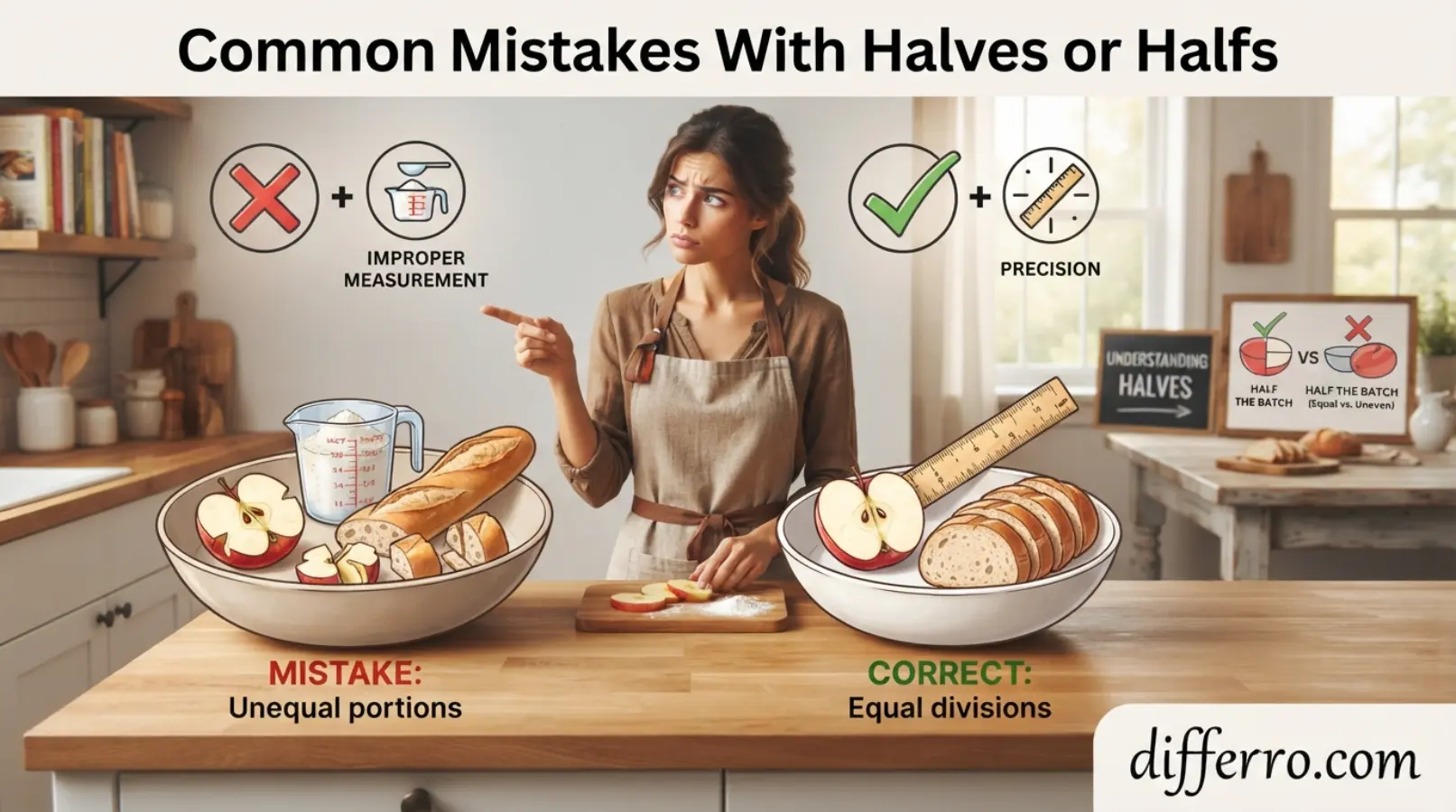
❌ Common Mistakes With Halves or Halfs
Mistake 1: Adding Only -S
Incorrect: The baker cut the cake into two halfs.
Correct: The baker cut the cake into two halves.
The word half changes its ending to -ves in the plural.
Mistake 2: Using Halves for One Part
Incorrect: I ate one halves of the apple.
Correct: I ate one half of the apple.
Use half for one part and halves for multiple parts.
Mistake 3: Confusing Half With Halve
Incorrect: Please half the orange into two pieces.
Correct: Please halve the orange into two pieces.
Half usually functions as a noun or adjective in this sentence context. Halve is the verb meaning to divide something into two equal parts.
Mistake 4: Using Halfs in Formal Writing
Incorrect: The report compares both halfs of the market.
Correct: The report compares both halves of the market.
Always use halves in standard English writing.
Mistake 5: Using Halves for Unequal Parts
Incorrect: I divided the cake into two halves, but one piece was twice as large.
Correct: I divided the cake into two pieces, but one piece was twice as large.
Two halves should represent two equal parts of a whole.
🧠 Easy Trick to Remember Halves
Use this simple memory trick:
Half changes F to V before adding ES.
Remember this pattern:
- Half → Halves
- Leaf → Leaves
- Knife → Knives
- Wolf → Wolves
Think of the phrase “One half, two halves.” Repeating it helps you remember the correct spelling.
Keep in mind that this pattern has exceptions. Words such as roof and chief form their plurals with -s.
🌍 Everyday-Life Examples of Halves
1. Sharing an Apple
Sara cuts an apple into two halves and gives one to her brother.
Keyword usage: Halves correctly describes the two equal parts of the apple.
2. Splitting a Restaurant Bill
Two friends divide their restaurant bill into equal halves.
Keyword usage: Use halves, not halfs, when describing equal portions of the bill.
3. Dividing a Chocolate Bar
The children break a chocolate bar into two halves and share it.
Keyword usage: The plural form halves describes the two parts.
4. Describing a Football Match
The referee divides the match into two halves.
Keyword usage: Halves is the correct plural form when discussing the two periods of a match.
5. Completing a School Project
The teacher asks students to divide a circle into two equal halves.
Keyword usage: Write halves when describing the two equal sections of the circle.
🌐 Google Trends and Usage Insights: Five Countries
Google Trends reports relative search interest rather than exact search volumes. Without live comparison data, country-specific rankings for these spellings cannot be confirmed.
- USA: English learners may search for the correct plural form of half.
- UK: Both students and writers should use halves in standard English.
- Australia: The correct spelling remains halves, following the same plural rule.
- India: Grammar learners may benefit from examples explaining the -f to -ves pattern.
- Pakistan: Simple spelling comparisons can help students improve everyday English writing.
SEO insight: Target the main keyword halves or halfs alongside related phrases such as correct plural of half and is halfs a word?. Check Google Trends and keyword research tools before reporting actual search popularity or country rankings.
Comparison Table: Keyword Variations
| Keyword variation | Search intent | Recommended content use |
|---|---|---|
| Halves or halfs | Spelling comparison | Main title and introduction |
| Half vs halves | Grammar explanation | Meaning section |
| Is halfs a word? | Correctness question | FAQ section |
| Correct plural of half | Educational search | Quick Answer |
| Half plural form | Grammar reference | Headings and body |
| Half spelling rules | Learning intent | Origin and memory trick |
| Words ending in f and ves | Broader grammar topic | Related article |
❓ Frequently Asked Questions
1. Is halves or halfs correct?
Halves is correct in standard English. Halfs is a common spelling mistake when writers refer to multiple halves.
2. What is the difference between half and halves?
Half refers to one of two equal parts. Halves is the plural form and refers to two or more such parts.
Example: I ate half the sandwich. My friends shared the remaining halves of two sandwiches.
3. Which spelling is more common, halves or halfs?
Halves is the standard and widely accepted spelling. Halfs appears mainly as a spelling error.
4. Should I use halves in formal writing?
Yes. Use halves in essays, reports, emails, academic work, and professional documents. Avoid halfs when you mean the plural of half.
5. Why do people confuse halves and halfs?
Many English nouns form plurals by adding -s. However, half follows a different pattern and changes its ending to -ves. This rule causes confusion for learners and some native speakers.
✅ Final Verdict: Halves or Halfs?
Halves is the correct spelling, while halfs is incorrect in standard English. Use half when referring to one of two equal parts. Use halves when referring to multiple parts.
For example, you can cut an orange into two halves or divide a payment into equal halves. Both expressions follow standard English grammar.
Remember the spelling pattern half → halves. Similar words include leaf → leaves and knife → knives. However, some words ending in -f form plurals differently.
If you are writing an essay, school assignment, professional email, or blog post, always choose halves. This simple rule will help you avoid spelling mistakes and communicate more clearly.
Conclusion
The spelling difference between halves or halfs is simple once you understand the plural rule. Halves is the correct plural form of half in standard English. The spelling halfs is incorrect when you mean two or more halves.
Use half for one of two equal parts and halves for multiple parts. For example, you can divide an apple into two halves or share a payment into equal halves. Remember that some English words change -f to -ves when forming plurals. Words such as leaf and knife follow a similar pattern. However, exceptions like roof and chief use -s. Learning these patterns will strengthen your spelling and grammar skills.

Imran Lodhra is a comparison-focused content writer at Differro.com.
He specializes in creating clear, simple, and informative comparison articles.
His work helps readers understand key differences, pros and cons, and important details.
Imran focuses on accurate, practical, and easy-to-read content for everyday readers.
2 thoughts on “Halves or Halfs: Which Spelling Is Correct?”