
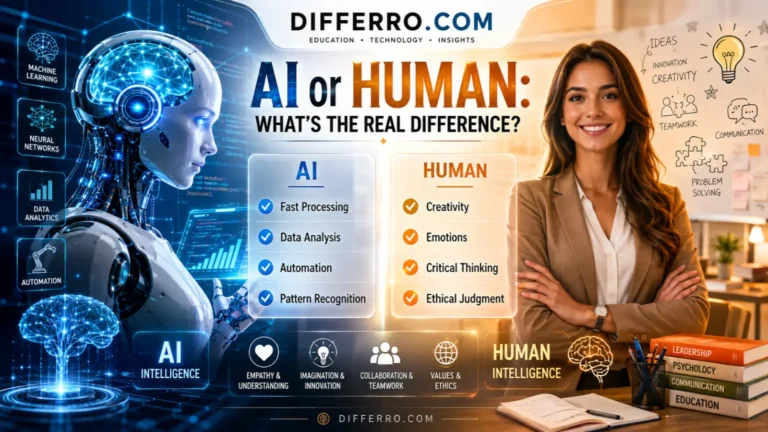
AI or Human: What’s the Real Difference? This question has become more important as artificial intelligence becomes part of daily life. People use AI tools for writing, designing, coding, customer support, and even education.
At the same time, humans continue to lead in creativity, emotions, critical thinking, and real-world experiences.
Many people wonder whether AI can replace humans or if both can work together. The confusion often comes from seeing AI perform tasks that once required human effort.
However, AI and humans are fundamentally different in how they think, learn, and make decisions.
In this guide, you’ll learn the meaning of AI and humans, their key differences, real-life examples, common misconceptions, and when each performs best.
⭐ Quick Answer
AI and humans differ mainly in how they think and make decisions. AI uses data, algorithms, and patterns to generate results, while humans use emotions, creativity, experience, and judgment.
Example: An AI can write an article in seconds, but a human can add personal stories, emotions, and unique insights.
📖 Meaning of AI
What Is AI?
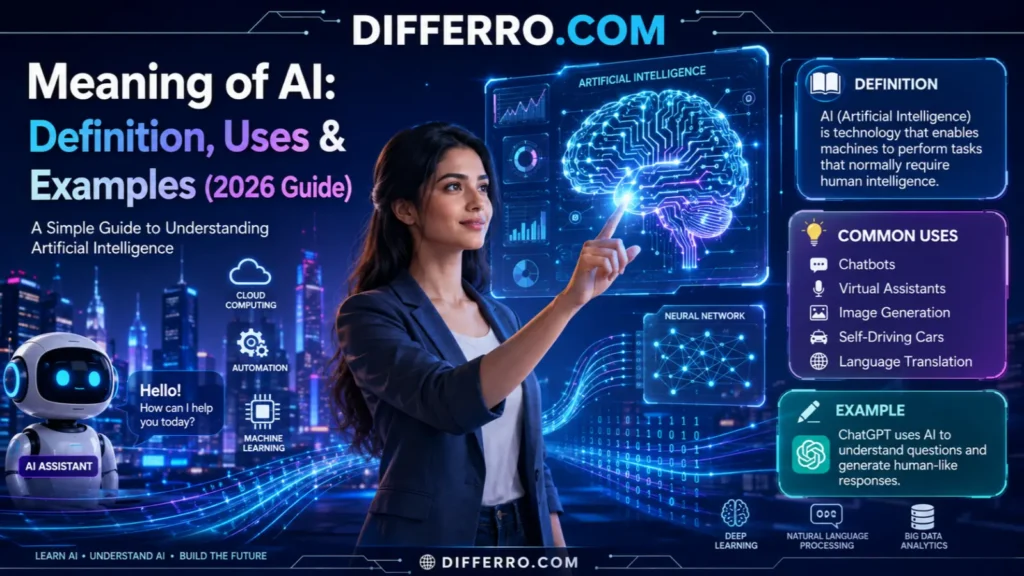
AI (Artificial Intelligence) refers to computer systems designed to perform tasks that usually require human intelligence.
These tasks include:
- Learning
- Problem-solving
- Language understanding
- Image recognition
- Decision-making
Examples of AI
- Chatbots answering customer questions.
- Voice assistants like Siri or Google Assistant.
👤 Meaning of Human
What Is a Human?
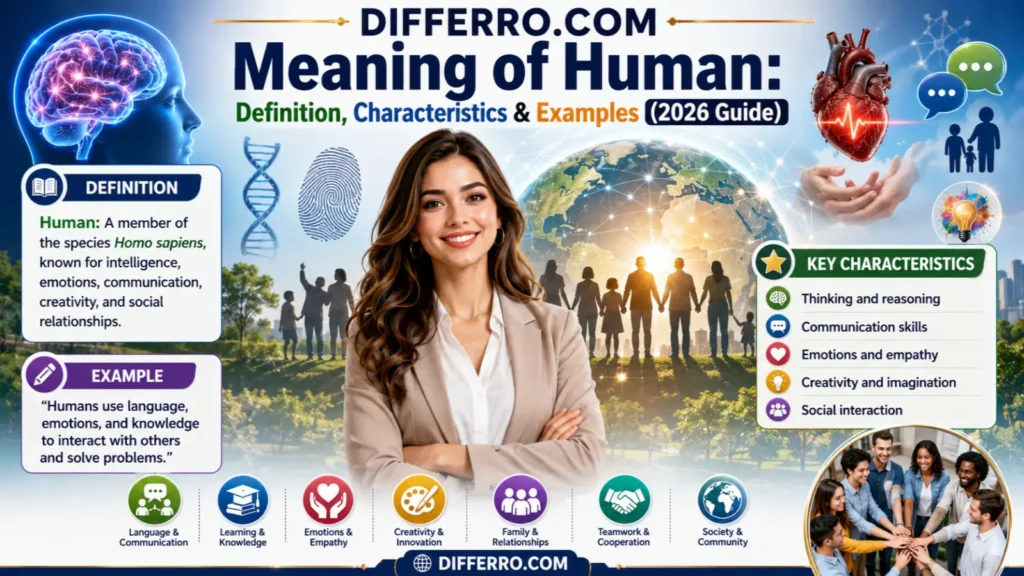
A human is a person capable of thinking, feeling emotions, creating ideas, and making decisions based on experience and judgment.
Humans can adapt to new situations and understand context beyond data.
Examples of Humans
- A teacher explaining a lesson creatively.
- A doctor comforting a patient while giving treatment advice.
📊 Key Differences Between AI and Humans
| Feature | AI | Human |
|---|---|---|
| Meaning | Machine intelligence | Natural intelligence |
| Tone | Data-driven | Emotion-driven |
| Usage | Automation and analysis | Creativity and judgment |
| Popularity | Growing rapidly | Essential in all fields |
| Learning | From data and algorithms | From experience and observation |
| Creativity | Limited to patterns | Original and innovative |
| Emotions | No real emotions | Real emotions and empathy |
| Speed | Extremely fast | Slower but thoughtful |
🕰️ Origin & History
The idea of artificial intelligence began in the 1950s when researchers started creating machines that could mimic human thinking.
Humans, on the other hand, have developed intelligence naturally through evolution over millions of years.
Similar comparison examples include:
- Robot vs Human
- Machine Learning vs Human Learning
- Automation vs Manual Work
- Computer Vision vs Human Vision
🇬🇧 British English vs American English Spelling
The phrase AI or Human does not change between British and American English. However, related technology terms often have spelling differences.
For example:
- British English often uses “-ise”
- American English often uses “-ize”
British vs American English Comparison
| British English | American English |
|---|---|
| Organise | Organize |
| Analyse | Analyze |
| Realise | Realize |
| Optimise | Optimize |
| Behaviour | Behavior |
✅ When to Use AI
Use AI when you need:
- Fast data processing
- Repetitive task automation
- Large-scale analysis
- Content assistance
- Pattern recognition
Examples
- Generating reports
- Customer support chatbots
- Image recognition systems
✅ When to Use Humans
Use humans when you need:
- Creativity
- Emotional understanding
- Leadership
- Ethical decisions
- Strategic thinking
Examples
- Counseling sessions
- Creative storytelling
- Business negotiations
❌ Common Mistakes
Mistake 1
Incorrect: AI thinks exactly like humans.
Correct: AI processes data differently from humans.
Mistake 2
Incorrect: AI has emotions.
Correct: AI simulates responses but does not feel emotions.
Mistake 3
Incorrect: AI can replace every job.
Correct: AI can automate some tasks but many jobs still need humans.
Mistake 4
Incorrect: Human decisions are always better.
Correct: Some tasks are completed faster and more accurately by AI.
🧠 Easy Trick to Remember
Think of it this way:
AI = Artificial Analysis
Human = Heart + Experience
AI processes information quickly.
Humans understand emotions and meaning.
✍️ Write 5 Examples
Example 1: Content Writing
AI can generate a draft quickly.
A human editor improves quality and storytelling.
Example 2: Customer Service
AI answers common questions.
Humans handle complex complaints.
Example 3: Healthcare
AI helps analyze medical data.
Doctors make final treatment decisions.
Example 4: Education
AI creates learning recommendations.
Teachers provide personal guidance.
Example 5: Business Decisions
AI identifies trends from data.
Business leaders use experience to decide actions.
🔍 Related Keywords
- AI vs Human
- Artificial Intelligence vs Human Intelligence
- Human vs Machine
- AI compared to Humans
- Difference Between AI and Humans
- AI Advantages and Disadvantages
- Human Intelligence vs Artificial Intelligence
🌍 Google Trends & Usage Data
Interest in AI vs Human has increased significantly worldwide due to advancements in generative AI and automation.
The topic is highly searched in technology, education, business, and digital marketing sectors.
Countries with strong interest include the USA, UK, Australia, India, and Pakistan.
Search trends show growing curiosity about whether AI can replace human work and creativity.
Usage Insight by Country
| Country | Search Interest | Main Reason |
|---|---|---|
| USA | Very High | AI adoption in business |
| UK | High | Education and technology |
| Australia | High | Workplace automation |
| India | Very High | Tech industry growth |
| Pakistan | Growing | Digital transformation |
📈 Comparison Table: Keyword Variations
| Keyword Variation | Search Intent |
|---|---|
| AI vs Human | Comparison |
| Human vs AI | Comparison |
| Artificial Intelligence vs Human Intelligence | Educational |
| Can AI Replace Humans | Informational |
| AI and Human Difference | Comparison |
| AI Compared to Humans | Informational |
| Human Intelligence Meaning | Educational |
🏆 Final Verdict
Neither AI nor humans are universally better.
AI is better for speed, automation, and data analysis.
Humans are better for creativity, empathy, ethics, and complex judgment.
The strongest results usually come when AI and humans work together.
❓ Frequently Asked Questions
1. Is AI or Human a correct comparison?
Yes. It compares artificial intelligence with human intelligence and abilities.
2. What is the main difference between AI and humans?
AI relies on data and algorithms, while humans rely on emotions, experience, and reasoning.
3. Which is more common today?
Humans remain essential, but AI usage is growing rapidly across industries.
4. Is AI suitable for formal business use?
Yes. Many organizations use AI for analytics, automation, and productivity tasks.
5. Why does confusion exist between AI and humans?
Because modern AI can perform tasks that once required human intelligence, creating the impression that both work similarly.
Conclusion
AI or Human: What’s the Real Difference? The answer lies in how each processes information and solves problems. AI excels at speed, automation, and handling large amounts of data. Humans excel at creativity, emotional intelligence, ethics, and real-world understanding. While AI continues to improve, it still depends on human guidance and oversight.
Rather than competing, AI and humans often achieve the best outcomes when working together. Understanding their strengths and limitations helps individuals and businesses make smarter decisions. As technology advances, the future will likely involve collaboration between artificial intelligence and human intelligence rather than replacement.

Sara Taylor is a passionate writer and language enthusiast. She specializes in creating simple and easy-to-understand articles about English grammar, spelling differences, and commonly confused words. Her writing style focuses on helping students, writers, and English learners improve their language skills with confidence. Through informative guides and practical examples, Sara makes complex grammar topics easier for everyday readers.