
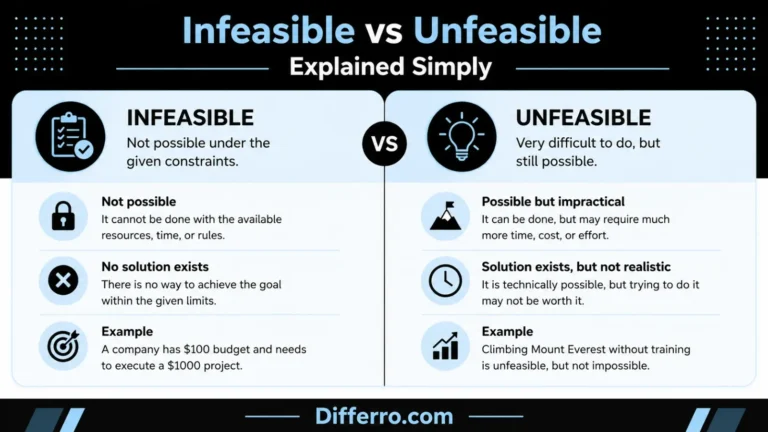
Infeasible or unfeasible are two words that often confuse English learners and writers. Both words describe something that cannot be done or achieved. Because their meanings are almost identical, many people wonder which one is correct.
The good news is that both words are valid English terms. However, infeasible is far more common in modern writing, business, academics, and professional communication. On the other hand, unfeasible appears less often and may sound unusual in formal contexts.
Understanding the difference helps you write more clearly and professionally. It also improves grammar accuracy in emails, reports, essays, and daily conversations.
In this guide, you will learn the meanings, differences, usage rules, examples, history, and common mistakes related to these two confusing words.
⭐ Quick Answer
Infeasible and unfeasible both mean “not possible” or “impractical.” However, infeasible is more common and preferred in formal English.
Example:
- ✅ The project became infeasible due to high costs.
- ✅ Building a bridge there seems unfeasible.
📖 Meaning of Infeasible
Infeasible means something cannot be done successfully or practically.
Examples:
- The plan was infeasible because of limited funding.
- Traveling during the storm became infeasible.
📖 Meaning of Unfeasible
Unfeasible also means impossible or difficult to achieve.
Examples:
- The deadline looked unfeasible for the team.
- The idea became unfeasible after new regulations.
📊 Key Differences Between Infeasible And Unfeasible
| Feature | Infeasible | Unfeasible |
|---|---|---|
| Meaning | Not practical or possible | Not practical or possible |
| Tone | Formal and professional | Less formal and less common |
| Usage | Very common | Rarely used |
| Popularity | Preferred globally | Limited usage |
| Best For | Academic and business writing | Casual or older usage |
🕰️ Origin & History
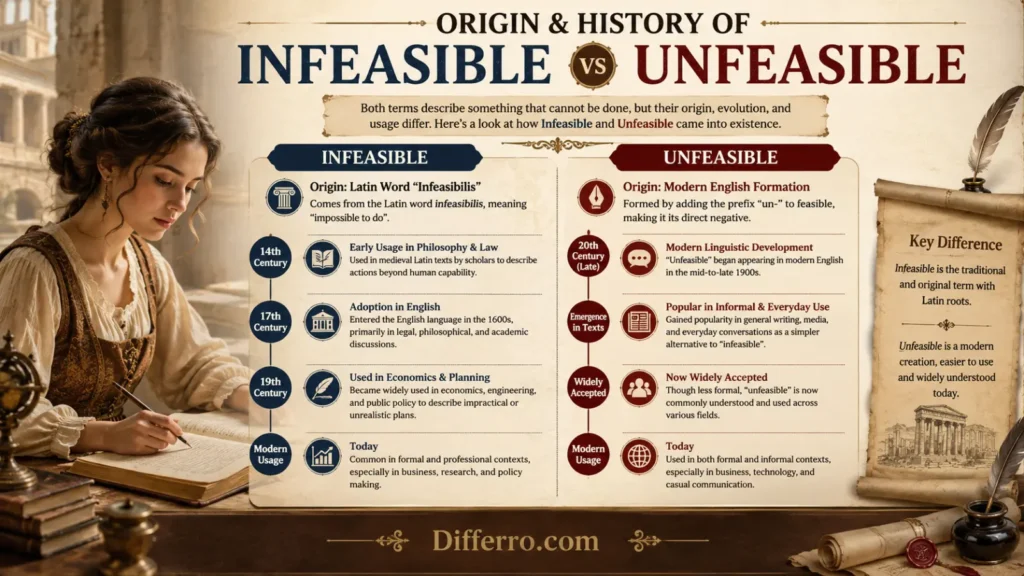
The word feasible comes from the French word faisable, meaning “capable of being done.”
English later added prefixes:
- in- → not
- un- → not
This created:
- infeasible
- unfeasible
Over time, infeasible became the preferred form in modern English. Similar examples include:
- inactive
- inaccurate
- ineffective
Words with the prefix in- are usually more common in formal English.
🇬🇧 British English vs American English Spelling
Both British and American English use infeasible more often than unfeasible. The difference is mainly about preference, not spelling rules.
In professional writing, newspapers, and research papers, infeasible dominates in both regions. Unfeasible still appears occasionally but sounds less natural.
Comparison Table: British vs American English
| English Style | Preferred Word | Notes |
|---|---|---|
| British English | Infeasible | Most common usage |
| American English | Infeasible | Strongly preferred |
| Australian English | Infeasible | Common in formal writing |
| Informal Usage | Unfeasible | Less frequent globally |
✍️ When to Use Infeasible
Use infeasible in:
- Business writing
- Academic papers
- Reports
- Technical discussions
- Professional communication
Examples:
- The budget made the proposal infeasible.
- Completing the task in one day is infeasible.
- The engineer called the design infeasible.
✍️ When to Use Unfeasible
Use unfeasible in:
- Informal writing
- Conversational English
- Rare stylistic situations
Examples:
- The vacation plan became unfeasible.
- The new rules made the idea unfeasible.
❌ Common Mistakes
| Incorrect Usage | Correct Usage |
|---|---|
| This plan is unpossible. | This plan is infeasible. |
| The project became infeasable. | The project became infeasible. |
| Unfeasible is always wrong. | Unfeasible is less common but correct. |
| Infeasible means illegal. | Infeasible means impractical or impossible. |
🧠 Easy Trick to Remember
Remember this simple trick:
👉 “In-” words are often formal in English.
So:
- Infeasible = professional and preferred
- Unfeasible = less common alternative
📝 Write 5 Examples
1. Business Project Example
The company rejected the idea because it was infeasible financially.
2. Travel Planning Example
Flying during the storm became unfeasible for tourists.
3. School Assignment Example
Finishing the research in one night seemed infeasible.
4. Technology Example
The software update became unfeasible on older devices.
5. Construction Example
Building the road there was technically infeasible.
🔍 Related Keywords
⚖️ Final Verdict
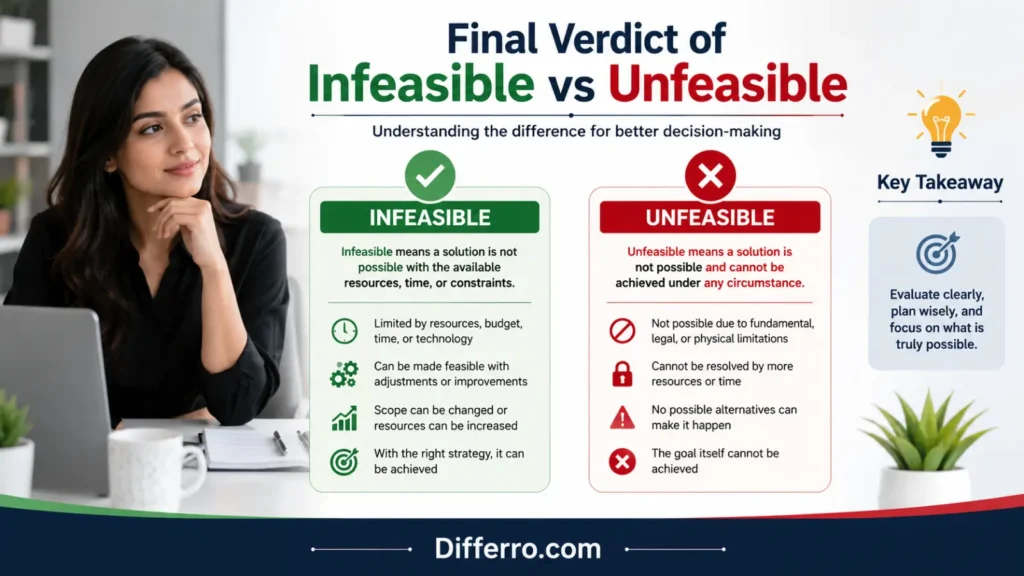
Both infeasible and unfeasible are grammatically correct. However, infeasible is the better choice in most situations.
It sounds more natural, professional, and modern. Most native speakers, businesses, and academic writers prefer it.
Use unfeasible only when you want a less common alternative or informal style.
📈 Google Trends & Usage Data
In the USA, “infeasible” receives far more searches because it is common in legal, academic, and business writing.
Meanwhile, the UK and Australia also use both words, although “infeasible” clearly dominates formal usage.
In India and Pakistan, many searches come from grammar confusion and English learning topics.
Overall, infeasible is much more popular globally because it sounds more standard and professional.
Comparison Table: Keyword Variations
| Keyword Variation | Popularity |
|---|---|
| Infeasible | Very High |
| Unfeasible | Low |
| Infeasible meaning | High |
| Infeasible vs unfeasible | Medium |
| Unfeasible meaning | Low |
| Feasible antonym | Medium |
FAQs ,
Is infeasible correct?
Yes, infeasible is completely correct and widely used.
What is the difference between infeasible and unfeasible?
Both mean “not possible,” but infeasible is more common and formal.
Which word is more common?
Infeasible is much more common worldwide.
Is unfeasible formal?
It is correct, but less preferred in professional writing.
Why does confusion exist?
Both words share the same meaning and use different negative prefixes.
🏁 Conclusion
Infeasible or unfeasible is a common English confusion because both words mean nearly the same thing. They describe something that cannot realistically happen or succeed. However, modern English strongly favors infeasible, especially in business, academic, and professional communication.
While unfeasible is not incorrect, it appears less often and may sound unusual to some readers. Choosing the right word depends on your audience and writing style.
If you want the safest and most professional option, use infeasible. It is clearer, more popular, and more widely accepted across English-speaking countries.
Learning small word differences like this can greatly improve your writing confidence and accuracy.
Discover More Post ,
Grill Or Grille : What’s the Real Difference?
Site Or Cite : Simple English Guide for Writers
Peeking Or Peaking : Which Word Should You Use?

Sara Taylor is a passionate writer and language enthusiast. She specializes in creating simple and easy-to-understand articles about English grammar, spelling differences, and commonly confused words. Her writing style focuses on helping students, writers, and English learners improve their language skills with confidence. Through informative guides and practical examples, Sara makes complex grammar topics easier for everyday readers.