

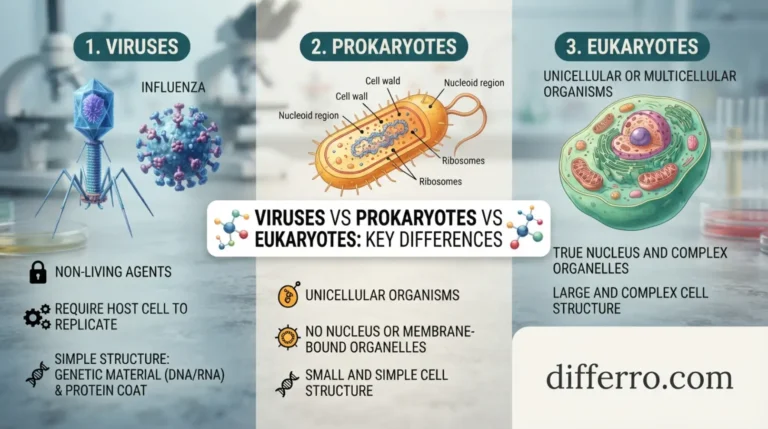
Viruses vs Prokaryotes vs Eukaryotes: Key Differences explain three major biological categories. They differ in structure, reproduction, genetic material, and their relationship with living organisms. Understanding these differences helps students learn basic biology and microbiology.
Viruses are infectious agents that cannot reproduce independently. Prokaryotes are single-celled organisms without a membrane-bound nucleus. Eukaryotes have cells with a true nucleus and specialized organelles. These differences affect how each group grows, functions, and interacts with its environment.
Although all three contain genetic information, they do not share the same cellular organization. Viruses lack cellular structures, while prokaryotes and eukaryotes have cells. Learning these features makes biology easier to understand. This guide explains their meanings, structures, examples, and major differences in simple language.
⭐ Quick Answer
Viruses are acellular infectious agents, prokaryotes are cells without a membrane-bound nucleus, and eukaryotes are cells with a membrane-bound nucleus. Viruses need host cells to replicate, while prokaryotes and eukaryotes can reproduce independently under suitable conditions.
Example: Influenza is a virus, Escherichia coli is a prokaryote, and a human cell is eukaryotic.
🔬 Meaning of Viruses
Viruses are tiny infectious agents that contain genetic material inside a protective protein coat. Their genetic material consists of DNA or RNA.
Some viruses also have an outer lipid envelope. Unlike cellular organisms, viruses lack cytoplasm, ribosomes, and independent metabolic systems.
They cannot reproduce on their own. Instead, they enter suitable host cells and use their machinery to produce new virus particles.
Main Characteristics of Viruses
- They are acellular, meaning they have no cellular structure.
- They contain either DNA or RNA as genetic material.
- A protein coat called a capsid protects their genetic material.
- Some viruses have an additional lipid envelope.
- They depend on host cells for replication.
- Antibiotics do not treat viral infections.
Examples of Viruses
Example 1: Influenza Virus
The influenza virus causes seasonal flu. It infects cells in the respiratory system and uses them to produce new viruses.
Example 2: Coronavirus
Coronaviruses form a group of viruses that can infect humans and animals. SARS-CoV-2, for example, causes COVID-19.
Other examples include HIV, adenovirus, and bacteriophages.
🦠 Meaning of Prokaryotes
Prokaryotes are single-celled organisms that lack a membrane-bound nucleus. Their genetic material usually occupies a region called the nucleoid.
They also lack membrane-bound organelles, such as mitochondria and the Golgi apparatus. However, they contain ribosomes that help produce proteins.
Prokaryotes include two major domains: Bacteria and Archaea. They live in soil, water, air, and many other environments.
Main Characteristics of Prokaryotes
- They usually consist of one cell.
- They lack a membrane-bound nucleus.
- Their DNA usually forms a circular chromosome.
- They contain ribosomes for protein production.
- They lack membrane-bound organelles.
- Many reproduce through binary fission.
- Some have cell walls, capsules, or flagella.
Examples of Prokaryotes
Example 1: Escherichia coli (E. coli)
E. coli is a bacterium that commonly lives in the intestines of humans and animals. Some strains cause illness, while many remain harmless.
Example 2: Lactobacillus
Lactobacillus bacteria help produce fermented foods such as yogurt. Some species also live in the human body.
Other examples include cyanobacteria, methanogens, and Staphylococcus aureus.
🧬 Meaning of Eukaryotes
Eukaryotes are organisms whose cells contain a membrane-bound nucleus. The nucleus stores most of their genetic material.
Their cells also contain specialized structures called organelles. These organelles perform different functions, such as energy production, protein processing, and waste removal.
Eukaryotes include animals, plants, fungi, and protists. Some consist of one cell, while others contain many specialized cells.
Main Characteristics of Eukaryotes
- Their cells contain a membrane-bound nucleus.
- They have membrane-bound organelles.
- Their chromosomes usually contain linear DNA.
- Their cells contain mitochondria or related energy-producing organelles.
- Some have cell walls, while others do not.
- They reproduce through mitosis or meiosis, depending on the organism and life cycle.
- They can be unicellular or multicellular.
Examples of Eukaryotes
Example 1: Human Cells
Human cells contain a nucleus, mitochondria, and other specialized organelles. They perform different functions throughout the body.
Example 2: Plant Cells
Plant cells contain a nucleus, chloroplasts, and a large central vacuole. Their cell walls provide support and protection.
Other examples include yeast, amoebas, mushrooms, and animals.
🔎 Viruses vs Prokaryotes vs Eukaryotes: Key Differences
These three biological categories differ mainly in cellular structure, reproduction, and genetic organization.
| Feature | Viruses | Prokaryotes | Eukaryotes |
|---|---|---|---|
| Basic structure | Acellular | Cellular | Cellular |
| Cell organization | No cells | Usually one cell | One or more cells |
| Nucleus | Absent | Absent | Present |
| Genetic material | DNA or RNA | Usually circular DNA | Usually linear nuclear DNA |
| Cytoplasm | Absent | Present | Present |
| Ribosomes | Absent | Present | Present |
| Membrane-bound organelles | Absent | Absent | Present |
| Cell membrane | No cellular membrane | Present | Present |
| Cell wall | No cellular wall | Present in many | Present in plants and fungi, absent in animals |
| Reproduction | Replicates inside host cells | Usually binary fission | Mitosis, meiosis, or other reproductive processes |
| Metabolism | No independent metabolism | Present | Present |
| Examples | Influenza, HIV | E. coli, Lactobacillus | Humans, plants, fungi |
| Biological classification | Not included in the three domains of life | Bacteria and Archaea | Eukarya |
Important: Viruses do not have cells, so scientists distinguish them from cellular life. Prokaryotes and eukaryotes are both cellular organisms.
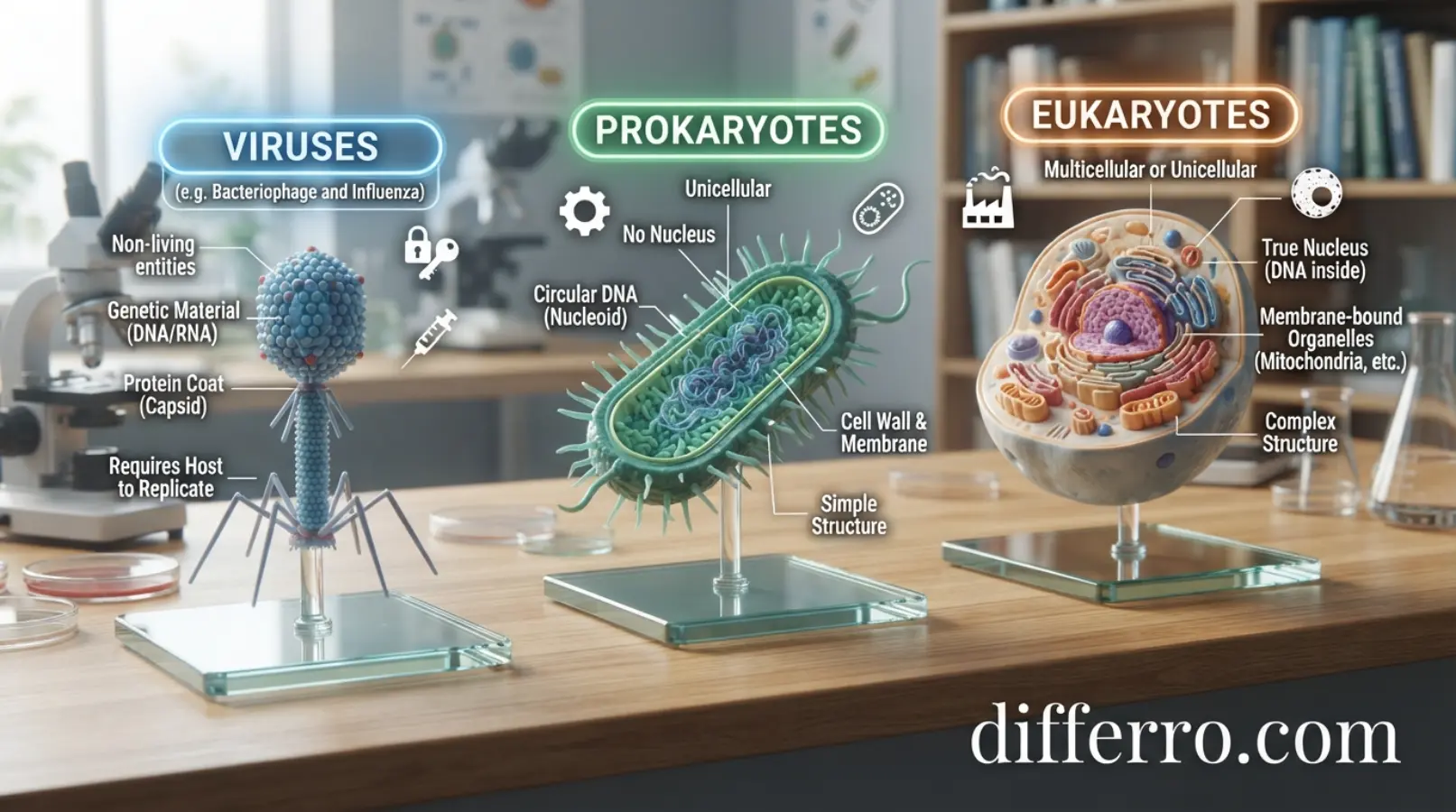
🕰️ Origin and History of Viruses, Prokaryotes, and Eukaryotes
Scientists developed modern classifications by studying cell structure, genetics, and evolutionary relationships.
In 1665, Robert Hooke described small compartments in cork and introduced the term “cell.” Later, Antonie van Leeuwenhoek observed living microorganisms using microscopes.
In 1937, French biologist Édouard Chatton helped establish the distinction between prokaryotic and eukaryotic cells.
In 1977, Carl Woese and George Fox identified major evolutionary differences among microorganisms. Woese later developed the three-domain system: Bacteria, Archaea, and Eukarya.
Scientists also continue investigating how viruses originated. Their evolutionary history remains complex and unresolved.
Similar Biological Terms
- Acellular: Describes structures that do not consist of cells.
- Unicellular: Describes organisms made of one cell.
- Multicellular: Describes organisms made of multiple cells.
- Microorganism: An organism or biological agent too small to see clearly without magnification.
- Organelle: A specialized structure inside a cell.
- Nucleoid: The region containing DNA in a prokaryotic cell.
These terms help explain the differences between viruses, prokaryotes, and eukaryotes.
🇬🇧 British English vs American English Spelling
The terms viruses, prokaryotes, and eukaryotes have the same spelling in British and American English.
Their scientific meanings also remain the same in both varieties of English.
Some related biological terms may have spelling differences, but these three terms do not.
British vs American English Comparison
| Biological term | British English | American English |
|---|---|---|
| Virus | Virus | Virus |
| Prokaryote | Prokaryote | Prokaryote |
| Eukaryote | Eukaryote | Eukaryote |
| Cell | Cell | Cell |
| Nucleus | Nucleus | Nucleus |
| Organism | Organism | Organism |
🦠 When to Use the Term Viruses
Use the term viruses when discussing acellular infectious agents that depend on host cells for replication.
Viruses infect different organisms, including humans, animals, plants, fungi, and bacteria.
Common Uses of Viruses
- Studying infectious diseases
- Understanding immune responses
- Explaining viral replication
- Learning about vaccines
- Researching genetic material and evolution
Example 1:
Influenza viruses can cause respiratory infections in humans.
Example 2: Bacteriophages are viruses that infect bacteria.
Example 3: Some plant viruses damage agricultural crops.
Remember that viruses are not prokaryotic or eukaryotic cells.
🔬 When to Use the Term Prokaryotes
Use prokaryotes when discussing organisms with cells that lack a membrane-bound nucleus.
The term includes both Bacteria and Archaea. These organisms perform important functions in natural environments.
Common Uses of Prokaryotes
- Studying bacteria and archaea
- Understanding decomposition
- Researching fermentation
- Explaining nutrient cycling
- Studying microbial diseases
ׂ╰┈➤Example 1: E. coli is a prokaryote commonly found in the human intestine.
Example 2: Methanogens are archaea that produce methane in oxygen-free environments.
Example 3: Cyanobacteria perform photosynthesis and contribute to oxygen production.
🧬 When to Use the Term Eukaryotes
Use eukaryotes when discussing organisms with cells containing a membrane-bound nucleus and specialized organelles.
This group includes animals, plants, fungi, and protists.
Common Uses of Eukaryotes
- Studying human and animal biology
- Understanding plant structures
- Researching fungi
- Explaining cell division
- Learning about complex organisms
ׂ╰┈➤Example 1: Humans are multicellular eukaryotic organisms.
Example 2: Yeast is a single-celled eukaryotic organism.
Example 3: Oak trees are multicellular eukaryotes.
⚠️ Common Mistakes When Comparing Viruses, Prokaryotes, and Eukaryotes
Mistake 1: Calling Viruses Prokaryotes
Incorrect: Viruses are prokaryotic organisms because they are very small.
Correct: Viruses are acellular infectious agents. Prokaryotes are single-celled organisms without a membrane-bound nucleus.
Mistake 2: Assuming All Prokaryotes Are Bacteria
Incorrect: Every prokaryote belongs to the Bacteria domain.
Correct: Prokaryotes include two domains: Bacteria and Archaea.
Mistake 3: Assuming All Eukaryotes Are Multicellular
Incorrect: Every eukaryote contains many cells.
Correct: Some eukaryotes are unicellular. Yeast and many protists are examples.
Mistake 4: Assuming Viruses Contain Both DNA and RNA
Incorrect: Every virus contains DNA and RNA together as its genome.
Correct: A virus uses either DNA or RNA as its genetic material.
Mistake 5: Assuming Prokaryotes Have No DNA
Incorrect: Prokaryotic cells lack genetic material because they have no nucleus.
Correct: Prokaryotes contain DNA, usually in a nucleoid region.
Mistake 6: Assuming All Eukaryotic Cells Have Cell Walls
Incorrect: Every eukaryotic cell has a cell wall.
Correct: Plants and fungi have cell walls. Animal cells do not.
Mistake 7: Assuming Antibiotics Treat All Three
Incorrect: Antibiotics can destroy viruses, bacteria, and eukaryotic cells equally.
Correct: Antibiotics target bacterial structures or processes. They do not treat viral infections.
🧠 Easy Trick to Remember
Use this simple memory trick to remember all three categories:
- Viruses = No cells: They need host cells to replicate.
- Prokaryotes = No nucleus: They have cells but lack a membrane-bound nucleus.
- Eukaryotes = True nucleus: Their cells contain a membrane-bound nucleus and organelles.
Remember these three points:
Virus = Acellular
Prokaryote = No nucleus
Eukaryote = True nucleus
This simple method makes the comparison easier for students.
🌍 Everyday-Life Examples: Viruses vs Prokaryotes vs Eukaryotes
1. Getting the Common Flu
A person catches influenza after contact with respiratory droplets from an infected person.
The influenza virus enters suitable host cells and uses their machinery to replicate.
Biological category: Virus.
Related concept: Viral infection and host-cell dependence.
2. Making Homemade Yogurt
Yogurt production uses helpful bacteria that convert milk sugars into lactic acid.
Lactobacillus and other starter bacteria help develop yogurt’s texture and taste.
Biological category: Prokaryote.
Related concept: Bacterial fermentation and food production.
3. Growing a Garden Plant
A tomato plant grows through the activity of specialized cells. Its cells contain nuclei, chloroplasts, and other organelles.
These structures support photosynthesis, growth, and nutrient processing.
Biological category: Eukaryote.
Related concept: Plant cells and multicellular organisms.
4. Digesting Food in the Human Body
The human intestine contains many microorganisms. Some bacteria help break down food components and support normal gut functions.
Human intestinal cells also perform specialized tasks.
Biological categories: Prokaryotes and eukaryotes.
Related concept: Microbiome and cellular organization.
5. Fighting a Bacterial Infection
A bacterial infection can occur when harmful bacteria enter the body and multiply.
The immune system recognizes these organisms and works to control the infection. Doctors may prescribe antibiotics when appropriate.
Biological category: Prokaryote.
Related concept: Bacterial diseases and antibiotic treatment.
🌍 Google Trends and Usage Insights: Five Countries
Google Trends measures relative search interest rather than exact search volume. The following observations are general topic expectations, not verified live rankings.
- USA: Students may search for cell biology comparisons, microbiology, and biological classification.
- UK: Searches may focus on prokaryotic and eukaryotic cell structures for biology education.
- Australia: Educational searches may include viruses, bacteria, and cell organization.
- India: Students may search for differences between viruses, prokaryotes, and eukaryotes for examinations.
- Pakistan: Search interest may relate to biology textbooks, school examinations, and university microbiology topics.
SEO insight: Compare the exact primary keyword with related phrases in Google Trends for each country. Use identical date ranges and search categories. Check actual interest before claiming one country has higher search demand.
Comparison Table: Keyword Variations
| Keyword variation | Search intent | Suggested content placement |
|---|---|---|
| Viruses vs Prokaryotes vs Eukaryotes | Three-way comparison | Main title and introduction |
| Virus vs Prokaryote vs Eukaryote | Basic biology comparison | Quick Answer |
| Prokaryotic vs Eukaryotic Cells | Cell structure comparison | Key differences |
| Viruses vs Bacteria | Biological comparison | Virus and prokaryote sections |
| Prokaryotes and Eukaryotes Differences | Educational research | Meaning sections |
| Characteristics of Viruses | Biology learning | Virus section |
| Three Domains of Life | Biological classification | Origin and history |
❓ Frequently Asked Questions
1. Is Viruses vs Prokaryotes vs Eukaryotes a correct comparison?
Yes. It is a useful biological comparison involving three different categories. Viruses are acellular, while prokaryotes and eukaryotes are cellular organisms.
2. What is the main difference between viruses, prokaryotes, and eukaryotes?
Viruses lack cellular structures and require host cells for replication. Prokaryotes have cells without a membrane-bound nucleus. Eukaryotes have cells with a membrane-bound nucleus and specialized organelles.
3. Which is more common: prokaryotes or eukaryotes?
Prokaryotes are extremely abundant and widespread across Earth. However, abundance and diversity depend on the environment and measurement method. Eukaryotes include animals, plants, fungi, and protists.
4. What is the formal scientific usage of these terms?
Scientists use viruses, prokaryotes, and eukaryotes as biological terms. Prokaryotes include Bacteria and Archaea. Eukaryotes belong to the domain Eukarya. Viruses do not belong to these three cellular domains.
5. Why do students confuse viruses, prokaryotes, and eukaryotes?
Students often confuse these categories because all contain genetic material. However, their structures and reproduction methods differ. Viruses lack cells, while prokaryotes and eukaryotes have cellular structures.
🏆 Final Verdict: Which Is Different and Why?
Viruses, prokaryotes, and eukaryotes represent three different biological categories. Their most important difference involves cellular organization.
Viruses are acellular and depend on host cells for replication. Prokaryotes are single-celled organisms without a membrane-bound nucleus. Eukaryotes contain cells with a true nucleus and specialized organelles.
Prokaryotes and eukaryotes are not better or worse than each other. They perform different biological functions and occupy important ecological roles. Viruses also influence ecosystems, evolution, and human health.
Understanding these differences helps students learn cell biology, microbiology, and biological classification more effectively.
Conclusion
Viruses vs Prokaryotes vs Eukaryotes: Key Differences explain three important biological categories. Viruses are acellular infectious agents that need host cells to replicate. Prokaryotes are cellular organisms without a membrane-bound nucleus. Eukaryotes have cells with a nucleus and specialized organelles.
Viruses contain DNA or RNA, while cellular organisms use DNA as their genetic material. Prokaryotes include Bacteria and Archaea. Eukaryotes include animals, plants, fungi, and protists.
Remember the easiest distinction: viruses have no cells, prokaryotes have no true nucleus, and eukaryotes have a true nucleus. These basic characteristics make biological classification easier to understand.


1 thought on “Viruses vs Prokaryotes vs Eukaryotes: Key Differences”