
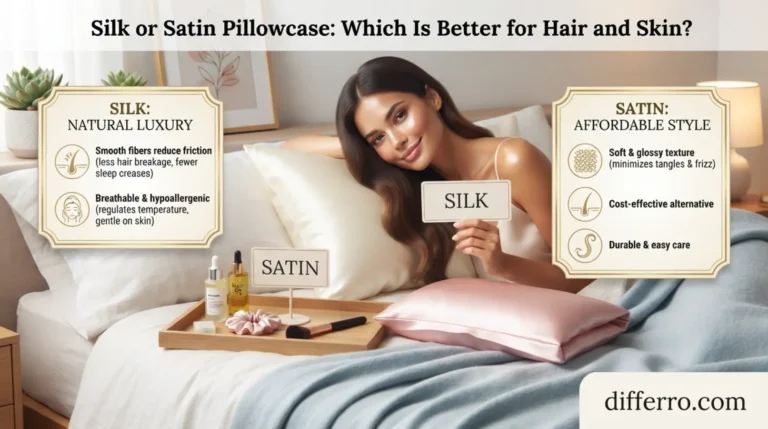
Silk or satin pillowcase is a common comparison for people who want smoother hair and healthier-looking skin. Both options feel soft, look luxurious, and may reduce friction while you sleep. However, silk and satin are not the same material. Silk is a natural fiber, while satin describes a weaving method that creates a smooth, glossy surface.
Silk pillowcases often attract buyers who prefer natural fibers and premium bedding. Satin pillowcases appeal to people who want a smooth surface at a lower price. Your best choice depends on your budget, fabric preferences, and care routine. Both options can help reduce friction compared with some rougher fabrics. However, neither pillowcase guarantees fewer wrinkles, stronger hair, or clearer skin. Understanding their differences helps you choose the right pillowcase for your needs. This guide compares silk and satin by material, comfort, price, maintenance, and everyday use.
⭐ Quick Answer
Silk is a natural fiber, while satin is a type of weave. Silk pillowcases usually cost more, while polyester satin options often cost less and require easier care. Both can provide a smooth sleeping surface.
Example: Choose silk if you prefer natural fibers and accept a higher price. Choose polyester satin if you want a budget-friendly, smooth pillowcase.
Meaning of a Silk Pillowcase
A silk pillowcase uses silk fibers, which come from silkworm cocoons. Mulberry silk is a popular choice for bedding because it feels smooth, lightweight, and soft.
Silk is a natural protein fiber. Its quality depends on factors such as fiber type, construction, and manufacturing.
Examples of Silk Pillowcases
Example 1: Someone chooses a 100% mulberry silk pillowcase because they prefer natural fibers and a smooth feel.
Example 2: A person with curly hair selects a silk pillowcase to help reduce friction and morning tangles.
Meaning of a Satin Pillowcase
A satin pillowcase uses satin weaving, which creates a smooth surface with a gentle shine. Manufacturers can produce satin from polyester, nylon, silk, or other fibers.
Many affordable satin pillowcases use polyester. These options can feel slippery and smooth without the higher cost of silk.
Examples of Satin Pillowcases
Example 1: A shopper buys a polyester satin pillowcase because it fits their budget and feels smooth.
Example 2: Someone chooses a washable satin pillowcase because they prefer simple bedding care.
🔎 Silk or Satin Pillowcase: Key Differences
| Feature | Silk Pillowcase | Satin Pillowcase |
|---|---|---|
| Meaning | Made from silk fibers | Made using a satin weave |
| Material | Natural protein fiber | May use polyester, nylon, silk, or other fibers |
| Feel | Smooth, soft, and lightweight | Smooth, slippery, and sometimes glossy |
| Hair care | May reduce friction and tangling | May also reduce friction and tangling |
| Skin care | May reduce friction against facial skin | May also provide a smooth sleeping surface |
| Price | Usually more expensive | Often more affordable, especially polyester satin |
| Breathability | Depends on silk quality and construction | Depends on the fiber and fabric construction |
| Maintenance | Often needs gentle washing | Polyester satin often allows easier care |
| Durability | Depends on silk quality and care | Depends on fiber quality and construction |
| Best for | People who prefer natural silk | People seeking smooth bedding at different price points |
Important: Satin is not always synthetic. Silk can also have a satin weave, so the two terms describe different things.
🕰️ Origin and History
Silk has a long history in textile production, especially in China, where people developed silk-making thousands of years ago. Traders later carried silk along routes connecting Asia with Europe and other regions.
Satin refers to a weaving technique rather than one specific fiber. Its smooth surface comes from the arrangement of threads, which creates a glossy appearance.
Today, manufacturers use satin weaves with different fibers to create bedding, clothing, and decorative fabrics.
Similar Fabric Terms
- Mulberry silk: Natural silk commonly used in premium bedding.
- Polyester satin: Synthetic fabric with a smooth, often shiny surface.
- Charmeuse: A lightweight fabric often made with a satin weave.
- Cotton sateen: Cotton fabric with a satin-like weave and a smooth feel.
- Silk charmeuse: A smooth, draping fabric made from silk with a satin weave.
These terms describe different fibers, fabrics, or weaving methods. Check the product label before buying.
🇬🇧 British English vs American English Spelling
The terms silk pillowcase and satin pillowcase use the same spelling in British and American English.
Neither term represents a British-versus-American spelling difference. Both describe bedding materials or fabric construction.
Other bedding terms may vary regionally, but these two terms remain consistent.
British vs American English Comparison
| Feature | British English | American English |
|---|---|---|
| Silk pillowcase | Silk pillowcase | Silk pillowcase |
| Satin pillowcase | Satin pillowcase | Satin pillowcase |
| Spelling difference | None | None |
| Meaning | Same | Same |
| Common usage | Bedding and beauty care | Bedding and beauty care |
🛏️ When to Choose a Silk Pillowcase
A silk pillowcase may suit you if you prefer natural fibers, a lightweight feel, and premium bedding.
Consider silk when:
- You prefer natural materials over synthetic fibers.
- You want a smooth surface that may reduce hair friction.
- You enjoy lightweight, soft bedding.
- You are comfortable paying more for a quality product.
- You can follow the manufacturer’s washing instructions.
Example of When to Choose Silk
A person with long, curly hair wants to reduce overnight tangling. They choose a silk pillowcase because they prefer natural fibers and a smooth texture.
Silk may help reduce friction, but results vary with hair type, hairstyle, and sleeping habits.
What Should You Check Before Buying?
Look for the following details:
- Fiber content: Confirm that the product contains real silk.
- Silk type: Check whether the seller specifies mulberry silk or another type.
- Construction: Review the fabric weight and stitching quality.
- Care instructions: Confirm whether the pillowcase needs handwashing or a gentle machine cycle.
- Product claims: Treat promises about wrinkle prevention or hair growth with caution.
💰 When to Choose a Satin Pillowcase
A satin pillowcase may suit you if you want a smooth sleeping surface without spending as much.
Consider satin when:
- You have a limited bedding budget.
- You want a smooth surface that may reduce hair friction.
- You prefer easy-care polyester satin.
- You want several colors or styles at affordable prices.
- You do not require natural silk fibers.
Example of When to Choose Satin
A student wants a soft pillowcase that fits a small budget. They choose polyester satin because it offers a smooth feel at an affordable price.
The right satin pillowcase can provide comfort without the cost of premium silk. However, breathability and softness depend on the fabric’s quality.
What Should You Check Before Buying?
- Fiber content: Determine whether the satin contains polyester, nylon, silk, or another fiber.
- Texture: Check whether the surface feels comfortable against your skin.
- Breathability: Consider whether you tend to sleep hot.
- Care requirements: Read the washing instructions.
- Quality: Check stitching, zipper design, and customer feedback.

⚠️ Common Mistakes When Comparing Silk and Satin
Mistake 1: Assuming Silk and Satin Mean the Same Thing
Incorrect: Every satin pillowcase contains silk.
Correct: Satin describes a weave, while silk describes a natural fiber. Satin can contain polyester or other fibers.
Mistake 2: Assuming Every Satin Pillowcase Is Synthetic
Incorrect: Satin always means polyester.
Correct: Manufacturers can produce satin using several fibers, including silk.
Mistake 3: Believing Silk Always Prevents Wrinkles
Incorrect: A silk pillowcase guarantees wrinkle-free skin.
Correct: A smooth pillowcase may reduce friction, but it cannot guarantee wrinkle prevention. Skin aging, sun exposure, and other factors also affect wrinkles.
Mistake 4: Assuming Satin Damages Hair
Incorrect: Satin always causes more hair breakage than silk.
Correct: Both fabrics can provide smooth surfaces. Friction depends on fabric quality, construction, and how you care for your hair.
Mistake 5: Ignoring Fabric Labels
Incorrect: A shiny pillowcase must be real silk.
Correct: Polyester satin can also look shiny. Check the fiber label before paying a premium price.
Mistake 6: Choosing Only by Price
Incorrect: The most expensive pillowcase always offers the best results.
Correct: Comfort, material, care, durability, and personal preference matter more than price alone.
🧠 Easy Trick to Remember
Use this simple memory tip:
- Silk = fiber. It tells you what material the manufacturer uses.
- Satin = weave. It tells you how the manufacturer arranges the threads.
Remember that a pillowcase can use silk fibers and a satin weave. When shopping, check both the material and the fabric construction.
🌿 Everyday-Life Examples: Silk or Satin Pillowcase
1. Choosing a Pillowcase for Curly Hair
A person with curly hair wants to reduce morning tangles. They compare silk and satin pillowcases and choose one with a smooth surface.
Primary keyword: Silk or satin pillowcase.
Secondary keyword: Best pillowcase for curly hair.
Both options may help reduce friction, but results vary.
2. Buying Bedding on a Budget
A college student wants comfortable bedding at a low price. They choose polyester satin instead of a premium silk pillowcase.
Primary keyword: Silk or satin pillowcase.
Secondary keyword: Affordable satin pillowcase.
This choice offers a smooth feel without the typical cost of silk.
3. Looking for a Natural Fabric
A shopper prefers natural fibers and wants premium bedding. They check the label and choose a genuine silk pillowcase.
Primary keyword: Silk or satin pillowcase.
Secondary keyword: 100% silk pillowcase.
The label helps confirm the actual fiber content.
4. Choosing Bedding for Warm Nights
A person often feels hot while sleeping. They compare silk and polyester satin for comfort and breathability.
Primary keyword: Silk or satin pillowcase.
Secondary keyword: Breathable pillowcase for hot sleepers.
Neither material guarantees a cooler night’s sleep. Fiber, weave, room temperature, and personal comfort all matter.
5. Buying a Pillowcase for Sensitive Skin
Someone with sensitive skin wants a smooth pillowcase that feels comfortable. They choose a soft fabric and wash it according to its care instructions.
Primary keyword: Silk or satin pillowcase.
Secondary keyword: Best pillowcase for sensitive skin.
Both fabrics may reduce friction, but neither guarantees relief from acne or skin irritation.
🌍 Google Trends and Usage Insights: Five Countries
Google Trends reports relative search interest, not exact search volumes. Without live comparison data, country-specific rankings remain unverified.
- USA: Compare searches for silk pillowcases, satin pillowcases, hair care, and beauty bedding.
- UK: Explore interest in silk bedding, satin pillowcases, and hair-friction concerns.
- Australia: Compare pillowcase searches related to comfort, hair care, and warm-weather sleeping.
- India: Investigate interest in affordable satin bedding and premium silk pillowcases.
- Pakistan: Compare interest in silk pillowcases, satin pillowcases, prices, and hair-care benefits.
SEO insight: These are research suggestions, not confirmed rankings. Compare both terms over the same time range in each country. Review related queries before deciding which secondary keywords deserve dedicated sections.
Comparison Table: Keyword Variations
| Keyword variation | Search intent | Suggested use |
|---|---|---|
| Silk or satin pillowcase | Direct comparison | Main title and introduction |
| Silk vs satin pillowcase | Product comparison | Key differences section |
| Best pillowcase for hair | Hair-care research | Benefits and buying advice |
| Silk pillowcase benefits | Material-specific research | Silk section |
| Satin pillowcase benefits | Material-specific research | Satin section |
| Silk or satin pillowcase for skin | Skin-care research | Skin-related discussion |
| Mulberry silk vs polyester satin | Material comparison | Detailed buying guide |
❓ Frequently Asked Questions
1. Is “silk or satin pillowcase” a correct phrase?
Yes. The phrase clearly compares two pillowcase options. Silk refers to a natural fiber, while satin describes a weave that can use different fibers.
2. What is the difference between silk and satin pillowcases?
A silk pillowcase contains silk fibers. A satin pillowcase uses a satin weave and may contain polyester, nylon, silk, or another fiber. Their feel, price, and care requirements depend on construction and material.
3. Which is more common, silk or satin pillowcases?
Both are available in the bedding market. Polyester satin often serves budget-conscious shoppers, while silk appeals to buyers seeking natural fibers and premium bedding. Exact popularity varies by market and retailer.
4. Which term is more suitable for formal or product descriptions?
Use silk pillowcase when the product contains silk fibers. Use satin pillowcase when the product uses a satin weave. For accurate product descriptions, state the fiber content clearly.
5. Why do people confuse silk and satin pillowcases?
Both can feel smooth, look shiny, and appear luxurious. Many shoppers also associate both fabrics with hair and skin care. The key difference is that silk identifies a fiber, while satin identifies a weave.
📝 Final Verdict: Which Is Better?
The best choice depends on your budget, material preferences, and care needs. A silk pillowcase suits people who prefer natural silk fibers and do not mind paying more. A polyester satin pillowcase suits shoppers who want a smooth surface at a lower price.
Both can help reduce friction against hair and skin. However, neither guarantees fewer wrinkles, less acne, or stronger hair. Product quality, fabric construction, and personal comfort all influence your experience.
Before buying, check the fiber content and washing instructions. Choose silk for natural-fiber preferences or satin for affordable variety. Remember that silk can also use a satin weave, so these options are not always mutually exclusive.
Conclusion
Silk or satin pillowcase comparisons help shoppers choose bedding that suits their needs. Silk is a natural fiber, while satin describes a weaving method. This difference explains why some satin pillowcases cost less than silk options.
Silk may appeal to people who prefer natural materials and premium bedding. Polyester satin may suit shoppers who want a smooth, affordable, easy-care option. Both fabrics can reduce friction compared with rougher surfaces, which may help limit hair tangling.
However, neither pillowcase guarantees clear skin, wrinkle prevention, or healthier hair. Always check the fiber label, construction, and care instructions before buying. Your budget, comfort, and personal preferences should guide the final decision.

Imran Lodhra is a comparison-focused content writer at Differro.com.
He specializes in creating clear, simple, and informative comparison articles.
His work helps readers understand key differences, pros and cons, and important details.
Imran focuses on accurate, practical, and easy-to-read content for everyday readers.
1 thought on “Silk or Satin Pillowcase: Which Is Better for Hair and Skin?”