

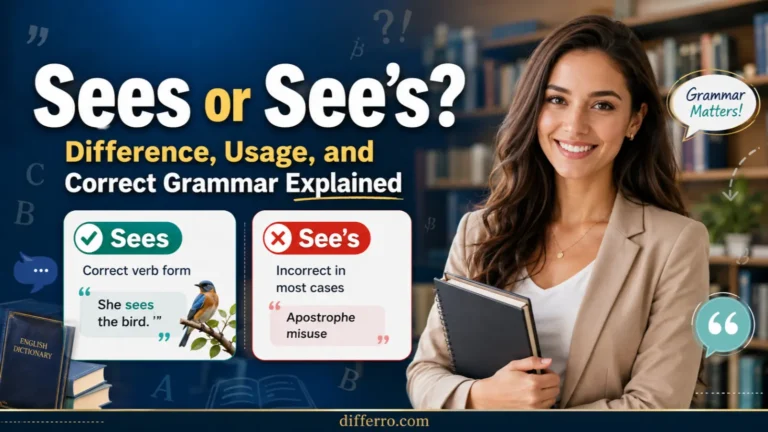
Sees or See’s is a common grammar question that confuses many English learners and native speakers alike. At first glance, both words may seem correct, but only one is usually correct in standard English writing.
The confusion happens because apostrophes often indicate possession, while adding -s can create different word forms. Many people mistakenly write see’s when they actually mean sees.
Understanding the difference is important for clear communication, professional writing, academic work, and everyday conversations. Once you learn the basic rule, choosing the correct form becomes easy.
In this guide, you’ll learn the meaning of sees and see’s, their differences, proper usage, examples, common mistakes, and simple memory tricks to help you remember the correct spelling every time.
⭐ Quick Answer
Sees is the correct third-person singular form of the verb see. It means “looks at” or “observes.”
See’s is generally incorrect unless it is a contraction or possessive form in very rare contexts.
Example:
✅ She sees a bird in the tree.
❌ She see’s a bird in the tree.
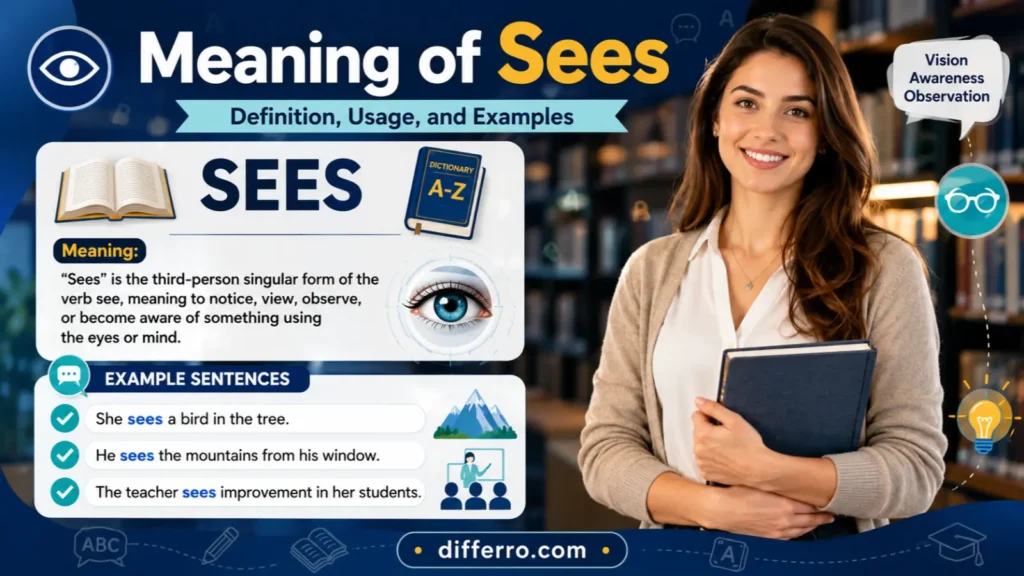
Meaning of Sees
Sees is the third-person singular present tense form of the verb see.
Definition
It means to notice, observe, watch, understand, or perceive something.
Examples
- He sees the mountains from his window.
- Sarah sees her friends every weekend.
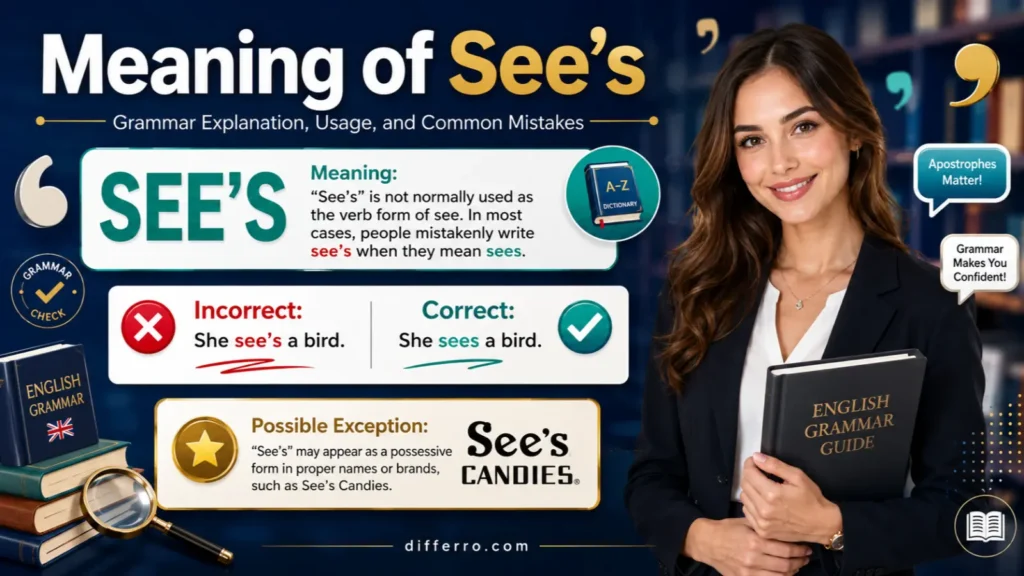
Meaning of See’s
See’s is not a standard English word in most situations.
Definition
It may appear as:
- A possessive form of the word “see” (rare and uncommon).
- A contraction in informal writing (generally not accepted in formal grammar).
Examples
- The term see’s rarely appears in modern English.
- Most grammar guides recommend avoiding see’s in standard writing.
Key Differences Between Sees and See’s
| Feature | Sees | See’s |
|---|---|---|
| Meaning | Third-person form of “see” | Rare possessive or contraction |
| Grammar | Correct standard English | Usually incorrect |
| Tone | Formal and informal | Rarely used |
| Usage | Very common | Extremely uncommon |
| Popularity | High | Very low |
Origin & History
The word see comes from Old English seon, meaning “to perceive with the eyes.”
Over time, English grammar added -s to verbs when used with third-person singular subjects.
Examples:
- Run → Runs
- Walk → Walks
- Read → Reads
- See → Sees
The form see’s developed from apostrophe usage rules but never became a standard replacement for sees.
British English vs American English Spelling
There is no spelling difference between British English and American English for sees. Both versions use the same spelling and grammar rules.
The confusion comes from punctuation, not regional spelling differences.
British vs American English Comparison
| Feature | British English | American English |
|---|---|---|
| Correct Form | Sees | Sees |
| See’s Usage | Rare | Rare |
| Grammar Rule | Same | Same |
| Formal Writing | Sees | Sees |
When to Use Sees
Use sees when talking about someone observing or understanding something in the present tense.
Examples
- She sees the problem clearly.
- Tom sees a rainbow after the storm.
- My teacher sees great potential in students.
When to Use See’s
Use see’s only in extremely rare possessive situations where style guides allow it.
Examples
- Rare linguistic examples may contain see’s.
- Most writers never need to use see’s.
Common Mistakes
Mistake 1
❌ She see’s the car.
✅ She sees the car.
Mistake 2
❌ He see’s a solution.
✅ He sees a solution.
Mistake 3
❌ My brother see’s everything.
✅ My brother sees everything.
Mistake 4
❌ The teacher see’s the mistake.
✅ The teacher sees the mistake.
Easy Trick to Remember
Remember this simple rule:
If you mean “looks at” or “observes,” use SEES.
Think:
He sees. She sees. It sees.
No apostrophe is needed.
Apostrophes usually show possession or contractions, not regular verb forms.
Write 5 Examples
1. At School
The teacher sees students working hard in class.
2. At Home
My mother sees the package at the door.
3. At Work
The manager sees progress in the project.
4. During Travel
He sees beautiful landscapes during the trip.
5. In Daily Conversation
She sees what you mean now.
Related Keywords
- sees meaning
- sees vs see’s
- correct spelling sees
- see’s grammar
- sees definition
- how to use sees
- grammar mistakes with sees
Final Verdict
Sees is the correct word in almost every situation.
Use sees when referring to someone who looks at, notices, understands, or observes something.
See’s is rarely needed and is generally considered incorrect when used instead of sees.
If you’re unsure, choose sees.
Google Trends & Usage Data
Search interest consistently shows that sees is far more common than see’s across English-speaking countries. Most searches involving see’s come from grammar-related questions rather than actual usage.
Country Insights
United States (USA)
Writers overwhelmingly use sees in education, business, and media content.
United Kingdom (UK)
British English follows the same grammar rule, making sees the preferred form.
Australia (AUS)
Australian publications and schools use sees almost exclusively.
India (IND)
Many learners search for the difference, but sees remains the correct standard form.
Pakistan (PAK)
Grammar learners frequently ask about sees vs see’s, yet sees dominates actual usage.
Comparison Table: Keyword Variations
| Keyword Variation | Search Intent |
|---|---|
| Sees or See’s | Grammar confusion |
| Sees meaning | Definition |
| Sees vs See’s | Comparison |
| Correct spelling sees | Grammar help |
| How to use sees | Usage |
| Is see’s correct | Grammar check |
| Sees examples | Learning |
FAQ
Is it correct to write see’s?
Usually no. In standard English, sees is the correct form.
What is the difference between sees and see’s?
Sees is a verb form. See’s is rarely used and generally incorrect in place of sees.
Which is more common, sees or see’s?
Sees is significantly more common.
Is sees acceptable in formal writing?
Yes. It is the correct grammatical form.
Why does confusion exist?
Many writers incorrectly add apostrophes to words ending in s, creating mistakes like see’s.
Conclusion
Sees or See’s is a grammar question with a simple answer. In nearly all situations, sees is the correct choice because it is the third-person singular form of the verb see. It describes someone observing, noticing, understanding, or viewing something. The form see’s is rarely used and is generally incorrect when replacing sees. Remember that regular verbs do not need apostrophes in the present tense. If you are writing a sentence such as “She sees the dog” or “He sees the answer,” always choose sees. By understanding this rule and practicing the examples above, you can avoid a common English grammar mistake and write with greater confidence and accuracy.

