
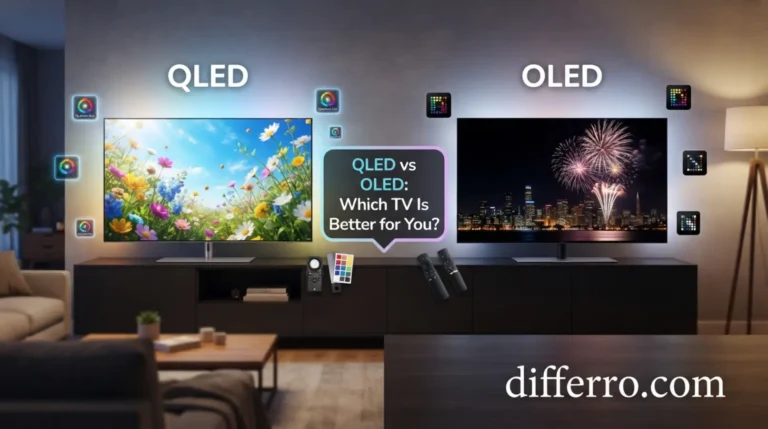
What’s better QLED vs OLED? The answer depends on your budget, room lighting, viewing habits, and picture quality preferences. Both technologies deliver excellent TV experiences, but they work differently. QLED TVs use LED backlighting and a quantum dot layer to produce bright, colorful images. OLED TVs use self-lit pixels that create deep blacks and precise contrast.
If you watch movies in a dark room, OLED often delivers a more cinematic experience. If your living room gets plenty of sunlight, QLED can offer a brightness advantage. QLED TVs also provide attractive options for buyers who want a large screen without spending as much. OLED appeals to people who value contrast, accurate shadows, and smooth gaming performance.
This guide compares QLED and OLED picture quality, brightness, lifespan, gaming, price, and everyday use. You will learn which technology suits your home and helps you make a smarter buying decision.
⭐ Quick Answer
OLED is generally better for picture quality, deep blacks, and contrast, while QLED is often better for bright rooms and budget-friendly large screens. The best choice depends on your lighting, budget, and viewing habits.
Example: Choose OLED for cinematic movie nights in a dark room. Choose QLED for a bright family living room where everyone watches TV during the day.
📺 What Is QLED?
QLED stands for Quantum Dot Light-Emitting Diode. It describes an LCD television that uses quantum dots to improve color reproduction and brightness.
A QLED TV uses a backlight to illuminate its pixels. Quantum dots help the display produce a wide range of rich, vibrant colors.
Some QLED models also include Mini-LED backlighting. This technology uses many small LEDs to improve brightness and local dimming. Premium models can deliver impressive contrast, although results vary between televisions.
Main Features of QLED
- High brightness for well-lit rooms
- Vivid colors and strong color volume
- Many affordable screen-size options
- Excellent choices for sports and daytime viewing
- No typical OLED-style permanent burn-in risk from static images
Examples of QLED Use
Example 1: A family watches football in a bright living room. A high-brightness QLED TV helps the picture remain clear during daytime viewing.
Example 2: Someone wants a 75-inch television for streaming, gaming, and family entertainment. A QLED model may provide a larger screen within the available budget.
🌑 What Is OLED?
OLED stands for Organic Light-Emitting Diode. Unlike QLED, OLED technology does not need a separate backlight.
Each OLED pixel produces its own light. A pixel can switch off completely when the picture requires black. This feature creates exceptionally deep blacks and precise contrast.
OLED TVs often excel at movies, premium streaming content, and gaming. They also provide wide viewing angles on many models. However, some OLED televisions cannot match the brightest QLED models in very bright rooms.
Main Features of OLED
- True black levels and excellent contrast
- Detailed dark scenes in movies
- Precise control over individual pixels
- Fast pixel response for gaming
- Wide viewing angles on many models
- Potential risk of permanent burn-in after prolonged exposure to certain static images
Examples of OLED Use
Example 1: A movie enthusiast watches films in a dimly lit room. An OLED TV displays dark scenes with rich blacks and minimal haloing around bright objects.
Example 2: A gamer plays fast-paced games on a compatible OLED television. Fast pixel response helps reduce visible motion blur.
🔍 What’s Better QLED or OLED? Key Differences
| Feature | QLED | OLED |
|---|---|---|
| Display technology | LCD with quantum dots and LED backlighting | Self-lit organic pixels |
| Picture quality | Excellent, depending on the model | Often superior for contrast and dark scenes |
| Brightness | Often brighter, especially in premium models | Strong brightness, but varies by model |
| Black levels | Depend on backlighting and local dimming | True blacks when pixels switch off |
| Color quality | Vivid colors and strong brightness | Rich colors with excellent contrast |
| Viewing angles | Vary by LCD panel type | Generally wide |
| Gaming | Excellent on suitable models | Excellent response and contrast |
| Burn-in risk | No typical OLED-style permanent burn-in risk | Possible with prolonged static content |
| Lifespan | Varies by components and usage | Varies by panel, brightness, and usage |
| Price | Wide range, often cheaper at larger sizes | Often costs more, especially at larger sizes |
| Bright living rooms | Often an excellent choice | Suitable, depending on brightness and glare |
| Dark movie rooms | Good, especially with strong local dimming | Usually the better choice |
Important: TV performance depends on the specific model. A premium Mini-LED QLED can outperform an entry-level television in several areas.
🕰️ Origin and History of QLED and OLED
OLED technology developed over decades of research into organic materials that emit light when electricity passes through them. Manufacturers later brought OLED technology into premium televisions and other displays.
Quantum dot technology also developed through years of research. TV manufacturers introduced quantum dot-enhanced LCD televisions to improve color performance and brightness.
Today, both technologies offer excellent viewing experiences. Modern QLED televisions may include Mini-LED backlighting, while OLED televisions may use WOLED or QD-OLED panels.
Similar Display Technologies
- LED TV: An LCD television that uses LED backlighting.
- QLED TV: An LCD television that uses quantum dots.
- Mini-LED TV: An LCD television with smaller backlight LEDs and advanced dimming.
- OLED TV: A television with self-emissive organic pixels.
- QD-OLED TV: An OLED display that combines blue OLED light with quantum dots to produce colors.
These names can confuse buyers because manufacturers often use them as marketing terms. Check the actual display technology and model specifications before purchasing.
🇬🇧 British English vs American English
QLED vs OLED have the same spelling in British and American English.
Neither term has a separate British or American spelling because both are technical display abbreviations.
Words in related descriptions may differ, such as colour in British English and color in American English.
British vs American English Comparison
| Feature | British English | American English |
|---|---|---|
| QLED | QLED | QLED |
| OLED | OLED | OLED |
| Color description | Colour | Color |
| General terminology | Same technical meaning | Same technical meaning |
| TV technology | Same | Same |
☀️ When to Choose QLED
QLED makes sense when brightness, screen size, and value matter most.
1. You Watch TV in a Bright Room
Strong backlighting helps many QLED televisions maintain a bright, clear picture during daytime viewing. This advantage matters in rooms with large windows or bright overhead lighting.
Example: A family watches television in a sunny living room throughout the day. A bright QLED model may suit their needs better.
2. You Want a Large Screen for Less
QLED televisions often offer competitive prices across large screen sizes. You may get a 75-inch or 85-inch display without paying premium OLED prices.
Example: Someone wants a large television for family movies and sports but has a limited budget.
3. You Watch News and Sports Frequently
QLED televisions can deliver bright colors and clear images for football, cricket, and other sports. They also work well for general television channels.
Example: A cricket fan watches long matches during the day and wants a bright screen.
4. You Display Static Content for Long Periods
QLED avoids the typical permanent burn-in concern associated with OLED. This can make it a practical choice for continuous news tickers, fixed dashboards, or certain business displays.
However, ordinary home viewing rarely makes burn-in an immediate concern for most buyers.
🌑 When to Choose OLED
OLED is an excellent choice when picture quality matters more than maximum brightness or the lowest price.
1. You Love Watching Movies
OLED’s pixel-level lighting creates deep blacks and precise contrast. Dark scenes often look more realistic, especially in a dim room.
Example: A movie enthusiast watches films at night and wants to see details in dark scenes.
2. You Want Excellent Gaming Performance
OLED televisions often offer extremely fast pixel response. Many models also include 120Hz or higher refresh rates, HDMI 2.1 features, and variable refresh rate support.
Check each model’s specifications because not every OLED television supports every gaming feature.
Example: A console gamer wants smooth gameplay, rich contrast, and responsive controls.
3. You Watch TV From Different Seats
Many OLED televisions maintain color and contrast well when viewers sit away from the center. This helps families who watch from different positions.
Example: Several people sit across a wide living room and want a consistent picture.
4. You Want the Best Dark-Scene Contrast
OLED switches individual pixels off to produce black. This helps bright stars, subtitles, and small lights stand out against dark backgrounds.
Example: Someone watches science-fiction films and notices details in dark space scenes.
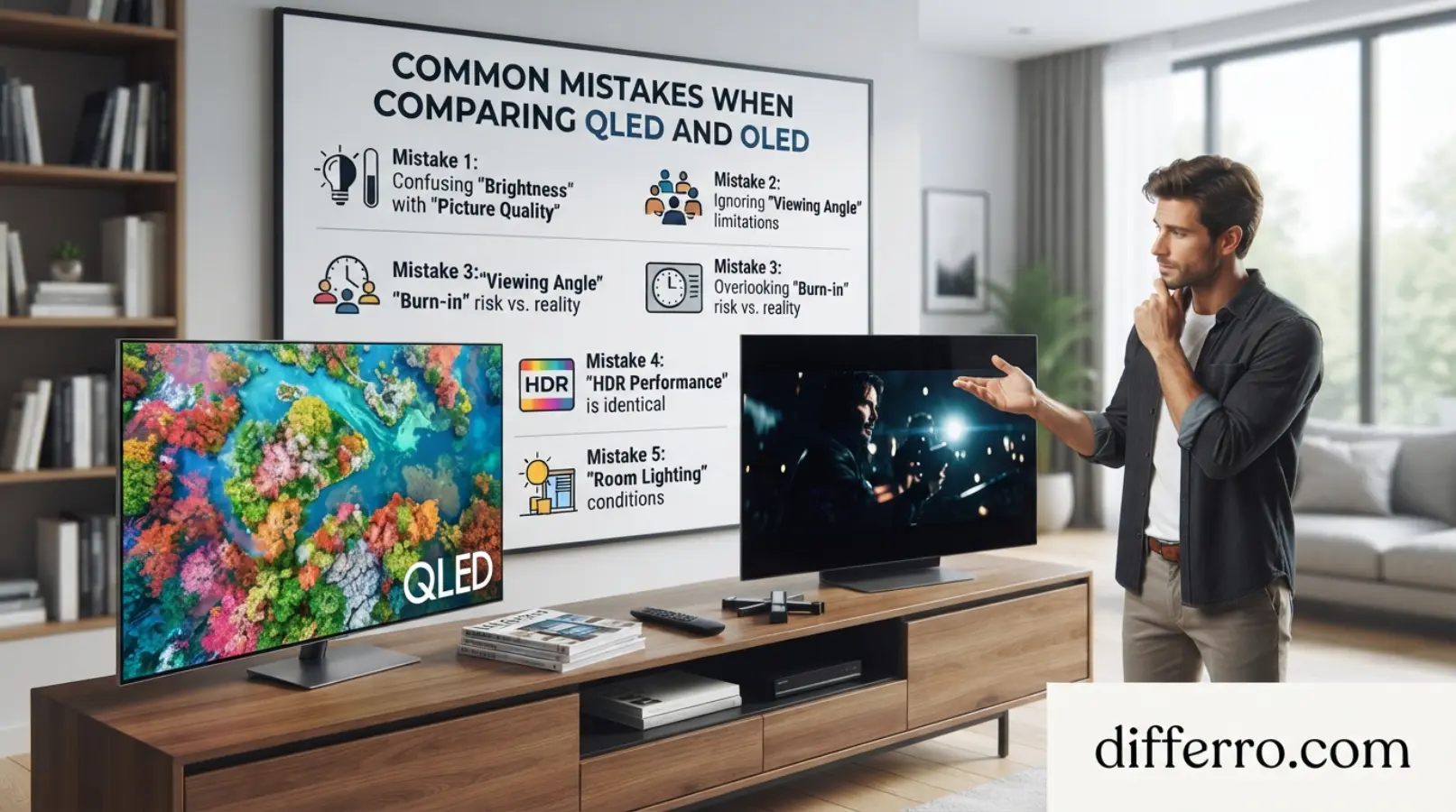
⚠️ Common Mistakes When Comparing QLED and OLED
Mistake 1: Assuming QLED and OLED Use the Same Technology
Incorrect: QLED and OLED both use the same type of self-lit pixels.
Correct: QLED uses an LCD panel with a backlight. OLED uses self-emissive pixels.
Mistake 2: Assuming OLED Always Looks Brighter
Incorrect: Every OLED TV is brighter than every QLED TV.
Correct: Premium QLED and Mini-LED televisions can reach higher brightness levels than many OLED models.
Mistake 3: Assuming Every QLED TV Has Poor Black Levels
Incorrect: QLED televisions cannot produce good contrast.
Correct: Premium QLED models with effective local dimming can deliver excellent contrast, although results vary.
Mistake 4: Believing OLED Always Suffers Burn-In
Incorrect: Every OLED TV develops burn-in quickly.
Correct: Burn-in remains possible, but its risk depends on usage patterns, static content, brightness, and protective features.
Mistake 5: Choosing Only by Brand Name
Incorrect: Every QLED television performs better than every OLED television from another brand.
Correct: Compare specific models, reviews, brightness, contrast, motion handling, and warranty terms.
Mistake 6: Ignoring Room Lighting
Incorrect: The same display technology suits every room equally well.
Correct: Room brightness and screen reflections can significantly affect the viewing experience. Choose a television that suits your environment.
🧠 Easy Trick to Remember
Use this simple memory tip:
- QLED = Quality brightness and colorful viewing. Think of bright rooms, vivid colors, and strong value.
- OLED = Outstanding blacks and contrast. Think of cinematic movies, dark scenes, and precise lighting.
This shortcut helps you remember their strengths. However, individual TV models can produce different results.
🏠 Everyday-Life Examples: What’s Better QLED or OLED?
1. Watching Cricket During the Day
You watch cricket in a bright living room with sunlight coming through the windows.
Better choice: QLED, especially a bright model with good reflection handling.
Related keyword: Best TV for a bright room.
2. Watching Movies at Night
You enjoy films in a dark room and want realistic shadows and deep blacks.
Better choice: OLED, particularly if you value contrast over maximum brightness.
Related keyword: OLED vs QLED picture quality.
3. Playing PlayStation or Xbox
You want responsive gameplay, smooth motion, and strong contrast.
Better choice: OLED can be excellent, but a high-performance QLED or Mini-LED model can also deliver impressive gaming.
Related keyword: Best gaming TV: QLED or OLED.
4. Buying a TV on a Budget
You need a large screen for family entertainment without spending too much.
Better choice: QLED often offers better value, although prices vary by brand and sale.
Related keyword: Affordable QLED vs OLED television.
5. Watching TV All Day
Your household watches news, sports, movies, and regular television channels for many hours.
Better choice: A bright QLED can suit mixed daytime viewing and reduce typical OLED burn-in concerns. An OLED can also work well with varied content and normal care.
Related keyword: QLED or OLED for everyday use.
🌍 Google Trends and Usage Insights: Five Countries
Google Trends reports relative search interest over time, not exact search volume. The following points describe possible search intent, not verified rankings.
- USA: Buyers may compare QLED and OLED picture quality, gaming features, and premium TV prices.
- UK: Searches may focus on television comparisons, energy use, and value for money.
- Australia: Bright-room performance and large-screen options may influence buying decisions.
- India: Price, screen size, smart features, and overall value may attract strong interest.
- Pakistan: Buyers may prioritize affordability, screen size, warranty coverage, and local availability.
SEO insight: These are hypotheses, not confirmed Google Trends results. Compare both keywords in Google Trends for the same date range and country before making numerical claims.
Comparison Table: Keyword Variations
| Keyword variation | Search intent | Suggested content section |
|---|---|---|
| What’s better QLED or OLED | General comparison | Title and introduction |
| QLED vs OLED | Direct comparison | Key differences |
| OLED vs QLED picture quality | Picture quality research | Picture quality |
| QLED vs OLED for gaming | Gaming research | Gaming section |
| QLED or OLED for movies | Movie viewing | OLED advantages |
| Best TV for a bright room | Practical buying advice | QLED advantages |
| QLED vs OLED price | Budget comparison | Price and value |
❓ Frequently Asked Questions
1. Is QLED better than OLED?
QLED can be better for bright rooms, high brightness, and budget-friendly large screens. OLED usually wins for black levels, contrast, and dark-room movie viewing.
2. What is the main difference between QLED and OLED?
QLED uses an LCD panel with LED backlighting and quantum dots. OLED uses self-emissive pixels that can switch off individually.
3. Which is more popular, QLED or OLED?
Popularity varies by country, price range, and sales period. QLED serves a broad range of budgets, while OLED remains popular among buyers seeking premium picture quality. Check current sales data before claiming one technology leads worldwide.
4. Which technology is better for formal presentations and business use?
QLED often suits bright offices, meeting rooms, and displays that show static content for long periods. OLED can work well for premium presentations and controlled lighting. Match the model to your usage, brightness needs, and operating hours.
5. Why do people confuse QLED and OLED?
Both names look similar and describe modern television technologies. Manufacturers also use similar marketing language about color, brightness, and picture quality. Their lighting systems, however, work differently.
🏆 Final Verdict: Which Is Better, QLED or OLED?
OLED is generally the better choice for people who want exceptional contrast, true blacks, and cinematic picture quality. It works especially well for movies, premium streaming, and gaming in controlled lighting.
QLED is often the smarter choice for bright living rooms, daytime sports, and buyers who want a large screen at a competitive price. Premium QLED and Mini-LED models can also deliver excellent picture quality.
Before choosing, compare the actual televisions rather than relying on technology names alone. Consider brightness, reflection handling, refresh rate, local dimming, warranty, and price.
Choose OLED for contrast and cinematic viewing. Choose QLED for brightness and value. Your room, budget, and viewing habits should guide your final decision.
Conclusion
What’s better QLED or OLED depends on how and where you watch television. OLED generally delivers deeper blacks, better contrast, and excellent dark-scene detail. These strengths make it an attractive choice for movie lovers and many gamers.
QLED often provides higher brightness, vivid colors, and better value across large screen sizes. It can suit bright living rooms, sports fans, and households that watch television throughout the day.
Neither technology wins every category. Premium QLED models can compete strongly with OLED, while OLED remains excellent for cinematic viewing. Compare individual models, room lighting, gaming features, and warranty coverage before buying. If you want the best overall movie picture, consider OLED first. If you want a bright, large television for less money, start with QLED.

Imran Lodhra is a comparison-focused content writer at Differro.com.
He specializes in creating clear, simple, and informative comparison articles.
His work helps readers understand key differences, pros and cons, and important details.
Imran focuses on accurate, practical, and easy-to-read content for everyday readers.
1 thought on “QLED vs OLED: Which TV Is Better for You?”