

Pumpkin a fruit or vegetable is a common question about this popular fall food. Many people call pumpkin a vegetable because they cook it in savory dishes. However, botanical science gives a different answer. Pumpkin is technically a fruit because it develops from a flower and contains seeds.
The confusion comes from the difference between scientific and culinary classifications. Botany focuses on how a plant grows and reproduces. Cooking focuses on how people prepare and eat the food.
So, is pumpkin a fruit or vegetable? Pumpkin is a fruit botanically, but people commonly use it as a vegetable in cooking. This guide explains the difference in simple English.
⭐ Quick Answer
Pumpkin is a fruit, not a vegetable, from a botanical perspective. It develops from a flower and contains seeds. However, cooks often treat pumpkin as a vegetable in soups, curries, stews, and side dishes.
Example: A pumpkin used in soup is culinary vegetable food, but the pumpkin itself is botanically a fruit.
🍎 Meaning of Fruit
A fruit is the part of a flowering plant that develops from its flower and contains seeds. Botanists use this definition to classify plant structures.
Pumpkin meets this definition because it grows from the female flower of the pumpkin plant. Its mature flesh surrounds many seeds.
Examples:
- A tomato is botanically a fruit because it develops from a flower.
- A cucumber is also a botanical fruit because it contains seeds and develops from a flower.
🥕 Meaning of Vegetable
A vegetable usually refers to edible plant parts used in cooking. These parts can include roots, leaves, stems, bulbs, and flowers.
Unlike the term fruit, vegetable does not have one strict botanical definition. Culinary traditions use the term based on taste, preparation, and common food habits.
Examples:
- Carrots are vegetables because people eat their roots.
- Spinach is a vegetable because people eat its leaves.
Pumpkin often receives the vegetable label because people commonly cook it in savory meals.
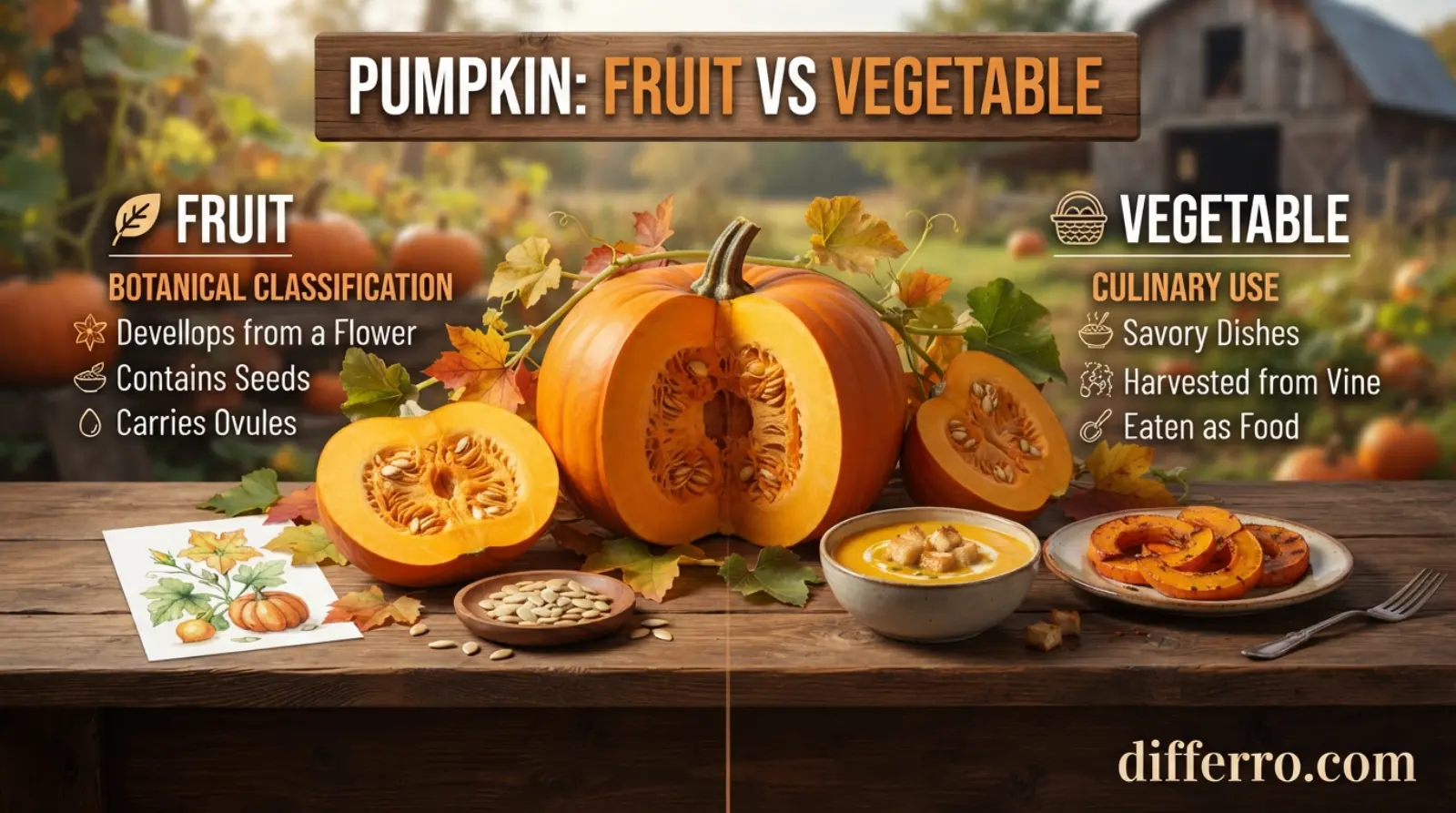
🔍 Pumpkin Fruit vs Vegetable: Key Differences
| Feature | Fruit | Vegetable |
|---|---|---|
| Meaning | Develops from a flower and usually contains seeds | Common culinary term for edible plant parts |
| Pumpkin classification | Pumpkin is botanically a fruit | Pumpkin is commonly treated as a vegetable |
| Main focus | Plant structure and reproduction | Cooking and food use |
| Taste | Can be sweet or savory | Often associated with savory foods |
| Usage | Botanical and scientific | Culinary and everyday |
| Popularity | Less common everyday label for pumpkin | Very common culinary label for pumpkin |
The important point is that fruit and vegetable describe different classification systems. Therefore, both terms can appear when people discuss pumpkin.
🌱 Origin and History
Pumpkins belong to the Cucurbitaceae family, which includes squash, cucumbers, melons, and related plants. Different pumpkin types belong to several Cucurbita species.
The word “pumpkin” does not describe one single botanical species. People use the name for several types of mature squash.
Pumpkins have long been important food crops in North America. Today, people use them for food, decoration, seeds, soups, pies, and many other recipes.
Similar Fruit Examples
Pumpkin is not the only food that creates this confusion. Several foods commonly called vegetables are botanical fruits.
Examples include:
- Tomato
- Cucumber
- Zucchini
- Eggplant
- Bell pepper
- Squash
- Avocado
These foods develop from flowers and contain seeds, so botanists classify them as fruits.
🇬🇧 British English vs 🇺🇸 American English
The terms fruit and vegetable have the same basic meanings in British and American English.
There is no major spelling difference for these words. Both British and American speakers can correctly say that pumpkin is botanically a fruit.
British vs American English Comparison
| Word | British English | American English |
|---|---|---|
| Fruit | fruit | fruit |
| Vegetable | vegetable | vegetable |
| Pumpkin | pumpkin | pumpkin |
| Spelling | Same | Same |
| Classification | Fruit botanically | Fruit botanically |
The main difference appears in food habits and regional usage, not spelling.
🍲 When to Use “Fruit”
Use fruit when discussing pumpkin from a botanical or scientific perspective.
Example 1
Pumpkin is a fruit because it develops from a flower.
Example 2
A pumpkin contains seeds, which supports its botanical classification as a fruit.
Example 3
Scientists classify pumpkin as a fruit rather than a vegetable.
Use this classification when writing about botany, plant science, or biological structures.
🥣 When to Use “Vegetable”
Use vegetable when discussing pumpkin as a food ingredient or cooking item.
Example 1
We added pumpkin to the vegetable soup.
Example 2
Pumpkin works well as a vegetable in savory recipes.
Example 3
Many families cook pumpkin with other vegetables.
This usage does not change pumpkin’s botanical classification. It simply describes how people use it as food.
⚠️ Common Mistakes
Mistake 1: Saying Pumpkin Is Only a Vegetable
Incorrect: Pumpkin is scientifically a vegetable.
Correct: Pumpkin is scientifically a fruit but is commonly used as a vegetable.
Mistake 2: Using Sweetness as the Main Test
Incorrect: Pumpkin must be a vegetable because it is not very sweet.
Correct: Botanical classification depends on how the plant develops, not its sweetness.
Mistake 3: Assuming All Fruits Taste Sweet
Incorrect: Every fruit must taste sweet.
Correct: Botanical fruits can taste sweet, sour, bitter, or savory.
Mistake 4: Thinking Culinary and Botanical Terms Must Match
Incorrect: A food cannot be both a fruit and a vegetable.
Correct: Pumpkin can be a botanical fruit and a culinary vegetable at the same time.
Mistake 5: Confusing Pumpkin With Its Cooking Category
Incorrect: Cooking pumpkin as a vegetable makes it botanically a vegetable.
Correct: Cooking method does not change its botanical classification.
🧠 Easy Trick to Remember
Use this simple rule:
Flower + seeds = think fruit.
Pumpkin develops from a flower and contains seeds. Therefore, remember:
Pumpkin = botanical fruit + culinary vegetable.
You can also remember it with this short phrase:
“Pumpkin grows from a flower, so it is a fruit.”
🎃 Everyday Life Examples
1. Pumpkin Soup
Pumpkin soup shows why people often call pumpkin a vegetable. Cooks prepare it with broth, herbs, onions, and other savory ingredients.
Botanically, however, the pumpkin remains a fruit.
Primary keyword: pumpkin a fruit or vegetable
Secondary keyword: pumpkin fruit or vegetable
2. Pumpkin Pie
Pumpkin pie gives another interesting example. And pumpkin can work in sweet recipes even though many people use it in savory dishes.
Its culinary use does not change its botanical classification.
Primary keyword: pumpkin a fruit or vegetable
Secondary keyword: is pumpkin a fruit
3. Halloween Pumpkin
People often carve pumpkins into jack-o’-lanterns. The fruit contains seeds inside its fleshy structure.
The decorative use does not affect its classification.
Primary keyword: pumpkin a fruit or vegetable
Secondary keyword: is a pumpkin a fruit or vegetable
4. Roasted Pumpkin
Roasted pumpkin often appears beside potatoes, carrots, and other vegetables. This explains why many people naturally call it a vegetable.
From a botanical viewpoint, it remains a fruit.
Primary keyword: pumpkin a fruit or vegetable
Secondary keyword: pumpkin fruit
5. Pumpkin Seeds
Pumpkin seeds provide an obvious clue about the plant’s classification. The seeds develop inside the pumpkin’s fruit.
This structure supports the botanical definition of fruit.
Primary keyword: pumpkin a fruit or vegetable
Secondary keyword: is pumpkin a vegetable
⚖️ Final Verdict
Pumpkin is a fruit botanically.
It develops from a flower and contains seeds. These features place it in the botanical fruit category.
However, pumpkin is commonly treated as a vegetable in cooking. People roast it, add it to soups, use it in curries, and serve it with savory meals. The USDA’s horticultural material also describes pumpkins as fruits while noting their culinary use as vegetables.
So, which answer should you use?
- For science: fruit
- For botany: fruit
- For everyday cooking: vegetable
- For recipes: vegetable
- For the question “What is pumpkin scientifically?”: fruit
Both descriptions can make sense when you understand the context.
📈 Google Trends & Usage Data: USA, UK, Australia, India, Pakistan
Google Trends measures search interest on a relative scale rather than giving exact search counts. Current Google Trends pages are available for markets including the UK, India, Australia, and Pakistan.
Search interest for this topic is strongly connected to seasonal pumpkin interest, especially during the autumn and Halloween period. The question also stays relevant because people frequently confuse botanical and culinary classifications.
Across the USA, UK, Australia, India, and Pakistan, related searches can use different wording, such as “is pumpkin a fruit,” “pumpkin fruit or vegetable,” and “is pumpkin a vegetable.”
The SEO insight is clear: target the exact question “pumpkin a fruit or vegetable” while naturally covering these semantic variations.
Keyword Variations Comparison
| Keyword Variation | Search Intent | SEO Value |
|---|---|---|
| pumpkin a fruit or vegetable | Direct confusion | Very High |
| is pumpkin a fruit or vegetable | Direct question | Very High |
| is a pumpkin a fruit or vegetable | Natural question | High |
| pumpkin fruit or vegetable | Short comparison | High |
| is pumpkin a fruit | Botanical question | High |
| is pumpkin a vegetable | Culinary question | Medium-High |
| why is pumpkin a fruit | Explanation | Medium-High |
| pumpkin botanical classification | Educational | Medium |
❓ FAQ
Is it correct to call pumpkin a fruit?
Yes. It is correct to call pumpkin a fruit in botanical terms. It develops from a flower and contains seeds.
What is the difference between pumpkin as a fruit and vegetable?
Fruit describes pumpkin’s botanical structure. Vegetable describes its common culinary use. These classifications use different systems.
Which is more common, fruit or vegetable?
People commonly treat pumpkin as a vegetable in cooking. However, scientists classify it as a fruit.
Is “fruit” formal usage for pumpkin?
Yes. “Fruit” is the correct formal term when discussing botanical classification. “Vegetable” works well in culinary contexts.
Why does confusion about pumpkin exist?
The confusion comes from the difference between botanical and culinary definitions. Pumpkin tastes and cooks like a vegetable but develops like a fruit.
📝 Conclusion
The answer to pumpkin a fruit or vegetable depends on the classification system you use. Botanically, pumpkin is a fruit because it develops from a flower and contains seeds.
In the kitchen, people commonly treat pumpkin as a vegetable. They use it in soups, curries, roasted dishes, stews, and other savory meals. This culinary usage does not change its scientific classification.
Therefore, both terms can appear in everyday conversation. If you are answering a biology question, choose fruit. If you are discussing cooking, calling pumpkin a vegetable is perfectly natural.
The easiest rule is simple: pumpkin is a botanical fruit that people commonly use as a culinary vegetable.

Imran Lodhra is a comparison-focused content writer at Differro.com.
He specializes in creating clear, simple, and informative comparison articles.
His work helps readers understand key differences, pros and cons, and important details.
Imran focuses on accurate, practical, and easy-to-read content for everyday readers.
1 thought on “Pumpkin Fruit or Vegetable? Here’s the Truth”