

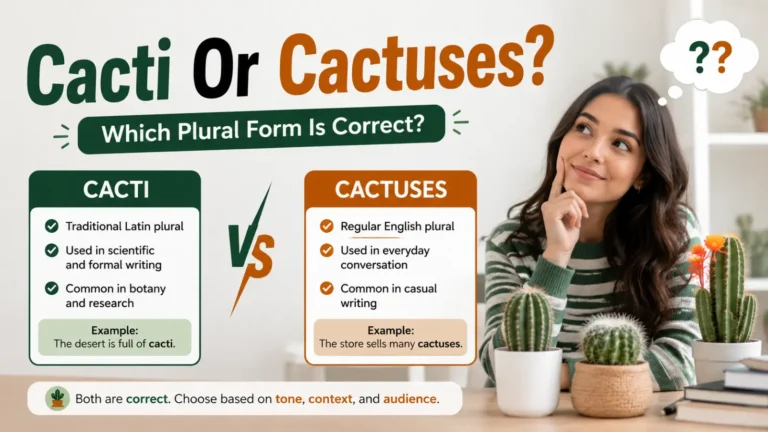
Cacti or Cactuses is a common grammar question that confuses many English speakers. Both words are used as the plural form of “cactus,” but people often wonder which one is correct.
The confusion exists because the word cactus comes from Latin. Many Latin words keep their original plural forms in English. However, modern English also creates regular plurals by adding -es. As a result, both cacti and cactuses appear in dictionaries, books, and everyday conversations.
If you write professionally, study English, or simply want to improve your grammar, understanding the difference between these two forms can help. This guide explains the meanings, history, usage, examples, and common mistakes related to cacti or cactuses in simple language.
⭐ Quick Answer:
Both cacti and cactuses are correct plural forms of cactus.
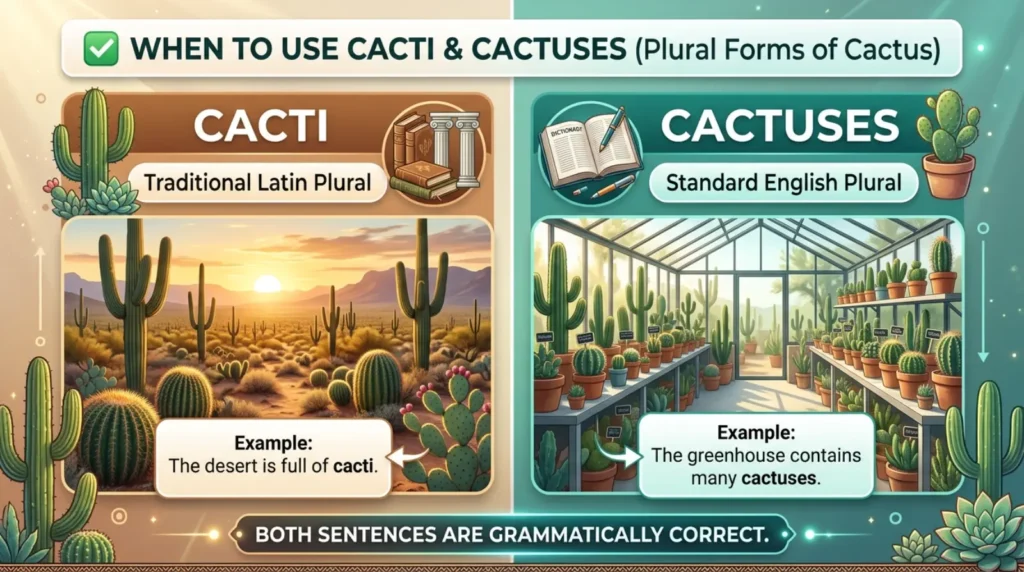
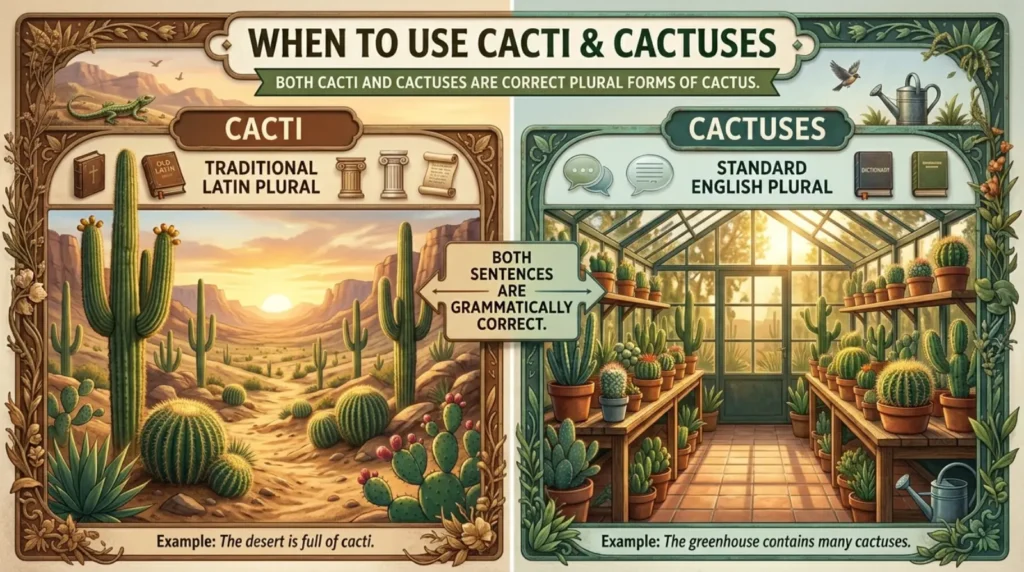
- Cacti is the traditional Latin plural.
- Cactuses is the standard English plural.
Example:
- The desert is full of cacti.
- The greenhouse contains many cactuses.
Both sentences are grammatically correct.
🌵 Meaning of Cacti
Cacti is the Latin plural form of the word cactus.
It is commonly used in scientific, botanical, and formal writing.
Examples:
- Several cacti grow naturally in desert regions.
- The researcher studied rare species of cacti.
🌵 Meaning of Cactuses
Cactuses is the regular English plural form of cactus.
It is common in everyday speech and informal writing.
Examples:
- My garden has three beautiful cactuses.
- The store sells different types of cactuses.
📊 Key Differences Between Cacti and Cactuses
| Feature | Cacti | Cactuses |
|---|---|---|
| Meaning | More than one cactus | More than one cactus |
| Tone | Formal, scientific | Casual, everyday |
| Usage | Academic and botanical contexts | General English |
| Popularity | Common in science | Common in conversation |
| Origin | Latin plural | English plural |
| Correctness | Correct | Correct |
📜 Origin & History
The word cactus comes from Latin, which borrowed it from ancient Greek.
In Latin grammar, many words ending in -us form plurals with -i. This created the plural cacti.
As English evolved, speakers began applying normal English plural rules. This led to the form cactuses.
Similar Examples
| Singular | Latin Plural | English Plural |
|---|---|---|
| Fungus | Fungi | Funguses |
| Radius | Radii | Radiuses |
| Cactus | Cacti | Cactuses |
| Focus | Foci | Focuses |
🇬🇧 British English vs American English Spelling
Unlike words such as colour/color or centre/center, cacti and cactuses are not a British-versus-American spelling difference.
Both forms are accepted in the UK and the US.
The choice depends more on style and context than location.
Comparison Table: British vs American English
| Usage Area | British English | American English |
|---|---|---|
| Formal Writing | Cacti preferred | Cacti preferred |
| Everyday Writing | Cactuses accepted | Cactuses accepted |
| Scientific Writing | Cacti common | Cacti common |
| Casual Speech | Both used | Both used |
✅ When to Use Cacti
Use cacti when:
- Writing scientific papers
- Discussing botany
- Using formal language
- Following traditional Latin forms
Examples
- The collection includes rare desert cacti.
- Scientists examined the growth of several cacti species.
✅ When to Use Cactuses
Use cactuses when:
- Writing casually
- Speaking in everyday situations
- Creating content for general audiences
- Teaching beginner English learners
Examples
- I bought two small cactuses today.
- These cactuses need very little water.
❌ Common Mistakes
Mistake 1
Incorrect: I saw many cactus in the garden.
Correct: I saw many cacti in the garden.
Correct: I saw many cactuses in the garden.
Mistake 2
Incorrect: The cacti is growing well.
Correct: The cacti are growing well.
Mistake 3
Incorrect: One cacti was damaged.
Correct: One cactus was damaged.
Mistake 4
Incorrect: These cactuses need sunlight.
Correct: These cactuses need sunlight.
🧠 Easy Trick to Remember
Think of it this way:
- Cacti = Latin style
- Cactuses = English style
If the writing feels formal or scientific, choose cacti.
If the writing feels casual, choose cactuses.
✍️ Write 5 Examples
Example 1: At a Garden Center
The shop displayed dozens of cacti near the entrance.
Example 2: Home Decoration
My living room contains three colorful cactuses.
Example 3: Science Class
Students learned how desert cacti survive drought.
Example 4: Plant Shopping
I purchased two new cactuses for my office desk.
Example 5: Nature Documentary
The film showed giant cacti growing in harsh climates.
🌎 Google Trends & Usage Data Insight
Across English-speaking countries, cacti generally receives more search interest than cactuses.
The scientific community strongly favors cacti, which increases its visibility online.
However, cactuses still appears frequently in everyday searches and educational content.
Both terms remain widely understood worldwide.
Comparison Table: Keyword Variations
| Country | Cacti | Cactuses |
|---|---|---|
| USA | More Popular | Less Popular |
| UK | More Popular | Less Popular |
| Australia | More Popular | Less Popular |
| India | More Popular | Less Popular |
| Pakistan | More Popular | Less Popular |
⚖️ Final Verdict
Both cacti and cactuses are correct.
Choose cacti for scientific, academic, and formal writing.
Choose cactuses for casual conversations and general content.
If you are unsure, cacti is slightly more common and widely accepted across different contexts.
❓ FAQ
Is cacti correct?
Yes. Cacti is the traditional Latin plural of cactus.
What is the difference between cacti and cactuses?
There is no difference in meaning. The difference is mainly style and origin.
Which is more common: cacti or cactuses?
Cacti is generally more common, especially in formal and scientific writing.
Which form should I use in formal writing?
Use cacti in most formal, academic, and botanical contexts.
Why does the confusion exist?
The confusion exists because English accepts both the Latin plural (cacti) and the regular English plural (cactuses).
📝 Conclusion
Cacti or cactuses is a grammar question with a simple answer: both forms are correct. The word cacti follows traditional Latin grammar, while cactuses follows modern English grammar rules. Neither form is wrong, and both appear in respected dictionaries. In scientific and formal writing, cacti is usually preferred because it sounds more traditional and professional. In everyday speech and casual writing, cactuses feels natural and easy to understand. Knowing the difference helps you choose the right word for your audience. Whether you write cacti or cactuses, readers will understand that you are talking about more than one cactus.

