

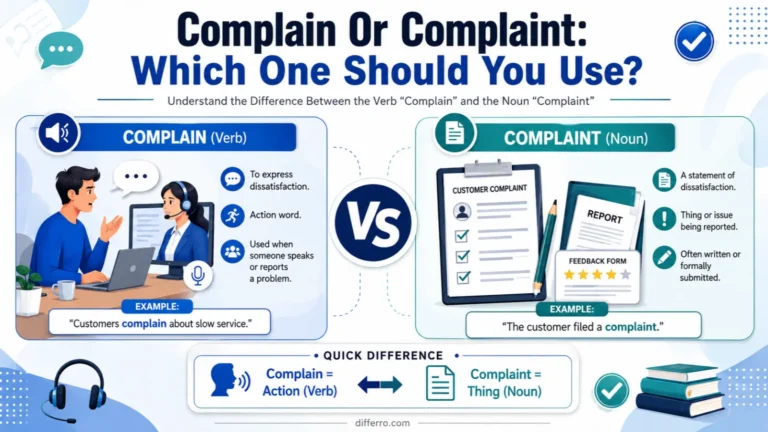
Complain Or Complaint is a common English grammar confusion that many learners face. Both words look similar and come from the same root, but they have different uses in a sentence.
Many people ask whether they should use complain or complaint in formal writing, emails, customer service conversations, or everyday speech. Using the wrong word can make a sentence sound incorrect and unprofessional.
The good news is that the difference is simple. One word is an action, while the other is a thing. Once you understand this basic rule, you will never confuse them again.
In this guide, you’ll learn the meaning of each word, key differences, common mistakes, examples, usage trends, and an easy trick to remember the correct choice.
⭐ Quick Answer
Complain is a verb that means to express dissatisfaction.
Complaint is a noun that refers to the statement or issue being reported.
Example:
✅ I want to complain about the poor service.
✅ I filed a complaint about the poor service.
Meaning of Complain
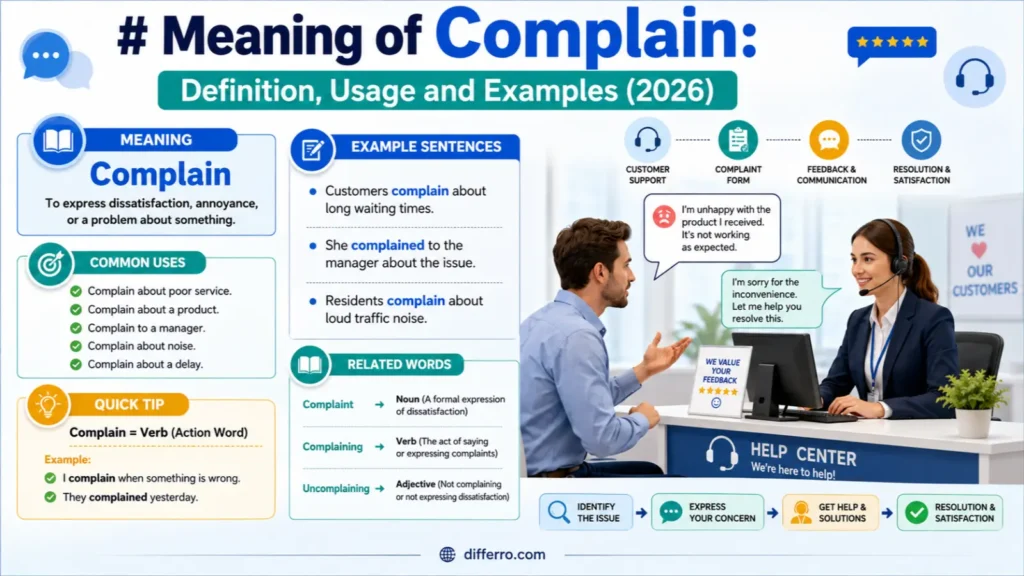
Complain is a verb. It means to express unhappiness, dissatisfaction, or annoyance about something.
Examples
- She likes to complain about the weather.
- Customers often complain when delivery is late.
Meaning of Complaint
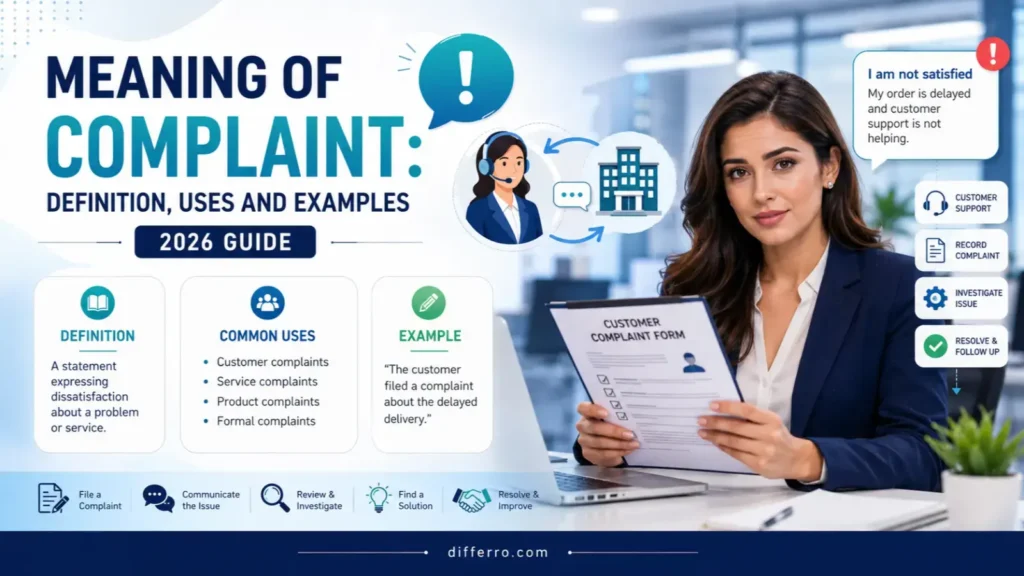
Complaint is a noun. It refers to the problem, concern, or statement made when someone complains.
Examples
- The manager received a complaint from a customer.
- I submitted a complaint about the damaged product.
Key Differences Between Complain and Complaint
| Feature | Complain | Complaint |
|---|---|---|
| Word Type | Verb | Noun |
| Meaning | To express dissatisfaction | A statement of dissatisfaction |
| Tone | Action-oriented | Issue-oriented |
| Usage | Speaking or acting | Referring to the issue |
| Popularity | Common in conversation | Common in formal writing |
📜 Origin & History
Both words come from the Latin word complangere, meaning “to lament” or “express grief.”
Over time, English developed two forms:
- Complain (verb)
- Complaint (noun)
Similar Examples
- Decide → Decision
- Explain → Explanation
- Apply → Application
- Respond → Response
These pairs follow the same pattern of action and result.
🇬🇧 British English vs American English Spelling
Unlike many English words, complain and complaint have the same spelling in British and American English.
The meaning and usage also remain identical in both versions of English.
Only pronunciation may vary slightly depending on accent.
Comparison Table: British vs American English
| Feature | British English | American English |
| Complain | Complain | Complain |
| Complaint | Complaint | Complaint |
| Meaning | Same | Same |
| Usage | Same | Same |
When to Use Complain
Use complain when talking about the action of expressing dissatisfaction.
Examples
- I want to complain about the noise.
- They complain every week.
- Customers complain when products arrive late.
- She complained to the hotel manager.
When to Use Complaint
Use complaint when referring to the actual issue or report.
Examples
- The company received a complaint.
- My complaint was resolved quickly.
- He submitted a written complaint.
- The complaint reached the customer service department.
❌ Common Mistakes
Mistake 1
Incorrect: I want to complaint about the service.
Correct: I want to complain about the service.
Mistake 2
Incorrect: She filed a complain yesterday.
Correct: She filed a complaint yesterday.
Mistake 3
Incorrect: The manager received many complain.
Correct: The manager received many complaints.
Mistake 4
Incorrect: I made a complain against the company.
Correct: I made a complaint against the company.
🧠 Easy Trick to Remember
Remember this simple rule:
- Complain = Action
- Complaint = Thing
Think of it this way:
You complain to make a complaint.
This memory trick works every time.
Write 5 Examples
Example 1: Customer Service
I want to complain about my delayed order.
The company accepted my complaint.
Example 2: Restaurant Visit
Customers often complain about slow service.
The manager reviewed the complaint immediately.
Example 3: Workplace Issue
Employees may complain about unfair policies.
HR investigates each complaint carefully.
Example 4: School Environment
Parents sometimes complain about safety concerns.
The school responded to the complaint.
Example 5: Online Shopping
Shoppers frequently complain about damaged products.
The seller resolved the complaint quickly.
🔍 Related Keywords
- complain vs complaint
- complaint meaning
- complain meaning
- complain or complaint difference
- complain grammar
- complaint examples
- when to use complaint
🌍 Google Trends & Usage Data
The keyword Complain Or Complaint receives interest from English learners worldwide. Search demand is especially strong in countries where English is used for education, business, and professional communication.
Country Insights
🇺🇸 USA
Users often search for grammar clarification and professional writing help.
🇬🇧 UK
Searches focus on formal complaint letters and business communication.
🇦🇺 Australia
Many users seek workplace and customer service usage examples.
🇮🇳 India
High search volume comes from students and competitive exam preparation.
🇵🇰 Pakistan
English learners frequently search for verb and noun differences.
Insight
Most searches occur because both words look similar but belong to different parts of speech. Understanding verb versus noun usage removes the confusion instantly.
Comparison Table: Keyword Variations
| Keyword Variation | Search Intent |
| complain or complaint | Grammar confusion |
| complain vs complaint | Comparison |
| complaint meaning | Definition |
| complain meaning | Definition |
| difference between complain and complaint | Educational |
| how to use complaint | Usage |
| how to use complain | Usage |
✅ Final Verdict
Neither word is better than the other.
Use complain when talking about the action of expressing dissatisfaction.
Use complaint when referring to the report, issue, or concern itself.
Quick Rule
- I want to complain.
- I filed a complaint.
Frequently Asked Questions
1. Is it correct to say “I want to complaint”?
No. The correct sentence is:
I want to complain.
2. What is the difference between complain and complaint?
Complain is a verb.
Complaint is a noun.
3. Which is more common, complain or complaint?
Both are common. Their usage depends on sentence structure.
4. Which word is used in formal writing?
Complaint appears more often in formal documents because it refers to an official report.
5. Why does confusion exist between complain and complaint?
They share the same root word and similar spelling, causing many learners to mix them up.
Conclusion
The confusion between Complain Or Complaint becomes easy to solve once you know the grammar rule. Complain is a verb that describes the action of expressing dissatisfaction. Complaint is a noun that refers to the issue or report itself. Both words are correct, but they serve different purposes in a sentence.
Whenever you talk about taking action, use complain. Whenever you mention the issue, use complaint. Remember the simple formula: You complain to make a complaint. This quick trick helps you choose the correct word in everyday conversations, professional emails, academic writing, and customer service situations.
Mastering this distinction will improve your English accuracy and confidence.

