

Ms or Mrs is one of the most common grammar and title-related questions in English. Many people feel confused about which title to use, especially in formal writing, emails, forms, and professional communication.
Both Ms. and Mrs. are respectful titles used before a woman’s name. However, they are not used in the same way. The main difference is that one title refers to marital status while the other does not.
Understanding when to use Ms or Mrs helps you communicate professionally and avoid mistakes. Whether you are writing a letter, filling out a form, or addressing someone at work, choosing the correct title matters.
This guide explains the meanings, differences, history, usage rules, examples, and common mistakes related to Ms or Mrs in simple English.
⭐ Quick Answer
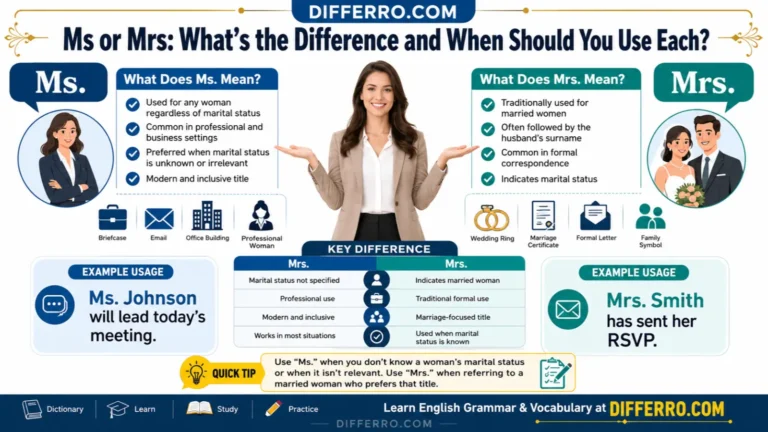
Ms. is used for a woman regardless of her marital status. Mrs. is used for a married woman.
Example:
- Ms. Sarah Johnson works as a lawyer.
- Mrs. Sarah Johnson is married.
Meaning of Ms
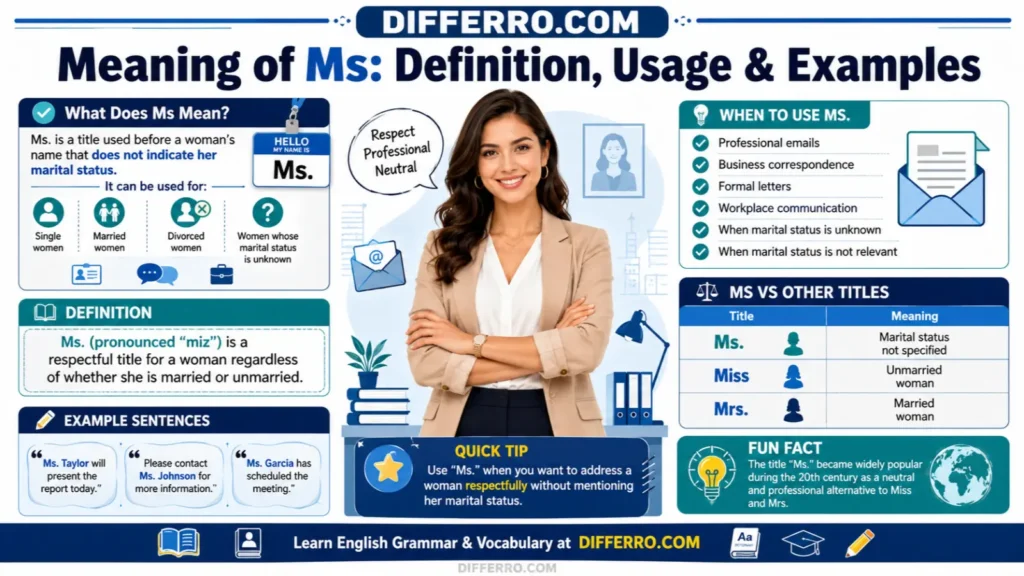
Ms. is a title used before a woman’s name without indicating whether she is married or unmarried.
Examples
- Ms. Taylor will lead today’s meeting.
- Please contact Ms. Roberts for assistance.
Meaning of Mrs
Mrs. is a title used before the name of a married woman.
Examples
- Mrs. Wilson teaches mathematics.
- We invited Mrs. Brown to the event.
Key Differences Between Ms and Mrs
| Feature | Ms | Mrs |
|---|---|---|
| Meaning | Woman of any marital status | Married woman |
| Tone | Neutral and professional | Traditional and personal |
| Usage | Business, workplace, formal writing | Marriage-related and traditional settings |
| Popularity | Increasing globally | Still common but less universal |
Origin & History
The title Mrs. originated from the word Mistress, which was historically used for adult women. Over time, it became associated with married women.
Ms. gained popularity in the 20th century as women sought a title that did not reveal marital status. Today, it is widely accepted in professional and formal communication.
Similar Word Examples
- Miss
- Mr.
- Madam
- Mistress
British English vs American English Spelling
The usage of Ms and Mrs is generally the same in British and American English. The main difference is punctuation style.
American English often uses periods after titles, while British English commonly omits them.
British vs American English
| British English | American English |
|---|---|
| Ms Smith | Ms. Smith |
| Mrs Brown | Mrs. Brown |
| Mr Jones | Mr. Jones |
| Dr Wilson | Dr. Wilson |
When to Use Ms
Use Ms when:
- Marital status is unknown
- Marital status is irrelevant
- Writing professionally
- Addressing women in business settings
Examples
- Ms. Adams submitted the report.
- Thank you, Ms. Parker, for your support.
- Ms. Green will attend the conference.
When to Use Mrs
Use Mrs when:
- The woman is married
- She prefers the title Mrs
- Traditional etiquette applies
Examples
- Mrs. Clark hosted the event.
- Mrs. Anderson will speak first.
- We appreciate Mrs. Miller’s contribution.
Common Mistakes
Mistake 1
❌ Mrs. Emma Lee (not married)
✅ Ms. Emma Lee
Mistake 2
❌ Assuming every adult woman is Mrs.
✅ Use Ms. when unsure.
Mistake 3
❌ Using Miss instead of Ms. in professional emails
✅ Use Ms. unless another preference is known.
Mistake 4
❌ Asking marital status before choosing a title
✅ Use Ms. as a neutral option.
Easy Trick to Remember
Think of Ms as meaning “Marital Status Unknown.”
Think of Mrs as meaning “Married Woman.”
This simple memory trick helps you choose the correct title quickly.
Write 5 Examples
Example 1: Workplace Email
Dear Ms. Johnson, thank you for your message.
Example 2: School Communication
Mrs. Roberts attended the parent-teacher meeting.
Example 3: Job Application
Please contact Ms. Taylor regarding recruitment.
Example 4: Wedding Invitation
We are pleased to invite Mrs. Smith to our ceremony.
Example 5: Customer Service
Ms. Ahmed requested additional information about the service.
Related Keywords
- Ms vs Mrs
- Difference between Ms and Mrs
- Ms meaning
- Mrs meaning
- Miss vs Ms vs Mrs
- When to use Ms
- When to use Mrs
Final Verdict
Neither Ms nor Mrs is better in every situation.
- Use Ms when marital status does not matter or is unknown.
- Use Mrs when referring to a married woman who prefers that title.
In modern professional communication, Ms is usually the safest and most widely accepted choice.
Google Trends & Usage Data
Interest in Ms has increased across many countries because workplaces prefer neutral titles. Mrs remains popular in traditional and family-related contexts. Professional communication increasingly favors Ms. Both titles remain widely recognized worldwide.
Usage Insight by Country
| Country | Ms Usage | Mrs Usage |
|---|---|---|
| USA | Very High | High |
| UK | High | High |
| Australia | High | Moderate |
| India | Growing Fast | High |
| Pakistan | Growing | High |
Comparison Table: Keyword Variations
| Keyword Variation | Search Intent |
|---|---|
| Ms or Mrs | Comparison |
| Ms vs Mrs | Difference |
| Meaning of Ms | Definition |
| Meaning of Mrs | Definition |
| When to use Ms | Usage |
| When to use Mrs | Usage |
| Miss vs Ms vs Mrs | Comparison |
Frequently Asked Questions
1. Is it correct to use Ms instead of Mrs?
Yes. Ms is correct regardless of marital status and is widely accepted.
2. What is the difference between Ms and Mrs?
Ms does not indicate marital status, while Mrs is used for married women.
3. Which is more common today?
Ms is more common in professional and formal communication.
4. Is Mrs more formal than Ms?
Not necessarily. Both are formal, but Ms is more neutral.
5. Why does the confusion exist?
The confusion exists because both titles refer to women, but one indicates marriage and the other does not.
Conclusion
Understanding Ms or Mrs is important for professional and everyday communication. The main difference is simple: Ms can be used for any woman regardless of marital status, while Mrs is specifically for married women. Modern workplaces, schools, and organizations often prefer Ms because it is neutral and respectful.
When you do not know a woman’s marital status, choosing Ms is usually the best option. However, if a woman prefers Mrs, that preference should always be respected. By learning these basic rules, you can address people correctly, avoid awkward mistakes, and communicate with confidence in both personal and professional situations.

