
More Or Less is a common English phrase. Many people use it in daily speech and writing. Still, learners often feel confused about its meaning and proper usage.
Some think it means “approximately.” Others use it to compare quantities. The phrase can also suggest uncertainty. That is why understanding the context matters.
In English, small phrases can change meaning based on tone and sentence structure. This phrase is one such expression. It appears in conversations, business writing, school work, and media.
This guide explains the meaning of these two how to use it correctly, common mistakes, and its popularity in different countries. You will also learn easy memory tricks and real-life examples.
⭐ Quick Answer
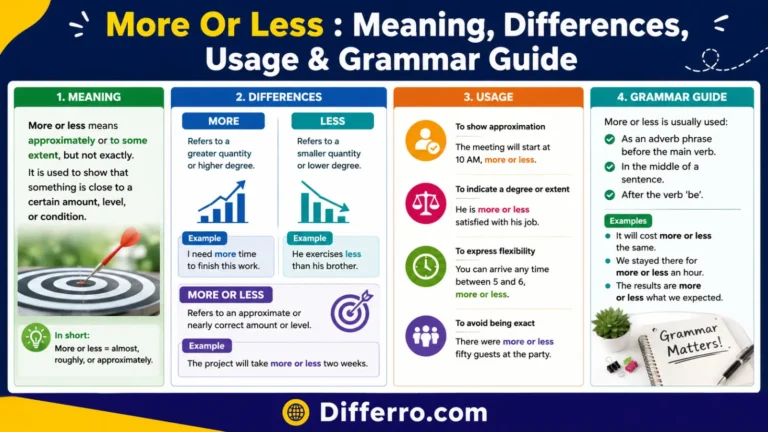
Both words means “approximately” or “almost.” It can also mean “to some degree.”
Example:
- “The project is more or less complete.”
- “There were more or less 100 people at the event.”
📖 Meaning of More
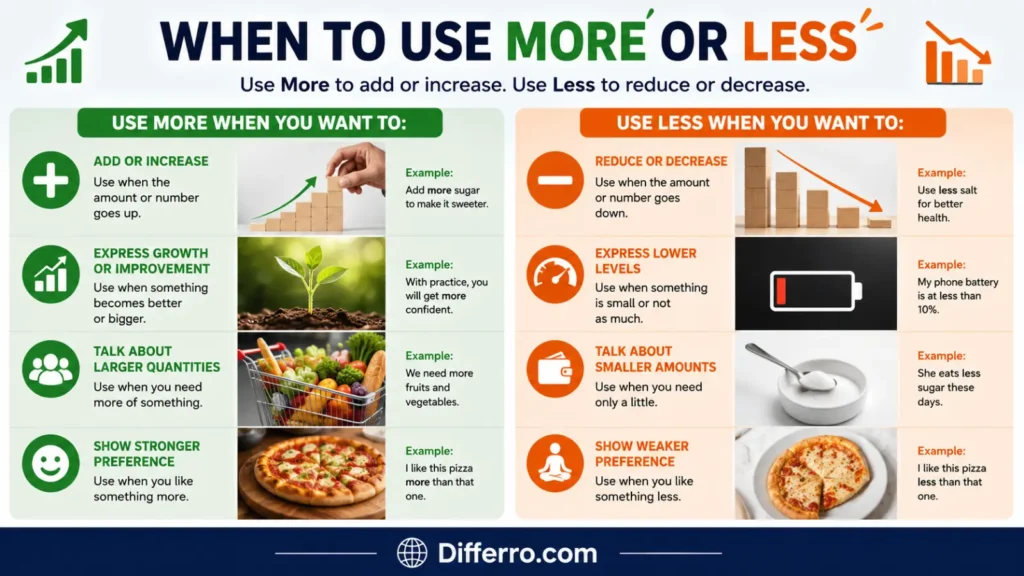
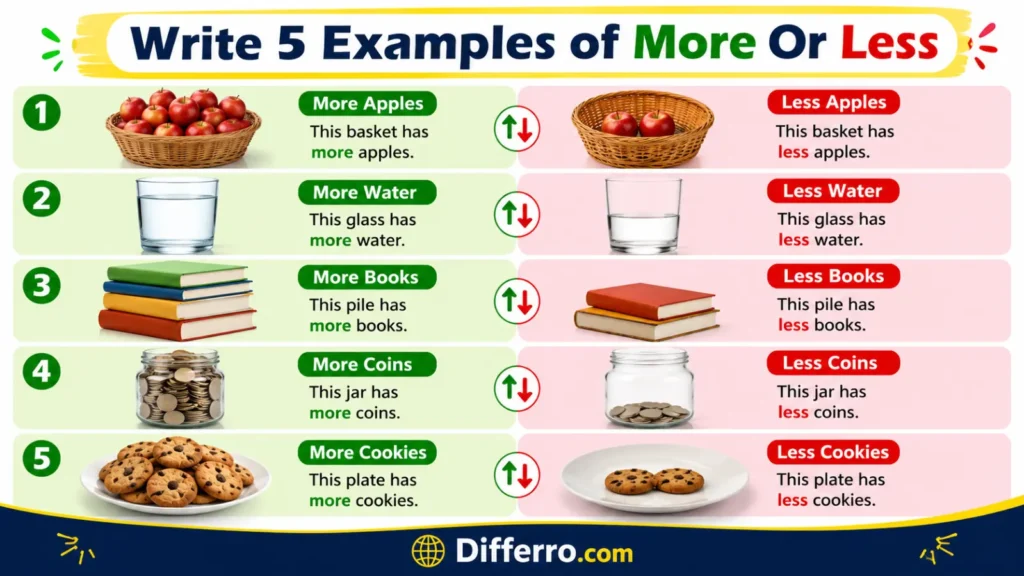
The word more means a greater amount, number, or degree.
Examples:
- “I need more time to finish my work.”
- “She wants more coffee.”
📖 Meaning of Less
The word less means a smaller amount or lower degree.
Examples:
- “We have less sugar at home.”
- “He spends less money now.”
📊 Key Differences Table
| Feature | More | Less |
|---|---|---|
| Meaning | Greater amount | Smaller amount |
| Tone | Positive increase | Negative decrease |
| Usage | Adding quantity | Reducing quantity |
| Popularity | Very common | Very common |
🕰️ Origin & History
This phrase entered English many centuries ago. Writers used it to describe estimates or uncertain amounts.
It became popular because it sounds natural and flexible in conversation.
Similar phrases include:
- “Approximately”
- “Roughly”
- “Almost”
- “About”
🇬🇧 British English vs 🇺🇸 American English Spelling
Both British and American English use this phrase in the same way. There is no spelling difference. However, British speakers may use it more casually in conversation.
Comparison Table: British vs American English
| Feature | British English | American English |
|---|---|---|
| Spelling | More or less | More or less |
| Usage Style | Slightly conversational | Common in speech and writing |
| Meaning | Same | Same |
✍️ When to Use both words
Use this phrase for Approximation
Use it when the number or result is not exact.
Examples:
- “The trip costs more or less $500.”
- “More or less 50 students attended.”
Use this phrase for Partial Truth
Use it when something is mostly true but not completely.
Examples:
- “The task is more or less finished.”
- “His explanation was more or less correct.”
❌ Common Mistakes
| Incorrect Usage | Correct Usage |
|---|---|
| “More less finished” | “More or less finished” |
| “It costed more or less” | “It cost more or less” |
| “More or lesser” | “More or less” |
| “She is less more happy” | “She is more or less happy” |
🧠 Easy Trick to Remember
Think of little extra as “close enough.”
- More = a little extra
- Less = a little lower
Together, they mean “approximately” or “almost.”
🏡 Write 5 Examples
1. Daily Conversation
“We are ready for the trip.”
2. Office Work
“The report is complete.”
3. Shopping
“The groceries cost about $100.”
4. Education
“The answer is correct.”
5. Travel Planning
“The drive takes two hours.”
🔍 Related Keywords
- Related Keywords
- meaning of approximately
- examples of almost
- synonym for nearly
- how to use approximately
- almost in a sentence
- definition of roughly
- approximately vs almost
🌍 Google Trends & Usage Data
The phrase remains popular worldwide. English speakers use it often in daily communication.
In the USA and UK, it appears commonly in casual speech. Australia also shows steady usage. India and Pakistan use it frequently in education and business English.
Search interest rises during grammar learning and IELTS preparation periods.
Comparison Table: Keyword Variations
| Country | Popular Variation |
|---|---|
| USA | more or less meaning |
| UK | more or less phrase |
| AUS | more or less usage |
| IND | more or less examples |
| PAK | more or less in English |
⚖️ Final Verdict
Both words is correct and widely accepted in English.
Use it when:
- You want to show approximation
- Something is nearly complete
- The amount is not exact
It works well in both formal and informal English. The phrase sounds natural and easy to understand.
FAQs ,
1. Is this phrase correct?
Yes. It is a correct English phrase.
2. What is the difference between “more” and “less”?
“More” means a greater amount. “Less” means a smaller amount.
3. Which is more common?
The phrase is very common in spoken English.
4. Can I use this phrase in formal writing?
Yes, but use it carefully in academic or business writing.
5. Why does confusion exist?
People confuse it because the phrase has multiple meanings based on context.
📝 Conclusion
More Or Less is a useful English phrase that means “approximately” and “almost.” It helps speakers describe uncertain amounts, partial truth, or estimated results. The phrase is simple, natural, and common in daily English.
Understanding its meaning improves both speaking and writing skills. It also helps English learners sound more fluent and confident.
Use this phrase when exact details are unnecessary. Avoid grammar mistakes by keeping the full phrase together.
With practice, you will easily recognize when and how to use it correctly in real conversations and writing.
Discover More Post ,
Whisky or Whiskey Explained Simply
Traveling or Travelling : Which Spelling Is Correct?
Sell Or Sale : What’s the Real Difference?

Sara Taylor is a passionate writer and language enthusiast. She specializes in creating simple and easy-to-understand articles about English grammar, spelling differences, and commonly confused words. Her writing style focuses on helping students, writers, and English learners improve their language skills with confidence. Through informative guides and practical examples, Sara makes complex grammar topics easier for everyday readers.