
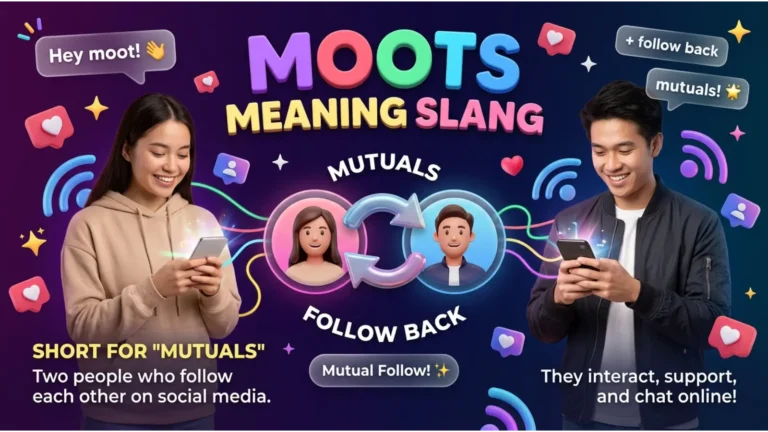
Moots meaning slang is a common search for people who spend time on social media platforms like TikTok, X (formerly Twitter), Instagram, and Tumblr.
If you have seen someone write “my moots,” “mutuals,” or “looking for moots” in a post or comment, you might wonder what they are talking about.
This term is especially popular in online communities where people connect with others who share similar interests, hobbies, fandoms, or opinions.
Understanding internet slang can make online conversations easier and help you feel more comfortable interacting with other users. The good news is that “moots” is generally friendly and simple to understand.
However, its exact meaning can depend on the platform and the conversation. In this guide, you will learn what the word means, where it comes from, how people use it, and how to respond when someone calls you their moot.
Quick Answer:
Moots is internet slang for mutual followers—people who follow each other on social media. For example, if you follow someone and they follow you back, you may call each other moots.
What Does Moots Mean in Text?
The word moots is a shortened form of mutuals, which refers to people who follow one another on social media.
Imagine you follow a person on TikTok, and that person follows your account in return. You are mutual followers. In some online communities, especially fandoms, users casually call each other “moots.”
People often use the term to build friendships, start conversations, and identify members of the same online community.
Here are a few examples:
- “My moots are so funny.” — The people who follow the user back are entertaining.
- “Any moots online?” — The user wants to interact with mutual followers.
- “I love my moots!” — The user appreciates their online connections.
- “We became moots yesterday.” — Two people followed each other recently.
In most social media conversations, the term is informal, friendly, and community-focused.
Moots Full Form and Definition
If you are searching for the moots full form, the most common internet meaning is connected to the phrase mutual followers.
Strictly speaking, “moots” is not an official acronym. It is a shortened slang term that developed from “mutuals.”
Here is a simple breakdown:
| Term | Meaning |
|---|---|
| Moots | Mutual followers on social media |
| Mutuals | People who follow each other |
| Follower | Someone who follows an account |
| Following | Accounts that a person chooses to follow |
For example, you might follow a creator who does not follow you back. That person is your follower or someone you follow, depending on the direction of the connection, but they are not necessarily your moot.
When both accounts follow each other, they can be described as mutuals or moots.
Moots Meaning in Different Contexts
The meaning of “moots” stays mostly the same across social platforms, but people use it in different ways.
1. Moots Meaning on TikTok
On TikTok, users may ask for moots when they want to make new online friends or connect with people who enjoy similar content.
Example:
“Any anime moots here?”
This means the person wants to connect with mutual followers who enjoy anime.
2. Moots Meaning on Twitter or X
On X, the word is particularly common in fandoms, fan accounts, and online communities.
Example:
“Good morning to all my moots!”
The user is greeting the people who follow them back and with whom they share an online connection.
3. Moots Meaning on Instagram
Instagram users may use “moots” when discussing mutual followers, particularly in comments, Stories, or direct messages.
Example:
“Let’s be moots!”
This usually means the person wants to follow each other and potentially interact more often.
4. Moots Meaning on Tumblr
Tumblr has long supported online communities built around fandoms, art, writing, and shared interests. Users may call their mutual followers “moots” as a casual way to describe those connections.
Across these platforms, the exact relationship can vary. Some users use “moots” for anyone who follows them back, while others reserve it for mutual followers they regularly interact with.
Is Moots Rude, Offensive, or Neutral?
Generally, moots is neutral and friendly slang. It is not normally considered rude, vulgar, or offensive.
People use it to describe social media connections without needing to write the longer phrase “mutual followers.”
For example:
- Friendly: “My moots always make me laugh.”
- Casual: “I need more moots who love gaming.”
- Welcoming: “New moots, feel free to say hi!”
However, the tone of a sentence can change how the term feels. Someone might use it sarcastically when talking about an online disagreement, but the word itself is not usually insulting.
It is also worth remembering that being mutual followers does not automatically mean two people are close friends. Their relationship depends on how they interact and what they choose to share.
Where Is Moots Commonly Used?
The term appears most often in online spaces where users follow each other and interact regularly.
Common places include:
- TikTok comments and captions
- X posts and replies
- Instagram Stories and direct messages
- Tumblr fandom communities
- Fan pages and entertainment communities
- Gaming communities and online friendship groups
- Posts looking for people with similar interests
The term is especially popular among users who participate in fandoms, such as communities dedicated to musicians, actors, television shows, anime, or video games.
It is less common in formal communication. You would usually say “mutual followers” rather than “moots” in a professional email, business report, or academic paper.
Real-Life Conversation Examples of Moots
The easiest way to understand the moots meaning slang is to see how people use it in everyday online conversations.
Friendly Conversations
Example 1
Person A: “I love your art posts!”
Person B: “Thank you! Let’s be moots.”
Meaning: Person B wants to follow each other and connect on social media.
Example 2
Person A: “My moots are the sweetest people.”
Person B: “Aww, that’s so nice!”
Meaning: The person appreciates their mutual followers.
Casual Conversations
Example 3
Person A: “Any gaming moots here?”
Person B: “I play Minecraft!”
Meaning: The person is looking for mutual followers who enjoy gaming.
Example 4
Person A: “I just made three new moots.”
Person B: “Nice! How did you meet them?”
Meaning: The person has connected with three new mutual followers.
Argumentative Conversations
Example 5
Person A: “Why are your moots arguing in the comments?”
Person B: “I have no idea. I didn’t start it.”
Meaning: The first person is referring to the other person’s mutual followers.
Example 6
Person A: “One of my moots disagreed with my post.”
Person B: “That’s normal. People don’t always share the same opinions.”
Meaning: One of the person’s mutual followers expressed a different opinion.
These examples show that the term identifies a social connection. It does not automatically communicate a positive or negative emotion.
Emotional and Psychological Meaning of Moots
Although “moots” has a straightforward definition, it can also reflect the social side of internet culture.
People often use the term because it makes online interactions feel more personal. Instead of describing someone as just another follower, calling them a moot can suggest that they belong to a shared online circle.
The term may help users:
- Feel included in a community.
- Find people with similar interests.
- Start conversations with strangers.
- Build friendships around hobbies or fandoms.
- Recognize familiar names in comments and replies.
However, mutual following does not necessarily indicate a close emotional bond. Some moots may chat every day, while others simply follow each other without interacting much.
It is best to view the term as a description of an online connection rather than proof of a real-life friendship.
Origin and Background of Moots
The slang term “moots” developed from “mutuals,” a word used in online communities to describe people who follow each other.
As social media platforms grew, users began shortening common expressions to make posts, replies, and messages quicker to write. “Moots” became one of the casual expressions used to describe mutual followers.
The term became especially visible in fandom communities, where users often interact through fan art, edits, discussions, and shared interests.
The word “moot” also has an older, unrelated meaning in standard English. Depending on context, it can refer to a subject open to debate or something that is no longer practically relevant. In legal education, a moot court is a simulated court proceeding.
These meanings are different from the social media slang meaning. When someone says “my moots” in an online fandom conversation, they are usually talking about mutual followers, not a debate or a legal exercise.
Moots vs. Mutuals vs. Followers
Several social media terms sound similar, but they do not always mean the same thing.
| Term | Meaning | Example |
|---|---|---|
| Moots | Mutual followers, often used casually | “My moots love this show.” |
| Mutuals | People who follow each other | “We are mutuals on X.” |
| Followers | People who follow an account | “I gained 100 followers.” |
| Besties | Close friends, sometimes used playfully online | “My besties are amazing.” |
| Online friends | People who have developed a friendship online | “I met my online friends through gaming.” |
The key difference is that followers do not have to follow you back. Moots usually implies a mutual following relationship.
Also, “besties” and “online friends” describe a relationship rather than simply a following arrangement.
When to Use Moots and When to Avoid It
You can use “moots” when talking casually with people who understand social media slang.
It works well in:
- Fandom posts
- Casual comments
- Direct messages
- Friendly conversations
- Community-building posts
- Discussions about online followers
For example, “Looking for new booktok moots” is a natural way to say you want to connect with mutual followers who enjoy book-related content.
Avoid using the term in formal or professional situations where your audience may not recognize it.
Instead of writing “Our brand has many moots,” you could write “Our brand has many mutual followers on social media.”
You should also avoid assuming that every mutual follower wants a close friendship. Respect people’s boundaries, privacy, and preferred level of interaction.
Why Do People Use Moots?
People use “moots” because it is short, easy to understand within online communities, and more casual than “mutual followers.”
The term can make conversations feel welcoming and help users identify people with shared interests.
It also saves space in short posts and comments. Rather than writing a full explanation, someone can simply ask, “Any new moots?”
In fandom communities, it can create a sense of belonging. Users may recognize each other’s usernames, discuss favorite characters, share edits, or react to each other’s posts.
However, not every moot is necessarily a friend. Sometimes the connection is limited to following each other.
Common Misunderstandings About Moots
People who are new to internet slang can misunderstand the word for several reasons.
1. Thinking it is an acronym: Moots is generally a shortened form of “mutuals,” not an official initialism.
2. Assuming it means best friends: Moots usually means mutual followers. The people involved may or may not be close.
3. Confusing it with the dictionary meaning: The slang meaning is different from the standard English word “moot.”
4. Thinking it is an insult: The term is usually neutral or friendly, not offensive.
5. Assuming a follow means a friendship: Two users can follow each other without regularly talking or knowing much about one another.
Understanding these differences helps you interpret online messages more accurately.
Variations and Types of Moots
People may combine “moots” with words that describe their interests or online communities.
Examples include:
- Anime moots: Mutual followers who enjoy anime.
- Gaming moots: Mutual followers who enjoy video games.
- Book moots: Mutual followers who enjoy reading and discussing books.
- Fandom moots: Mutual followers who share an interest in a celebrity, show, artist, or fictional character.
- New moots: Recently established mutual-following connections.
These phrases are informal descriptions rather than official categories. Their meaning depends on the community using them.
How to Respond When Someone Uses Moots
Your response depends on the situation and whether you want to connect with the person.
Here are a few natural replies:
- If someone asks to be moots: “Sure, let’s connect!”
- If someone says hello to their moots: “Hey! Hope you’re doing well.”
- If someone asks for gaming moots: “I love gaming too. What do you play?”
- If someone says you are mutuals: “Yes, I’ve seen your posts!”
- If you are unsure what they mean: “Do you mean mutual followers?”
You do not need to use slang yourself to participate in the conversation. A simple, friendly response works perfectly well.
Regional and Cultural Usage of Moots
“Moots” is primarily associated with internet culture, so its use is shaped more by online communities than by geographical location.
English-speaking users in the United States, United Kingdom, Canada, Australia, Pakistan, and other countries may encounter the term on social platforms.
However, not everyone uses or recognizes it. Someone who rarely participates in fandom communities may be unfamiliar with the expression, even if they use social media every day.
Its popularity also varies by platform, age group, and community. It is particularly recognizable in some fandom spaces, but it is not universal internet slang.
Is Moots Safe to Use on Social Media?
Yes. The term itself is generally harmless and does not contain offensive language.
You can use it in captions, posts, comments, and direct messages when the context is casual.
Still, remember that online connections require basic privacy and safety practices. A mutual follower is not automatically a trusted person, and you do not have to share private information simply because someone follows you back.
Keep personal details private, respect boundaries, and block or report users who harass you.
The word is safe to use, but your overall online behavior and the people you interact with matter more than the slang itself.
Frequently Asked Questions
1. What does moots mean in slang?
Moots is slang for mutual followers on social media. It usually describes two users who follow each other.
2. What does moots mean on TikTok?
On TikTok, moots usually refers to people who follow each other. Users may ask for moots to connect with others who share their interests.
3. What does moots stand for?
Moots is commonly understood as a shortened form of “mutuals.” It is associated with the phrase “mutual followers” rather than being an official acronym.
4. Is moots the same as friends?
Not necessarily. Moots are mutual followers, but they may not know each other personally. Some become close friends, while others only interact occasionally.
5. Is calling someone a moot rude?
Usually not. The term is generally friendly or neutral. The tone of the surrounding conversation determines whether it is being used positively or negatively.
6. How do I become moots with someone?
You can follow someone and interact respectfully with their content. If they follow you back, you may become mutual followers. However, never pressure anyone to follow you.
Conclusion
Understanding moots meaning slang is simple once you know that the word usually refers to mutual followers on social media. It is commonly used on TikTok, X, Instagram, Tumblr, and other online platforms where people connect through shared interests.
The term is generally friendly and informal. People use it to find online communities, make connections, and talk about followers who follow them back. However, being moots does not automatically mean being close friends.
When you see phrases such as “my moots,” “new moots,” or “looking for moots,” consider the context to understand the intended meaning. Use the word freely in casual online conversations, but choose clearer language in professional settings.
Once you understand this internet slang, you can follow online discussions more confidently and recognize when someone is talking about their mutual followers.
Ali Raza is an M.Phil. scholar and English language expert specializing in English grammar, slang meanings, vocabulary, and everyday expressions. He writes clear, practical, and easy-to-understand content that helps readers master confusing English words, phrases, spelling, and modern slang. His goal is to make English learning simple, useful, and accessible for students, beginners, and everyday readers.
3 thoughts on “Moots Meaning Slang: What Does Moots Mean in Text?”