
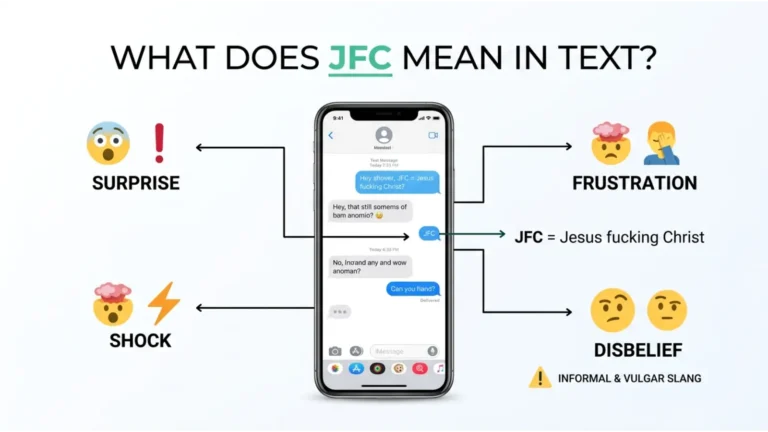
JFC meaning in text can be confusing if you see it in a text message, comment, meme, or social media post for the first time. Unlike many harmless internet abbreviations, JFC contains profanity, so understanding its meaning and tone is important before using it.
People commonly use JFC to express strong surprise, frustration, disbelief, annoyance, or shock. Its meaning can change slightly depending on the conversation and the person’s tone. You may see it when someone reacts to unexpected news, an irritating situation, or something they find unbelievable.
In this guide, you’ll learn the JFC full form, JFC meaning slang, common examples, emotional tone, origins, appropriate usage, alternatives, and how to respond when someone uses it.
Quick Answer
JFC is a slang abbreviation commonly used to mean “Jesus fucking Christ.” It is an exclamation used to express strong surprise, frustration, anger, disbelief, or shock. Because it contains profanity and a religious reference, it may be inappropriate in formal or professional situations.
What Does JFC Mean in Text?
JFC is an internet and texting abbreviation for “Jesus fucking Christ.”
In casual communication, it usually does not refer literally to the religious figure. Instead, people use it as an emotional exclamation.
For example:
“JFC, that was expensive!”
Here, the person is expressing strong surprise or frustration about the price.
Another example is:
“JFC, I can’t believe that happened.”
The speaker is showing disbelief or shock.
The exact emotion depends on the context, punctuation, and relationship between the people communicating.
JFC Full Form and Definition
The JFC full form is “Jesus fucking Christ.”
It combines a religious reference with an offensive intensifier. The word beginning with “f” makes the expression vulgar, so JFC is generally considered profanity.
The abbreviation is often used because typing three letters feels quicker and less explicit than writing the entire expression.
What Does JFC Stand For?
If you’re wondering what does JFC stand for, it stands for:
J — Jesus
F — fucking
C — Christ
The abbreviation is mainly used as an emotional reaction rather than as a literal statement.
JFC Meaning in Different Contexts
JFC can communicate different emotions depending on the situation.
Surprise
Someone might use JFC after hearing unexpected news.
Example:
“JFC, you actually bought the car?”
Here, the expression shows strong surprise.
Frustration
It can also communicate annoyance.
Example:
“JFC, this computer keeps freezing.”
The speaker is frustrated with the situation.
Disbelief
JFC may express that something seems difficult to believe.
Example:
“JFC, did they really say that?”
Shock
It can also be used after seeing something shocking or unexpected.
Example:
“JFC, look at that damage!”
Annoyance
Sometimes JFC simply intensifies irritation.
Example:
“JFC, why is this taking so long?”
Is JFC Rude, Offensive, or Neutral?
JFC is generally considered vulgar or offensive slang.
The profanity makes it unsuitable for many formal situations. The religious reference can also make the expression uncomfortable or offensive to some people.
Its acceptability depends on the audience and context.
Usually acceptable in casual settings
- Private conversations with close friends
- Informal texting
- Some online communities
- Casual social media conversations
- Memes and humorous posts
Better avoided in formal settings
- Job interviews
- Professional emails
- Academic assignments
- Workplace communication
- Customer service conversations
- Formal presentations
- Communication with people you do not know well
Even when friends use JFC casually, that does not mean everyone will find it appropriate.
Where Is JFC Commonly Used?
JFC is especially common in texting, social media, online conversations, memes, gaming communities, and informal chats.
People often use abbreviations online because they make emotional reactions quick and easy to type.
For example:
“JFC 😂 that was unexpected.”
The emoji can make the message appear more humorous, although the underlying expression is still vulgar.
JFC Meaning in Social Media
On platforms such as social networks, JFC can appear in comments, captions, replies, and direct messages.
A person might write:
“JFC, this video is wild.”
The writer is expressing strong surprise or amusement.
However, social media audiences can be mixed. A post intended for close friends may be seen by teachers, employers, family members, or professional contacts.
Therefore, think about your audience before using profanity.
Real-Life JFC Conversation Examples
Friendly Conversation
Alex: “I just finished the entire project in one night.”
Sam: “JFC, how did you manage that?”
Here, JFC expresses surprise.
Casual Conversation
Mia: “The concert tickets cost $300.”
Leo: “JFC, that’s expensive!”
Here, it expresses shock about the price.
Argumentative Conversation
Person 1: “You forgot the appointment again.”
Person 2: “JFC, I said I was sorry.”
In this situation, JFC can intensify frustration.
Online Conversation
User 1: “Did you see the ending?”
User 2: “JFC! I did not expect that.”
The abbreviation expresses shock and disbelief.
Emotional and Psychological Meaning of JFC
JFC does not have one fixed emotional meaning.
It often works as an emotional intensifier. In other words, it makes the speaker’s reaction sound stronger.
Depending on context, it may communicate:
- Surprise
- Frustration
- Anger
- Shock
- Disbelief
- Exasperation
- Amazement
The same abbreviation can therefore sound funny in one conversation and aggressive in another.
Tone is especially important because text messages do not include voice or facial expressions.
Origin and Background of JFC
JFC comes from the phrase “Jesus fucking Christ,” which has been used as an exclamation in English.
The abbreviated form became especially visible in internet culture, texting, forums, social media, and other forms of digital communication.
As online communication became more abbreviation-heavy, users began shortening longer expressions into initials or acronyms.
JFC is now recognizable to many English-speaking internet users, although familiarity does not make it formal or universally acceptable.
JFC vs Similar Slang Terms
JFC is similar to several other expressions used to communicate strong emotions.
| Slang | Common meaning | Tone |
|---|---|---|
| JFC | Strong surprise, frustration, shock, or disbelief | Vulgar |
| OMG | Surprise, excitement, or shock | Usually mild |
| WTF | Confusion, anger, surprise, or disbelief | Vulgar |
| WTH | What the heck/hell; surprise or confusion | Mild to moderate |
| Jeez | Annoyance, surprise, or disbelief | Mild |
| Wow | Surprise or admiration | Neutral |
Among these, OMG and wow are generally safer choices for wider audiences.
When Should You Avoid Using JFC?
Avoid JFC when you are communicating with someone who may dislike profanity or when the situation requires professionalism.
You should generally avoid it in:
- Business emails
- Schoolwork
- Formal applications
- Professional presentations
- Interviews
- Official documents
- Customer communications
It is also wise to avoid it when you are unsure how the other person feels about profanity.
Polite Alternatives to JFC
If you want to express surprise or frustration without profanity, try:
- “Oh my gosh!”
- “Oh wow!”
- “Seriously?”
- “Goodness!”
- “I can’t believe it!”
- “Wow, that’s surprising!”
- “That’s unbelievable!”
- “What happened?”
These alternatives communicate a similar emotional reaction without the profanity in JFC.
Why Do People Use JFC?
People use JFC because it is short, expressive, and emotionally powerful.
Common reasons include:
- Quick communication: Three letters are faster to type.
- Strong emotion: It conveys a powerful reaction.
- Internet culture: Online communities frequently use abbreviations.
- Informal tone: It fits casual conversations.
- Humor: Sometimes it is deliberately exaggerated for comedic effect.
Impact of Using JFC in Communication
Using JFC can make a message sound more emotional, casual, or intense.
However, it can also create misunderstandings.
For example, someone may intend JFC humorously, while the reader interprets it as anger. This happens because written communication lacks vocal tone and facial expressions.
Context, punctuation, emojis, and the relationship between speakers can help clarify the intended meaning.
Is JFC Safe for Social Media?
JFC is commonly seen on social media, but “safe” depends on what you mean by safe.
It is not inherently a dangerous expression, but it contains profanity and may be considered offensive by some audiences.
If you’re posting publicly, consider:
- Your audience
- The platform’s rules
- Your personal or professional image
- Whether children may see the content
- Whether the religious reference could offend someone
For professional or family-friendly content, a milder alternative is usually more appropriate.
Common Misunderstandings About JFC
One common misunderstanding is assuming that JFC always expresses anger.
It doesn’t.
Someone can use JFC to show surprise, disbelief, amusement, frustration, or shock.
Another misunderstanding is thinking that everyone interprets it the same way. Slang varies between communities, age groups, cultures, and individual speakers.
The surrounding sentence is therefore important when interpreting JFC.
Variations and Types of JFC Usage
JFC may appear in different forms online.
JFC!
Used as a standalone emotional reaction.
JFC, seriously?
Used to express frustration or disbelief.
JFC 😂
Often suggests humorous surprise or disbelief.
Oh JFC
Can express exasperation or annoyance.
The punctuation and surrounding words can change the perceived tone.
How to Respond When Someone Uses JFC
Your response depends on the situation.
If a friend says:
“JFC, that was crazy!”
You could respond:
“I know! I wasn’t expecting it either.”
If someone uses JFC angrily, you may want to keep your response calm rather than matching their tone.
If you are unsure what they mean, simply ask:
“What happened?”
You don’t need to use JFC yourself to understand the conversation.
Regional and Cultural Usage
JFC is primarily associated with informal English-language communication, particularly online.
However, its interpretation can vary across cultures. Some people may see it as ordinary internet profanity, while others may consider the religious reference especially disrespectful.
English learners should therefore avoid assuming that every English speaker considers JFC harmless.
Understanding the audience is just as important as understanding the dictionary meaning.
FAQs About JFC Meaning Slang
What does JFC mean in text?
JFC commonly means “Jesus fucking Christ.” It is an informal and vulgar expression used to show surprise, frustration, shock, or disbelief.
What does JFC stand for?
JFC stands for “Jesus fucking Christ.” It is commonly used as an emotional exclamation rather than a literal religious statement.
Is JFC a bad word?
JFC contains profanity, so it is generally considered vulgar or offensive. It is better avoided in formal and professional communication.
Is JFC the same as WTF?
They can express similar emotions, such as surprise, frustration, or disbelief, but they are different expressions. Both contain profanity.
Can I use JFC with friends?
You can encounter it in casual conversations between friends, but whether you should use it depends on your friends’ comfort with profanity.
What is a polite alternative to JFC?
Polite alternatives include “Oh my gosh,” “Oh wow,” “Seriously?” “Goodness,” and “I can’t believe it!”
Conclusion
JFC meaning slang refers to the abbreviation for “Jesus fucking Christ,” a vulgar expression commonly used to show strong surprise, frustration, disbelief, shock, or annoyance.
Its meaning is heavily influenced by context and tone. While JFC is common in texting, social media, memes, and informal conversations, it is not suitable for most professional or formal situations because it contains profanity and a religious reference.
If you are unsure about your audience, safer alternatives such as “Oh wow,” “Seriously?” or “I can’t believe it!” can communicate a similar reaction without using offensive language.

Ali Raza is an M.Phil. scholar and English language expert specializing in English grammar, slang meanings, vocabulary, and everyday expressions. He writes clear, practical, and easy-to-understand content that helps readers master confusing English words, phrases, spelling, and modern slang. His goal is to make English learning simple, useful, and accessible for students, beginners, and everyday readers.
1 thought on “JFC Meaning in Text: What Does JFC Mean in Slang?”