
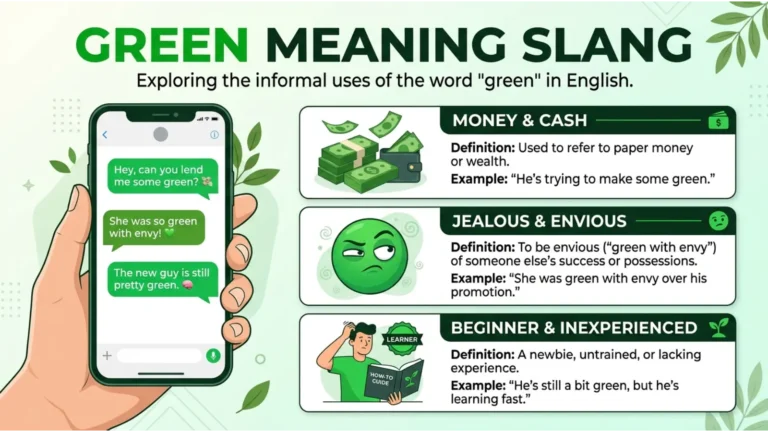
Green meaning slang can be confusing when you see the word in a text message, TikTok comment, Instagram caption, or online conversation. Although green is a color, it has several meanings in everyday English and internet slang.
Someone might use it to talk about money, describe a jealous person, or explain that someone lacks experience. In certain conversations, green can also refer to cannabis or environmental awareness.
For example, “He’s still green at his job” means he is inexperienced, while “I’m green with envy” means someone feels jealous. These different meanings make context especially important when interpreting messages.
If you have seen green in a chat and are unsure what the sender means, understanding its common uses can help you avoid confusion and respond naturally.
Quick Answer:
Green meaning slang depends on context. It can mean money, jealousy, inexperience, or cannabis, while in other situations it refers to nature and environmentally friendly choices.
What Does Green Mean in Text?
In text messages, green is a word with several slang and figurative meanings. Unlike abbreviations such as LOL or BRB, green is a complete English word rather than an acronym.
The most common meanings include:
- Money: Cash or financial success.
- Jealousy: Envy, especially in the expression green with envy.
- Inexperience: Being new to a job, activity, or situation.
- Cannabis: Marijuana in certain conversations.
- Environmental awareness: Supporting nature and eco-friendly practices.
For example, if someone texts, “I’m trying to make some green,” they probably mean they want to earn money. If they say, “I’m still green at driving,” they mean they are inexperienced.
The surrounding conversation usually reveals which definition makes the most sense.
Green Full Form and Definition
Many people search for the green full form because they assume it is a texting abbreviation. However, green does not have one official full form in slang.
Instead, it is a regular word that has developed several meanings over time.
| Meaning | Definition | Example |
|---|---|---|
| Money | Cash or wealth | “I need to earn more green.” |
| Jealousy | Feeling envious | “She’s green with envy.” |
| Inexperience | Being new or unskilled | “He’s still green at work.” |
| Cannabis | Marijuana in certain contexts | “They were talking about green.” |
| Environmental awareness | Protecting the environment | “Our company is going green.” |
Not every use of green is slang. It can also refer to the actual color, plants, traffic lights, or other things.
Green Meaning Slang in Different Contexts
1. Green Meaning Money
In informal American English, green can mean money because U.S. paper currency is traditionally associated with green ink.
People may use it when discussing earnings, financial goals, business, or spending.
Examples:
- “I’m working overtime to make some green.”
- “That business brings in serious green.”
- “I saved my green for a new laptop.”
In these examples, green means cash or money. This usage is casual and is generally better suited to informal conversations than formal financial writing.
2. Green Meaning Jealousy
Green is strongly associated with jealousy through the expression “green with envy.”
People use this phrase when someone wishes they had another person’s possessions, achievements, opportunities, or experiences.
Examples:
- “I’m green with envy over her vacation.”
- “He’s green with envy because his friend got a new car.”
- “Don’t be green just because someone else succeeded.”
The expression can be playful or serious, depending on the situation.
3. Green Meaning Inexperienced
Green can describe someone who is new to a job, skill, or activity.
Examples:
- “I’m still green at public speaking.”
- “The new employee is a little green.”
- “She’s green when it comes to managing a business.”
This meaning does not always carry a negative tone. Someone may use it simply to explain that they need more practice.
However, calling another person green can sound insulting if you use it to question their ability or intelligence.
4. Green Meaning Cannabis
In some slang conversations, green refers to cannabis, also called marijuana or weed. This meaning is connected partly to the plant’s appearance.
For example:
- “They were talking about green.”
- “He used green as a nickname for cannabis.”
This interpretation depends heavily on context. If the conversation is about gardening, money, or environmental protection, the word may have an entirely different meaning.
5. Green Meaning Environmentally Friendly
Green is widely used to describe activities that protect the environment.
Common expressions include:
- “Let’s go green.”
- “The company is becoming greener.”
- “Choose green products whenever possible.”
These phrases relate to recycling, reducing waste, conserving energy, and making sustainable choices. Although this usage is not necessarily slang, it is important when understanding the word in everyday communication.
Is Green Rude, Offensive, or Neutral?
Green is generally a neutral word. Whether it sounds rude depends on the intended meaning and how the speaker uses it.
- Friendly: “Let’s go green and recycle more.”
- Casual: “I’m saving my green for a vacation.”
- Playful: “You’re green with envy!”
- Potentially insulting: “You’re too green to understand this job.”
Calling someone inexperienced may sound dismissive, especially in a professional setting. Similarly, using green to refer to cannabis may not be appropriate in every workplace or family conversation.
The word itself is not usually offensive, but the surrounding message can change how people interpret it.
Where Is Green Commonly Used?
Green appears in many types of communication.
- Text messages: Talking about money, jealousy, or experience.
- TikTok and Instagram: Captions, jokes, trends, and comments.
- Snapchat: Informal conversations among friends.
- Gaming communities: Discussing beginners, currency, or game-specific concepts.
- Workplace conversations: Describing an inexperienced employee.
- Environmental discussions: Talking about sustainability and conservation.
The meaning can differ between communities. For example, a word used in a gaming chat may have a specific meaning that does not apply to a conversation about money.
Real Life Conversation Examples of Green
Here are examples showing how green can be used in friendly, casual, and argumentative conversations.
Friendly Examples
Example 1:
Friend A: “She got tickets to her favorite concert!”
Friend B: “I’m green with envy!”
Meaning: Friend B wishes they could attend the concert too.
Example 2:
Friend A: “Have you tried this new software?”
Friend B: “No, I’m still pretty green.”
Meaning: Friend B is unfamiliar with the software.
Casual Examples
Example 3:
Person A: “How are you paying for that new phone?”
Person B: “I’ve been saving my green.”
Meaning: Person B has been saving money.
Example 4:
Person A: “We’re switching to reusable shopping bags.”
Person B: “Nice! Let’s go green.”
Meaning: They are discussing environmentally friendly habits.
Argumentative Examples
Example 5:
Person A: “You don’t know how this business works.”
Person B: “I’m new, but I can learn.”
Meaning: The conversation concerns experience, and the first person is being dismissive.
Example 6:
Person A: “You’re just jealous because he got promoted.”
Person B: “I’m not green with envy. I disagree with his decision.”
Meaning: The speakers are arguing about whether jealousy is affecting someone’s opinion.
Emotional and Psychological Meaning of Green
Green can carry emotional meaning because colors often have symbolic associations in language and culture.
The phrase “green with envy” describes jealousy, which can arise when people compare their achievements, relationships, possessions, or opportunities with those of others.
Calling someone green can suggest that they are still learning or gaining confidence.
Green can also symbolize growth, freshness, hope, and renewal. These associations vary across cultures and situations, so they should not be treated as universal psychological rules.
For example, saying “I’m green at public speaking” can acknowledge limited experience without suggesting that someone is incapable of improving.
Origin and Background of Green Slang
Green has been used figuratively in English for centuries.
The expression “green with envy” developed from historical associations between green and the physical appearance of jealousy or illness in older literary traditions. The phrase eventually became an established way to describe envy.
Green also came to describe inexperienced people. This usage is often associated with youth, freshness, and a lack of development or experience.
The meaning related to money is particularly familiar in American English because U.S. paper currency is traditionally green.
Meanwhile, the environmental meaning grew from the association between green plants, nature, and conservation.
Social media continues to spread these expressions, but green itself is not a newly invented internet abbreviation.
Green vs. Similar Slang Terms
Several words have meanings similar to green in particular contexts, but they are not always interchangeable.
| Term | Meaning | Main difference |
|---|---|---|
| Green | Money, jealousy, or inexperience, depending on context | Has several meanings |
| Cash | Physical or available money | Directly refers to money |
| Bread | Slang for money | Informal financial expression |
| Jealous | Feeling unhappy about another person’s advantage | Directly describes an emotion |
| Inexperienced | Lacking experience or practice | More neutral and precise |
| Newbie | Someone new to an activity | Often used in gaming and online communities |
| Weed | Cannabis | More explicit than the ambiguous word green |
Choose the word that communicates your intended meaning most clearly. For example, cash is clearer than green in a financial discussion, while inexperienced may sound more professional than green in a workplace conversation.
When to Use Green and When to Avoid It
When to Use Green
Use green when:
- You are chatting casually with friends.
- The meaning is clear from the surrounding conversation.
- You are describing someone who is new to an activity.
- You are discussing money in an informal setting.
- You are talking about jealousy or environmental awareness.
When to Avoid Green
Avoid using it without clarification when:
- You are writing a formal business email.
- The audience may misunderstand the intended meaning.
- You are discussing a sensitive disagreement.
- The topic involves cannabis and your audience may interpret the word differently.
- You need to describe someone’s qualifications professionally.
For example, instead of saying “He’s too green for this position” in a formal evaluation, you could say, “He is still developing the experience needed for this role.”
Polite Alternatives to Green
Green is not inherently offensive, but some alternatives can make your message clearer or more respectful.
- For money: Cash, earnings, funds, or income.
- For jealousy: Envious or feeling jealous.
- For inexperience: New to the role, inexperienced, or still learning.
- For environmental awareness: Eco-friendly or environmentally responsible.
- For cannabis: Use the specific term when it is appropriate and relevant to the discussion.
For example, “She’s still learning the job” sounds more constructive than “She’s green.”
Why Do People Use Green Slang?
People use green because it is short, familiar, and flexible. It allows them to communicate ideas without always using formal language.
Common reasons include:
- Convenience: One word can express a familiar idea.
- Informal communication: It fits casual chats and social media.
- Humor: Expressions such as “green with envy” can make conversations playful.
- Group identity: Certain communities develop their own slang meanings.
- Cultural familiarity: Many green expressions have been used for generations.
However, slang works best when the other person understands the intended meaning.
Impact of Using Green in Communication
Using green can make informal communication sound natural and concise. It can also create confusion because the word has several meanings.
For example, “I need more green” might mean someone wants more money, but a reader unfamiliar with the expression could interpret it differently.
The best approach is to consider your audience and provide extra context when necessary.
In professional or sensitive situations, direct language is often more effective than slang because it reduces the chance of misunderstanding.
Is Green Safe for Social Media?
Yes. Green is generally safe to use on social media because it is an ordinary word without an inherently offensive meaning.
It can appear in captions, comments, direct messages, and online discussions. However, its meaning may vary according to the topic.
For example, green in an environmental campaign has a different meaning from green in a discussion about jealousy or cannabis.
Before posting, consider your audience and make sure your message cannot easily be misunderstood. The word itself is usually harmless, but context still matters.
Common Misunderstandings About Green
Misunderstanding 1: Green always means money.
No. It can also refer to jealousy, inexperience, cannabis, or environmental awareness.
Misunderstanding 2: Green is an abbreviation.
No. Green is a complete English word, not an acronym with an official full form.
Misunderstanding 3: Green always means jealousy.
No. Jealousy is one meaning, especially in the expression “green with envy.”
Misunderstanding 4: Calling someone green is always insulting.
Not necessarily. It can simply mean that someone is new or inexperienced, although the tone may sound critical.
Misunderstanding 5: Green only has slang meanings online.
No. Green is also used in everyday speech, literature, business, and environmental discussions.
Variations and Types of Green Slang
Green appears in several common expressions. Each has its own meaning.
- Green with envy: Feeling jealous.
- Make some green: Earn money.
- Green around the gills: Looking unwell or nauseated.
- Still green: Inexperienced or new to something.
- Go green: Adopt environmentally friendly practices.
- Green light: Permission or approval to proceed; this is an established expression rather than necessarily slang.
Understanding the complete phrase is often more useful than interpreting the word green on its own.
How to Respond When Someone Uses Green
Your response depends on what the other person means.
- If they mean money: “Are you saving for something?”
- If they mean jealousy: “Don’t worry, your opportunity will come too.”
- If they mean inexperience: “Everyone starts somewhere. You’ll get better with practice.”
- If they mean environmental awareness: “That’s a great way to reduce waste.”
- If the meaning is unclear: “What do you mean by green here?”
Asking a simple question is often the easiest way to avoid misunderstanding.
Regional and Cultural Usage
Green is understood across many English-speaking communities, but its most common meanings can vary by context.
In the United States, green is familiar as a word for money and in the expression “green with envy.” In the United Kingdom, Canada, and Australia, the meanings related to jealousy and inexperience are also widely understood.
English speakers in countries such as Pakistan and India may encounter these expressions through movies, online content, and everyday English conversations. However, the preferred slang can vary by age group, social circle, and language background.
The safest approach is to interpret green using the complete sentence rather than assuming it has the same meaning in every situation.
FAQs About Green Meaning Slang
1. What does green mean in text slang?
Green can mean money, jealousy, inexperience, or cannabis, depending on the context. It can also refer to environmentally friendly choices.
2. What does green stand for in slang?
Green does not have an official slang full form. It is a regular English word with several established figurative meanings.
3. Does green mean money?
Yes. In informal American English, green can refer to money because U.S. paper currency is traditionally green.
4. Does green mean jealous?
It can. The expression “green with envy” means feeling jealous of another person’s possessions, achievements, or experiences.
5. Is green a bad word?
No. Green is generally neutral and is not inherently offensive. However, calling someone inexperienced may sound insulting depending on the tone.
6. What does green mean on social media?
On social media, green may refer to money, jealousy, inexperience, cannabis, or environmental awareness. The surrounding post or conversation determines the intended meaning.
Conclusion
Green meaning slang has several interpretations, including money, jealousy, inexperience, and cannabis. It can also describe environmentally friendly choices, so understanding the surrounding conversation is essential.
Green is not an acronym and does not have one official slang full form. Instead, its meaning depends on the expression, audience, and situation. Phrases such as “green with envy,” “make some green,” and “still green” communicate different ideas.
Use green naturally in casual conversations when the meaning is clear. In professional, sensitive, or potentially confusing situations, choose a more specific word. Paying attention to context and tone will help you understand green slang and use it confidently.

Ali Raza is an M.Phil. scholar and English language expert specializing in English grammar, slang meanings, vocabulary, and everyday expressions. He writes clear, practical, and easy-to-understand content that helps readers master confusing English words, phrases, spelling, and modern slang. His goal is to make English learning simple, useful, and accessible for students, beginners, and everyday readers.
1 thought on “Green Meaning Slang Explained With Examples”