
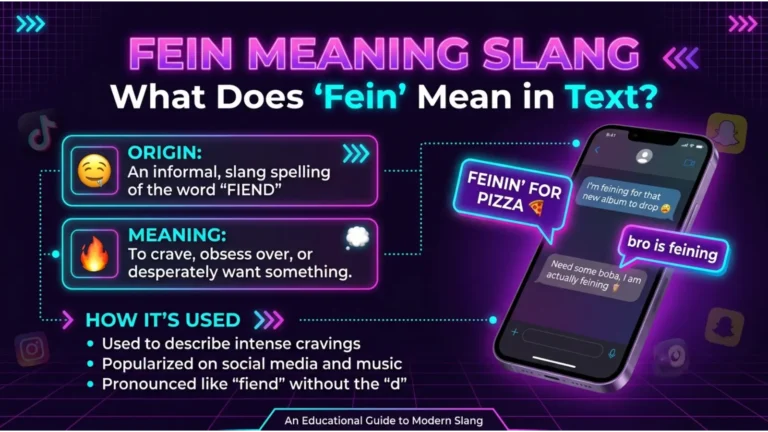
Fein meaning slang is a common search among people who encounter the word in text messages, TikTok videos, Instagram comments, and hip-hop music.
If someone writes “I’m a fein” or says “You feining for that,” you might wonder what the expression means and whether it is positive or negative.
In informal online conversations, fein usually means someone who strongly craves, desires, or wants something. It is commonly used as a nonstandard spelling of fiend in this slang context.
Someone might call themselves a fein for coffee, their favorite artist, or a new pair of sneakers. However, the word can also have a more serious meaning when discussing substance dependence or addiction.
Understanding the context is essential because the same expression can be playful among friends but insulting in another situation.
Quick Answer:
Fein is an informal slang spelling of fiend, describing someone who intensely craves or wants something. Depending on the context, it can refer to harmless enthusiasm, obsession, or addiction-related behavior.
What Does Fein Mean in Text?
In text messages, fein means a person who strongly wants or craves something. It is often used humorously to exaggerate how much someone likes a particular thing.
For example:
- “I’m a fein for chocolate.” — I really love chocolate.
- “Bro, you a fein for sneakers.” — You really want or love sneakers.
- “She feining for attention.” — She desperately wants attention.
The word is informal, so spelling and grammar can vary between conversations.
Although people sometimes use fein to describe ordinary interests, its association with addiction means it can sound negative in certain situations.
What Does Fein Stand For?
Fein does not have a standard full form like LOL or BRB. It is not generally an acronym. In this slang usage, it is an informal spelling associated with the English word fiend.
The standard spelling is important when writing formal English. Use fiend in conventional writing and recognize fein as an informal variation found in slang.
Fein Meaning on TikTok, Instagram, and Snapchat
The meaning of fein generally stays the same across social media platforms, but the context can change its tone.
Fein Meaning on TikTok
On TikTok, fein may appear in memes, music-related videos, jokes, and captions about strong interests. Users might describe themselves as a fein for a particular artist, song, celebrity, or trend.
Example:
“I’m a fein for this album.”
Meaning: The person loves the album and wants to keep listening to it.
The word is also recognizable through music culture, particularly the song title “FE!N” by Travis Scott featuring Playboi Carti.
Fein Meaning on Instagram
On Instagram, the word can appear in Reels, comments, captions, and direct messages.
Example:
“You a fein for her pictures.”
Meaning: The speaker suggests that someone is very eager to see or repeatedly looks at another person’s pictures.
Depending on the relationship and tone, this might be playful teasing or a criticism.
Fein Meaning on Snapchat and in Text Messages
In private chats, people may use fein to describe cravings, habits, or romantic interest.
Example:
“I’m feining for some coffee right now.”
Meaning: The person really wants coffee.
A casual message like this does not automatically indicate addiction. People often exaggerate their cravings for humor.
Fein Meaning in Rap and Hip-Hop
The word fiend has long been used in English to describe intense desire and, in some contexts, compulsive substance-seeking behavior. These associations also appear in hip-hop lyrics.
The stylized spelling FE!N became especially recognizable through Travis Scott’s 2023 song of the same title, featuring Playboi Carti, on the album Utopia.
The song’s title helped make the expression familiar to many music listeners and social media users. However, the title alone does not establish one universal definition for every use of fein.
When interpreting a lyric, consider the surrounding words, the song’s themes, and the artist’s intended expression rather than assuming every use refers to the same thing.
Is Fein Rude, Offensive, or Neutral?
Fein is not automatically offensive. Its meaning depends on who uses it, whom it describes, and what the conversation is about.
| Context | Possible tone | Example |
|---|---|---|
| Friends joking | Playful | “You a fein for pizza!” |
| Music discussion | Casual | “I’m a fein for this song.” |
| Romantic conversation | Teasing or negative | “You feining for her attention.” |
| Argument | Insulting | “Stop acting like a fein.” |
| Addiction discussion | Potentially stigmatizing | Calling someone a drug fiend |
When friends joke about food, music, or hobbies, the expression may be harmless. Calling someone a fein during an argument can sound judgmental.
It is particularly important to avoid using addiction-related language to shame people who may be struggling with substance use.
Real-Life Examples of Fein in Conversations
These examples show how the word can be used in different situations.
Friendly Examples
Example 1
A: “You bought another pair of sneakers?”
B: “Yeah, I’m a fein for sneakers!”
Meaning: B really loves sneakers and enjoys buying them.
Example 2
A: “You ate the whole pizza?”
B: “I’m a fein for pizza!”
Meaning: B is joking about how much they enjoy pizza.
Casual Examples
Example 3
A: “Why are you playing that song again?”
B: “I’m feining for it.”
Meaning: B really wants to keep listening to the song.
Example 4
A: “You keep checking your phone.”
B: “I’m feining for her messages.”
Meaning: B is eager to receive messages from someone they like.
Argumentative Examples
Example 5
A: “You keep asking everyone for attention.”
B: “I’m not feining for attention.”
Meaning: A accuses B of desperately wanting attention, and B denies it.
Example 6
A: “Stop calling me a fein.”
B: “Fine, I won’t.”
Meaning: The person feels offended by the label.
These examples demonstrate why context matters. The word can express enthusiasm, humor, or criticism.
Fein vs. Fiend: What Is the Difference?
The main difference is spelling and conventional usage.
Fiend is the standard English word. It can refer to an evil or wicked person, but informal expressions such as “coffee fiend” describe someone who strongly enjoys or craves something.
Fein is an informal or phonetic spelling used in some slang conversations. It generally communicates a similar idea in this context, but it is not the standard spelling in formal English.
FE!N is a stylized title associated with Travis Scott’s song. Its distinctive spelling should not be confused with a separate, universally accepted acronym.
If you are writing an essay, professional email, or formal article, use conventional wording such as craving, strongly wanting, or fiend where appropriate.
Fein vs. Similar Slang Terms
Several words describe intense desire, but their meanings are not identical.
| Term | Meaning | Example |
|---|---|---|
| Fein | Informal slang for someone who intensely craves something | “I’m a fein for coffee.” |
| Fiend | Standard spelling; someone with an intense desire or, traditionally, a wicked person | “He’s a coffee fiend.” |
| Obsessed | Extremely interested in or preoccupied with something | “I’m obsessed with this show.” |
| Thirsty | Slang for desperately seeking attention, approval, or romantic interest | “He’s thirsty for attention.” |
| Down bad | Desperate or struggling, often because of romantic interest | “He’s down bad for her.” |
| Addicted | Dependent on a substance or strongly compelled by a behavior; sometimes used casually | “He’s addicted to nicotine.” |
These expressions overlap, but they are not interchangeable in every situation. In particular, addicted can have a clinical meaning, whereas calling yourself a fein for chocolate is often just humorous exaggeration.
Why Do People Use Fein?
People use fein because it communicates strong desire in a short, expressive way.
Common reasons include:
- Humor: “I’m a fein for fries” exaggerates an ordinary craving.
- Emphasis: The word makes a preference sound particularly intense.
- Social connection: Friends may share slang as part of their everyday communication.
- Online trends: Music, memes, and videos help slang spread between communities.
- Personal expression: Some people prefer informal language because it feels natural and relatable.
The word’s popularity and interpretation vary across communities, so it is best not to assume everyone uses it in exactly the same way.
When Should You Use or Avoid Fein?
Fein can work well in casual conversations when everyone understands the intended meaning.
Appropriate situations include:
- Joking about favorite foods or drinks.
- Discussing music, films, or entertainment.
- Writing informal captions and comments.
- Talking casually about hobbies and interests.
Avoid using it when a clearer or more respectful expression would be better, especially in professional communication or serious discussions about addiction.
For example:
- Casual: “I’m a fein for basketball.”
- Professional: “I’m very passionate about basketball.”
- Everyday: “I’m feining for coffee.”
- Clearer alternative: “I’m really craving coffee.”
Choosing the right wording helps you communicate your meaning without unintentionally offending someone.
Common Misunderstandings About Fein
Several misconceptions can make this slang confusing.
1. Fein is an acronym. It generally is not; in this context, it is an informal spelling associated with fiend.
2. Fein always refers to drugs. Not necessarily. It can describe ordinary cravings or intense enthusiasm.
3. Fein and fiend are unrelated. They are closely related in this slang usage, although fiend is the conventional spelling.
4. Everyone who uses fein has an addiction. The word alone provides no evidence of a medical condition or substance dependence.
5. Fein is always an insult. It can be playful, neutral, or negative depending on the situation.
Understanding these distinctions makes it easier to interpret the word accurately.
Frequently Asked Questions About Fein Meaning Slang
1. What does fein mean in text?
Fein generally describes someone who strongly craves or wants something. It is commonly used as an informal spelling of fiend in slang.
2. What does fein stand for?
Fein has no standard acronym expansion in this usage. It is an informal spelling associated with the word fiend.
3. Is fein a bad word?
Not necessarily. It can be harmless when describing a strong interest, but it may be insulting when used to criticize someone.
4. What does fein mean on TikTok?
On TikTok, fein can describe an intense craving or interest. It is also recognizable through music references, including Travis Scott’s song “FE!N.”
5. Is fein the same as fiend?
They are closely related in this slang context. Fiend is the standard English spelling, while fein is an informal variation.
6. What does feining for someone mean?
It usually means strongly wanting someone’s attention, affection, or presence. Depending on context, it can sound playful or suggest desperation.
Conclusion
Fein meaning slang generally refers to someone who strongly craves, desires, or wants something. It is commonly understood as an informal spelling of fiend and appears in text messages, social media posts, memes, and hip-hop discussions.
The word can describe harmless enthusiasm for food, music, or hobbies, but it may also carry negative associations when used in discussions about addiction. Its meaning is not determined by the word alone; the conversation and the speaker’s intention matter.
Use fein in casual settings when the meaning is clear, and choose more precise or respectful language when discussing serious topics. Understanding the difference between fein and fiend will help you interpret the slang confidently without confusing informal expression with standard English.

Ali Raza is an M.Phil. scholar and English language expert specializing in English grammar, slang meanings, vocabulary, and everyday expressions. He writes clear, practical, and easy-to-understand content that helps readers master confusing English words, phrases, spelling, and modern slang. His goal is to make English learning simple, useful, and accessible for students, beginners, and everyday readers.
1 thought on “Fein Meaning Slang: What Does Fein Mean in Text?”