
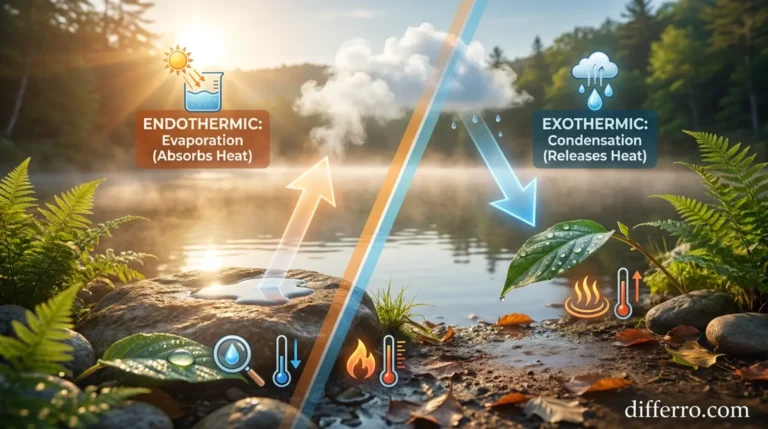
Is evaporation endothermic vs exothermic? Evaporation is an endothermic process because a liquid absorbs energy to change into a gas. This process happens every day, from drying wet clothes to sweat cooling your skin. However, many students confuse evaporation with condensation because these processes involve opposite energy changes.
During evaporation, liquid particles gain enough energy to escape into the air as gas. The liquid absorbs heat from its surroundings, which can cause those surroundings to cool. Condensation works differently because gas particles release energy when they change back into liquid. Understanding this difference makes chemistry easier and helps explain many everyday experiences.
In this guide, you will learn why evaporation is endothermic, how it differs from exothermic processes, and how temperature affects evaporation. You will also explore simple examples, common mistakes, and useful ways to remember the concept for school science and chemistry exams.
⭐ Quick Answer
Evaporation is an endothermic process because a liquid absorbs energy from its surroundings when particles escape into the gas phase.
Example: Water absorbs heat from your skin as sweat evaporates, helping your body cool down.
🔬 Meaning of Endothermic
An endothermic process absorbs energy from its surroundings, usually in the form of heat. The system gains energy during the process.
In evaporation, liquid particles absorb energy that helps them overcome the attractive forces holding them together. The particles then escape from the liquid and enter the gas phase.
Examples of Endothermic Processes
Example 1: Water absorbs energy as it evaporates from a wet surface.
Example 2: Melting ice absorbs heat from its surroundings as solid ice becomes liquid water.
Other endothermic processes include sublimation and many chemical reactions that absorb heat.
🔥 Meaning of Exothermic
An exothermic process releases energy from the system into its surroundings, often as heat. The surroundings may become warmer.
Condensation is exothermic because gas particles release energy when they form a liquid. Freezing is also exothermic because a liquid releases energy as it becomes a solid.
Examples of Exothermic Processes
Example 1: Water vapor releases energy when it condenses into liquid droplets on a cold surface.
Example 2: Water releases heat to its surroundings as it freezes into ice.
Other examples include many combustion reactions and certain chemical reactions that release heat.
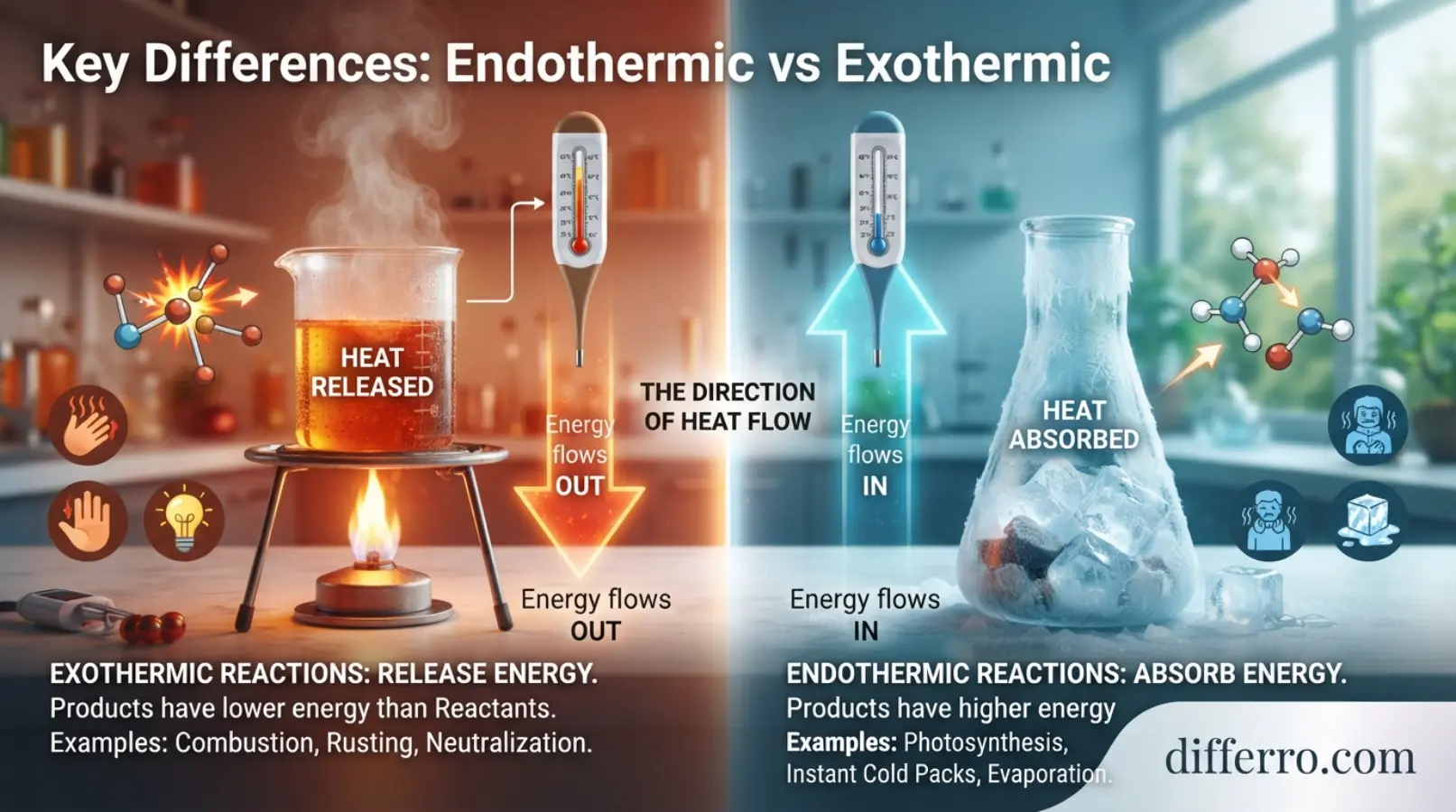
📊 Key Differences: Endothermic vs Exothermic
| Feature | Endothermic | Exothermic |
|---|---|---|
| Meaning | Absorbs energy | Releases energy |
| Energy transfer | Into the system | Out of the system |
| Surroundings | Often cool down | Often warm up |
| Evaporation | Endothermic | Not applicable |
| Condensation | Not applicable | Exothermic |
| Melting | Endothermic | Not applicable |
| Freezing | Not applicable | Exothermic |
| Enthalpy change | Positive, (\Delta H > 0) | Negative, (\Delta H < 0) |
| Common example | Evaporating water | Condensing water vapor |
Important: Endothermic and exothermic describe the direction of energy transfer. The temperature of the surroundings may not always change noticeably.
📚 Origin and History of the Terms
The words Endothermic vs Exothermic come from Greek roots associated with internal and external relationships, along with heat.
- Endothermic: “Endo” means within, while “thermic” relates to heat.
- Exothermic: “Exo” means outside, while “thermic” relates to heat.
Scientists use these terms to describe energy changes during physical processes and chemical reactions.
Similar Science Terms
- Evaporation: A liquid changes into a gas at its surface.
- Condensation: A gas changes into a liquid.
- Vaporization: A liquid changes into a gas through evaporation or boiling.
- Sublimation: A solid changes directly into a gas.
- Freezing: A liquid changes into a solid.
- Melting: A solid changes into a liquid.
These processes involve energy transfers that depend on the direction of the phase change.
🇬🇧 British English vs American English Spelling
The terms evaporation, endothermic, and exothermic have the same spelling in British and American English.
Their scientific meanings also remain the same in both varieties of English. Some related words, such as vapour and vapor, use different spellings.
British vs American English Comparison
| Term | British English | American English |
|---|---|---|
| Evaporation | Evaporation | Evaporation |
| Endothermic | Endothermic | Endothermic |
| Exothermic | Exothermic | Exothermic |
| Water vapor | Water vapour | Water vapor |
| Meaning | Same scientific meaning | Same scientific meaning |
💧 Why Is Evaporation Endothermic?
Evaporation occurs when particles at a liquid’s surface gain enough energy to escape into the gas phase. They must overcome attractive forces between neighboring liquid particles.
The liquid absorbs energy from its surroundings to support this process. As higher-energy particles escape, the remaining liquid may lose thermal energy and cool down.
Evaporation can happen below a liquid’s boiling point. It does not require the entire liquid to reach a specific temperature.
What Happens During Evaporation?
- Liquid particles move at different speeds.
- Some surface particles gain enough energy to escape.
- Those particles enter the gas phase.
- The liquid absorbs energy from its surroundings to support continued evaporation.
- The surroundings may cool as they transfer energy to the liquid.
The exact temperature change depends on the conditions, including heat supplied from the environment.
🌡️ When to Use the Term Endothermic
Use endothermic when a process absorbs energy from its surroundings.
Example 1: Evaporation of Water
Water absorbs energy as liquid particles escape into the air. Therefore, evaporation is endothermic.
Example 2: Melting Ice
Ice absorbs heat from its surroundings as it changes into liquid water. Therefore, melting is endothermic.
Example 3: Sweat Evaporation
Sweat absorbs energy from your skin as it evaporates. This energy transfer helps cool your body.
🔥 When to Use the Term Exothermic
Use exothermic when a process releases energy into its surroundings.
Example 1: Condensation
Water vapor releases energy when it changes into liquid water. Therefore, condensation is exothermic.
Example 2: Freezing Water
Water releases energy as it changes into ice. Therefore, freezing is exothermic.
Example 3: Burning Fuel
Combustion releases energy into the surroundings. Many fuels produce heat and light during burning.
⚠️ Common Mistakes About Evaporation
Mistake 1: Calling Evaporation Exothermic
Incorrect: Evaporation releases heat into the surroundings.
Correct: Evaporation absorbs energy from the surroundings, so it is endothermic.
Mistake 2: Confusing Evaporation With Condensation
Incorrect: Evaporation and condensation both release heat.
Correct: Evaporation absorbs energy, while condensation releases energy.
Mistake 3: Assuming Evaporation Only Happens at Boiling Point
Incorrect: Water evaporates only when it reaches (100^\circ\text{C}).
Correct: Water can evaporate below its boiling point. Boiling and evaporation are different forms of vaporization.
Mistake 4: Thinking Evaporation Always Makes the Liquid Hotter
Incorrect: Absorbing energy always increases the liquid’s temperature.
Correct: Energy supports the phase change. Evaporation can cool the remaining liquid because faster particles escape.
Mistake 5: Confusing Heat With Temperature
Incorrect: Heat and temperature mean exactly the same thing.
Correct: Heat is energy transferred because of a temperature difference. Temperature measures the thermal state of a substance.
Mistake 6: Assuming Every Endothermic Process Must Feel Cold
Incorrect: Every endothermic process immediately makes its surroundings noticeably cold.
Correct: An endothermic process absorbs energy, but the temperature change depends on the conditions and energy supply.
🧠 Easy Trick to Remember
Use this simple memory trick:
- Endothermic = Energy enters.
- Exothermic = Energy exits.
For evaporation, energy enters the liquid system to support the change from liquid to gas. Therefore, evaporation is endothermic.
For condensation, energy leaves the water vapor as it becomes liquid. Therefore, condensation is exothermic.
Remember the opposite pair: evaporation absorbs; condensation releases.
🌍 Five Everyday Examples of Evaporation
1. Wet Clothes Drying in the Sun
Wet clothes dry as liquid water evaporates from their fibers. The water absorbs energy from sunlight and the surrounding air.
Science concept: Evaporation is endothermic because water absorbs energy during the change from liquid to gas.
2. Sweat Cooling Your Skin
Your body produces sweat to help regulate temperature. When sweat evaporates, it absorbs energy from your skin.
Science concept: Endothermic evaporation transfers energy away from your skin, helping it cool down.
3. A Puddle Disappearing After Rain
A puddle gradually shrinks when water molecules escape into the air. This process can occur even when the weather feels cool.
Science concept: Water absorbs energy from its surroundings during evaporation.
4. Perfume Drying on Your Skin
Perfume contains volatile substances that evaporate after you apply them. These substances absorb energy as their molecules enter the gas phase.
Science concept: Evaporation is an endothermic physical change, although different ingredients have different properties.
5. Water Evaporating From a Bowl
Water left in an open bowl slowly evaporates. Warm conditions and moving air can increase the evaporation rate.
Science concept: Evaporation absorbs energy, while condensation releases energy when vapor returns to liquid.
🌐 Google Trends and Search Insights: Five Countries
Google Trends shows relative search interest rather than exact search volumes. The following observations describe likely educational search intent, not verified country rankings.
- USA: Students may search for evaporation, phase changes, and endothermic processes for chemistry homework.
- UK: Searches may focus on energy transfer, evaporation, and condensation in school science.
- Australia: Learners may explore evaporation through weather, water cycles, and temperature examples.
- India: Search intent may include chemistry definitions, exam preparation, and endothermic versus exothermic processes.
- Pakistan: Students may seek simple explanations, textbook examples, and short answers for science examinations.
SEO insight: These are potential search patterns, not measured Google Trends results. Compare the exact keyword across countries and date ranges before claiming that one country has greater search interest.
Comparison Table: Keyword Variations
| Keyword variation | Search intent | Recommended content section |
|---|---|---|
| Is evaporation endothermic or exothermic | Direct answer | Title and quick answer |
| Why is evaporation endothermic | Scientific explanation | Why evaporation is endothermic |
| Is condensation endothermic or exothermic | Related concept | Endothermic vs exothermic |
| Evaporation energy change | Conceptual learning | Energy transfer explanation |
| Endothermic and exothermic examples | Study and revision | Examples section |
| Does evaporation absorb heat | Quick factual answer | Featured snippet |
| Evaporation vs condensation | Process comparison | Key differences table |
❓ Frequently Asked Questions
1. Is evaporation endothermic or exothermic?
Evaporation is endothermic because liquid particles absorb energy as they escape into the gas phase.
2. What is the difference between endothermic and exothermic processes?
Endothermic processes absorb energy from their surroundings. Exothermic processes release energy into their surroundings.
3. Which is more common, endothermic or exothermic evaporation?
Evaporation is always an endothermic phase change under ordinary conditions. It does not become exothermic simply because the surrounding air is warm.
4. Is evaporation endothermic in formal scientific writing?
Yes. Calling evaporation an endothermic physical process is scientifically correct. The term describes the energy absorbed during the liquid-to-gas phase change.
5. Why do students confuse evaporation with condensation?
Both processes involve liquid and gas phases, but they transfer energy in opposite directions. Evaporation absorbs energy, while condensation releases energy.
🏁 Final Verdict: Is Evaporation Endothermic vs Exothermic?
Evaporation is endothermic, not exothermic. A liquid absorbs energy as particles escape from its surface and enter the gas phase.
This energy transfer explains why evaporation can cool your skin, dry wet clothes, and make puddles disappear. Condensation works in the opposite direction and releases energy into the surroundings.
For exams, remember this simple rule: evaporation absorbs energy, while condensation releases energy. Understanding this distinction helps you explain phase changes and answer related chemistry questions correctly.
Conclusion
Is evaporation Endothermic vs Exothermic? Evaporation is an endothermic process because a liquid absorbs energy as it changes into gas. This process occurs in everyday situations, including drying clothes, evaporating sweat, and water disappearing from puddles.
Endothermic processes absorb energy from their surroundings, while exothermic processes release energy. Condensation provides the opposite example because water vapor releases energy when it becomes liquid. Remembering this difference makes phase changes easier to understand.
Evaporation can occur below the boiling point, and it often cools the remaining liquid. For school science and chemistry exams, remember one essential rule: evaporation absorbs energy, so it is endothermic. This simple principle explains the process and helps prevent common mistakes.

Imran Lodhra is a comparison-focused content writer at Differro.com.
He specializes in creating clear, simple, and informative comparison articles.
His work helps readers understand key differences, pros and cons, and important details.
Imran focuses on accurate, practical, and easy-to-read content for everyday readers.
1 thought on “Endothermic vs Exothermic: Understanding Evaporation”