

are crocodiles or alligators bigger? Crocodiles are generally bigger than alligators, but species matter.
People often confuse these reptiles because both have long bodies, powerful jaws, and armored skin. They also belong to the same broader crocodilian group.
The biggest difference appears when we compare the largest species. Saltwater crocodiles can exceed 20 feet and weigh more than 2,000 pounds. Large American alligators usually remain smaller, although exceptional individuals can become very large.
Size also depends on age, sex, species, food, and habitat. Therefore, saying every crocodile is bigger would be inaccurate.
This guide explains their sizes, differences, uses, common mistakes, and everyday examples. It also answers the most common questions about crocodiles and alligators.
⭐ Quick Answer
Crocodiles are generally bigger than alligators. The saltwater crocodile is the largest living crocodilian and can exceed 20 feet. Large American alligators usually reach about 13–15 feet.
Example: A saltwater crocodile can grow much longer and heavier than an American alligator.
🐊 Meaning of Crocodile
A crocodile is a large semi-aquatic reptile from the family Crocodylidae.
Crocodiles live across parts of Africa, Asia, Australia, and the Americas. Several species tolerate freshwater, brackish water, or saltwater.
They usually have long, narrow, pointed snouts. Their lower teeth can remain visible when their mouths close.
Examples of “crocodile”
- The saltwater crocodile is the largest living crocodilian.
- The Nile crocodile is another very large crocodile species.
Saltwater crocodiles can exceed six meters in length and weigh more than 1,000 kilograms.
🐊 Meaning of Alligator
An alligator is a crocodilian reptile from the family Alligatoridae.
Only two living species carry the alligator name. They are the American alligator and Chinese alligator.
Alligators usually have broad, rounded, U-shaped snouts. Their darker bodies also help distinguish them from many crocodiles.
Examples of “alligator”
- The American alligator lives mainly in the southeastern United States.
- The Chinese alligator is much smaller than the American species.
American alligators can reach impressive sizes, with males growing much larger than females.
📊 Crocodile vs Alligator: Key Differences
| Feature | Crocodile | Alligator |
|---|---|---|
| Meaning | A crocodilian from Crocodylidae | A crocodilian from Alligatoridae |
| Size | Usually larger across the biggest species | Usually smaller overall |
| Snout | Long and pointed | Broad and rounded |
| Teeth | Some lower teeth remain visible | Lower teeth usually stay hidden |
| Habitat | Freshwater, brackish water, and some saltwater | Mostly freshwater |
| Usage | Common for many crocodilian species | Refers mainly to two species |
| Popularity | Common worldwide | Especially common in the United States |
The two animals share many traits, but their body shapes provide useful clues. PBS also describes crocodiles as generally larger than alligators.
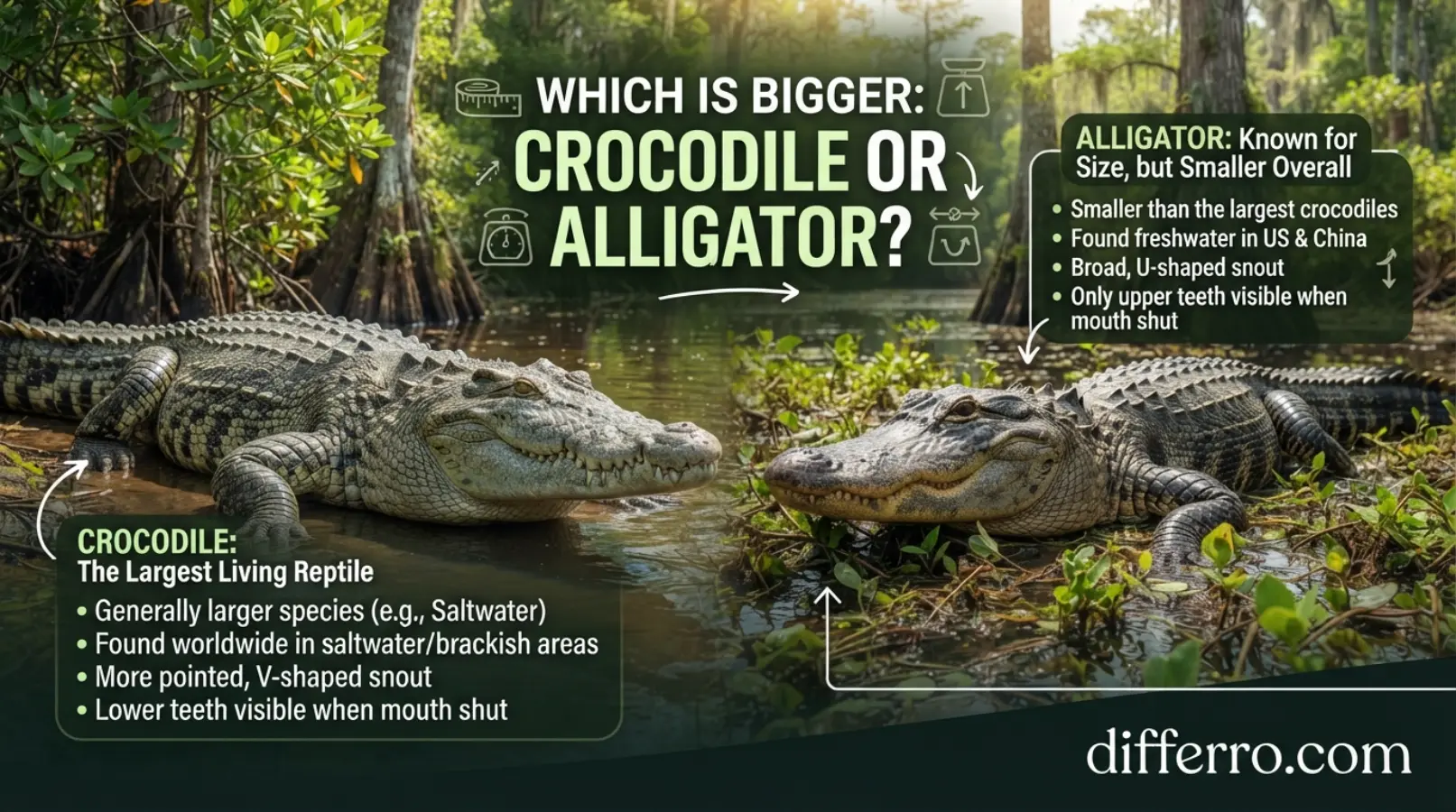
📏 Which Is Bigger: Crocodile or Alligator?
The short answer is crocodile.
However, the comparison depends on the species.
The saltwater crocodile is the clear size champion. It can exceed six meters and weigh more than 1,000 kilograms.
The Nile crocodile can also reach around five meters or more.
American alligators can reach roughly 4.6 meters in exceptional cases. They can also become extremely heavy.
Chinese alligators are much smaller. They rarely approach the size of large American alligators.
So, crocodiles generally win the size comparison because several crocodile species grow much larger.
🧬 Origin and History
Crocodiles and alligators belong to the ancient crocodilian lineage.
They share a distant evolutionary history but belong to different families. Crocodiles belong to Crocodylidae. Alligators belong to Alligatoridae.
Their similar appearance creates much of the modern confusion.
Similar animal examples
Other crocodilians include:
- Caimans
- Gharials
- False gharials
- Black caimans
- Dwarf crocodiles
These animals share important crocodilian features, but they differ in size and body shape.
🇬🇧 British English vs American English Spelling
The words crocodile and alligator have the same spelling in British and American English.
Neither word changes spelling between the two varieties.
The main differences involve pronunciation, vocabulary, and regional usage.
British vs American English Comparison
| Term | British English | American English |
|---|---|---|
| Crocodile | Crocodile | Crocodile |
| Alligator | Alligator | Alligator |
| Main difference | Same spelling | Same spelling |
| Common reference | Crocodile is common globally | Alligator is especially common in the U.S. |
Therefore, this is not a British-versus-American spelling issue.
🐊 When to Use “Crocodile”
Use crocodile when you mean an animal from the crocodile family.
The word works for specific species and general references.
Examples
- The crocodile moved slowly through the river.
- A saltwater crocodile can become extremely large.
- Tourists watched the Nile crocodile from a safe distance.
- The guide explained how a crocodile differs from an alligator.
Use the specific species name when size matters.
For example, saying saltwater crocodile gives readers more useful information than simply saying crocodile.
🐊 When to Use “Alligator”
Use alligator when you mean one of the two living alligator species.
The American alligator is much more familiar to most English speakers.
Examples
- The alligator rested beside the lake.
- An American alligator can grow several meters long.
- The zoo displayed a large alligator.
- The ranger warned visitors not to approach the alligator.
Use American alligator or Chinese alligator when you need precise identification.
⚠️ Common Mistakes
Mistake 1: Saying all crocodiles are bigger
Incorrect: All crocodiles are bigger than alligators.
Correct: Crocodiles are generally larger, but size varies by species.
Some alligators can become larger than some smaller crocodile species.
Mistake 2: Comparing families without naming species
Incorrect: A crocodile always weighs more than an alligator.
Correct: Large crocodile species can outweigh large American alligators.
Species differences make broad comparisons less precise.
Mistake 3: Calling every crocodilian an alligator
Incorrect: The saltwater alligator can exceed 20 feet.
Correct: The saltwater crocodile can exceed 20 feet.
The saltwater crocodile is a crocodile, not an alligator.
Mistake 4: Assuming American alligators are tiny
Incorrect: Alligators are small compared with crocodiles.
Correct: American alligators can become very large.
Large males can reach impressive lengths and weights.
Mistake 5: Treating crocodile and alligator as synonyms
Incorrect: Crocodile and alligator mean exactly the same animal.
Correct: Crocodiles and alligators are related but distinct animals.
🧠 Easy Trick to Remember
Use this simple rule:
Croc = generally bigger. Gator = generally smaller.
Remember the C in crocodile as “C for colossal.”
This trick does not cover every species, but it helps with basic comparisons.
For scientific accuracy, always consider the species.
🌿 Everyday Life Examples
1. Watching Wildlife
A visitor may see an alligator in a Florida wetland.
The animal may look huge because American alligators can grow several meters long.
This example uses the primary keyword are crocodiles or alligators bigger.
2. Reading About Australia
Someone reading about Australian wildlife may encounter the saltwater crocodile.
This species can grow far larger than most alligators.
The secondary keyword crocodile vs alligator size fits this context.
3. Visiting a Zoo
A zoo may display both crocodiles and alligators.
Visitors can compare their snouts, teeth, body shapes, and sizes.
This makes crocodile or alligator bigger a natural search question.
4. Watching a Wildlife Documentary
A documentary may feature a massive saltwater crocodile.
Viewers often wonder how its size compares with an American alligator.
The phrase are alligators or crocodiles bigger matches that search intent.
5. Helping Children Learn
Parents and teachers can use crocodiles and alligators to teach animal differences.
Simple size comparisons make the lesson easier to remember.
The keyword which is bigger, crocodile or alligator works naturally here.
These variations support the main search intent without forcing keyword repetition.
📈 Google Trends & Usage Insight
Search interest for these terms varies by country and season.
The United States has strong interest because American alligators are widely known there.
The UK and Australia often show interest around wildlife and crocodile-related searches.
India and Pakistan can also show interest because crocodiles and related reptiles occur across South Asia.
Exact Google Trends scores change over time, so relative interest should guide content rather than fixed numbers.
Keyword Variations Comparison
| Keyword variation | Search intent | Best content use |
|---|---|---|
| are crocodiles or alligators bigger | Direct comparison | Main keyword |
| are crocodiles bigger than alligators | Size comparison | H2 or FAQ |
| are alligators or crocodiles bigger | Direct question | FAQ |
| crocodile vs alligator size | Informational | Comparison section |
| which is bigger crocodile or alligator | Question | Featured snippet |
| crocodile or alligator bigger | Short comparison | Supporting keyword |
| how big are crocodiles | Size research | Supporting section |
🏆 Final Verdict: Are Crocodiles or Alligators Bigger?
Crocodiles are generally bigger than alligators.
The biggest reason is the enormous size of species such as the saltwater crocodile.
Saltwater crocodiles can exceed six meters and weigh more than 1,000 kilograms.
American alligators can also become very large, but they usually do not match the largest crocodiles.
However, species matter.
A small crocodile species may be smaller than a large American alligator.
Therefore, the most accurate answer is:
Crocodiles are generally larger, but not every crocodile is larger than every alligator.
❓ Frequently Asked Questions
Is it correct to say crocodiles are bigger than alligators?
Yes, the statement is generally correct.
Several crocodile species grow much larger than alligators.
However, individual size varies with species, age, sex, and health.
What is the difference between a crocodile and an alligator?
Crocodiles usually have longer, narrower snouts.
Alligators usually have wider, rounded snouts.
Their teeth, color, habitat preferences, and geographic ranges also differ.
Which is more common, crocodiles or alligators?
Crocodiles have a broader global distribution.
Alligators naturally occur mainly in the United States and China.
The American alligator has a particularly strong presence in the southeastern United States.
Which animal has a more formal name?
Neither word is more formal.
Crocodile and alligator are standard animal names.
Scientific writing usually uses the exact species name for greater accuracy.
Why do people confuse crocodiles and alligators?
Both animals have long bodies, strong tails, armored skin, and powerful jaws.
They also share a similar semi-aquatic lifestyle.
Their close evolutionary relationship adds to the confusion.
Can an alligator be bigger than a crocodile?
Yes.
A large American alligator can exceed a small crocodile species.
That is why species matter when comparing individual animals.
What is the biggest crocodilian?
The saltwater crocodile is the largest living crocodilian.
Large males can exceed six meters and weigh more than 1,000 kilograms.
📝 Conclusion
So, are crocodiles or alligators bigger? Crocodiles are generally bigger than alligators.
The saltwater crocodile provides the clearest example of this difference. It can grow beyond six meters and weigh more than 1,000 kilograms. American alligators can also reach impressive sizes, especially large males.
However, they usually remain smaller than the largest crocodile species. Remember that species make the biggest difference. A smaller crocodile can still be shorter than a large alligator. The best answer is therefore simple: crocodiles usually win the size comparison, but exceptions exist.
Their snout shape, teeth, habitat, and geographic range also help distinguish them.

Imran Lodhra is a comparison-focused content writer at Differro.com.
He specializes in creating clear, simple, and informative comparison articles.
His work helps readers understand key differences, pros and cons, and important details.
Imran focuses on accurate, practical, and easy-to-read content for everyday readers.