
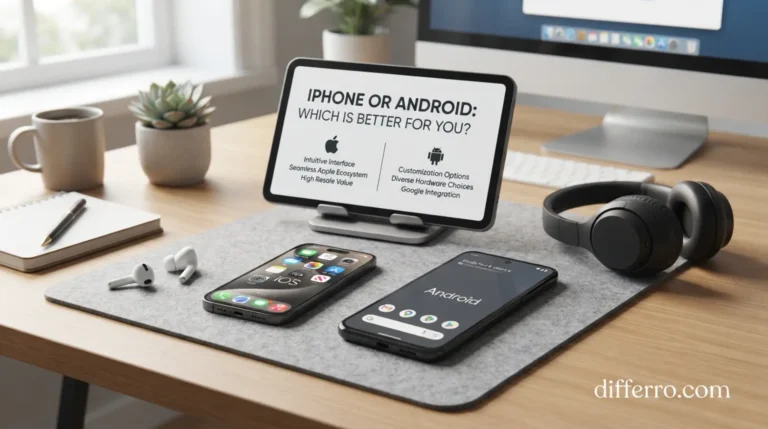
iPhone or Android is a common comparison for people choosing a new smartphone. Both offer useful features, strong performance, and access to popular apps. However, they differ in price, customization, privacy controls, software updates, and device choices. An iPhone runs Apple’s iOS operating system, while Android powers phones from brands such as Samsung, Google, Xiaomi, and OnePlus.
Your best choice depends on your budget and daily needs. iPhones appeal to users who prefer a simple experience and close integration with other Apple devices. Android phones offer more variety, flexible customization, and options at different prices. Both platforms support photography, gaming, messaging, video streaming, and online work. Neither platform wins in every category. This guide compares iPhone and Android features, costs, usability, and everyday benefits. By the end, you can choose the smartphone that best fits your lifestyle.
⭐ Quick Answer
Choose an iPhone for Apple’s connected ecosystem, consistent software experience, and long-term support. Choose Android for greater customization, more device choices, and flexible budgets. Both offer excellent smartphones, cameras, security features, and apps.
Example: An iPhone may suit someone who owns a MacBook and Apple Watch. An Android phone may suit someone who wants more hardware choices and customizable settings.
📱 Meaning of iPhone
An iPhone is a smartphone designed and sold by Apple. It runs iOS, Apple’s mobile operating system. iPhones combine hardware, software, security features, and Apple’s services in one connected system.
Users can download apps, take photos, make video calls, browse the internet, and manage everyday tasks. Apple also offers features such as AirDrop, FaceTime, iCloud, and Apple Pay in supported markets.
Examples of iPhone Use
Example 1: A student uses an iPhone to attend online classes, take notes, and share files with a MacBook.
Example 2: A photographer uses an iPhone to capture videos, edit images, and back up files to iCloud.
🤖 Meaning of Android
Android is a mobile operating system developed by Google and used by many smartphone manufacturers. Samsung, Google, Xiaomi, OnePlus, and other brands offer Android phones.
Android gives users access to apps, widgets, customizable home screens, and many hardware designs. Features vary by manufacturer, model, software version, and region.
Examples of Android Use
Example 1: A student buys an affordable Android phone for messaging, online learning, and everyday photography.
Example 2: A business owner chooses a Samsung Android phone with a large display for emails, documents, and multitasking.
🔍 iPhone or Android: Key Differences
| Feature | iPhone | Android |
|---|---|---|
| Operating system | Apple’s iOS | Google’s Android, with manufacturer-specific changes |
| Device choices | Apple designs the iPhone range | Many manufacturers offer different models |
| Price range | Mostly midrange to premium, depending on market and model | Budget to premium |
| Customization | More controlled, with customization options | Generally more flexible |
| Ease of use | Consistent experience across iPhone models | Experience varies by brand and software |
| App availability | Major apps available through Apple’s App Store | Major apps available through Google Play and other supported sources |
| Software updates | Apple manages iOS updates for supported iPhones | Updates depend on the manufacturer, model, and region |
| Security | Strong platform protections and privacy controls | Strong protections, with details varying by device and software |
| Hardware variety | Apple controls the hardware range | Many screen sizes, designs, and features |
| Ecosystem | Works closely with Apple devices and services | Integrates with Google services and many other products |
| Gaming | Strong performance on supported models | Strong performance on many premium models |
| Best for | Apple ecosystem users and people who prefer a consistent experience | Customization fans and shoppers who want more choices |
🕰️ Origin and History of iPhone and Android
Apple introduced the first iPhone in 2007. It combined a mobile phone, an iPod, and internet features in one touchscreen device. Apple later developed iOS into a broader mobile platform.
Google introduced Android as an open mobile operating system. The first commercial Android phone arrived in 2008. Android later spread across devices from many manufacturers.
Today, both platforms support advanced cameras, mobile payments, artificial intelligence features, gaming, and productivity apps.
Similar Technology Terms
- iOS: Apple’s operating system for iPhones.
- Android: A mobile operating system used by many smartphone brands.
- Smartphone: A mobile phone with advanced computing and internet features.
- App Store: Apple’s marketplace for iPhone applications.
- Google Play: Google’s main app marketplace for Android devices.
🇬🇧 British English vs American English Spelling
The words iPhone and Android have the same spelling in British and American English.
Both terms are product or technology names, not words with regional spelling variations.
Writers should capitalize them correctly, using iPhone and Android in formal articles.
British vs American English Comparison
| Feature | British English | American English |
|---|---|---|
| Product name | iPhone | iPhone |
| Operating system | Android | Android |
| Standard spelling | Same | Same |
| Capitalization | iPhone and Android | iPhone and Android |
| Usage | Technology reviews and everyday speech | Technology reviews and everyday speech |
🍎 When to Choose an iPhone
An iPhone may be the better choice if you value Apple’s ecosystem, a consistent interface, and integrated services.
1. You Already Own Apple Devices
An iPhone works closely with a Mac, iPad, and Apple Watch. You can share files, sync data, and move between supported tasks more easily.
Example: A student can start writing notes on an iPhone and continue working on a MacBook.
2. You Prefer a Consistent Experience
Apple controls both iPhone hardware and iOS. This approach creates a relatively consistent experience across supported models.
Example: Someone who dislikes changing settings may prefer the familiar iPhone interface.
3. You Want Strong Video Features
Many iPhone models offer excellent video recording and editing features. However, results depend on the model and shooting conditions.
Example: A content creator can record social media videos and edit them directly on an iPhone.
4. You Plan to Keep Your Phone for Years
Apple provides software updates for supported iPhones. The exact support period depends on the model and Apple’s current policies.
Example: A buyer who wants to use one phone for several years should compare update support before purchasing.
5. You Value Apple’s Services
Apple offers services such as FaceTime, iCloud, and AirDrop. Their usefulness depends on your other devices, location, and personal needs.
Example: A family that uses several Apple devices may find these connected services convenient.
🤖 When to Choose Android
Android may suit you better if you want flexibility, more device options, or a specific hardware feature.
1. You Have a Limited Budget
Android phones cover a wide range of prices. You can find basic models for everyday tasks and premium models for demanding work.
Example: A student can choose an affordable Android phone for messaging, browsing, and online classes.
2. You Want More Customization
Android generally offers greater control over home screens, widgets, launchers, and default apps.
Example: A user can arrange widgets and shortcuts to match their daily routine.
3. You Want More Hardware Choices
Different Android brands offer varied screen sizes, camera systems, battery capacities, and charging features.
Example: Someone who wants a large display can compare several Android models at different prices.
4. You Need Flexible File Management
Many Android phones offer convenient access to local files and computer connections. The exact experience depends on the device and apps.
Example: A user can organize downloaded documents and transfer supported files to a computer.
5. You Prefer Different Form Factors
Android manufacturers offer standard phones, foldable phones, and other designs. Availability depends on the market.
Example: Someone who wants a foldable smartphone can compare models from Android manufacturers.
⚠️ Common Mistakes When Comparing iPhone and Android
Mistake 1: Assuming Every iPhone Is Better Than Every Android Phone
Incorrect: Every iPhone performs better than every Android phone.
Correct: Performance depends on the exact models, processors, software, and tasks. Compare devices within similar price ranges.
Mistake 2: Assuming Android Is Always Cheaper
Incorrect: Every Android phone costs less than an iPhone.
Correct: Android includes budget devices and expensive flagship phones. Some premium Android models cost as much as or more than iPhones.
Mistake 3: Believing iPhones Never Get Viruses or Security Problems
Incorrect: iPhones cannot face security threats.
Correct: Both platforms need security updates and careful app use. No smartphone is completely risk-free.
Mistake 4: Assuming Every Android Phone Receives the Same Updates
Incorrect: All Android phones receive updates at the same time.
Correct: Update schedules and support periods vary by manufacturer, model, and region.
Mistake 5: Choosing Only by Camera Megapixels
Incorrect: A phone with more megapixels always takes better photos.
Correct: Image quality also depends on sensor size, lenses, image processing, stabilization, and lighting.
Mistake 6: Ignoring Total Ownership Costs
Incorrect: The phone’s purchase price tells you its full cost.
Correct: Consider accessories, repairs, storage, subscriptions, resale value, and battery replacement.
🧠 Easy Trick to Remember
Use this simple memory tip:
- iPhone = Apple’s integrated experience. Think consistency, Apple services, and connected devices.
- Android = more choices and flexibility. Think customization, multiple manufacturers, and different price levels.
This is a general guide, not a rule for every model. Both platforms can meet most everyday smartphone needs.

🌟 Everyday-Life Examples: iPhone or Android
1. A Student Choosing a First Smartphone
A student needs a phone for online classes, messaging, research, and photos. An affordable Android phone may offer better value within a limited budget.
However, an iPhone may suit a student who already uses a MacBook and other Apple devices.
2. A Content Creator Recording Videos
A creator wants reliable video recording, editing tools, and social media apps. A recent iPhone may offer a convenient workflow, especially with other Apple devices.
A premium Android phone can also deliver excellent video quality. Compare sample footage, stabilization, storage, and editing needs before buying.
3. A Business Owner Managing Daily Work
A business owner needs email, documents, video calls, banking apps, and reliable battery life. Both platforms can handle these tasks.
An Android phone may offer more options for screen size and price. An iPhone may suit a business owner who already relies on Apple’s ecosystem.
4. A Gamer Looking for Strong Performance
A gamer wants smooth gameplay, good cooling, and a responsive display. Both iPhone and Android offer capable gaming phones.
Compare processor performance, supported games, heat management, battery life, and screen refresh rates. Do not choose by brand alone.
5. A Family Buying Phones for Everyone
A family wants reliable phones at different prices. Android offers models across many budget levels, making it easier to compare varied needs.
An iPhone may suit a family that uses Apple services and devices together. Check parental controls, update support, and repair costs before deciding.
🌍 Google Trends and Usage Data: USA, UK, Australia, India, and Pakistan
Google Trends shows relative search interest, not exact search volume or market share. Without a live comparison, exact country rankings for “iPhone” and “Android” cannot be confirmed.
- USA: Compare interest in iPhone, Android, and individual smartphone models.
- UK: Review brand-related searches alongside price and model comparisons.
- Australia: Compare interest in premium phones, Android alternatives, and new releases.
- India: Include searches for budget Android phones and iPhone price comparisons.
- Pakistan: Consider searches related to phone prices, PTA approval, used devices, and local availability.
SEO insight: Search interest changes with product launches, discounts, and seasonal buying patterns. Compare the same date range and search type for each country. Treat Google Trends interest as a relative measure, not proof that one platform has more users.
Comparison Table: Keyword Variations
| Keyword variation | Search intent | Recommended use |
|---|---|---|
| iPhone or Android | Broad comparison | Main title and introduction |
| iPhone vs Android | Direct comparison | Main heading and key differences |
| iPhone or Android which is better | Buying advice | Quick Answer and conclusion |
| Android vs iPhone pros and cons | Product evaluation | Comparison section |
| iPhone vs Android for beginners | Beginner guidance | Practical examples |
| Best smartphone for the money | Budget-focused shopping | Buying advice section |
| Android or iPhone for gaming | Gaming comparison | Gaming example |
❓ Frequently Asked Questions
1. Is “iPhone or Android” a correct phrase?
Yes. “iPhone or Android” is a correct phrase when comparing Apple’s smartphones with phones running Android. “iPhone vs Android” is also common for comparison articles.
2. What is the difference between iPhone and Android?
An iPhone is Apple’s smartphone, and it runs iOS. Android is an operating system used by smartphones from many manufacturers. The platforms differ in customization, device choices, services, and software management.
3. Which is more common, iPhone or Android?
Android has a larger global smartphone user base overall. However, the balance varies by country, and individual markets may favor iPhones more strongly. Search interest and smartphone market share measure different things.
4. Which term should I use in formal writing?
Use iPhone when referring to Apple’s smartphone and Android when referring to the operating system or Android-powered phones. In a comparison article, “iPhone vs Android” is a clear, familiar heading.
5. Why do people find it difficult to choose between iPhone and Android?
Both platforms offer strong cameras, apps, security features, and performance. The best choice depends on budget, preferred features, existing devices, software support, and personal habits.
🏆 Final Verdict: Which Is Better?
Neither iPhone nor Android is best for everyone. An iPhone is a strong choice for people who value Apple’s ecosystem, a consistent user experience, and integrated services.
Android is a strong choice for people who want more customization, broader hardware choices, and devices at different prices.
Before buying, compare specific models rather than judging entire platforms. Check battery life, camera performance, update support, storage, repair costs, and local prices. Also consider the devices you already own.
Best overall choice: Pick the platform that matches your budget and daily needs. If you want flexibility and more price options, start with Android. If you prefer Apple’s connected experience, start with iPhone.
Conclusion
iPhone or Android is a personal choice that depends on your budget, lifestyle, and preferred features. iPhones offer Apple’s connected ecosystem, a consistent software experience, and useful integration with other Apple devices. Android phones provide greater customization, a wider range of designs, and options for different budgets.
Both platforms support popular apps, photography, gaming, Communication, and productivity. However, features and performance vary across individual models. Compare battery life, camera quality, software updates, storage, repair costs, and local prices before purchasing.
Do not assume one brand always delivers better value. Think about how you use your phone every day and which features matter most. The right smartphone is the one that meets your needs without exceeding your budget.

Imran Lodhra is a comparison-focused content writer at Differro.com.
He specializes in creating clear, simple, and informative comparison articles.
His work helps readers understand key differences, pros and cons, and important details.
Imran focuses on accurate, practical, and easy-to-read content for everyday readers.
1 thought on “iPhone or Android: Which Is Better for You?”