
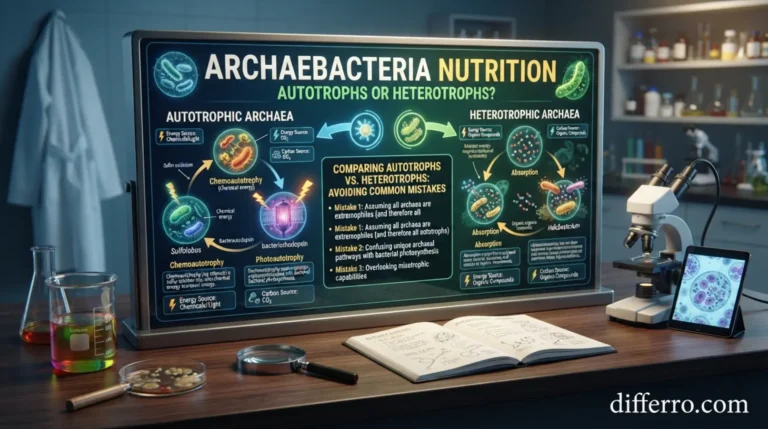
Are archaebacteria autotrophs or heterotrophs? The answer is that archaebacteria can be both autotrophs and heterotrophs. These ancient microorganisms use different methods to obtain energy and carbon for growth. Some make their own organic food from carbon dioxide. Others obtain carbon and nutrients from existing organic substances. Archaebacteria Nutrition , now commonly called archaea, belong to a distinct group of microorganisms. They differ from bacteria in several important ways, including their cell chemistry and genetic features. Many archaea live in extreme environments, such as hot springs, salty lakes, and oxygen-free habitats. However, scientists also find them in oceans, soil, and the human body.
Understanding their nutritional methods helps explain how archaea survive in different environments. Their food sources also play important roles in Earth’s ecosystems. This guide explains autotrophic and heterotrophic archaea with simple definitions, examples, and key differences.
⭐ Quick Answer
Archaebacteria Nutrition can be both autotrophs and heterotrophs. Autotrophic archaea use carbon dioxide to build organic compounds, while heterotrophic archaea obtain carbon from organic substances.
Example: Some methanogens use carbon dioxide and hydrogen to produce methane, while other archaea consume organic compounds for growth.
🔬 Meaning of Autotrophs
Autotrophs are organisms that build organic compounds from inorganic carbon sources, usually carbon dioxide. They use energy from light or chemical reactions to support this process.
Most autotrophs use photosynthesis or chemosynthesis. Archaea do not perform the familiar chlorophyll-based photosynthesis used by plants. However, some archaea use chemical energy to fix carbon dioxide.
Examples of Autotrophic Archaea
Example 1: Methanogens
Some methanogens use carbon dioxide and hydrogen to produce methane. They can use this process to obtain energy and support carbon fixation.
Example 2: Chemolithoautotrophic Archaea
Some archaea obtain energy by oxidizing inorganic substances. They use that energy to convert carbon dioxide into organic compounds.
These organisms help recycle nutrients and support microbial communities in environments with little sunlight.
🧫 Meaning of Heterotrophs
Heterotrophs obtain their carbon from organic compounds produced by other organisms. They cannot meet their carbon needs solely by fixing inorganic carbon.
Some archaea use organic compounds as energy sources, while others rely on them mainly for carbon or growth. Their exact nutritional needs depend on the species and environment.
Examples of Heterotrophic Archaea
Example 1: Organic-Matter-Using Archaea
Some archaea in soil and aquatic environments use organic compounds released by other organisms. These compounds help supply carbon and may also provide energy.
Example 2: Certain Halophilic Archaea
Some salt-loving archaea use organic substances to support their growth. They live in highly salty environments, including salt lakes and evaporation ponds.
Heterotrophic archaea contribute to the breakdown and recycling of organic matter in many ecosystems.
📊 Key Differences: Autotrophic vs Heterotrophic Archaea
| Feature | Autotrophic Archaea | Heterotrophic Archaea |
|---|---|---|
| Meaning | Build organic compounds from inorganic carbon | Obtain carbon from organic compounds |
| Carbon source | Usually carbon dioxide | Organic substances |
| Energy source | Light or chemical reactions, depending on the organism | Organic compounds or other suitable energy sources |
| Food production | Fix inorganic carbon into organic molecules | Depend on existing organic carbon |
| Examples | Some methanogens and chemolithoautotrophic archaea | Certain soil, aquatic, and salt-loving archaea |
| Habitat | Oxygen-free sediments, hydrothermal environments, and other habitats | Soil, oceans, salty environments, and other habitats |
| Ecological role | Support primary production and carbon cycling | Recycle organic matter and support microbial food webs |
| Main purpose | Obtain carbon for building cellular material | Obtain carbon for building cellular material |
Important: Autotrophy describes how an organism obtains carbon, not simply how it gets energy. Some organisms use different energy and carbon sources, so nutrition can be more complex than this basic comparison suggests.
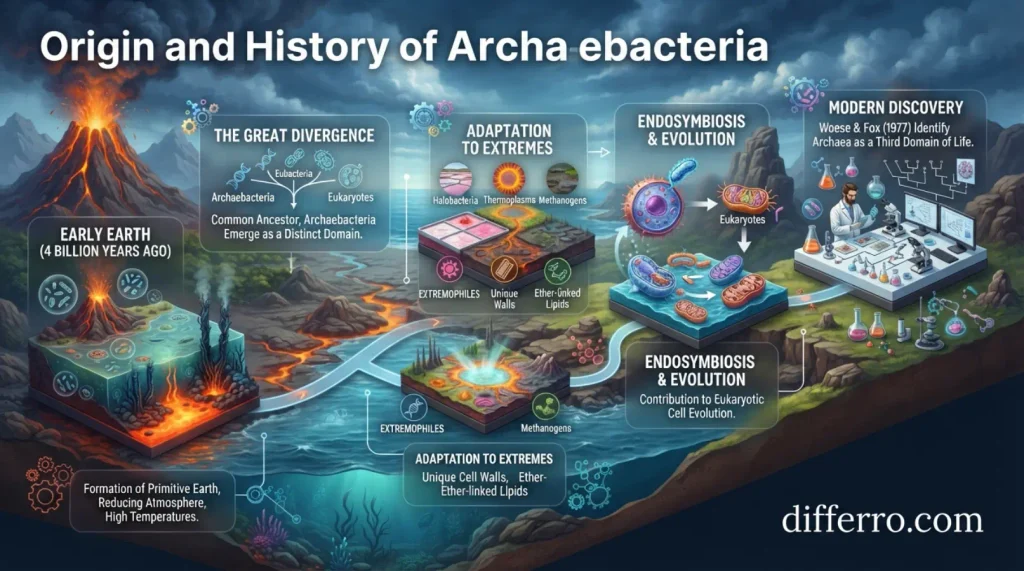
📚 Origin and History of Archaebacteria Nutrition
The term archaebacteria combines archae, meaning ancient, with bacteria. Scientists once grouped archaea with bacteria because both lack a nucleus.
In 1977, Carl Woese and George Fox identified major differences between these microorganisms and other bacteria. Later research established Archaea as a separate domain of life alongside Bacteria and Eukarya.
Scientists now generally use the term archaea rather than archaebacteria. This distinction matters because archaea have unique molecular and biochemical features.
Similar Biological Terms
- Autotroph: An organism that builds organic compounds from inorganic carbon.
- Heterotroph: An organism that obtains carbon from organic compounds.
- Chemotroph: An organism that obtains energy from chemical reactions.
- Phototroph: An organism that obtains energy from light.
- Methanogen: An archaeon that produces methane as part of its metabolism.
These terms describe different features of an organism’s nutrition and metabolism.
🇬🇧 British English vs American English Spelling
The terms Archaebacteria Nutrition, autotrophs, and heterotrophs have the same standard spelling in British and American English.
Scientists in both countries commonly use archaea as the modern group name.
The main differences involve pronunciation preferences or general spelling conventions, not these scientific terms.
British vs American English Comparison
| Feature | British English | American English |
|---|---|---|
| Archaebacteria | Archaebacteria | Archaebacteria |
| Autotrophs | Autotrophs | Autotrophs |
| Heterotrophs | Heterotrophs | Heterotrophs |
| Modern scientific term | Archaea | Archaea |
| Scientific meaning | Same | Same |
🧪 When Are Archaebacteria Autotrophs?
Archaea are autotrophs when they obtain inorganic carbon, usually carbon dioxide, and convert it into organic compounds.
Many autotrophic archaea use chemical energy rather than sunlight. Scientists call organisms that use energy from inorganic chemical reactions chemolithotrophs. When they also fix carbon dioxide, they are chemolithoautotrophs.
Examples of Autotrophic Archaea
- Some methanogens use carbon dioxide as a carbon source.
- Certain ammonia-oxidizing archaea obtain energy by oxidizing ammonia and can fix carbon dioxide.
- Some archaea in hydrothermal environments use chemical energy to support carbon fixation.
These processes help support ecosystems where sunlight cannot provide the main energy source.
Why Autotrophy Matters
Autotrophic archaea help move carbon from inorganic sources into living organisms. Their activities also contribute to nitrogen and carbon cycling.
In some environments, they support other microorganisms by producing organic compounds that enter the local food web.
🌱 When Are Archaebacteria Heterotrophs?
Archaea are heterotrophs when they obtain their carbon from existing organic compounds. Depending on the species, they may also obtain energy from these compounds.
Some heterotrophic archaea use sugars, amino acids, or other organic substances. Others rely on more specialized compounds found in particular environments.
Examples of Heterotrophic Archaea
- Some soil archaea use organic compounds from decomposing material.
- Certain marine archaea consume organic carbon compounds in seawater.
- Some salt-loving archaea use organic nutrients available in salty habitats.
Their nutritional strategies vary widely. Scientists continue to discover how different archaeal groups obtain carbon and energy.
Why Heterotrophy Matters
Heterotrophic archaea help recycle organic carbon. They participate in microbial food webs and interact with bacteria and other microorganisms.
These activities support nutrient cycling in soil, oceans, sediments, and other habitats.
⚠️ Common Mistakes About Archaebacteria Nutrition
Mistake 1: Saying All Archaea Are Autotrophs
Incorrect: All Archaebacteria Nutrition make their own food.
Correct: Archaea include autotrophs and heterotrophs. Their nutritional methods vary by species.
Mistake 2: Saying All Archaea Are Heterotrophs
Incorrect: Every archaeon depends on organic food from other organisms.
Correct: Some archaea fix carbon dioxide and build organic compounds from inorganic carbon.
Mistake 3: Confusing Energy Sources With Carbon Sources
Incorrect: An organism that uses chemical energy must be a heterotroph.
Correct: Chemical energy does not determine whether an organism is autotrophic or heterotrophic. Carbon source determines that distinction.
Mistake 4: Assuming All Methanogens Have Identical Nutrition
Incorrect: Every methanogen uses exactly the same food sources.
Correct: Methanogens use different substrates, depending on the species. Some use carbon dioxide and hydrogen, while others use compounds such as acetate or methylated substances.
Mistake 5: Calling Archaea Ordinary Bacteria
Incorrect: Archaebacteria Nutrition are simply another type of modern bacteria.
Correct: Scientists classify Archaea and Bacteria as separate domains of life. Archaea have distinct genetic and biochemical features.
🧠 Easy Trick to Remember
Use this simple memory trick:
- Autotroph = makes organic food from inorganic carbon.
- Heterotroph = gets carbon from organic compounds.
Remember the phrase “Archaea can do both.”
Some archaea fix carbon dioxide, while others depend on organic carbon. Their energy sources can also differ, so always check both carbon and energy requirements when studying a species.
🌍 Everyday-Life Examples: Are Archaebacteria Autotrophs or Heterotrophs?
1. Archaea in Deep-Sea Environments
Some archaea live near hydrothermal vents, where chemical reactions provide energy. Certain species use this energy to fix carbon dioxide.
Nutrition type: Autotrophic, when they use inorganic carbon to build organic compounds.
Related keyword: Autotrophic archaea examples.
2. Archaea in Oxygen-Free Sediments
Some methanogens live in oxygen-free mud and sediments. Certain species use carbon dioxide and hydrogen to produce methane.
Nutrition type: Some are autotrophic because they fix carbon dioxide.
Related keyword: Are methanogens autotrophs or heterotrophs?
3. Archaea in Salty Lakes
Salt-loving archaea live in environments with very high salt concentrations. Some species use organic compounds to obtain carbon and support growth.
Nutrition type: Heterotrophic, when they rely on organic carbon.
Related keyword: Heterotrophic archaea examples.
4. Archaea in Soil
Soil contains many microorganisms that interact with organic matter. Some archaea use available organic compounds, while others obtain energy from inorganic chemical reactions.
Nutrition type: It depends on the species and its metabolism.
Related keyword: Archaea nutrition and habitats.
5. Archaea in Marine Environments
Marine archaea contribute to carbon and nitrogen cycling. Some ammonia-oxidizing archaea gain energy by oxidizing ammonia and fix carbon dioxide.
Nutrition type: Autotrophic in species that fix inorganic carbon.
Related keyword: Autotrophic archaea in oceans.
🌎 Google Trends and Usage Insights: Five Countries
Google Trends reports relative search interest rather than exact search volumes. The following observations are topic-based expectations, not verified live rankings.
- USA: Students may search this question for biology homework, quizzes, and microbiology lessons.
- UK: Searches may focus on archaeal nutrition, classification, and the differences between archaea and bacteria.
- Australia: Educational searches may include autotrophic archaea, methanogens, and extremophiles.
- India: The question may attract students studying school biology, microbiology, and competitive examinations.
- Pakistan: Search intent may center on biology notes, textbook questions, and exam preparation.
SEO insight: The exact keyword targets a clear educational question. Include a direct answer near the top, then support it with definitions, examples, and a comparison table. Check Google Trends for each country before claiming search-volume differences or ranking one variation above another.
Comparison Table: Keyword Variations
| Keyword variation | Search intent | Best placement |
|---|---|---|
| Are archaebacteria autotrophs or heterotrophs | Direct educational answer | Title and introduction |
| Are archaea autotrophs or heterotrophs | Modern scientific terminology | FAQ and introduction |
| Archaebacteria nutrition | General biology learning | Main sections |
| Autotrophic archaea examples | Example-based learning | Autotroph section |
| Heterotrophic archaea examples | Example-based learning | Heterotroph section |
| Are methanogens autotrophs or heterotrophs | Specific organism question | Everyday examples |
| How do archaea obtain energy | Metabolism research | Related content |
❓ Frequently Asked Questions
1. Is it correct to say archaebacteria are autotrophs or heterotrophs?
Yes, but the most accurate answer is that archaea include both types. Some fix carbon dioxide, while others obtain carbon from organic compounds.
2. What is the difference between autotrophic and heterotrophic archaea?
Autotrophic archaea use inorganic carbon, usually carbon dioxide, to build organic compounds. Heterotrophic archaea obtain carbon from existing organic compounds.
3. Which type is more common among archaea?
There is no single answer that applies to every archaeal environment or species group. Archaea have diverse nutritional strategies, and their distribution depends on their habitat and ecological role.
4. What is the formal scientific term for archaebacteria?
Scientists generally use Archaea for this domain of life. The term archaebacteria is older and can cause confusion because archaea are not members of the Bacteria domain.
5. Why do students confuse autotrophic and heterotrophic archaea?
Students often assume that all archaea share one nutritional method because textbooks introduce them as a single group. In reality, different archaeal species use different carbon and energy sources.
✅ Final Verdict: Are Archaebacteria Autotrophs or Heterotrophs?
Archaebacteria Nutrition can be both autotrophs and heterotrophs. The answer depends on how each species obtains its carbon.
Autotrophic archaea use inorganic carbon, usually carbon dioxide, to build organic compounds. Heterotrophic archaea obtain carbon from existing organic substances.
Some methanogens and ammonia-oxidizing archaea provide examples of autotrophic metabolism. Other archaea rely on organic compounds for growth.
Remember that energy source and carbon source describe different aspects of nutrition. An archaeon can use chemical energy and still qualify as an autotroph if it fixes carbon dioxide.
For biology exams, the clearest answer is: Archaea include both autotrophic and heterotrophic organisms. Their nutritional methods vary according to the species and environment.
Conclusion
Are archaebacteria autotrophs or heterotrophs? Archaea can be both, depending on their nutritional strategies. Autotrophic archaea build organic compounds from inorganic carbon, usually carbon dioxide. Heterotrophic archaea obtain carbon from existing organic compounds.
Some archaea use chemical reactions to obtain energy, while others rely on organic substances. Methanogens and ammonia-oxidizing archaea provide useful examples of archaeal metabolism. These microorganisms contribute to carbon cycling and other important ecosystem processes.
Remember that scientists now commonly use the name Archaea instead of archaebacteria. Their nutritional diversity helps them survive in many habitats, from oceans and soil to extreme environments. For exams, always distinguish between an organism’s energy source and its carbon source.

Imran Lodhra is a comparison-focused content writer at Differro.com.
He specializes in creating clear, simple, and informative comparison articles.
His work helps readers understand key differences, pros and cons, and important details.
Imran focuses on accurate, practical, and easy-to-read content for everyday readers.
1 thought on “Archaebacteria Nutrition: Autotrophs or Heterotrophs?”