
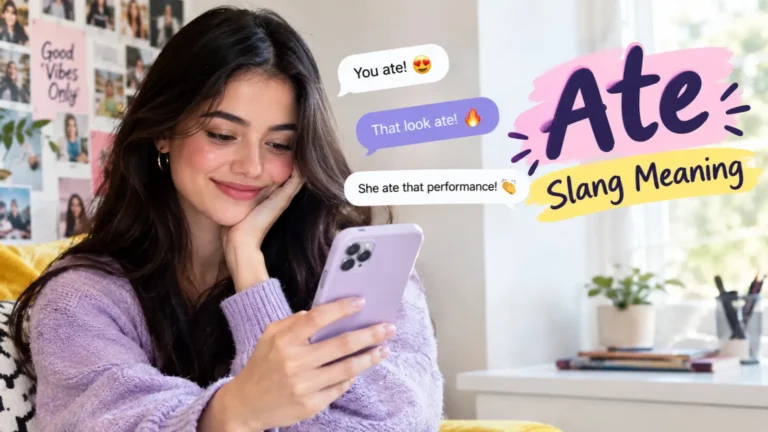
Ate slang meaning is something many people search for when they see this word in text messages, TikTok comments, Instagram captions, or conversations among Gen Z.
If someone comments “You ate!” on your photo or tells you “She ate that look,” they are probably giving a compliment rather than talking about food.
This popular internet expression has become a common way to praise someone’s appearance, performance, confidence, or impressive achievement.
However, its meaning can change slightly depending on the conversation, tone, and situation. Understanding this slang helps you follow online trends and communicate naturally with friends.
In this guide, you’ll learn what ate means, where it came from, how people use it, and how it differs from similar expressions.
Quick Answer:
The slang word “ate” means someone did something extremely well or looked amazing. Saying “You ate!” is a way to praise someone’s style, performance, confidence, or achievement.
What Does Ate Mean in Text?
In texting and online conversations, ate means someone did an excellent job or impressed others with their appearance, skills, attitude, or performance.
When someone says “You ate,” they are usually expressing admiration. They might be complimenting your outfit, celebrating your success, or praising something clever you said.
For example:
- “Girl, you ate that outfit!”
- “He ate during the performance.”
- “You ate and left no crumbs!”
- “She absolutely ate with that makeup look.”
In each example, ate is a positive expression. It suggests that the person did something so well that others were impressed.
Unlike the traditional meaning of eating food, this slang uses “ate” figuratively to describe success or excellence.
Ate Slang Full Form and Definition
People sometimes search for the ate slang full form, but ate is not an abbreviation. It does not have a longer phrase behind each letter.
It is the past tense of the verb “eat,” used as internet slang.
The expression developed a figurative meaning in which someone performs so impressively that they metaphorically consume or dominate the moment.
Simple definition: Ate means performed exceptionally well, looked fantastic, or did something impressive.
For example, if your friend gives a brilliant presentation and you say, “You ate that presentation,” you mean your friend did an outstanding job.
Ate Meaning in Different Contexts
The meaning of ate stays generally positive, but people use it in several situations.
1. Ate Meaning on TikTok
On TikTok, users often write “ate” in comments to praise videos, dance performances, makeup, outfits, or creative content.
Example: “That transition ate!”
Meaning: The video transition was excellent.
2. Ate Meaning on Instagram
On Instagram, ate frequently appears under selfies, fashion posts, makeup pictures, and performance clips.
Example: “You ate this look 🔥”
Meaning: You look amazing, and your style is impressive.
3. Ate Meaning in Text Messages
Friends may use ate in everyday chats to congratulate each other or express excitement.
Example:
Friend: “I finally passed my driving test!”
You: “You ate! Congratulations!”
Here, ate means the person did well and deserves praise.
4. Ate Meaning in Music and Dance
People use ate to compliment a singer, dancer, actor, or performer who delivers an impressive performance.
Example: “She ate that dance routine.”
Meaning: She performed the routine exceptionally well.
5. Ate Meaning in Fashion and Beauty
In fashion and beauty discussions, ate often describes a stylish outfit, flawless makeup, or a confident appearance.
Example: “Your makeup ate today.”
Meaning: Your makeup looks fantastic.
Is Ate Slang Rude, Offensive, or Neutral?
Generally, ate is positive, informal, and friendly. It is commonly used as a compliment among friends, online communities, and people familiar with internet slang.
It is not normally considered rude or offensive.
However, context matters. Someone could use the word sarcastically to mock a poor performance or exaggerate a compliment.
For example:
- Genuine praise: “You ate that speech!”
- Sarcasm: “Wow, you really ate that up,” said after an obvious mistake.
The surrounding conversation, facial expressions, and tone can help you determine the intended meaning.
In professional emails, academic writing, and formal conversations, expressions such as “excellent work” or “you did a great job” are usually more appropriate.
Where Is Ate Slang Commonly Used?
The expression appears across many digital platforms and informal conversations.
Common places include:
- TikTok: Comments about dances, trends, outfits, and videos.
- Instagram: Compliments on photos, reels, makeup, and fashion.
- Snapchat: Friendly messages praising someone’s appearance or achievement.
- X: Reactions to celebrities, music releases, performances, and trending topics.
- Group chats: Celebrating friends’ successes or joking about impressive moments.
- Everyday conversations: Informal praise among people who understand the expression.
The word is especially recognizable in internet and Gen Z culture, although people from other age groups also use it.
Real-Life Conversation Examples of Ate
Here are examples showing how people use ate in different tones and situations.
Friendly Examples
Example 1
Friend A: “What do you think of my new outfit?”
Friend B: “You ate! You look amazing.”
Meaning: The outfit looks excellent.
Example 2
Friend A: “I finally finished my artwork.”
Friend B: “You ate with this one!”
Meaning: The artwork is impressive.
Casual Examples
Example 3
Person A: “Did you watch her performance?”
Person B: “Yes, she ate that!”
Meaning: Her performance was outstanding.
Example 4
Person A: “Look at my new makeup.”
Person B: “The eyeliner ate.”
Meaning: The eyeliner looks especially good.
Argumentative or Sarcastic Examples
Example 5
Person A: “I told everyone I was right, but I got every fact wrong.”
Person B: “Yeah, you really ate that up.”
Meaning: Depending on the tone, this may be sarcastic rather than complimentary.
Example 6
Person A: “He tried to insult her, but she had a perfect comeback.”
Person B: “She ate him up!”
Meaning: She responded so effectively that she won the exchange.
Notice that “ate him up” can mean someone verbally outperformed another person. It does not usually describe literal eating in this context.
Emotional and Psychological Meaning of Ate
Ate is more than a description of success. It can also communicate excitement, admiration, encouragement, and social connection.
People use it to:
- Make friends feel confident.
- Celebrate achievements.
- Show appreciation for creativity.
- Express excitement about a performance.
- Participate in online trends.
- Build a sense of belonging within a community.
For example, commenting “You ate!” on a friend’s achievement can make the praise feel energetic and personal.
Like other slang expressions, its emotional effect depends on the relationship between the people communicating and whether the compliment sounds sincere.
Origin and Background of Ate Slang
The slang use of ate is associated with African American English and Black LGBTQ+ and ballroom cultures, where expressive language has influenced wider internet and popular culture.
The figurative idea of “eating” something up connects to doing something impressively or dominating a performance. The expression “ate and left no crumbs” intensifies the compliment, suggesting that someone performed so well that nothing was left to criticize.
Social media platforms, particularly TikTok and Instagram, helped spread the expression to broader audiences.
Today, people use ate in fashion, entertainment, gaming, school, work-related discussions, and everyday online conversations.
Ate vs. Similar Slang Terms
Several internet expressions have meanings close to ate, but each carries a slightly different emphasis.
| Slang term | Meaning | Example |
|---|---|---|
| Ate | Did something exceptionally well | “You ate that performance!” |
| Slayed | Looked amazing or performed brilliantly | “She slayed that outfit.” |
| Nailed it | Did something successfully | “You nailed the presentation.” |
| Killed it | Performed extremely well | “He killed it on stage.” |
| Served | Presented an impressive look, style, or attitude | “She served confidence.” |
| Understood the assignment | Successfully met expectations | “That outfit understood the assignment.” |
All these expressions can be compliments, but ate often sounds especially natural in social media comments and Gen Z conversations.
When Should You Use Ate Slang?
Use ate when you want to give an enthusiastic, informal compliment.
It works well when:
- Praising a friend’s outfit.
- Complimenting a dance or singing performance.
- Celebrating someone’s achievement.
- Reacting to a clever comeback.
- Commenting on impressive creative work.
- Responding to a great social media post.
For example, “You ate that presentation!” is appropriate in a casual conversation with a friend.
Avoid using it when a formal or respectful tone is expected, especially in official business communication, academic writing, or conversations with people who may not understand internet slang.
In those settings, say “You did an excellent job” or “Your work was impressive.”
Polite Alternatives to Ate
Although ate is not offensive, some situations call for clearer or more formal wording.
Consider these alternatives:
- “You did an amazing job.”
- “That looks fantastic.”
- “Your performance was excellent.”
- “You handled that perfectly.”
- “Your work is impressive.”
- “You really nailed it.”
- “I love your style.”
These expressions communicate similar praise without relying on internet slang.
Why Do People Use Ate Slang?
People use ate because it is short, expressive, and easy to understand in many online communities.
Instead of writing a long compliment, someone can simply comment “Ate!” or “You ate that!”
The word also adds excitement to conversations. It can make a compliment sound more playful and enthusiastic than a simple “good job.”
Another reason for its popularity is social media culture. Short expressions spread quickly through comments, videos, memes, and celebrity discussions. Once people recognize a phrase, they often adopt it in their own conversations.
Impact of Ate on Communication
Slang can make communication feel relaxed, lively, and personal. Using ate may help friends share excitement and connect through familiar internet language.
However, slang can also create confusion when someone does not know the expression or interprets it literally.
For example, a person unfamiliar with the slang might think “You ate” refers to food rather than a compliment.
The best approach is to consider your audience. Use slang with people who understand it, and choose clearer language when communicating across generations, cultures, or professional settings.
Is Ate Safe to Use on Social Media?
Yes. Ate is generally harmless slang and is widely used as a compliment in online conversations.
It is not inherently vulgar, threatening, or offensive. You can usually use it in comments, captions, messages, and casual discussions.
Still, consider the context before posting. A sarcastic comment can hurt someone’s feelings, even when the words themselves are harmless. Avoid using it to embarrass others or mock a sensitive situation.
Common Misunderstandings About Ate
People sometimes misunderstand this slang because it has a familiar meaning in standard English.
Here are a few common mistakes:
- Thinking it always refers to food: In slang, ate usually describes excellent performance or appearance.
- Assuming it is an acronym: Ate is a word, not an abbreviation with a full form.
- Believing it always refers to looks: It can describe skills, achievements, performances, and clever responses.
- Assuming it is always sincere: It can be sarcastic when the context suggests mockery.
- Thinking only Gen Z can use it: The expression is popular with Gen Z, but anyone familiar with its meaning can use it informally.
Variations and Types of Ate Slang
Several variations add emphasis or change the meaning slightly.
“You Ate”
A direct compliment meaning someone did something exceptionally well.
Example: “You ate that presentation!”
“Ate That Up”
Often means someone performed brilliantly or handled a situation impressively.
Example: “She ate that debate up.”
“Ate and Left No Crumbs”
An intensified compliment suggesting someone did an outstanding job with nothing left to improve.
Example: “That makeup look ate and left no crumbs.”
“She Ate” or “He Ate”
These phrases praise a person’s performance, appearance, or achievement.
Example: “He ate during the final round.”
“Ate Down”
A variation used in some online communities to emphasize an impressive performance or look.
Example: “She ate down with that outfit.”
Usage can vary by community, so not every expression will sound equally natural to every speaker.
How to Respond When Someone Says “You Ate”
If someone tells you that you ate, they are probably complimenting you. You can respond casually or warmly.
Here are some natural replies:
- “Thank you!”
- “Aww, appreciate you!”
- “You think so? 😂”
- “I had to do it!”
- “You already know!”
- “Thanks, I tried my best.”
- “You’re too kind!”
Choose a response that matches the conversation. A simple thank-you works well when you want to acknowledge the compliment without using more slang.
Regional and Cultural Usage
Ate is widely recognized in English-language social media communities, including users in the United States, the United Kingdom, Canada, Australia, and other countries.
Its usage is particularly associated with internet culture and communities that helped popularize the expression. Social media has made it familiar to people who may not use it regularly in everyday speech.
However, slang changes across regions and communities. Some people use ate frequently, while others prefer words such as “slayed,” “crushed it,” or “nailed it.”
Understanding the audience and situation is more important than trying to use every trending expression.
FAQs About Ate Slang Meaning
1. What does ate mean in slang?
Ate means someone did something extremely well, looked amazing, or impressed others. It is generally used as a compliment.
2. What does ate mean in text messages?
In texts, ate usually means “you did an excellent job.” For example, “You ate that outfit” means the outfit looks fantastic.
3. What does ate and left no crumbs mean?
It means someone performed so well or looked so impressive that there was seemingly nothing left to criticize.
4. Is ate slang a compliment?
Yes. Ate is usually a positive compliment used to praise someone’s appearance, skills, performance, or achievement. It can be sarcastic in some contexts.
5. What is the ate slang full form?
Ate has no full form because it is not an acronym. It is the past tense of “eat,” used figuratively in internet slang.
6. Can I use ate in a professional setting?
You can use it with colleagues in informal conversations if everyone understands the slang. In formal emails, meetings, and professional documents, phrases such as “excellent work” are more appropriate.
Conclusion
The ate slang meaning is simple: someone did something exceptionally well, looked fantastic, or impressed others. It is a popular expression in texting, social media comments, and everyday conversations, especially among people familiar with Gen Z internet culture.
From “You ate!” to “ate and left no crumbs,” the expression gives compliments an enthusiastic and playful tone. Although it is generally positive and harmless, sarcasm and context can change how a message sounds.
Use ate when celebrating a friend’s outfit, praising a performance, or recognizing an impressive achievement. When communicating formally or with someone unfamiliar with slang, choose a clearer alternative. Understanding the meaning and context will help you use this expression naturally and confidently.

Ali Raza is an M.Phil. scholar and English language expert specializing in English grammar, slang meanings, vocabulary, and everyday expressions. He writes clear, practical, and easy-to-understand content that helps readers master confusing English words, phrases, spelling, and modern slang. His goal is to make English learning simple, useful, and accessible for students, beginners, and everyday readers.
1 thought on “Ate Slang Meaning in Text: Definition, Examples, and Usage”