
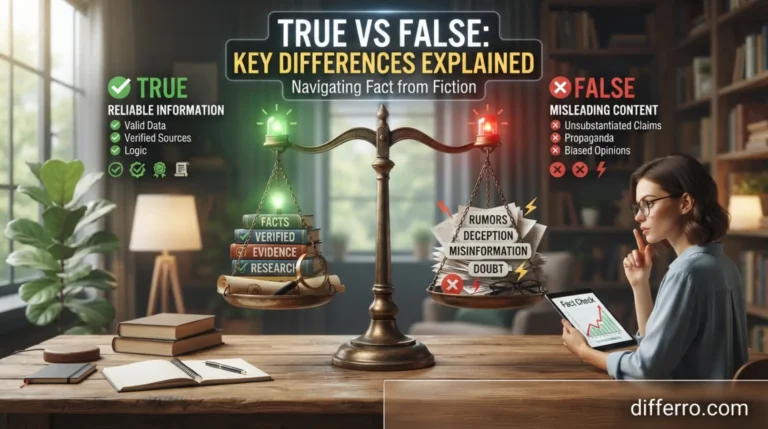
True vs False ? This common phrase helps people decide whether a statement matches reality. People use it in quizzes, classroom activities, online discussions, and everyday conversations. However, the phrase can also describe a question, a judgment, or a way to check information.
Understanding true or false helps you answer questions accurately and express your opinions clearly. The word true describes something that agrees with facts or reality. The word false describes something incorrect, untrue, or misleading.
Both words play an important role in English grammar, education, logic, and communication. They often appear together because they represent opposite answers. For example, a teacher might ask whether the Earth revolves around the Sun. Students can answer “true” because the statement matches scientific evidence.
This guide explains the meaning of True vs False , its common uses, everyday examples, and frequent mistakes. You will also learn how to use the phrase correctly in formal and informal situations.
⭐ Quick Answer
True or false is a phrase that asks whether a statement is correct or incorrect. True means something agrees with facts, while false means something does not.
Example: “The Earth revolves around the Sun. True or false?” The correct answer is true.
📘 Meaning of True
The word true means correct, accurate, or consistent with facts and reality. It can also describe something genuine, faithful, or sincere.
People use true to confirm information, describe honest feelings, and identify facts.
Examples of True
- The statement is true. The information matches the facts.
- She is a true friend. She shows genuine care and loyalty.
Other everyday examples include:
- “Your answer is true.”
- “This story is based on true events.”
- “He always tells the truth.”
- “A true friend supports you during difficult times.”
📘 Meaning of False
The word false means incorrect, untrue, or inconsistent with facts. It can also describe something fake, misleading, or deliberately dishonest.
People use false to identify incorrect statements, reject inaccurate information, and describe things that lack authenticity.
Examples of False
- The statement is false. The information does not match the facts.
- The police discovered a false identity. Someone used an identity that was not genuine.
Other everyday examples include:
- “That answer is false.”
- “The rumor turned out to be false.”
- “The document contains false information.”
- “The advertisement made a false claim.”
🔍 True or False: Key Differences
True vs False have opposite meanings, but both help people evaluate information.
| Feature | True | False |
|---|---|---|
| Meaning | Correct or factual | Incorrect or untrue |
| Tone | Confirms or supports a claim | Rejects or contradicts a claim |
| Usage | Facts, statements, answers, and genuine feelings | Errors, incorrect claims, fake items, and misleading information |
| Popularity | Common in everyday English | Common in everyday English |
| Opposite word | False | True |
| Example | Water freezes at 0°C under standard atmospheric pressure. | The Sun revolves around the Earth. |
The popularity of each word depends on context. Neither word is universally more common or better than the other.
📚 Origin and History of True or False
The word true comes from Old English trēowe, which carried meanings related to faithfulness, honesty, and reliability. Over time, it also developed its familiar meaning of factual correctness.
The word false entered English through Old French and Latin. Its historical roots connect it with deception, untruth, and dishonesty.
English speakers have used these words for centuries to discuss honesty, accuracy, and reliable information.
Similar Word Examples
These related words can help you understand the difference:
- Truth and falsehood: A truth agrees with reality; a falsehood contradicts it.
- Correct and incorrect: Correct information meets the relevant standard; incorrect information does not.
- Accurate and inaccurate: Accurate information reflects the facts; inaccurate information contains errors.
- Genuine and fake: Genuine describes something authentic; fake describes something that imitates the real thing.
- Right and wrong: These words can describe factual accuracy, proper conduct, or moral judgments.
Remember that these pairs do not always have identical meanings. For example, right and wrong can express moral judgments, while true and false often evaluate statements.
🇬🇧 British English vs American English
British English and American English use true, false, and True vs False in the same way. Neither variety changes the spelling of these words. Both varieties also use the phrase in quizzes, examinations, and everyday conversations.
| Feature | British English | American English |
|---|---|---|
| Correct spelling | True or false | True or false |
| Meaning | Correct or incorrect | Correct or incorrect |
| Quiz usage | True-or-false questions | True-or-false questions |
| Common variation | Context and local teaching preferences | Context and local teaching preferences |
The phrase has no major British-American spelling difference. Writers in both countries can use it confidently.
📝 When to Use True
📝 When to Use True
Use true when a statement matches facts, evidence, or reality. You can also use it to describe genuine feelings, loyalty, or authenticity.
1. To Confirm Facts
Use true when information agrees with established facts.
Example: “The Earth has one natural moon.” This statement is true.
2. To Answer Questions
Use true when a quiz or examination presents a correct statement.
Example: “A triangle has three sides. True or false?” The answer is true.
3. To Describe Genuine Feelings
Use true when someone expresses sincere emotions or loyalty.
Example: “My best friend is a true supporter.”
4. To Describe Authentic Things
Use true when something is genuine rather than fake.
Example: “This shop sells true leather products.”
In this example, genuine leather may sound more natural in formal product descriptions.
📝 When to Use False
Use false when a statement contradicts facts or contains incorrect information. You can also use it for fake objects, misleading claims, and dishonest actions.
1. To Correct Incorrect Statements
Use false when a statement does not match reality.
Example: “The Moon produces its own light.” This statement is false because the Moon reflects sunlight.
2. To Identify Wrong Quiz Answers
Use false when a question presents an incorrect statement.
Example: “Fish live naturally on land. True or false?” The answer is false.
3. To Warn About Misleading Information
Use false to identify claims that lack factual support or contradict reliable evidence.
Example: “The newspaper corrected its false report.”
4. To Describe Fake Information or Objects
Use false when something misrepresents its identity or facts.
Example: “The website displayed a false address.”
⚠️ Common Mistakes With True or False
Writers sometimes confuse these words with related expressions. These mistakes can make sentences unclear or grammatically incorrect.
Mistake 1: Confusing True With Truth
Incorrect: “Your answer is truth.”
Correct: “Your answer is true.”
Use true as an adjective and truth as a noun.
Mistake 2: Confusing False With Falsely
Incorrect: “The statement is falsely.”
Correct: “The statement is false.”
Use false to describe a statement. Use falsely to describe an action or claim.
Mistake 3: Treating an Unproven Claim as Automatically False
Incorrect: “Nobody has proved the claim, so it must be false.”
Correct: “Nobody has proved the claim, so we cannot confirm it yet.”
A lack of evidence does not always prove a claim false. Sometimes the available evidence remains incomplete.
Mistake 4: Writing True or False as One Word
Incorrect: “Choose the trueorfalse answer.”
Correct: “Choose the true-or-false answer.”
Use hyphens when the phrase functions as a compound adjective before a noun. Otherwise, write it without hyphens.
Mistake 5: Using False When You Mean Dishonest
Incorrect: “She gave a false answer because she wanted to deceive everyone.”
Better: “She gave a dishonest answer because she wanted to deceive everyone.”
False can describe an incorrect answer, while dishonest emphasizes intentional deception. Choose the word that matches your meaning.
Mistake 6: Assuming Every Opinion Is True or False
Incorrect: “Chocolate ice cream tastes better than vanilla. That is objectively true.”
Correct: “I prefer chocolate ice cream to vanilla.”
Personal preferences express opinions. They do not always have objectively verifiable true-or-false answers.
🧠 Easy Trick to Remember
Remember this simple rule:
- True = Facts match.
- False = Facts do not match.
Think of a classroom quiz. If the statement agrees with reliable facts, select true. If it contradicts reliable facts, select false.
Memory example:
“The Earth revolves around the Sun.”
- True: The statement agrees with scientific evidence.
- False: This answer contradicts scientific evidence.
You can also remember that truth is the noun and true is the adjective.
Example: “The truth is clear, and the statement is true.”
🌍 Everyday Life Examples: Write 5 Examples
These five situations show how people use true, false, and true or false in everyday English.
Example 1: In a Classroom
A teacher writes a statement on the board and asks students to evaluate it.
Question: “Plants need sunlight to grow. True vs False ?”
Answer: True. Most plants need light for photosynthesis, although their specific light requirements vary.
This example shows how true-or-false questions help students test their knowledge.
Example 2: On Social Media
A friend shares a surprising claim online. You decide to check it before sharing it.
Example: “This viral post contains false information.”
The phrase identifies information that contradicts reliable evidence. Always verify the claim before labeling it false.
Example 3: During a Conversation
Two friends discuss something they heard about a local event.
Example: “Is it true that the school will reopen tomorrow?”
The speaker asks whether the information matches reality. The listener should check a reliable announcement before answering.
Example 4: In a Job Interview
An interviewer asks a candidate to describe their experience honestly.
Example: “Please provide true information about your previous employment.”
Here, true emphasizes accuracy and honesty. The candidate should provide accurate details rather than exaggerate their experience.
Example 5: While Taking an Online Quiz
A student answers a general knowledge question on a website.
Question: “The Pacific Ocean is the largest ocean on Earth. True or false?”
Answer: True.
This example demonstrates the common use of true-or-false questions in digital learning activities.
These variations cover related search intentions without requiring repetitive keyword usage.
📊 Google Trends and Usage Data: USA, UK, Australia, India, and Pakistan
The phrase True vs False appears in education, quizzes, fact-checking, and everyday communication. However, I have not verified live Google Trends figures for these five countries, so the table below provides qualitative search-intent insights rather than measured rankings.
- USA: Relevant to classroom quizzes, online trivia, fact-checking, and general knowledge.
- UK: Useful for school exercises, educational resources, and everyday questions.
- Australia: Relevant to quizzes, learning materials, and factual discussions.
- India: May attract learners searching for meanings, examples, grammar explanations, and quiz questions.
- Pakistan: May interest English learners, students, teachers, and people preparing educational activities.
Comparison Table: Keyword Variations
| Country | Suggested keyword variation | Likely search intent |
|---|---|---|
| USA | True or false questions | Quizzes and trivia |
| UK | True or false meaning | Vocabulary and education |
| Australia | True or false quiz | Learning and entertainment |
| India | True or false meaning in English | English learning |
| Pakistan | True or false examples | Grammar and classroom learning |
SEO insight: These suggestions represent plausible search intents, not confirmed country-specific search volumes. Use Google Trends with each country selected to compare actual interest over the same period. The results can help you prioritize keywords based on observed demand.
⚖️ Final Verdict: True or False?
Neither word is better in every situation. Choose true when a statement agrees with facts, and choose false when it contradicts them.
Use true to confirm accurate information, genuine feelings, or authentic things. Use false to identify incorrect statements, misleading claims, or fake information.
The complete phrase True vs False works especially well in quizzes, classroom exercises, surveys, and fact-checking activities. It asks readers to decide whether a statement matches reality.
Remember that an unverified statement is not automatically false. Check reliable evidence before reaching a conclusion.
If you understand this basic distinction, you can use both words confidently in everyday conversations, academic writing, and professional communication.
❓ Frequently Asked Questions
1. Is “true or false” grammatically correct?
Yes, true or false is grammatically correct. People use it to ask whether a statement agrees with facts or contradicts them. For example, “Water is wet. True or false?”
2. What is the difference between true and false?
True means correct or consistent with reality. False means incorrect or inconsistent with reality. For example, “The Earth orbits the Sun” is true, while “The Sun orbits the Earth” is false.
3. Which word is more common, true or false?
Both words are common in English. Their frequency depends on the subject, context, and sentence. Educational quizzes often use both words together.
4. Can I use true or false in formal writing?
Yes. You can use both words in academic papers, reports, examinations, and professional communication. However, formal writing may require you to explain the evidence supporting your conclusion.
5. Why do people confuse true and false?
People sometimes confuse these words when they misunderstand a statement, lack relevant knowledge, or encounter misleading information. Checking reliable evidence helps them distinguish accurate claims from incorrect ones.
🏁 Conclusion
Understanding True or false helps you communicate clearly and evaluate information accurately. The word true describes statements that agree with facts, while false describes statements that contradict them. Both words serve important roles in education, everyday conversations, professional communication, and online discussions.
Remember the simple rule: true means the facts match, and false means they do not. Use these words carefully when answering questions, checking claims, or explaining information to others. Do not automatically label an unverified statement false. Instead, examine reliable evidence before reaching a conclusion. With these examples and practical tips, you can confidently understand the meaning of True vs False and use the phrase correctly in everyday English.

Imran Lodhra is a comparison-focused content writer at Differro.com.
He specializes in creating clear, simple, and informative comparison articles.
His work helps readers understand key differences, pros and cons, and important details.
Imran focuses on accurate, practical, and easy-to-read content for everyday readers.
1 thought on “True vs False : Key Differences Explained”