
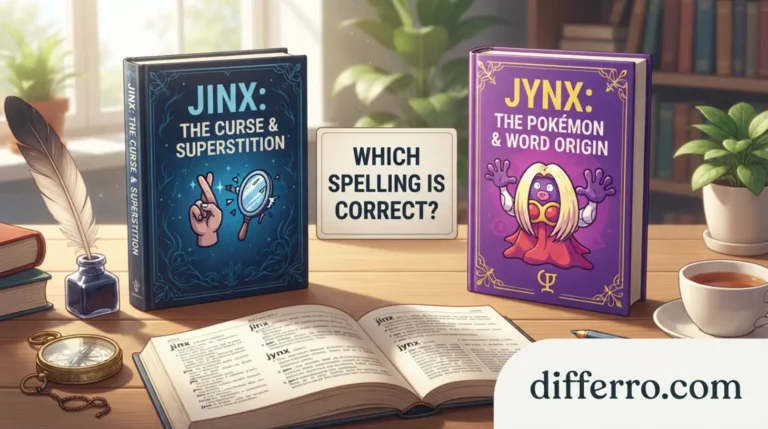
Jinx or jynx is a common spelling confusion in English. Both spellings look similar, but only one works as the standard English word.
The correct spelling is jinx. It describes bad luck, something that brings misfortune, or an action people believe causes bad luck. People also use it as a verb when they think someone has brought bad luck to an event or situation.
The spelling jynx sometimes appears in usernames, brand names, creative writing, and online conversations. However, it does not serve as the standard spelling of the ordinary English word. This difference matters when you write school assignments, blog posts, professional messages, or everyday English.
In this guide, you will learn the meanings of both spellings, their origins, and their correct uses. You will also find practical examples, common mistakes, memory tips, and answers to frequently asked questions.
⭐ Quick Answer
Jinx is the correct standard English spelling. It means bad luck or something believed to cause misfortune. Jynx is a nonstandard spelling that people may use for creative names or usernames.
Example: Don’t say that our team will lose. You might jinx us!
📖 Meaning of Jinx
The word jinx works as both a noun and a verb.
As a noun, it means a person, thing, or situation associated with bad luck. As a verb, it means to bring or seem to bring bad luck to someone or something.
Examples of Jinx
- Everyone blamed the jinx when their team lost another important match.
- Don’t jinx our plans by talking about success too early.
Common Uses of Jinx
- Bad luck: People sometimes call a series of unfortunate events a jinx.
- Superstition: Someone may believe that certain words or actions bring bad luck.
- Everyday conversation: Friends may jokingly accuse each other of causing bad luck.
- Sports: Fans sometimes avoid discussing victory because they fear jinxing their team.
The word often appears in playful conversations. However, people may also use it seriously when discussing superstitions.
📖 Meaning of Jynx
Jynx is not the standard spelling of the ordinary English word jinx. Writers may choose it as a creative alternative for names, usernames, fictional characters, or brands.
Its meaning depends on the context. A person who uses Jynx as a username might simply like the appearance of the spelling. A fictional character named Jynx may have a special meaning within a story.
Examples of Jynx
- Jynx is the username she chose for her gaming account.
- The fantasy novel introduces Jynx as a mysterious character.
These examples use Jynx as a chosen name, not as the standard English word for bad luck.
Important: Do not replace jinx with jynx in ordinary sentences about bad luck.
🔍 Jinx vs Jynx: Key Differences
| Feature | Jinx | Jynx |
|---|---|---|
| Spelling status | Standard English word | Nonstandard variant spelling |
| Meaning | Bad luck or to bring bad luck | Depends on the chosen name or context |
| Tone | Neutral, playful, or superstitious | Creative, stylized, or name-like |
| Usage | Everyday English, writing, and speech | Usernames, fictional names, and branding |
| Popularity | Established dictionary spelling | Less common as an ordinary word |
| Formal writing | Correct | Avoid as a substitute for jinx |
The main difference is simple: jinx is the correct spelling for the ordinary English word. Use jynx only when a specific name, title, or creative choice requires it.
📚 Origin and History of Jinx
The English word jinx emerged in American English around the early twentieth century. It became associated with bad luck, superstitions, and people or things believed to cause misfortune.
Its deeper origin remains uncertain. Some accounts connect it with jynx, an older word for the wryneck bird. Ancient beliefs associated this bird with magical practices and omens. However, the exact historical path from those associations to the modern English word is not completely certain.
The modern spelling jinx became established through ordinary English usage. The spelling jynx may resemble older forms or appear as a deliberate creative variation, but it does not replace jinx in standard writing.
Similar Words and Expressions
- Curse: Words or actions believed to bring harm or misfortune.
- Hex: A spell or act intended to bring bad luck.
- Bad omen: Something people interpret as a warning of future trouble.
- Misfortune: An unlucky or unfortunate event.
- Superstition: A belief that certain actions or events influence luck without a reliable basis.
These words share related ideas, but they do not always mean exactly the same thing.
🇬🇧 British English vs American English Spelling
The standard spelling jinx works in both British and American English. Neither variety normally uses jynx as the correct spelling of the ordinary word.
Unlike words such as colour and color, this spelling does not change between the two major varieties. Writers in Australia, India, and Pakistan also generally use jinx.
British vs American English Comparison
| Feature | British English | American English |
|---|---|---|
| Correct spelling | Jinx | Jinx |
| Alternative spelling | Jynx is nonstandard | Jynx is nonstandard |
| Meaning | Bad luck or to bring bad luck | Bad luck or to bring bad luck |
| Example | Don’t jinx the match. | Don’t jinx the game. |
The examples reflect common regional word choices, not a difference in the spelling of jinx.
✍️ When to Use Jinx
✍️ When to Use Jinx
Use jinx whenever you discuss bad luck, an unlucky situation, or the act of bringing bad luck.
1. Use Jinx as a Noun
A noun names a person, place, thing, or idea. The word jinx can describe a supposed source of bad luck.
Examples:
- That broken clock seems to be a jinx.
- Our team cannot escape this jinx.
- He thinks the old house carries a jinx.
2. Use Jinx as a Verb
A verb describes an action. People use jinx when they believe someone’s words or actions might cause bad luck.
Examples:
- Don’t jinx our chances of winning.
- I hope I haven’t jinxed the weather.
- She jinxed the game by celebrating too early.
3. Use Jinx in Casual Conversations
Friends often use the word jokingly. They may say it when two people speak the same words simultaneously.
Example:
“We both said the same thing! Jinx!”
This playful expression does not necessarily involve a serious belief in bad luck.
🎮 When to Use Jynx
Use jynx when the context specifically calls for that spelling, such as a username, fictional name, or established brand.
1. Usernames and Gaming
Players sometimes choose unusual spellings to create memorable online identities.
Example: Jynx joined the gaming tournament with a new team.
Here, Jynx represents a username rather than the ordinary word for bad luck.
2. Fictional Characters
Authors can create characters with distinctive names.
Example: Jynx used her magical powers to protect the village.
The spelling works because the author deliberately chose it as a character’s name.
3. Creative Branding
Businesses and creators sometimes choose unusual spellings to make their names distinctive.
Example: The designer named her digital art project Jynx.
Remember that creative names follow their owners’ choices. Standard English spelling rules still apply to ordinary writing.

⚠️ Common Mistakes: Jinx or Jynx
Avoid these common spelling and usage mistakes.
Mistake 1: Using Jynx to Mean Bad Luck
Incorrect: I don’t want to jynx our chances.
Correct: I don’t want to jinx our chances.
Why? Jinx is the standard spelling for the verb meaning to bring or seem to bring bad luck.
Mistake 2: Assuming Both Spellings Are Interchangeable
Incorrect: The word jynx is the standard spelling for bad luck.
Correct: The word jinx is the standard spelling for bad luck.
Why? Similar appearances do not make two spellings equally correct.
Mistake 3: Changing a Person’s Chosen Name
Incorrect: The gaming character’s name must be Jinx, not Jynx.
Correct: The gaming character’s name is Jynx.
Why? Proper names can use creative spellings. Follow the spelling the person or creator actually uses.
Mistake 4: Using Jynx in School Assignments
Incorrect: I think this rainy weather will jynx our picnic.
Correct: I think this rainy weather will jinx our picnic.
Why? Standard spelling matters in schoolwork, professional writing, and formal communication.
Mistake 5: Confusing Jinx With a Guaranteed Curse
Incorrect: Saying the word jinx always causes bad luck.
Correct: Some people believe certain words can bring bad luck.
Why? A jinx describes a superstition or perceived cause of misfortune. The word itself does not establish that supernatural effects occur.
🧠 Easy Trick to Remember Jinx or Jynx
Use this simple memory trick:
JINX = bad luck.
Remember the letter I in jinx as the first letter of the phrase “I don’t want bad luck.”
For example:
- I don’t want to jinx the match.
- I hope I didn’t jinx our plans.
- That losing streak feels like a jinx.
Keep Jynx for a specific name or creative spelling.
One more tip: If you can replace the word with “bring bad luck,” use jinx.
Example: “Don’t bring bad luck to our team” becomes “Don’t jinx our team.”
🌟 Everyday Life Examples: Jinx or Jynx
1. Jinx in Sports
Example: “Don’t talk about winning yet. You might jinx the team.”
This sentence uses the correct spelling because the speaker fears causing bad luck.
2. Jinx in Everyday Plans
Example: “I won’t celebrate until the tickets arrive. I don’t want to jinx anything.”
The speaker uses jinx to express caution in a playful, superstitious way.
3. Jynx as a Gaming Username
Example: “Jynx defeated every opponent in the final round.”
Here, Jynx works as a chosen username. It does not replace the ordinary English word.
4. Jinx in Family Conversations
Example: “You said the baby would sleep all night, and now she’s awake. You jinxed it!”
The speaker uses jinxed as the past tense of the standard verb jinx.
5. Jynx as a Fictional Character
Example: “Jynx discovered a hidden doorway beneath the castle.”
The spelling is appropriate if the story identifies Jynx as a character’s name.
These variations address spelling confusion, word meaning, and practical usage without unnecessary repetition.
🌍 Google Trends and Usage Data: USA, UK, Australia, India, and Pakistan
Google Trends can help writers compare search interest across countries. However, it does not automatically provide exact search volumes for every spelling.
- USA: The standard spelling jinx is the appropriate choice for everyday American English.
- UK: British English also uses jinx, with no regional spelling change.
- Australia: Australian writers generally use jinx in standard English.
- India: English learners can benefit from spelling comparisons and example sentences.
- Pakistan: Clear explanations of jinx and jynx can help students and online readers avoid spelling mistakes.
These are spelling and usage recommendations, not measured country-by-country search rankings. I have not verified numerical Google Trends scores for these five countries.
Comparison Table: Keyword Variations
| Keyword | Search Intent | Content Opportunity |
|---|---|---|
| Jinx or Jynx | Spelling comparison | Explain the correct spelling |
| Jinx meaning | Definition | Explain noun and verb meanings |
| Is Jynx a word? | Word validity | Explain standard usage and names |
| Jinx vs Jynx difference | Comparison | Show the main differences |
| How to use jinx | Grammar and examples | Provide practical sentences |
| Jinx spelling in English | Spelling help | Explain the standard spelling |
| Jinx examples | Learning and usage | Give everyday examples |
SEO insight: Focus on the exact phrase “jinx or jynx” in the title, introduction, and one relevant heading. Add meaning-based variations naturally to answer related questions.
For reliable regional comparisons, select a time range and compare both terms separately in Google Trends. Google normalizes its interest scores, so they do not represent exact search counts. Google Trends also notes that misspellings and spelling variations may not appear automatically in search-term comparisons. See the official Google Trends comparison guide and regional interest guide.
❓ Frequently Asked Questions
1. Is Jynx a correct spelling?
Jynx is not the standard spelling of the ordinary English word for bad luck. However, it can work as a proper name, username, or creative spelling.
2. What is the difference between Jinx and Jynx?
Jinx is the standard English word for bad luck or the act of bringing bad luck. Jynx is a nonstandard alternative when used as the ordinary word, but it can serve as a chosen name.
3. Which spelling is more common, Jinx or Jynx?
Jinx is the standard spelling in ordinary English writing. Jynx appears in some names, usernames, and creative contexts.
4. Should I use Jinx or Jynx in formal writing?
Use jinx in formal writing when you mean bad luck or causing bad luck. Use Jynx only when reproducing a specific name or title.
5. Why do people confuse Jinx and Jynx?
Both spellings look similar and represent a similar sound for many English speakers. Online usernames and fictional names also expose readers to the alternative spelling.
✅ Final Verdict: Jinx or Jynx?
Jinx is the correct choice for standard English. Use it when discussing bad luck, superstition, or an action believed to cause misfortune.
For example, write “Don’t jinx our chances” rather than “Don’t jynx our chances.”
Choose Jynx when you refer to a specific person, character, username, or brand that uses that spelling. In those situations, the spelling serves as a name rather than a standard alternative to jinx.
If you are writing an essay, school assignment, website article, or professional message, choose jinx for the ordinary word. This simple rule will help you avoid spelling mistakes and communicate clearly.
📝 Conclusion
The difference between jinx and jynx is simple once you understand their uses. Jinx is the standard English spelling for bad luck, an unlucky influence, or the act of bringing bad luck. You can use it as both a noun and a verb in everyday conversations and formal writing.
Jynx is not the standard spelling of that ordinary English word. However, writers, gamers, and creators may use it as a distinctive name or creative variation. The context determines whether that choice fits.
Remember this easy rule: use jinx for bad luck and Jynx for a specific name that uses the alternative spelling. Applying this rule will improve your spelling, strengthen your writing, and help you choose the correct word confidently.

Imran Lodhra is a comparison-focused content writer at Differro.com.
He specializes in creating clear, simple, and informative comparison articles.
His work helps readers understand key differences, pros and cons, and important details.
Imran focuses on accurate, practical, and easy-to-read content for everyday readers.
1 thought on “Jinx or Jynx: Which Spelling Is Correct?”