

Dying or dieing can confuse writers because the base verb is die. Many people expect to add -ing directly and write “dieing.” However, standard English uses dying when you mean the process of losing life or coming to an end. Dictionaries list dying as the present participle of die. (Cambridge Dictionary)
The spelling becomes easier when you remember the -ie to -y pattern. Similar verbs include lie → lying and tie → tying. This spelling pattern explains why dieing is not the normal form for death.
There is one important exception. Dieing can appear in specialized manufacturing contexts when it relates to a die, a tool used to cut, shape, or form materials. This meaning is rare in everyday English. (Scrabble Dictionary)
⭐ Quick Answer
Dying is the correct spelling when you mean losing life, fading, declining, or coming to an end. Dieing is not the normal spelling for this meaning.
Example: The old tree is dying because it lacks water. ✅
Meaning of Dying
Dying is the present participle of the verb die. It describes someone or something that is losing life or moving toward an end. (Cambridge Dictionary)
It can also describe something that is becoming weaker or less common.
Examples of Dying
- The flowers are dying without enough water.
- Many traditional crafts are dying out.
The word can also appear in figurative expressions.
For example, someone can say, “I am dying to see the movie.” This means they are extremely eager to see it.
Meaning of Dieing
Dieing is usually incorrect when you mean the process of dying.
However, dieing has a specialized meaning connected with the verb die, when die means to cut, shape, or stamp material with a manufacturing die. Some dictionaries list this technical verb form. (Scrabble Dictionary)
Examples of Dieing
- The factory uses machines for dieing metal parts.
- The technical manual discusses dieing processes.
For everyday English, avoid this rare technical form unless your context specifically requires it.
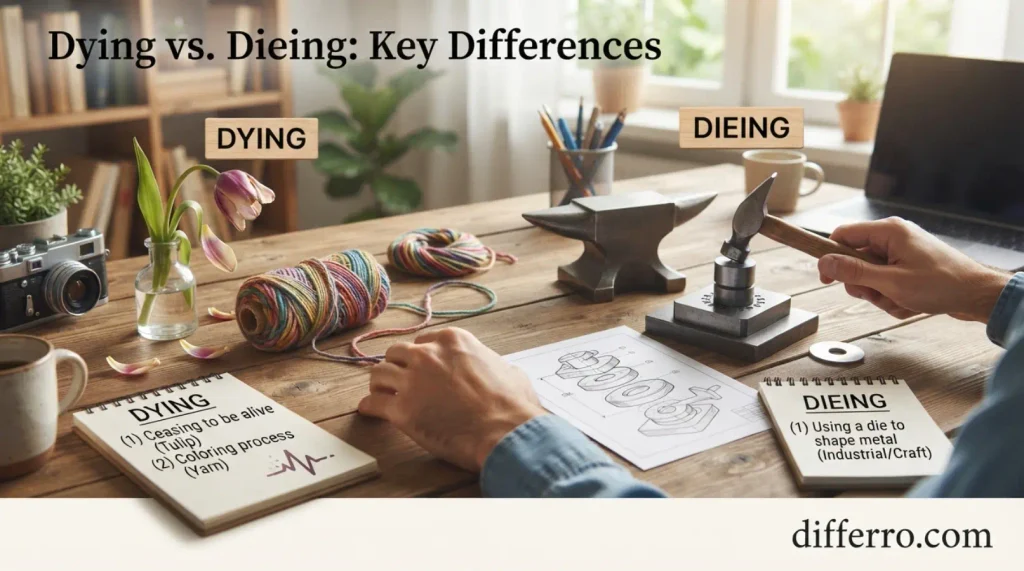
🔍 Dying or Dieing: Key Differences
| Feature | Dying | Dieing |
|---|---|---|
| Meaning | Losing life or coming to an end | Cutting or shaping with a die |
| Tone | Normal and widely used | Rare and technical |
| Usage | Everyday, academic, news, and formal writing | Specialized manufacturing contexts |
| Popularity | Very common | Very rare |
| Standard choice for death | Yes | No |
For almost every general writing situation, choose dying.
📚 Origin and History
The word dying comes from the verb die. Oxford lists dying as the present participle of die and traces its word origin to the late 16th century. (Oxford Learner’s Dictionaries)
English spelling changes some verbs ending in -ie before adding -ing. The ie changes to y.
This gives us familiar forms such as:
- Die → dying
- Lie → lying
- Tie → tying
The change prevents forms such as “dieing,” “lieing,” and “tieing” in standard spelling.
The technical word dieing has a different history. It comes from another meaning of die, which refers to a tool used for cutting or shaping materials. (Dictionary.com)
British English vs American English Spelling
There is no normal British-American spelling difference for this word.
British English uses dying.
American English also uses dying.
🇬🇧 British vs 🇺🇸 American English
| Feature | British English | American English |
|---|---|---|
| Correct spelling | Dying | Dying |
| Meaning | Losing life or declining | Losing life or declining |
| “Dieing” for death | Incorrect | Incorrect |
| Technical “dieing” | Rare | Rare |
So, dying works correctly in both British and American English.
✍️ When to Use Dying
Use dying when someone or something is losing life.
Example:
- The patient is dying.
- The injured animal is dying.
Use it when something is gradually disappearing.
Example:
- The old tradition is dying.
- The village’s fishing industry is dying.
You can also use dying for things that are running out or stopping.
Example:
- My phone battery is dying.
- The fire is dying down.
You can also use it in informal expressions.
Example:
- I am dying to know what happened.
- We were dying with laughter.
🏭 When to Use Dieing
Use dieing only when your writing specifically discusses the technical process connected with a manufacturing die.
A die can be a tool that cuts, forms, stamps, or shapes materials. (Dictionary.com)
For example:
- The company uses dies to shape metal parts.
- The technical report discusses dieing operations.
However, modern technical writing often prefers clearer terms such as die cutting, die forming, or die stamping.
Therefore, general readers should almost always choose dying.
⚠️ Common Mistakes
Mistake 1: Writing Dieing for Death
❌ The plant is dieing.
✅ The plant is dying.
Use dying when something is losing life.
Mistake 2: Following Die + Ing Literally
❌ Die + ing = dieing
✅ Die → dying
Remember the spelling change from ie to y.
Mistake 3: Confusing Dying With Dyeing
❌ She is dying her hair.
✅ She is dyeing her hair.
Dyeing means changing the color of something with dye.
Mistake 4: Assuming Dieing Is the British Spelling
❌ British English uses dieing.
✅ Both British and American English use dying.
There is no normal regional spelling difference here.
Mistake 5: Calling Every Use of Dieing Wrong
❌ “Dieing” can never appear in English.
✅ “Dieing” can appear in a rare technical sense related to a manufacturing die.
This distinction matters in specialist writing. (Scrabble Dictionary)
🧠 Easy Trick to Remember
Use this simple rule:
IE → Y before -ING
Think of these three words together:
- Die → Dying
- Lie → Lying
- Tie → Tying
So, when you mean “losing life,” remember:
Die + ing = Dying ✅
Not:
Die + ing = Dieing ❌
For most everyday writing, this trick will give you the correct answer.
🌎 Dying or Dieing in Everyday Life
1. Talking About Plants
The flowers are dying because nobody watered them.
Here, dying describes plants losing life.
Primary keyword: dying
Secondary keyword: dying or dieing
2. Talking About Phone Batteries
My phone is dying, so I need to find a charger.
English speakers commonly use dying for a battery that is almost empty.
3. Talking About Traditions
Some old traditions are slowly dying.
Here, dying means becoming less common or disappearing.
Dictionaries also use dying for things that are declining or nearing an end. (Oxford Learner’s Dictionaries)
4. Talking About a Person
The doctors knew that the patient was dying.
Here, dying describes the process of approaching death.
5. Talking About Hair Color
Mia is dyeing her hair this weekend.
This example shows why dying and dyeing need attention.
Dying relates to death or decline.
Dyeing relates to adding color.
📈 Google Trends & Usage Data
Search interest around dying or dieing mainly reflects spelling confusion rather than equal word usage.
Current web usage strongly favors dying, while dieing appears mostly in spelling questions or rare technical contexts. (Grammer Nests)
The same spelling rule applies across the USA, UK, Australia, India, and Pakistan.
Country-level search interest can change with education, news, culture, and current events, so trends do not determine correct spelling.
🌍 Five-Country Usage Insight
| Country | Standard spelling | Search intent insight |
|---|---|---|
| 🇺🇸 USA | Dying | Grammar and general usage |
| 🇬🇧 UK | Dying | Spelling and English learning |
| 🇦🇺 Australia | Dying | General English usage |
| 🇮🇳 India | Dying | Strong English-learning interest |
| 🇵🇰 Pakistan | Dying | Common learner spelling confusion |
The important SEO insight is simple: “dying” is the standard word, while “dieing” creates a strong correction intent.
That makes dying or dieing a useful comparison keyword for English-learning content.
📊 Comparison Table: Keyword Variations
| Keyword Variation | Main Intent | Best Answer |
|---|---|---|
| dying or dieing | Spelling confusion | Dying |
| dieing or dying | Spelling comparison | Dying |
| dying vs dieing | Difference | Dying is standard |
| is it dying or dieing | Correctness | Dying |
| correct spelling of dying | Spelling | Dying |
| how to spell dying | Educational | Dying |
| is dieing a word | Word validity | Rare technical use |
⚖️ Final Verdict
Dying is the correct and standard spelling when you mean losing life, declining, fading, or coming to an end.
Use:
The tree is dying. ✅
Do not write:
The tree is dieing. ❌
Use dieing only if your subject specifically involves the rare technical meaning connected with a manufacturing die.
For schoolwork, websites, emails, social media, journalism, and normal professional writing, dying is the safe and correct choice.
Also remember dyeing. Use it when you mean changing the color of something.
❓ FAQ
Is “dying” correct?
Yes. Dying is the standard present participle of die. It describes losing life or moving toward an end. (Cambridge Dictionary)
What is the difference between dying and dieing?
Dying means losing life, declining, fading, or approaching an end. Dieing is rare and can describe a technical process involving a manufacturing die.
Which is more common, dying or dieing?
Dying is far more common in ordinary English. It appears in everyday speech, news, literature, education, and formal writing.
Is dieing acceptable in formal writing?
Avoid dieing in normal formal writing. Use dying when you mean death or decline. A specialized technical context may use dieing for a manufacturing process. (Scrabble Dictionary)
Why does the confusion between dying and dieing exist?
The confusion comes from the base verb die. Writers may naturally expect to add -ing and produce “dieing.” English instead changes ie to y before -ing.
📝 Conclusion
The correct spelling depends on what you mean, but dying is the answer in almost every everyday situation. Use dying when someone loses life or something gradually disappears, weakens, or ends. The word works the same way in British and American English. Dieing is rare and belongs mainly to a specialized technical meaning related to a manufacturing die. You should not use it for ordinary references to death. Also watch for dyeing, which means changing the color of something. The easiest memory trick is to remember die → dying, just like lie → lying and tie → tying. When in doubt, choose dying for normal English writing.

Imran Lodhra is a comparison-focused content writer at Differro.com.
He specializes in creating clear, simple, and informative comparison articles.
His work helps readers understand key differences, pros and cons, and important details.
Imran focuses on accurate, practical, and easy-to-read content for everyday readers.
1 thought on “Dying or Dieing: Which Spelling Is Correct?”