

is 19 prime or composite? The answer is simple: 19 is a prime number. It has exactly two positive factors, 1 and 19. (Cuemath)
Many students confuse prime and composite numbers because both describe whole numbers greater than 1. The easiest way to decide is to check the number’s factors. A prime number has exactly two factors. A composite number has more than two factors.
When we check 19, no whole number from 2 through 18 divides it evenly. Therefore, 19 has no factor besides 1 and itself. This makes 19 an odd prime number.
⭐ Quick Answer
Is 19 prime or composite?
19 is a prime number, not a composite number. Its only factors are 1 and 19, so it has exactly two factors.
Example: 19 ÷ 1 = 19 and 19 ÷ 19 = 1.
🔢 What Is a Prime Number?
A prime number is a whole number greater than 1 with exactly two positive factors. Those factors are 1 and the number itself.
For example:
- 7 is prime because its factors are 1 and 7.
- 11 is prime because its factors are 1 and 11.
Is 19 a Prime Number?
Yes. 19 is prime because it has only two factors:
1 × 19 = 19
No other whole number divides 19 without leaving a remainder. Therefore, 19 meets the definition of a prime number. (Cuemath)
🔢 What Is a Composite Number?
A composite number is a whole number greater than 1 with more than two positive factors.
For example:
- 8 is composite because its factors are 1, 2, 4, and 8.
- 15 is composite because its factors are 1, 3, 5, and 15.
A composite number can always be divided evenly by at least one number besides 1 and itself.
Is 19 a Composite Number?
No. 19 is not composite because it has only two factors.
Its factors are:
1 and 19
Since it does not have a third factor, 19 cannot be classified as composite. (Cuemath)
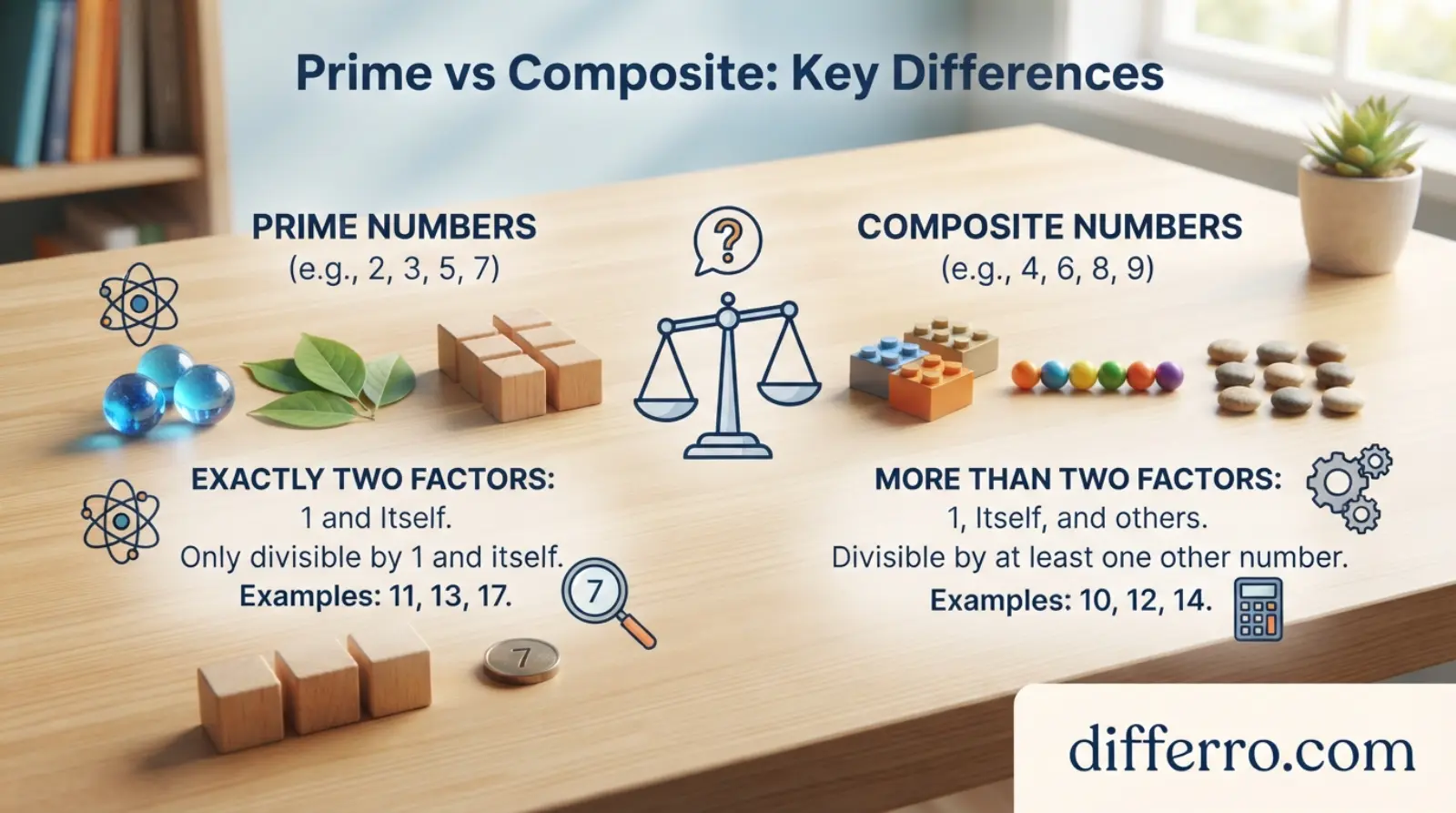
📊 Prime vs Composite: Key Differences
| Feature | Prime Number | Composite Number |
|---|---|---|
| Meaning | Has exactly two factors | Has more than two factors |
| Factors | 1 and itself | More than 1 and itself |
| Example | 19 | 18 |
| Usage | Used in prime factorization | Can be broken into smaller factors |
| Popularity | Common in number theory | Common in basic arithmetic |
🧮 Why Is 19 Prime?
You can prove that 19 is prime by testing possible divisors.
The square root of 19 is about 4.36. Therefore, we only need to test prime numbers up to 4.36.
Those numbers are:
- 2
- 3
Now check them:
19 ÷ 2 = 9.5
So, 2 does not divide 19 evenly.
19 ÷ 3 = 6.333…
So, 3 does not divide 19 evenly.
Because neither 2 nor 3 divides 19, the number has no additional factor. Therefore, 19 is prime. (Ask Math Guru)
📚 Origin and History of the Terms
The word prime comes from the Latin word primus, meaning “first” or “primary.” Mathematics uses the term because prime numbers act as basic building blocks for whole numbers.
The word composite comes from Latin roots meaning “put together.” Composite numbers can be formed by multiplying smaller whole numbers.
For example:
- 2 × 3 = 6
- 3 × 5 = 15
- 4 × 5 = 20
These products create composite numbers.
Other related mathematical terms include:
- Factor
- Divisor
- Multiple
- Prime factor
- Composite number
British English vs American English Spelling
The terms prime number and composite number have the same spelling in British and American English.
There is no British-versus-American spelling difference for these mathematical terms. Both forms are standard.
| Term | British English | American English |
|---|---|---|
| Prime number | Prime number | Prime number |
| Composite number | Composite number | Composite number |
| Factor | Factor | Factor |
| Divisor | Divisor | Divisor |
✏️ When to Use “Prime Number”
Use prime number when a whole number has exactly two positive factors.
Examples:
- 19 is a prime number.
- 13 is a prime number.
- 17 is a prime number.
- 23 is a prime number.
You can also say:
“19 is prime.”
Both expressions have the same mathematical meaning.
✏️ When to Use “Composite Number”
Use composite number when a whole number has more than two positive factors.
Examples:
- 12 is a composite number.
- 18 is a composite number.
- 21 is a composite number.
- 25 is a composite number.
For example, 21 has factors 1, 3, 7, and 21, so it is composite.
⚠️ Common Mistakes About 19
Mistake 1: Saying 19 Is Composite
Incorrect: 19 is a composite number.
Correct: 19 is a prime number.
19 has only two factors.
Mistake 2: Thinking Every Odd Number Is Prime
Incorrect: Every odd number is prime.
Correct: Some odd numbers are composite.
For example, 9 is odd but composite because its factors are 1, 3, and 9.
Mistake 3: Forgetting That 1 Is a Factor
Incorrect: 19 has only one factor.
Correct: 19 has two factors: 1 and 19.
The number itself always counts as a factor.
Mistake 4: Calling 19 an Even Number
Incorrect: 19 is an even prime.
Correct: 19 is an odd prime.
19 cannot divide evenly by 2.
Mistake 5: Assuming “Not Composite” Means Neither
Incorrect: 19 is neither prime nor composite.
Correct: 19 is prime.
Every whole number greater than 1 is either prime or composite.
🧠 Easy Trick to Remember
Use this simple rule:
Prime = exactly two factors.
Think:
1 + itself = prime
For 19:
1 and 19 → only two factors → PRIME
A quick memory sentence is:
“19 has two, so it is prime too.”
🌟 Everyday Life Examples
Example 1: A Math Worksheet
A student sees the question, “Is 19 prime or composite?”
The student lists its factors:
1, 19
There are exactly two factors. The answer is prime.
Example 2: Checking Divisibility
A teacher asks students to divide 19 by 2, 3, 4, and 5.
None divides 19 evenly. Therefore, students identify 19 as a prime number.
Example 3: Prime Number Lists
A student writes prime numbers from 1 to 20.
The list includes:
2, 3, 5, 7, 11, 13, 17, 19
Therefore, 19 is the eighth prime number. (Wikipedia)
Example 4: Comparing 19 and 21
19 has factors 1 and 19.
21 has factors 1, 3, 7, and 21.
So, 19 is prime, while 21 is composite.
Example 5: Prime Factorization
Suppose you need the prime factorization of 19.
Because 19 is already prime, its prime factorization is simply:
19
There is no smaller prime factor to break it down further.
🌍 Google Trends & Usage Insight
Search interest can vary across the USA, UK, Australia, India, and Pakistan because students use different educational resources and search habits. Exact Google Trends values also change by date, location, and search category.
For this topic, the strongest search intent centers on “is 19 prime,” “is 19 a prime number,” and “is 19 prime or composite.” These variations all seek the same mathematical answer.
The keyword is especially suitable for educational search traffic because students often search direct question-style queries.
Keyword Variations Comparison
| Keyword Variation | Search Intent | Best Content Use |
|---|---|---|
| is 19 prime or composite | Direct answer | Primary keyword |
| is 19 a prime number | Informational | H2 and FAQ |
| is 19 prime | Short question | Introduction |
| is 19 composite | Verification | FAQ |
| factors of 19 | Educational | Supporting section |
| prime factors of 19 | Mathematics | Supporting section |
| 19 prime number | Direct fact | Supporting keyword |
✅ Final Verdict
19 is a prime number, not a composite number.
The factors of 19 are only:
1 and 19
A prime number has exactly two positive factors. Since 19 meets this condition, it is prime.
19 is also an odd prime number because it is not divisible by 2. It is the eighth prime number in the sequence of prime numbers. (Wikipedia)
So, if you see the question “Is 19 prime or composite?”, choose:
Prime ✅
❓ Frequently Asked Questions
Is 19 a prime number?
Yes. 19 is a prime number because it has exactly two positive factors: 1 and 19. (Cuemath)
What is the difference between prime and composite numbers?
A prime number has exactly two factors. A composite number has more than two factors.
Is 19 more commonly considered prime or composite?
19 is always classified as prime. Its only positive factors are 1 and 19.
Is 19 a prime number in formal mathematics?
Yes. Standard mathematical definitions classify 19 as a prime number.
Why does confusion about 19 exist?
Students may confuse odd numbers with prime numbers. However, being odd does not automatically make a number prime.
For example, 9 is odd but composite. 19 is odd and prime.
📝 Conclusion
Is 19 prime or composite? 19 is prime because it has exactly two positive factors: 1 and 19. No whole number between 2 and 18 divides 19 evenly.
This makes 19 different from composite numbers. Composite numbers have more than two factors. For example, 18 has several factors, including 1, 2, 3, 6, 9, and 18.
You can quickly test 19 by checking whether smaller prime numbers divide it evenly. Neither 2 nor 3 divides 19 without a remainder. Therefore, 19 has no additional factor.
Remember the simple rule: two factors means prime, while more than two means composite. So, the correct answer is clear: 19 is a prime number.
🔗 URL Slug
is-19-prime-or-composite
🏷️ 5 SEO-Optimized Title Options
- Is 19 Prime or Composite? Complete Answer
- Is 19 a Prime Number or Composite Number?
- Is 19 Prime or Composite? Factors Explained
- Is 19 Prime? Factors, Proof, and Easy Answer
- 19 Prime or Composite? Learn the Simple Rule
🔗 3 Internal Linking Ideas
- What Is a Prime Number? — Link to your guide explaining prime numbers and their properties.
- What Is a Composite Number? — Link to a beginner-friendly guide on composite numbers and factors.
- Prime Numbers 1 to 100 — Link to a complete list with examples and explanations.
📌 Meta Description
Is 19 prime or composite? Learn why 19 is prime, its factors, and an easy way to check whether a number is prime.

Imran Lodhra is a comparison-focused content writer at Differro.com.
He specializes in creating clear, simple, and informative comparison articles.
His work helps readers understand key differences, pros and cons, and important details.
Imran focuses on accurate, practical, and easy-to-read content for everyday readers.
1 thought on “Is 19 Prime or Composite? Complete Answer”