
ICL meaning slang is a common search among people who see this abbreviation in text messages, TikTok comments, Snapchat chats, Instagram DMs, and online conversations.
If someone sends you “ICL,” you might wonder what it means and why they use it before sharing an opinion. Understanding this popular abbreviation can help you follow conversations and respond naturally.
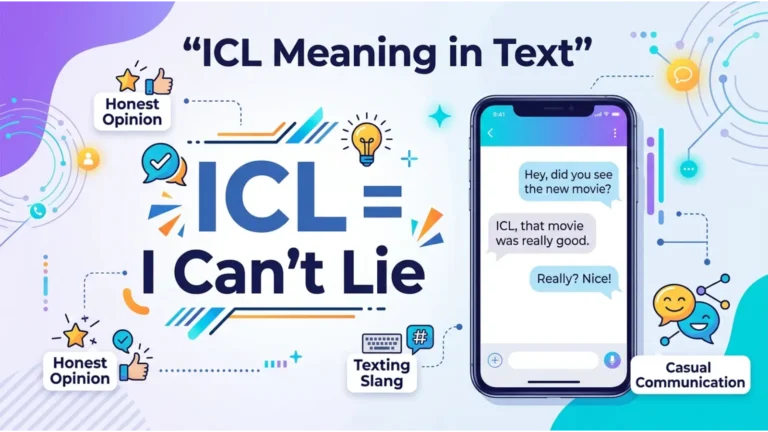
In internet slang, ICL usually stands for “I Can’t Lie.” People use it before expressing an honest opinion, admitting something, sharing a personal preference, or reacting to a situation.
For example, “ICL, this movie was amazing” means the person wants to emphasize their genuine opinion. Although ICL is generally informal and neutral, its tone depends on the complete message and the relationship between the people communicating.
Quick Answer:
ICL means “I Can’t Lie” in texting and internet slang. It is commonly used to introduce an honest-sounding opinion, personal admission, reaction, or confession.
What Does ICL Mean in Text?
In text messages, ICL usually means “I Can’t Lie.” It is a casual abbreviation that people use when they want to introduce something they genuinely think, feel, or believe.
For example:
Person A: What did you think of the new movie?
Person B: ICL, it was better than I expected.
Meaning: The sender is sharing a personal opinion and emphasizing their reaction to the movie.
ICL can appear at the beginning of a sentence, before a statement, or as part of a longer message. It often serves a similar purpose to phrases such as “honestly,” “to be honest,” and “not gonna lie.”
However, using ICL does not prove that someone is telling the truth. It simply communicates how the person wants their statement to be understood.
What Is the ICL Full Form in Slang?
The most common ICL full form in internet slang is I Can’t Lie.
Each letter represents the first letter of a word:
- I = I
- C = Can’t
- L = Lie
Instead of typing the entire phrase, people use ICL to make informal conversations quicker and more convenient.
For example:
- ICL, I miss those days.
- ICL, your idea makes sense.
- ICL, I wasn’t expecting that.
ICL can also have other meanings in specialized fields, including technical and professional contexts. When you encounter it in a casual message or social media comment, however, “I Can’t Lie” is usually the intended meaning.
ICL Meaning Slang in Different Contexts
Although ICL generally stands for “I Can’t Lie,” the message that follows it determines how it functions in a conversation.
1. ICL for Honest Opinions
People often use ICL before expressing a personal judgment or viewpoint.
Example: ICL, the original song is much better.
Meaning: The person is emphasizing their opinion about the song.
2. ICL for Confessions
ICL can introduce an admission about something someone did, forgot, or experienced.
Example: ICL, I completely forgot about our meeting.
Meaning: The sender is openly admitting a mistake.
3. ICL for Compliments
The abbreviation can also emphasize a positive opinion or compliment.
Example: ICL, your new haircut looks amazing.
Meaning: The sender wants the compliment to sound sincere and personal.
4. ICL for Criticism
Sometimes, ICL introduces a negative opinion or disagreement.
Example: ICL, that wasn’t your best performance.
Meaning: The person is expressing a critical opinion. The sentence may sound direct, but the abbreviation itself is not offensive.
5. ICL for Personal Preferences
ICL can help someone introduce a preference without making it sound like an objective fact.
Example: ICL, I’d rather stay home tonight.
Meaning: The sender is explaining what they personally prefer.
Is ICL Rude, Offensive, or Neutral?
ICL is generally neutral and is not inherently rude or offensive. It is an informal expression rather than a swear word or insult.
Its tone depends on the complete sentence, punctuation, and situation.
Here are some examples:
| Example | Possible tone |
|---|---|
| ICL, you’re really talented. | Friendly |
| ICL, I haven’t watched that show. | Neutral |
| ICL, that decision was disappointing. | Critical |
| ICL, you should have told me earlier. | Potentially argumentative |
A message containing ICL can sound supportive, sarcastic, defensive, or critical depending on what comes next.
For this reason, avoid assuming someone is angry simply because they use the abbreviation. Read the whole message before interpreting its tone.
Where Is ICL Commonly Used?
ICL appears in informal digital communication, particularly in conversations where people share opinions or reactions.
You may encounter it on:
- TikTok: In video comments, captions, and discussions.
- Snapchat: In private messages and conversations with friends.
- Instagram: In direct messages, replies, and comments.
- WhatsApp: In personal chats and group conversations.
- Discord: In gaming discussions and online communities.
- Text messages: In everyday conversations with friends and family.
For example, someone commenting “ICL, this deserves more attention” under a video is emphasizing their personal reaction.
ICL is less suitable for formal emails, academic essays, job applications, and professional reports. In those settings, complete expressions such as “honestly” or “in my opinion” are usually clearer.
ICL Conversation Examples in Real Life
The following conversations demonstrate how ICL works in different situations.
Friendly Conversation
Friend A: Do you like my new shoes?
Friend B: ICL, they look really good!
Meaning: The sender is giving a positive opinion.
Casual Conversation
Person A: Are you coming to the party?
Person B: ICL, I’m probably staying home tonight.
Meaning: The sender is sharing a personal preference.
Argumentative Conversation
Person A: You promised to finish the project yesterday.
Person B: ICL, you never reminded me.
Meaning: The sender responds defensively. The argumentative tone comes from the complete message, not ICL alone.
Social Media Conversation
User A: This song is underrated.
User B: ICL, it deserves way more attention.
Meaning: The second user strongly agrees and emphasizes their opinion.
School Conversation
Student A: Was the exam difficult?
Student B: ICL, it was easier than I expected.
Meaning: The student is sharing an honest personal assessment.
Gaming Conversation
Player A: That was a close match!
Player B: ICL, that final round was insane.
Meaning: The player emphasizes their reaction to the game.
ICL vs. NGL vs. TBH: What’s the Difference?
ICL is similar to other texting abbreviations used to introduce opinions, admissions, and reactions. However, each abbreviation has a different full form.
| Slang | Full form | Common use |
|---|---|---|
| ICL | I Can’t Lie | Emphasizing an honest-sounding statement |
| NGL | Not Gonna Lie | Introducing an opinion or admission |
| TBH | To Be Honest | Expressing a sincere opinion |
| IMO | In My Opinion | Sharing a personal viewpoint |
| FR | For Real | Showing agreement or emphasis |
ICL vs. NGL
ICL means “I Can’t Lie,” while NGL means “Not Gonna Lie.” Both often introduce a statement that the speaker wants to present as honest.
- ICL, that restaurant was excellent.
- NGL, that restaurant was excellent.
In these examples, the overall meaning is almost identical.
ICL vs. TBH
TBH means “To Be Honest.” Like ICL, it introduces a sincere opinion or personal admission.
- ICL, I prefer the original version.
- TBH, I prefer the original version.
Both express a personal preference, although the wording differs.
ICL vs. IMO
IMO stands for “In My Opinion.” It specifically identifies a statement as the speaker’s viewpoint, while ICL emphasizes the idea of speaking honestly.
For example, “IMO, this is the best option” directly frames the statement as an opinion.
Why Do People Use ICL?
People use ICL because it is short, familiar to many online users, and convenient for casual conversations.
Common reasons include:
- Speed: It takes less time to type than the full phrase.
- Emphasis: It highlights an opinion or reaction.
- Personal expression: It introduces preferences, admissions, and confessions.
- Conversational style: It helps messages sound informal and relaxed.
- Social familiarity: People who recognize the abbreviation can understand it quickly.
ICL is particularly useful when someone wants to share an opinion that might surprise others or differ from what the group expects.
However, the abbreviation does not automatically make a statement more truthful, polite, or convincing. The actual message still matters.
When Should You Avoid Using ICL?
ICL works well in casual conversations, but it is not appropriate for every situation.
Consider avoiding it in:
- Formal business emails
- Job applications and cover letters
- Academic essays
- Official reports
- Professional presentations
- Important communications that require precise wording
Instead of writing:
“ICL, I think this plan needs changes.”
You could write:
“To be honest, I think this plan needs some changes.”
For a more professional tone, you could say:
“In my opinion, this plan could be improved.”
These alternatives communicate a similar idea while keeping your language clear and appropriate for the audience.
Common Misunderstandings About ICL
Understanding ICL becomes easier when you avoid these common mistakes.
Misunderstanding 1: ICL always means the speaker is telling the truth.
ICL signals an intention to sound honest. It does not independently prove that a statement is accurate.
Misunderstanding 2: ICL is always rude.
No. ICL is generally neutral, although it can appear in critical or argumentative messages.
Misunderstanding 3: ICL and NGL have completely different meanings.
Their full forms differ, but they often serve the same purpose in casual conversations.
Misunderstanding 4: ICL is only used on TikTok.
It can appear across messaging apps, social networks, gaming communities, and group chats.
Misunderstanding 5: Everyone knows what ICL means.
Not everyone is familiar with internet slang. If clarity matters, write the full phrase instead.
How to Respond When Someone Uses ICL
You do not need a special response simply because someone uses ICL. The best reply depends on the statement itself.
Example 1: Someone shares a feeling
Person A: “ICL, I’m exhausted today.”
Person B: “Same here. I barely slept last night.”
Example 2: Someone criticizes something
Person A: “ICL, that restaurant wasn’t very good.”
Person B: “Really? What didn’t you like about it?”
Example 3: Someone gives you a compliment
Person A: “ICL, you did an amazing job.”
Person B: “Thank you! I really appreciate that.”
If you don’t understand the abbreviation, you can simply ask, “What does ICL mean?” In a casual conversation, that is a perfectly reasonable question.
Regional and Cultural Usage of ICL
ICL appears in English-language online conversations across different countries and communities. Social media and messaging platforms allow abbreviations to spread beyond the communities where people first encounter them.
You may see ICL in conversations involving users from the United States, United Kingdom, Canada, Australia, and other English-speaking communities.
However, familiarity varies according to personal experience, age group, and online community. Some people recognize ICL immediately, while others prefer expressions such as “honestly” or “to be honest.”
There is no need to assume everyone will understand the abbreviation. When communicating with someone unfamiliar with internet slang, using the complete phrase is often the clearest option.
Is ICL Safe to Use on Social Media?
Yes. In its common slang meaning, ICL is generally harmless. It is not inherently a swear word, insult, or offensive expression.
For example, “ICL, this is my favorite song” is an ordinary statement of personal preference.
However, the overall message matters more than the abbreviation. Adding ICL before an insult or threatening statement does not make the content harmless.
As with any online communication, consider your audience, tone, and the information you share.
Frequently Asked Questions About ICL Meaning Slang
1. What does ICL mean in texting?
ICL usually means “I Can’t Lie.” People use it before sharing an opinion, reaction, admission, or personal statement.
2. What is the ICL full form in slang?
The common ICL full form in internet slang is “I Can’t Lie.”
3. Is ICL the same as NGL?
They have very similar meanings. ICL stands for “I Can’t Lie,” while NGL stands for “Not Gonna Lie.” Both can introduce an honest-sounding statement.
4. Is ICL rude in a text message?
No. ICL is generally neutral. The complete sentence determines whether a message sounds friendly, critical, sarcastic, or argumentative.
5. What does ICL mean on TikTok?
On TikTok, ICL generally means “I Can’t Lie.” Users may place it before a comment, opinion, or reaction to a video.
6. Can I use ICL in professional emails?
It is better to avoid ICL in formal emails. Use “to be honest,” “honestly,” or “in my opinion” when a more professional tone is needed.
Conclusion
The most common ICL meaning slang is “I Can’t Lie.” It is an informal abbreviation used in text messages, social media comments, gaming chats, and everyday online conversations.
People commonly use ICL before sharing an opinion, admitting something, expressing a reaction, or emphasizing a personal preference. The abbreviation is generally neutral, but its tone depends on the complete message and the context.
When chatting with friends, ICL can sound natural and conversational. In professional or academic communication, complete expressions such as “to be honest” or “in my opinion” are usually more appropriate.
Understanding the context helps you interpret ICL correctly, avoid misunderstandings, and respond naturally in everyday digital communication.

Ali Raza is an M.Phil. scholar and English language expert specializing in English grammar, slang meanings, vocabulary, and everyday expressions. He writes clear, practical, and easy-to-understand content that helps readers master confusing English words, phrases, spelling, and modern slang. His goal is to make English learning simple, useful, and accessible for students, beginners, and everyday readers.
2 thoughts on “ICL Meaning Slang: What Does ICL Mean in Text?”