

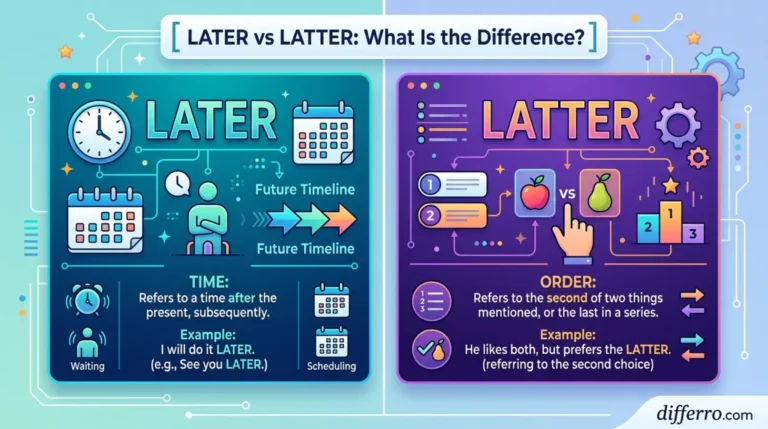
Later vs Latter can confuse writers because these words look and sound very similar. However, they have different meanings and uses. Later mainly refers to time. It means something happens after another time or event. For example, “I will call you later.”
Latter usually refers to the second of two people or things mentioned. It can also mean something near the end of a period. For example, “Between tea and coffee, I prefer the latter.” The key difference is simple. Later relates mainly to time, while latter relates mainly to order or position. Understanding this difference helps you avoid common grammar mistakes.
This guide explains later vs latter with simple definitions, examples, usage rules, common mistakes, and memory tips.
⭐ Quick Answer
Later means at a time after now or after another event. Latter means the second of two things mentioned or something near the end.
Example: “I will call you later.” “I chose tea over coffee because I prefer the latter.”
Meaning of Later
Later means at a time after the present moment or after another event. It can also describe something that happens afterward.
Later commonly works as an adverb. It can also work as a comparative adjective.
Examples of Later
- I will finish my homework later.
- We arrived later than expected.
As an adjective, later can describe a subsequent time or period.
- We made a later decision.
- She moved to another city in her later years.
The word later focuses on time rather than the position of something in a list.
Meaning of Latter
Latter usually means the second of two people or things already mentioned.
It can also mean something closer to the end of a period, activity, or process.
Examples of Latter
- I like both tea and coffee, but I prefer the latter.
- The latter half of the movie was more exciting.
In the first example, “latter” means coffee because coffee appears second.
In the second example, “latter” means the later or final part of the movie.
Dictionaries also describe latter as referring to the second-mentioned item or something near the end.
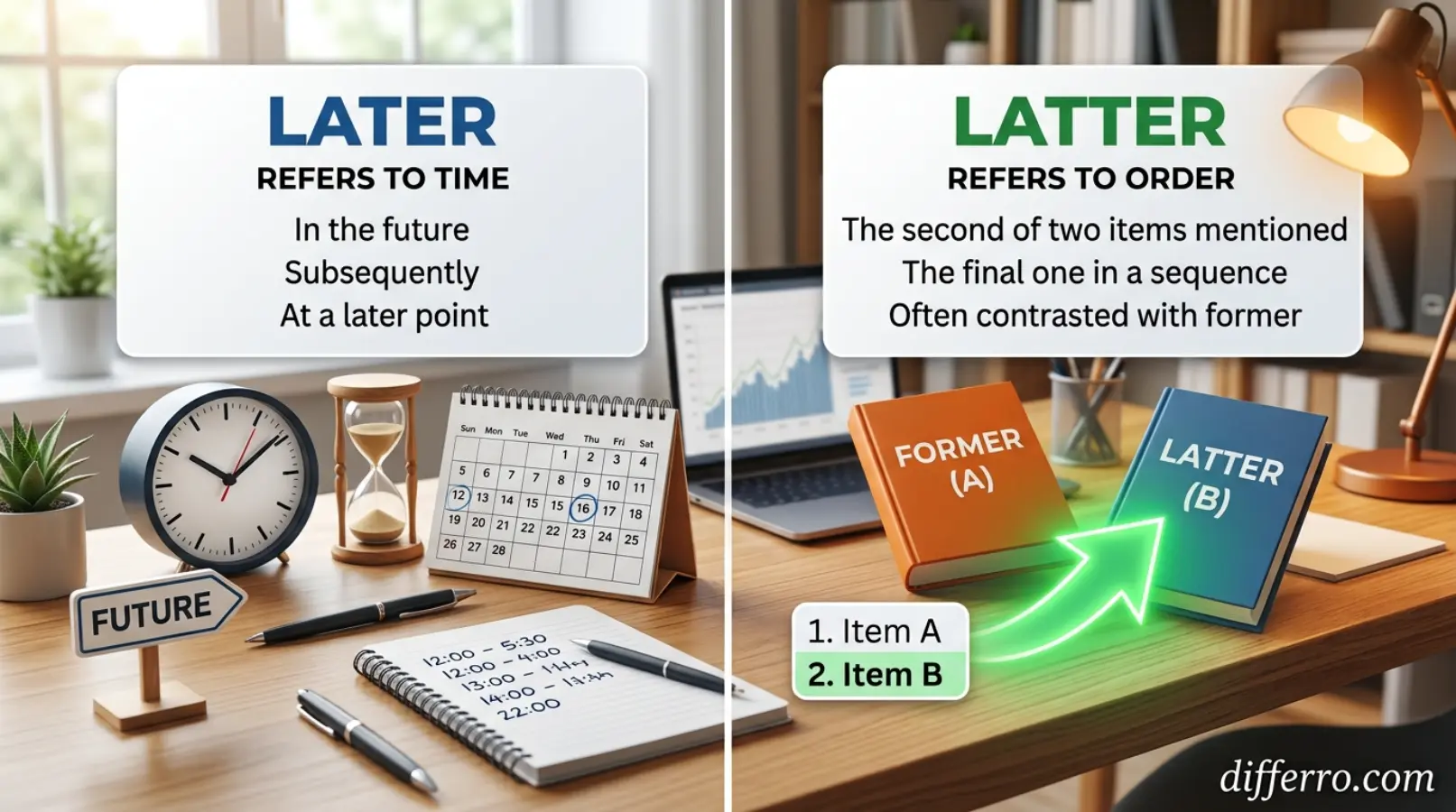
🔍 Key Differences Between Later and Latter
| Feature | Later | Latter |
|---|---|---|
| Meaning | After a time or event | Second of two or near the end |
| Main idea | Time | Order or position |
| Tone | Common and natural | More formal |
| Usage | Daily speech and writing | Formal or comparative writing |
| Popularity | Very common | Less common |
| Example | I will call you later. | I prefer the latter. |
The easiest distinction is time versus position.
Use later when you mean “afterward.”
Use latter when you mean “the second one mentioned.”
📚 Origin and History
Later and latter share a historical connection with the word late.
Later developed from the comparative form of Old English læte or related forms. Its meaning became connected with something happening afterward or at a subsequent time.
Latter developed from an Old English form related to the same root. Middle English forms helped create the spelling and meaning used today.
Over time, the two words developed different modern uses.
Today, later mainly focuses on time.
Latter mainly focuses on the second of two items or the later part of something.
Similar Word Examples
Other related words include:
- Late
- Latest
- Latterly
- Former
- Last
- Afterwards
- Earlier
A useful comparison is former vs latter.
“Former” refers to the first of two items.
“Latter” refers to the second of two items.
🇬🇧 British English vs 🇺🇸 American English Spelling
There is no major spelling difference between later and latter in British and American English.
Both varieties use later for subsequent time.
Both varieties use latter for the second of two items or something near the end.
The main differences involve pronunciation, style, and regional preferences rather than spelling.
British vs American English Comparison
| Word | British English | American English |
|---|---|---|
| Later | Later | Later |
| Latter | Latter | Latter |
| Meaning | Same | Same |
| Spelling | Same | Same |
| Main difference | Pronunciation may vary | Pronunciation may vary |
⏰ When to Use Later
Use later when you talk about a time that comes afterward.
It can refer to a future time.
- I will call you later.
- We can discuss the problem later.
- She arrived later than me.
- I will finish the report later today.
Use later when comparing two times.
- The second train arrived later than the first.
- We chose a later appointment.
You can also use later for a period that follows another period.
- In later years, he became a successful writer.
- The company changed its policy later.
Simple Rule for Later
Ask yourself:
“Am I talking about time?”
If the answer is yes, later will often be correct.
📌 When to Use Latter
Use latter when referring to the second of two previously mentioned items.
For example:
“John enjoys football and tennis, but he prefers the latter.”
Here, latter means tennis because tennis appears second.
You can also use latter for the later part of a period or process.
- The latter half of the year was difficult.
- Sales increased during the latter part of the campaign.
- The latter stages of the project required more work.
Simple Rule for Latter
Ask yourself:
“Am I talking about the second of two things or the later part of something?”
If yes, latter may be the correct word.
⚠️ Common Mistakes
1. Using Later for the Second Item
❌ I like tea and coffee, but I prefer the later.
✅ I like tea and coffee, but I prefer the latter.
The second item is coffee, so latter is correct.
2. Using Latter for Future Time
❌ I will call you latter.
✅ I will call you later.
The sentence refers to future time.
3. Confusing Latter Half With Later Half
Both phrases can appear in English, but they carry different emphasis.
Latter half means the second half of a period.
Later usually describes a time that comes afterward.
✅ The latter half of the year was busy.
✅ We visited the city later that year.
4. Using Latter With More Than Two Items
Latter traditionally refers to the second of two mentioned items.
❌ I compared apples, oranges, and bananas. I chose the latter.
This creates uncertainty because three items appear.
Better:
✅ I compared three fruits and chose bananas.
For a larger list, name the item directly.
Etymological and usage references also caution against using latter for more than two items.
5. Assuming Later and Latter Are Interchangeable
❌ I will discuss this latter.
✅ I will discuss this later.
❌ I prefer the later of the two choices.
✅ I prefer the latter of the two choices.
The words may sound similar, but their meanings differ.
🧠 Easy Trick to Remember Later vs Latter
Use this simple memory trick:
Later = Time
Latter = Two choices
Think of later when something happens afterward.
Think of latter when you choose the second of two things.
You can also remember this:
Latter has two T’s for Two.
This is only a memory trick, but it makes the difference easier to remember.
Quick Memory Examples
- See you later. → Time
- Tea or coffee? I prefer the latter. → Second choice
- We arrived later. → Time
- The latter option is cheaper. → Second option
✍️ Everyday Life Examples of Later vs Latter
1. Daily Conversation
“I am busy right now, but I will call you later.”
Here, later refers to a future time.
2. Choosing Between Two Foods
“I like pizza and burgers, but I prefer the latter.”
Here, latter refers to burgers.
3. Work and Meetings
“The meeting started later than planned.”
The sentence describes time.
4. Comparing Two Options
“The first plan costs less, but the latter offers more features.”
The latter refers to the second plan.
5. Talking About a Period
“The latter part of the year brought several changes.”
Here, latter refers to the part closer to the end.
📊 Google Trends & Usage Data
Google Trends measures search interest rather than dictionary usage or correct grammar.
Search interest can also change by country, period, and search wording.
For Later vs Latter, “later” has a much broader everyday meaning and appears in many ordinary searches.
“Latter” has a narrower meaning and usually appears in grammar, education, and formal writing contexts.
Across the USA, UK, Australia, India, and Pakistan, the practical distinction remains the same. Later serves general time-related searches, while latter serves a narrower language-use purpose.
Country-by-Country Usage Insight
| Country | Later | Latter | Main Insight |
|---|---|---|---|
| USA | Very common | Less common | Later dominates everyday use |
| UK | Very common | Common in formal writing | Both remain established |
| Australia | Very common | Less common | Later appears more broadly |
| India | Very common | Common in education | Grammar searches often explain the difference |
| Pakistan | Very common | Common in English learning | Confusion often appears in grammar contexts |
These patterns reflect the different meanings and everyday applications of the two words. Dictionary sources also show that later has broad time-related uses, while latter has more specific functions.
Keyword Variations Comparison
| Keyword Variation | Search Intent | Main Meaning |
|---|---|---|
| Later vs Latter | Comparison | Difference between both words |
| Later or Latter | Grammar confusion | Which word is correct |
| Latter vs Later | Comparison | Meaning and usage |
| Difference Between Later and Latter | Informational | Detailed grammar explanation |
| Later Meaning | Definition | Meaning of later |
| Latter Meaning | Definition | Meaning of latter |
| Later and Latter Examples | Educational | Sentence examples |
🏁 Final Verdict
Neither word is universally “better.”
The correct choice depends on what you want to express.
Choose later when you mean afterward or at a subsequent time.
- I will finish it later.
- We can talk later.
Choose latter when you mean the second of two things.
- I prefer the latter.
- Between tea and coffee, I chose the latter.
Use latter when describing the part closer to the end.
- The latter half was more interesting.
- The latter stages were challenging.
The simplest rule is:
Later = time.
Latter = second or near the end.
❓ FAQ: Later vs Latter
Is “later” correct?
Yes. Later is correct when you refer to a subsequent time or event.
Example: “I will complete the task later.”
It can also describe a time or period that follows another.
What is the difference between later and latter?
Later mainly refers to time.
Latter usually refers to the second of two mentioned things.
Latter can also mean something closer to the end of a period.
Which is more common, later or latter?
Later is more common in everyday English.
It has many uses related to time and appears frequently in ordinary conversation.
Latter has a narrower function.
It often appears in formal writing, comparisons, and educational contexts.
Is latter more formal than later?
Generally, yes.
Latter can sound more formal because it replaces the name of the second item.
For clarity, writers often repeat the item instead.
For example, “I prefer coffee” may be clearer than “I prefer the latter.”
Why do people confuse later and latter?
People confuse them because they look and sound very similar.
Both words also have historical connections with late.
Their meanings later became more distinct.
Later developed a strong connection with time.
Latter developed a strong connection with order and position.
Conclusion
Later vs Latter becomes easy once you understand their main functions. Later refers mainly to time. It means something happens afterward or at a subsequent time. Latter usually refers to the second of two things already mentioned. It can also describe something near the end of a period.
Remember the simple rule: later means time, while latter means the second or later part. For example, “I will call you later” describes future time. “I prefer the latter” identifies the second choice. Using this distinction will help you write clearer English. When a sentence feels confusing, check if you mean time or position. That quick check can prevent most later vs latter mistakes.


1 thought on “Later vs Latter: What Is the Difference?”