

Among or Amongst is a common English usage question. Both words are correct, and both have the same basic meaning. They describe something that exists within a group or is surrounded by people or things. The main difference comes from style, region, and frequency. Among is the more common choice in modern English. Amongst is also correct, but it can sound more formal, traditional, or literary. It appears more often in British English than American English.
This difference often confuses students, writers, and English learners. Many people wonder if one spelling is grammatically wrong. It is not. You can use both forms in many of the same sentences. However, among is usually the safer choice for everyday and professional writing. This guide explains the meaning, history, usage, tone, and regional differences between among and amongst.
⭐ Quick Answer
Among and amongst are both correct and have the same meaning. Among is more common in modern English, especially in American English. Amongst sounds more formal, traditional, or British.
Example:
She sat among her friends.
She sat amongst her friends.
Both sentences are grammatically correct.
📖 Meaning of Among
Among is a preposition that means being in the middle of, surrounded by, or included within a group.
It can describe people, objects, ideas, or groups. It can also describe something shared or divided within a group.
Examples:
- The teacher walked among the students.
- She found her phone among the books.
Among is the standard choice in most modern English writing. It works naturally in conversations, emails, essays, reports, and professional communication.
📖 Meaning of Amongst
Amongst has the same basic meaning as among. It means being surrounded by or within a group.
It is grammatically correct, but it appears less often than among. And it can sound slightly formal, literary, traditional, or old-fashioned.
Examples:
- The house stood amongst the trees.
- He felt comfortable amongst his old friends.
You can usually replace amongst with among without changing the meaning. Collins lists amongst as a variant of among and notes its literary and chiefly British use.
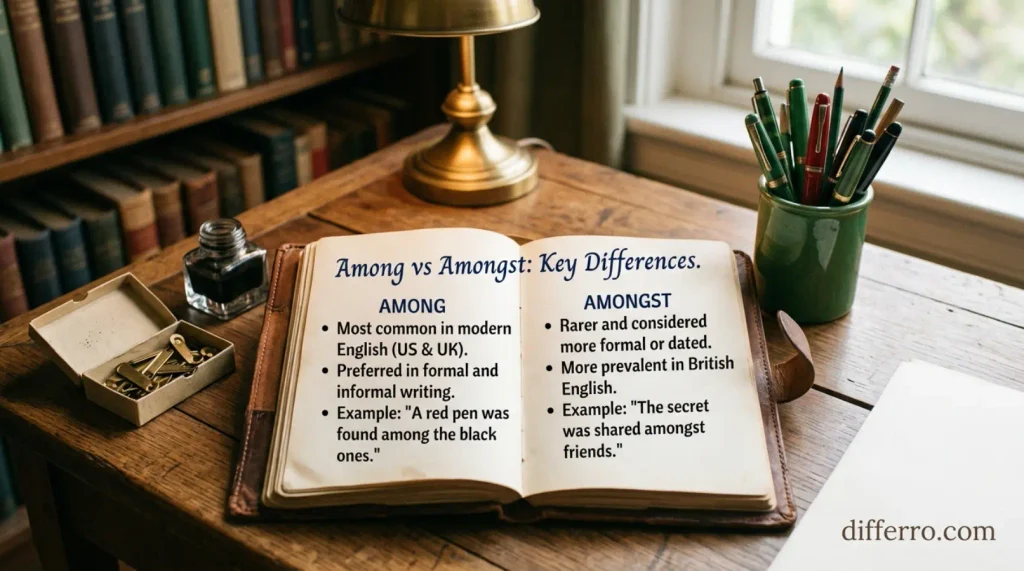
🔍 Among vs Amongst: Key Differences
| Feature | Among | Amongst |
|---|---|---|
| Meaning | In or surrounded by a group | In or surrounded by a group |
| Tone | Neutral and modern | More formal or literary |
| Usage | Very common | Less common |
| American English | Strongly preferred | Rare |
| British English | Very common | More accepted |
| Professional writing | Recommended | Usually unnecessary |
| Meaning difference | None | None |
The important point is simple: among and amongst do not have a meaningful difference in definition. The main difference involves usage and style.
Among is generally preferred in both American and British English. Amongst remains acceptable, particularly in British English and literary contexts.
📜 Origin & History of Among and Amongst
The history of these words explains why they look different.
Among is the older form. It comes from Old English and has been used for many centuries. Amongst appeared later during the Middle English period. The extra -st developed as part of an older pattern in English.
English has several words that show similar patterns.
Examples include:
- Among → Amongst
- While → Whilst
- Amid → Amidst
These longer forms survived in English, but shorter forms became more common over time.
Among has remained the dominant modern form. Amongst still appears in British writing, literature, speeches, and traditional expressions.
🇬🇧 British English vs American English Spelling
There is no spelling difference in the normal sense because both among and amongst are accepted words.
American English strongly favors among, especially in everyday and professional writing.
British English also uses among frequently, but amongst is more familiar and acceptable there.
British vs American English Comparison
| Usage Area | British English | American English |
|---|---|---|
| Among | Very common | Very common |
| Amongst | More accepted | Much less common |
| Everyday speech | Among preferred | Among strongly preferred |
| Formal writing | Among preferred | Among strongly preferred |
| Literary writing | Both possible | Among usually preferred |
✍️ When to Use Among
Use among when you want a natural and widely accepted word.
It works especially well in:
- Everyday conversations
- School assignments
- Business emails
- Academic writing
- Websites
- News writing
- Professional reports
- General American English
Examples:
- The teacher divided the students among three groups.
- Trust is important among team members.
- She felt happy among her friends.
- The answer was hidden among several choices.
- There was excitement among the crowd.
When you are unsure, among is usually the best choice.
✍️ When to Use Amongst
Use amongst when you want a slightly traditional, literary, or British tone.
It can work naturally in descriptive writing.
Examples:
- The cottage stood quietly amongst the hills.
- He walked amongst the old trees.
- She felt peaceful amongst her family.
- The rumor spread amongst the villagers.
These sentences are correct. However, among would also work in every example.
For most modern writing, among sounds simpler and more direct.
⚠️ Common Mistakes with Among or Amongst
1. Thinking Amongst Is Incorrect
Some learners think amongst is a spelling mistake.
Incorrect idea: Amongst is always wrong.
Correct: Amongst is grammatically correct, but less common.
Both forms can be used correctly.
2. Thinking Amongst Is More Correct
The longer spelling does not make a sentence more grammatical.
Less natural belief: Amongst is more educated than among.
Better understanding: Both words are correct, but among is more common.
Choose based on your audience and writing style.
3. Using Amongst in Every Formal Sentence
Amongst does not automatically make writing more professional.
Awkward: The report was shared amongst all employees.
Natural: The report was shared among all employees.
Among usually sounds clearer in modern professional writing.
4. Assuming Among Is Only for American English
This is another common mistake.
Incorrect: British writers must use amongst.
Correct: British writers commonly use among too.
Among is widely used in both British and American English.
5. Confusing Among with Between
The real grammar question is sometimes among vs between, not among vs amongst.
Traditional advice often says to use among for more than two people. Modern English allows between with more than two items in many contexts.
Example:
The agreement was made among the three friends.
Both words should not be treated as interchangeable in every situation.
🧠 Easy Trick to Remember
Remember this simple rule:
Among = modern and common.
Amongst = correct but more traditional.
Think of the shorter word as the everyday choice.
If you are writing an email, essay, article, school answer, or business report, choose among unless you have a specific reason to use amongst.
A quick memory sentence is:
“Among is the everyday choice; amongst adds an older style.”
🌎 Everyday Life Examples
1. Among Friends
Primary keyword: among
We often use among when talking about relationships or groups.
Example:
She felt relaxed among her closest friends.
Secondary keyword: amongst
The same sentence can use amongst:
She felt relaxed amongst her closest friends.
The meaning stays the same.
2. Among Students
Primary keyword: among
Teachers commonly use among when discussing groups of students.
Example:
The teacher noticed a lot of excitement among the students.
Secondary keyword: amongst
The teacher noticed a lot of excitement amongst the students.
Both forms are correct.
3. Among the Trees
Primary keyword: among
Among can describe something surrounded by objects.
Example:
A small cabin stood among the trees.
Secondary keyword: amongst
A small cabin stood amongst the trees.
The second version sounds slightly more literary.
4. Among Family Members
Primary keyword: among
Among works naturally when discussing family relationships.
Example:
There should be honesty among family members.
Secondary keyword: amongst
There should be honesty amongst family members.
The meaning does not change.
5. Among Several Choices
Primary keyword: among
Among can also describe selection from a group.
Example:
She had to choose among several different options.
Secondary keyword: amongst
She had to choose amongst several different options.
The first version sounds more natural in modern general English.
📊 Google Trends & Usage Data
Exact Google Trends scores can change by date, country, and search category. Therefore, the table below gives a practical usage direction rather than fixed trend numbers.
| Country | Among | Amongst | Usage Insight |
|---|---|---|---|
| USA | Very high | Very low | Among is the clear everyday choice |
| UK | Very high | Moderate | Both appear, but among remains more common |
| Australia | Very high | Low | Among is generally the safer choice |
| India | Very high | Low | Among is common in modern English |
| Pakistan | Very high | Low | Among is generally preferred in educational writing |
The broader evidence supports this pattern. Among is more common overall, while amongst has stronger British associations. Even in British English, among remains widely preferred.
Keyword Variations Comparison
| Keyword Variation | Meaning | General Usage | Best Choice |
|---|---|---|---|
| among | Within or surrounded by a group | Very common | ⭐ Best default |
| amongst | Within or surrounded by a group | Less common | Use for style |
| among friends | Within a group of friends | Very common | Recommended |
| amongst friends | Within a group of friends | Less common | Acceptable |
| among people | Within a group of people | Very common | Recommended |
| amongst people | Within a group of people | Less common | Acceptable |
⚖️ Final Verdict: Among or Amongst?
Among is the better default choice for most writers.
Both among and amongst are grammatically correct. They also have the same basic meaning. The difference mainly involves style, frequency, and regional preference.
Choose among for everyday English, American English, professional writing, academic work, websites, and general communication.
Choose amongst when you want a traditional, literary, or distinctly British tone.
If you are still unsure, remember one rule:
Use among.
It is shorter, more common, and natural for almost every modern English audience.
❓ Frequently Asked Questions
Is “amongst” correct English?
Yes. Amongst is correct English. It has the same basic meaning as among. It is less common, especially in American English.
What is the difference between among and amongst?
There is no major difference in meaning. Both mean being within, surrounded by, or included in a group. The main difference involves style and usage.
Which is more common, among or amongst?
Among is more common. It is strongly preferred in American English and remains more common in British English.
Is amongst more formal than among?
Amongst can sound more formal, traditional, or literary. However, it is not automatically more professional. Among is usually clearer for modern formal writing.
Why do people confuse among and amongst?
People confuse them because both words have the same meaning. Their spelling differs, and amongst has stronger British and traditional associations.
📝 Conclusion
The choice between among or amongst is easier than it first appears. Both words are correct and both describe something within or surrounded by a group. The main difference involves style, frequency, and regional preference. Among is the more common and modern choice. It works well in American and British English, as well as professional and academic writing. Amongst is also correct, but it can sound more traditional, literary, or British. If you are unsure which word to choose, use among. It is natural, clear, and widely understood. Knowing this small difference can help you write with greater confidence and avoid unnecessary confusion.

Imran Lodhra is a comparison-focused content writer at Differro.com.
He specializes in creating clear, simple, and informative comparison articles.
His work helps readers understand key differences, pros and cons, and important details.
Imran focuses on accurate, practical, and easy-to-read content for everyday readers.