
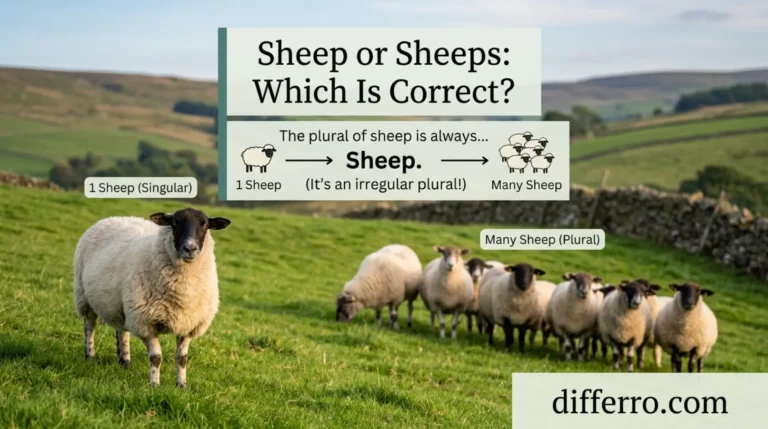
Sheep or sheeps can confuse English learners because most plural nouns take -s. However, sheep follows a different plural rule. The word sheep works for both one animal and several animals. Sheeps is not the standard plural form in modern English. You can say “one sheep” and “ten sheep” without changing the spelling. The surrounding words show whether the meaning is singular or plural. For example, “The sheep is eating” describes one animal. “The sheep are eating” describes several animals. This unusual pattern makes sheep or sheeps a common grammar question. Learning this simple rule can help you avoid mistakes in school, work, and everyday writing. Major English dictionaries list sheep as both the singular and plural form.
⭐ Quick Answer
Sheep is correct for both singular and plural use. Sheeps is not the standard plural form.
Examples: one sheep, two sheep, many sheep.
Example:
- Correct: The farmer owns fifty sheep.
- Incorrect: The farmer owns fifty sheeps.
Meaning of Sheep
Sheep is a noun that names a farm animal with a thick wool coat. People raise sheep for wool, meat, and other products.
The important point is that sheep can be singular or plural.
Singular example:
- A sheep is standing near the fence.
- One sheep escaped from the field.
Plural example:
- The sheep are grazing in the field.
- We saw several sheep near the farm.
The verb helps show whether sheep means one or many animals.
Meaning of Sheeps
Sheeps is generally an incorrect plural form of sheep. Standard English uses sheep for both singular and plural meanings.
People often write sheeps because regular nouns usually add -s.
Incorrect example:
- The farmer has twenty sheeps.
Correct example:
- The farmer has twenty sheep.
In some informal or humorous contexts, sheeps may appear. It is not suitable for standard formal English.
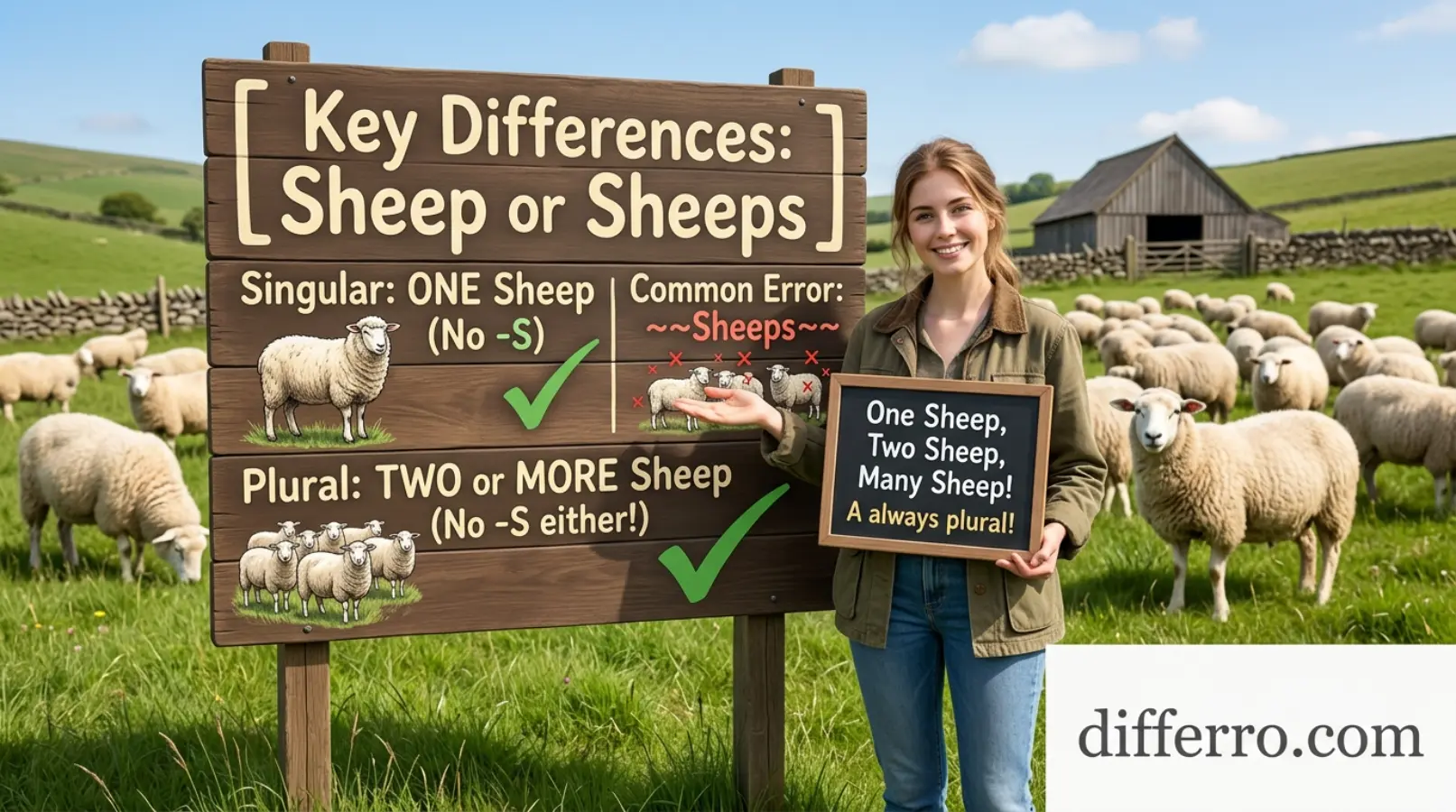
📊 Key Differences: Sheep or Sheeps
| Feature | Sheep | Sheeps |
|---|---|---|
| Meaning | One or more sheep | Nonstandard plural |
| Tone | Standard English | Informal or incorrect |
| Usage | Correct in normal writing | Avoid in standard writing |
| Popularity | Very common | Much less common |
| Singular use | Correct | Incorrect |
| Plural use | Correct | Incorrect |
The main difference is simple. Sheep is the standard word for both one and many animals.
📚 Origin & History
The word sheep has a very old English history. It comes from Old English forms such as scēap and is related to Germanic words.
English kept the same noun form for singular and plural use. This makes sheep an example of an unchanged or zero plural.
Other examples include:
- deer
- moose
- elk
- salmon
- trout
- bison
These nouns can also keep the same form when they become plural.
For example:
- One deer is crossing the road.
- Three deer are crossing the road.
- One moose lives nearby.
- Several moose live nearby.
This history explains why adding -s to sheep is unnecessary.
🇬🇧 British English vs American English Spelling
There is no meaningful British-American spelling difference for sheep.
Both varieties use sheep for singular and plural meanings.
Sheeps is not the standard plural in either variety.
British vs American English
| Feature | British English | American English |
|---|---|---|
| Singular | sheep | sheep |
| Plural | sheep | sheep |
| Pronunciation | /ʃiːp/ | /ʃiːp/ |
| Standard plural | sheep | sheep |
| Sheeps | Not standard | Not standard |
🐑 When to Use Sheep
Use sheep when you mean one animal.
Examples:
- A sheep is eating grass.
- One sheep is missing.
- This sheep has thick wool.
- That sheep belongs to my uncle.
Use sheep when you mean two or more animals.
Examples:
- Two sheep are resting nearby.
- Many sheep are grazing outside.
- The farmer owns 100 sheep.
- Several sheep crossed the road.
The surrounding grammar tells readers whether the noun is singular or plural.
❌ When to Use Sheeps
In normal English writing, avoid sheeps as the plural of sheep.
Do not write:
- The farmer owns many sheeps.
- Five sheeps are eating grass.
- We counted twenty sheeps.
Write:
- The farmer owns many sheep.
- Five sheep are eating grass.
- We counted twenty sheep.
You may occasionally see sheeps in jokes, games, informal speech, or nonstandard writing. That does not make it the standard plural form.
⚠️ Common Mistakes
Mistake 1: Adding -s to sheep
Incorrect:
The farmer has ten sheeps.
Correct:
The farmer has ten sheep.
Mistake 2: Using a singular verb with many sheep
Incorrect:
The sheep is grazing in the field.
Correct:
The sheep are grazing in the field.
The second sentence refers to several sheep.
Mistake 3: Using a plural verb for one sheep
Incorrect:
One sheep are sleeping.
Correct:
One sheep is sleeping.
The word one clearly shows a singular meaning.
Mistake 4: Changing sheep after numbers
Incorrect:
I saw five sheeps near the river.
Correct:
I saw five sheep near the river.
Numbers already show that the noun is plural.
Mistake 5: Assuming every animal plural needs -s
Incorrect:
We saw three deers and four sheeps.
Correct:
We saw three deer and four sheep.
Several animal nouns have unchanged plural forms.
🧠 Easy Trick to Remember
Use this simple rule:
One sheep, two sheep, many sheep.
Never add -s when you mean multiple sheep.
You can also remember this pattern:
- One sheep is
- Two sheep are
- Many sheep are
The noun stays the same. The verb changes with the number.
🌱 Everyday Life Examples
1. On a Farm
A farmer may keep hundreds of sheep on a large farm.
- One sheep is near the gate.
- Many sheep are grazing outside.
2. At a Zoo or Animal Park
Visitors may see sheep in a small farm animal area.
- The child touched a sheep.
- The children watched several sheep.
3. In School Writing
Students often learn about irregular plural nouns.
- Sheep is both singular and plural.
- Sheeps is not the standard plural.
This example helps students understand unusual English plurals.
4. In Everyday Conversation
People commonly use sheep without changing its spelling.
- I saw a sheep today.
- We saw many sheep yesterday.
The number changes, but the noun stays the same.
5. In Farming and Agriculture
Farmers regularly discuss sheep in livestock contexts.
- The farmer bought ten sheep.
- The sheep are ready for shearing.
These examples show natural primary keyword usage.
These variations cover common search questions about sheep grammar.
📈 Google Trends & Usage Data
Search and dictionary evidence strongly favor sheep as the standard English form.
The word sheep has established usage across British and American English.
Searches for sheeps usually reflect grammar confusion rather than a standard alternative.
The same rule applies across the USA, UK, Australia, India, and Pakistan.
Keyword Usage Comparison
| Country | Sheep | Sheeps | Main Insight |
|---|---|---|---|
| USA | Very common | Incorrect usage | Sheep is standard |
| UK | Very common | Incorrect usage | Sheep is standard |
| Australia | Very common | Incorrect usage | Sheep is standard |
| India | Very common | Common learner confusion | Sheep is correct |
| Pakistan | Very common | Common learner confusion | Sheep is correct |
SEO insight: The primary search opportunity is usually the comparison itself. People search sheep or sheeps because they want a quick grammar answer. A clear answer should appear near the beginning of the article.
📝 Keyword Variations Comparison
| Keyword Variation | Search Intent | Correct Form |
|---|---|---|
| Sheep or sheeps | Spelling confusion | Sheep |
| Sheeps or sheep | Grammar comparison | Sheep |
| Plural of sheep | Grammar question | Sheep |
| Is sheep plural? | Singular/plural question | Yes |
| Is sheeps correct? | Spelling question | No |
| Sheep singular or plural | Grammar learning | Both |
| One sheep two sheep | Usage question | Correct |
🏆 Final Verdict
Sheep is the correct choice in standard English.
Use sheep for one animal:
One sheep is eating grass.
Use sheep for several animals:
Ten sheep are eating grass.
Do not normally use sheeps as the plural.
The reason is simple. Sheep has the same singular and plural form. This type of noun is sometimes called an unchanged or zero plural.
So, if you are writing an essay, email, article, school assignment, or professional document, choose sheep.
The easiest rule is:
One sheep, two sheep, many sheep.
❓ FAQ
Is “sheeps” a correct word?
Sheeps is not the standard plural form of sheep. Use sheep for both singular and plural meanings.
What is the difference between sheep and sheeps?
Sheep is the standard singular and plural noun. Sheeps is generally a nonstandard plural form.
Which is more common, sheep or sheeps?
Sheep is much more common and is the standard form used in dictionaries and formal writing.
Is “sheep” formal English?
Yes. Sheep is completely standard and appropriate for formal and informal English.
Why does the confusion between sheep and sheeps exist?
The confusion comes from the common English rule of adding -s to form plurals. Sheep is an exception because its plural remains unchanged.
Conclusion
The answer to sheep or sheeps is simple: sheep is correct. English uses sheep for both one animal and several animals. You can say “one sheep,” “two sheep,” or “many sheep.” The word does not need an -s ending. Sheeps is not the standard plural form in normal English writing. This rule applies in British and American English. Remember the easy pattern: one sheep, two sheep, many sheep. The verb can help you identify the number. Say “the sheep is” for one animal and “the sheep are” for several animals. Once you remember this pattern, the sheep or sheeps confusion becomes easy to solve.

Imran Lodhra is a comparison-focused content writer at Differro.com.
He specializes in creating clear, simple, and informative comparison articles.
His work helps readers understand key differences, pros and cons, and important details.
Imran focuses on accurate, practical, and easy-to-read content for everyday readers.
1 thought on “Sheep or Sheeps: Which Is Correct?”