

Lable Or Label is a common spelling confusion for English learners and writers. The correct spelling is label, while lable is a common misspelling. Both forms look similar, but they do not have the same status in standard English. The word label works as both a noun and a verb. It can describe a tag, name, category, or identifying mark. It can also mean to identify or classify something. The incorrect form lable often appears because people spell the word based on its sound. Fast typing can also cause the letters to move or disappear. Standard English uses label in American, British, and Australian English. (Scribbr)
⭐ Quick Answer
Label is the correct spelling. Lable is a common spelling mistake and should not be used in standard English.
Example: Please label each box before shipping.
📖 Meaning of Label
Label is a standard English word that works as both a noun and a verb.
Label as a Noun
A label is a tag, name, description, or piece of information attached to something.
Examples:
- Read the label before using the product.
- The clothing label shows the washing instructions.
Label as a Verb
As a verb, label means to identify, mark, describe, or classify something.
Examples:
- Please label every package clearly.
- The teacher asked students to label the diagram.
📖 Meaning of Lable
Lable is not the standard spelling of an English word. It usually appears as a misspelling of label. (Wiktionary)
Examples of incorrect usage:
- ❌ Please lable the files.
- ❌ The product lable is damaged.
Correct versions:
- ✅ Please label the files.
- ✅ The product label is damaged.
🔍 Lable Or Label: Key Differences
| Feature | Label | Lable |
|---|---|---|
| Meaning | Tag, name, category, or identify | No standard meaning |
| Tone | Standard and professional | Incorrect |
| Usage | Everyday and formal English | Spelling error |
| Popularity | Very common | Mostly used as a typo |
| Dictionary status | Standard word | Misspelling |
The evidence is consistent across major English-writing references: label is the accepted form, while lable is incorrect. (Scribbr)
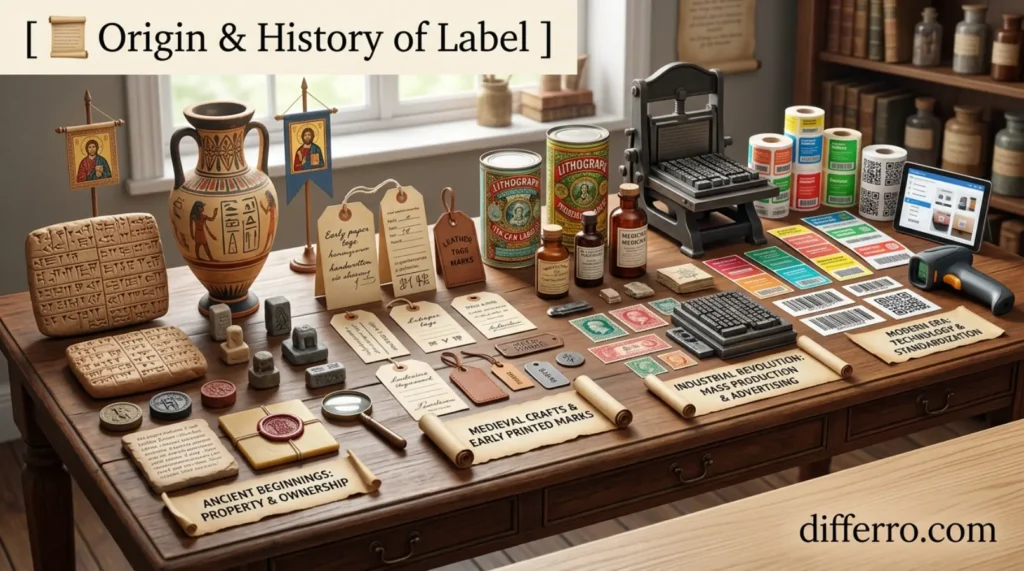
📜 Origin & History of Label
The word label has historical roots in Old French and Medieval Latin. Its early meaning related to a small tag, strip, or piece attached to something. Its meaning later expanded to include names, descriptions, classifications, and brands. (Grammar Tribe)
Similar spelling patterns appear in words such as:
- table
- cable
- stable
- noble
- parcel
The mistake lable likely comes from spelling the word by sound or typing the letters incorrectly.
🇬🇧 British English vs American English Spelling
The base word label has the same spelling in British and American English.
The main difference appears in some forms with suffixes. American English commonly uses labeled and labeling. British English commonly uses labelled and labelling. (Scribbr)
British vs American English Comparison
| Form | American English | British English |
|---|---|---|
| Base word | label | label |
| Plural | labels | labels |
| Past tense | labeled | labelled |
| -ing form | labeling | labelling |
| Negative form | unlabeled | unlabelled |
Important: Neither British nor American English uses lable as the standard spelling.
✍️ When to Use Label
⋆Use label whenever you mean a tag, description, name, category, or identification.
Use Label as a Noun
- The bottle has a clear label.
- Check the food label for ingredients.
- The designer removed the brand label.
Use Label as a Verb
- Label each folder by subject.
- Please label the diagram.
- Workers label every package before delivery.
❌ When Not to Use Lable
Do not use lable in schoolwork, business writing, articles, emails, or professional documents.
Incorrect
- ❌ Read the product lable.
- ❌ Please lable the boxes.
- ❌ The lable contains important information.
Correct
- ✅ Read the product label.
- ✅ Please label the boxes.
- ✅ The label contains important information.
⚠️ Common Mistakes
1. Writing Lable Instead of Label
Incorrect: The shirt has a new lable.
Correct: The shirt has a new label.
2. Writing Labled Instead of Labeled
Incorrect: The boxes were labled yesterday.
Correct: The boxes were labeled yesterday.
British English uses labelled.
3. Writing Lableing Instead of Labeling
Incorrect: We are lableing the products.
Correct: We are labeling the products.
British English uses labelling.
4. Writing Lables Instead of Labels
Incorrect: The lables are colorful.
Correct: The labels are colorful.
5. Treating Lable as a British Spelling
Incorrect: “Lable” is British English.
Correct: British English also uses label.
🧠 Easy Trick to Remember
Use this simple memory trick:
LABEL = LA + BEL
Remember the ending “bel”, not “ble.”
You can also connect label with table. Both words have the -bel/-ble pattern that can cause spelling confusion, so check the letters carefully.
The easiest rule is:
Label has “bel” at the end.
🌎 Label in Everyday Life: 5 Examples
1. Product Labels
A product label gives buyers useful information.
Example: Check the product label before purchasing it.
2. Clothing Labels
Clothing labels often show size and care instructions.
Example: The shirt label says to wash it in cold water.
3. Food Labels
Food labels provide information about ingredients and nutrition.
Example: Always read the food label before buying a product.
4. School Labels
Teachers use labels to identify diagrams, objects, and classroom materials.
Example: Please label each part of the science diagram.
5. Digital Labels
Websites and software also use labels for buttons, fields, and categories.
Example: Click the label to find related information.
📊 Google Trends & Usage Data: USA, UK, Australia, India & Pakistan
Search-interest discussions consistently show label as the dominant standard form, while lable mainly represents spelling confusion. (Grammar Tribe)
- USA: Label is the expected standard spelling in American English.
- UK: Label remains correct, while forms such as labelled follow British conventions.
- Australia: Label is standard, with British-style labelled/labelling commonly used.
- India & Pakistan: Label is the standard English spelling used in formal and educational contexts.
SEO insight: Treat lable as a spelling-intent keyword rather than an alternative spelling. Use the exact misspelling naturally when answering the user’s question, but use label throughout the main content.
Keyword Variations Comparison
| Keyword Variation | Correct? | Search Intent | Recommended Use |
|---|---|---|---|
| label | ✅ Yes | Spelling and meaning | Primary keyword |
| lable | ❌ No | Spelling confusion | Secondary keyword |
| label or lable | ✅ Query | Comparison | SEO heading |
| lable or label | ✅ Query | Spelling confusion | SEO variation |
| lable vs label | ✅ Query | Comparison | Secondary variation |
| labeled | ✅ Yes | American English | Related keyword |
| labelled | ✅ Yes | British English | Related keyword |
⚖️ Final Verdict: Lable Or Label?
Label is always the correct choice in standard English.
Use label for a tag, name, category, description, or act of identification.
Use labeled in American English and labelled in British English.
Never use lable as an alternative spelling. It is normally a misspelling, not a regional English variation. (Scribbr)
❓ Frequently Asked Questions
1. Is “lable” correct?
No. Lable is a common misspelling. The correct spelling is label. (Wiktionary)
2. What is the difference between label and lable?
Label is the correct English word. Lable is normally an incorrect spelling of that word.
3. Which is more common, label or lable?
Label is far more common and is the standard spelling. Lable mainly appears when people make spelling or typing mistakes.
4. Is label suitable for formal writing?
Yes. Label is appropriate for academic, professional, business, technical, and everyday writing.
5. Why does the confusion between lable and label exist?
The confusion often comes from pronunciation, fast typing, and spelling by sound. The weak second syllable can make the correct spelling less obvious. (Scribbr)
📝 Conclusion
The confusion between Lable Or Label has a simple answer. Label is the correct spelling in standard English. It can work as both a noun and a verb. As a noun, it means a tag, name, description, or category. As a verb, it means to identify, mark, or classify something. Lable is a common misspelling and should not replace label in formal writing. The base word stays the same in American and British English. Only related forms can differ, such as labeled and labelled. If you remember one rule, remember this: label ends with “bel,” not “ble.” Using the correct spelling keeps your writing clear, accurate, and professional.

Imran Lodhra is a comparison-focused content writer at Differro.com.
He specializes in creating clear, simple, and informative comparison articles.
His work helps readers understand key differences, pros and cons, and important details.
Imran focuses on accurate, practical, and easy-to-read content for everyday readers.