
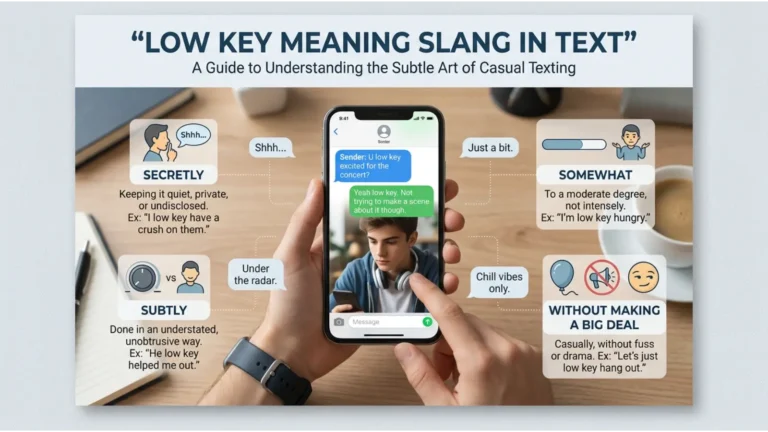
Low key meaning slang is a common question because you may see “low key” in texts, TikTok comments, Instagram posts, and everyday conversations. It can be confusing because the phrase does not always mean exactly the same thing.
In modern slang, people often use “low key” to express something quietly, subtly, secretly, or without making a big deal about it.
For example, someone might say, “I low key love this song,” meaning they really like the song but are not making a big announcement about it.
Quick Answer
Low key means quietly, secretly, somewhat, or without drawing much attention to something. Its exact meaning depends on the context and tone of the conversation.
What Does Low Key Mean in Text?
The low key meaning slang usually refers to something that a person wants to keep subtle, private, or understated.
For example:
“I low key want to go home.”
This can mean, “I actually want to go home, but I am not making a big deal about it.”
Another example is:
“That movie was low key amazing.”
Here, “low key” softens the statement. The person is saying the movie was surprisingly or quietly very good.
In texting, low key is usually informal and conversational.
Low Key Full Form and Definition
Many people search for the low key full form, but “low key” is not an abbreviation with a traditional full form.
It is a phrase made from two ordinary English words:
- Low = not high, quiet, or reduced
- Key = a level, quality, or style in this expression
Together, low-key traditionally describes something restrained, relaxed, or not attention-seeking.
In modern slang, the phrase has developed additional meanings such as:
- Secretly
- Quietly
- A little
- Somewhat
- Honestly, but subtly
- Without making it obvious
Low Key Meaning Slang in Different Contexts
The meaning can change depending on how someone uses it.
1. Low Key = Secretly
“I low key have a crush on him.”
This means the person has a crush but does not openly talk about it.
2. Low Key = Somewhat
“I’m low key tired.”
This means the speaker is somewhat tired.
3. Low Key = Quietly or Without Attention
“We had a low-key birthday party.”
This means the party was simple, relaxed, and not very flashy.
4. Low Key = Surprisingly
“That restaurant is low key incredible.”
The speaker may mean the restaurant is surprisingly good, even though it does not receive much attention.
Is “Low Key” Rude or Offensive?
No. “Low key” is generally neutral and not offensive.
It is widely used in casual conversations, texting, social media, and online communities.
However, it may sound too informal in some professional situations.
For example:
“I low key disagree with the manager.”
This might be understandable, but a professional email would be better with:
“I have some concerns about this decision.”
The issue is not that “low key” is rude. It is simply casual slang.
Where Is Low Key Commonly Used?
You can commonly find “low key” in:
- Text messages
- TikTok captions and comments
- Snapchat
- X and other social platforms
- Online chats
- Friendly conversations
- Memes
- Informal posts
It is especially common among younger English speakers, although people of different ages use it too.
Low Key in Real-Life Conversations
Here are some natural examples.
Friendly Example
Person A: “Do you like this song?”
Person B: “Yeah, I low key love it.”
Meaning: Person B really likes the song but expresses it casually.
Casual Example
Friend A: “Want to get pizza tonight?”
Friend B: “I’m low key hungry right now.”
Meaning: Friend B is actually somewhat hungry.
Argumentative Example
Person A: “You don’t seem interested in the project.”
Person B: “I’m low key annoyed because nobody asked for my opinion.”
Meaning: The speaker is revealing a feeling that may not have been obvious.
Social Media Example
“This outfit is low key perfect.”
Meaning: The outfit is surprisingly or quietly very good.
Emotional and Psychological Meaning of Low Key
When someone says “low key” about an emotion, they may be expressing a feeling without fully exposing how strongly they feel.
For example:
“I’m low key nervous about tomorrow.”
The speaker is admitting nervousness but using a softer, less dramatic expression.
Similarly:
“I low key miss my old friends.”
This can communicate genuine emotion while keeping the statement casual.
The phrase can therefore make emotional statements feel less intense or vulnerable.
Origin and Background of “Low Key”
The traditional expression “low-key” has long been associated with something quiet, restrained, or not attracting attention.
Over time, especially through informal American English and internet culture, its meaning expanded.
Today, “low key” can describe both a situation and a person’s feelings or opinions.
For example:
- “a low-key event” = a relaxed, simple event
- “I low key like it” = I secretly or somewhat like it
This newer slang usage became especially common through social media and online communication.
Low Key vs. High Key
“High key” is sometimes used as an informal opposite of “low key.”
| Slang | Common Meaning | Example |
|---|---|---|
| Low key | Secretly, subtly, somewhat | “I low key like this.” |
| High key | Openly, strongly, obviously | “I high key love this.” |
“High key” is less common than “low key,” but both can appear in online conversations.
Low Key vs. Secretly
These words can be similar, but they are not always identical.
Secretly strongly suggests that something is hidden from others.
“I secretly like him.”
Low key can suggest secrecy, but it can also mean somewhat, subtly, or without making a big deal about it.
“I low key like him.”
So “low key” is often softer and more casual than “secretly.”
When Should You Use Low Key?
Use low key when talking casually with friends or communicating online.
It works well when you want to make a statement sound relaxed or understated.
For example:
- “I low key want some coffee.”
- “That game was low key fun.”
- “I’m low key excited.”
- “She’s low key funny.”
When Should You Avoid It?
Avoid slang when writing:
- Formal business emails
- Academic papers
- Official reports
- Legal documents
- Professional applications
Instead of:
“I’m low key worried about the deadline.”
Use:
“I’m somewhat concerned about the deadline.”
Why Do People Use Low Key?
People use this slang because it makes communication feel casual, expressive, and less serious.
It can also help people express opinions without sounding too strong.
Compare:
“I love this.”
with:
“I low key love this.”
The second sentence sounds more relaxed and understated.
This makes “low key” useful in conversations where people want to express feelings without sounding dramatic.
Impact of Low Key in Communication
The phrase can change the emotional tone of a sentence.
Without it:
“I want to leave.”
With it:
“I low key want to leave.”
The second version can sound less direct and more conversational.
However, because slang depends heavily on context, different people may interpret the phrase slightly differently.
Is Low Key Safe for Social Media?
Yes. “Low key” is generally safe and harmless for social media.
It is a common informal expression and does not normally carry offensive meaning.
Still, remember that social media posts can reach different audiences. If you are writing for a professional brand, formal organization, or business account, a more standard expression may be appropriate.
Common Misunderstandings About Low Key
One common mistake is assuming that “low key” always means secretly.
That is not always true.
For example:
“This café is low key amazing.”
This does not necessarily mean the speaker is secretly visiting the café. It may simply mean the café is surprisingly good or good without receiving much attention.
Another misunderstanding is thinking that “low key” always reduces the intensity of a statement. Sometimes people use it almost as an emphasis marker:
“I low key need this right now.”
The phrase can still communicate a strong feeling.
Variations and Types of Low Key
You may see several forms online.
Low-key
This is the traditional hyphenated form when used as an adjective.
“It was a low-key event.”
Low key
This is extremely common in informal slang.
“I low key love it.”
Lowkey
Online users sometimes combine the words into one word.
“I lowkey want to go.”
All three forms can appear online, but “low key” is especially common when it functions as an informal adverb.
How to Respond When Someone Says “Low Key”
Your response depends on the conversation.
If someone says:
“I low key want ice cream.”
You could reply:
“Same! Let’s get some.”
If they say:
“I low key miss school.”
You might respond:
“Honestly, I understand.”
You do not need to interpret “low key” as a secret code. Usually, the surrounding sentence makes the intended meaning clear.
Regional and Cultural Usage
“Low key” is strongly associated with modern informal English, particularly American English and internet culture.
Because social media crosses borders, the expression is now familiar to English speakers around the world.
Its meaning can still vary slightly by speaker. Someone may use it to mean secretly, while another person may use it to mean somewhat or surprisingly.
Context is therefore important.
Similar Slang Terms
Here are some expressions that can overlap with “low key”:
| Term | Meaning | Example |
|---|---|---|
| Low key | Subtly or somewhat | “I low key like it.” |
| Secretly | Without others knowing | “I secretly like it.” |
| Kinda | Somewhat | “I kinda like it.” |
| Honestly | Truthfully | “Honestly, I like it.” |
| High key | Openly or strongly | “I high key love it.” |
These terms are not perfect replacements in every sentence.
FAQs About Low Key Meaning Slang
What does low key mean in slang?
Low key usually means secretly, subtly, somewhat, or without drawing attention. The exact meaning depends on context.
What does low key mean in text messages?
In texts, “low key” often means that someone feels or thinks something but is expressing it casually or subtly.
What does low key stand for?
“Low key” does not have a special full form. It is a phrase rather than an abbreviation.
Is low key a bad word?
No. “Low key” is not generally a bad or offensive word. It is informal slang.
Can I use low key in formal writing?
It is better to avoid it in formal academic or professional writing. Use words such as “somewhat,” “quietly,” or “subtly” instead.
What is the opposite of low key?
In modern slang, “high key” is sometimes used as the opposite, meaning openly, strongly, or very obviously.
Conclusion
The low key meaning slang is usually quietly, secretly, subtly, somewhat, or without making a big deal about something. Its meaning depends on the sentence and the speaker’s tone.
You might say, “I low key love this song” when you want to express that you really like it in a relaxed way. In another situation, “low-key party” can simply mean a quiet and casual event.
The phrase is common, harmless, and especially useful in texts, social media, and friendly conversations. Just remember that “low key” is informal slang, so standard words are usually better for academic and professional writing.

Ali Raza is an M.Phil. scholar and English language expert specializing in English grammar, slang meanings, vocabulary, and everyday expressions. He writes clear, practical, and easy-to-understand content that helps readers master confusing English words, phrases, spelling, and modern slang. His goal is to make English learning simple, useful, and accessible for students, beginners, and everyday readers.
2 thoughts on “Low Key Meaning Slang in Text: What Does “Low Key” Mean?”