
Somber or sombre is a common spelling question that confuses many English learners and writers.
Both words have the same meaning, but they belong to different versions of English.
The choice depends on whether you use American English or British English.
Understanding this small spelling difference can improve your writing and help you communicate more clearly.
This guide explains the meaning, history, usage, and differences between somber and sombre with easy examples.
By the end, you’ll know exactly which spelling to use in emails, school assignments, blogs, books, and professional writing.
⭐ Quick Answer
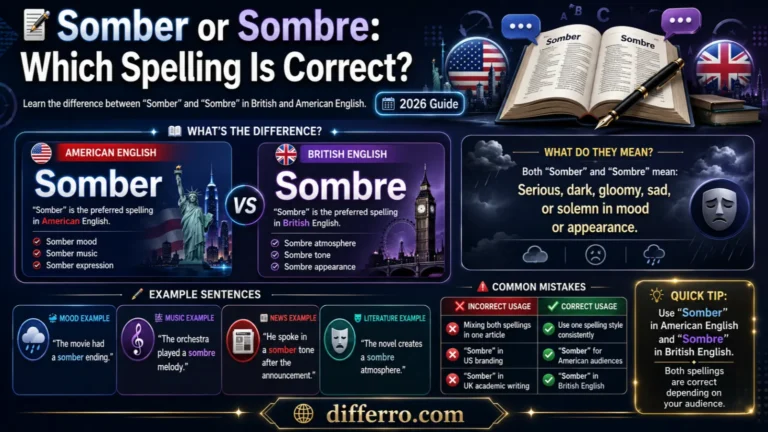
Somber and sombre have the same meaning. Somber is the American English spelling, while sombre is the British English spelling.
Example:
- American English: She wore a somber black dress.
- British English: She wore a sombre black dress.
📖 Meaning of Somber
Somber means dark, serious, sad, gloomy, or lacking brightness.
Examples
- The movie had a somber ending.
- His somber voice worried everyone.
📖 Meaning of Sombre
Sombre has exactly the same meaning as somber. It is simply the British spelling.
Examples
- The church had a sombre atmosphere.
- She looked sombre after hearing the news.
📊 Key Differences Between Somber and Sombre
| Feature | Somber | Sombre |
|---|---|---|
| Meaning | Serious, gloomy | Serious, gloomy |
| Tone | Identical | Identical |
| Usage | American English | British English |
| Popularity | USA, Canada | UK, Australia, New Zealand |
📜 Origin & History
Both spellings come from the French word sombre, meaning dark or gloomy. English adopted the word centuries ago. Later, American English simplified many spellings, changing sombre to somber.
Similar spelling differences
- Color → Colour
- Honor → Honour
- Theater → Theatre
- Center → Centre
- Neighbor → Neighbour
🇬🇧 British English vs American English Spelling
British English often keeps older spellings from French and Latin. American English prefers shorter, simplified spellings. Neither spelling is wrong. The correct choice depends on your audience.
Comparison Table
| British English | American English |
| Sombre | Somber |
| Colour | Color |
| Favourite | Favorite |
| Centre | Center |
| Theatre | Theater |
✍️ When to Use Somber
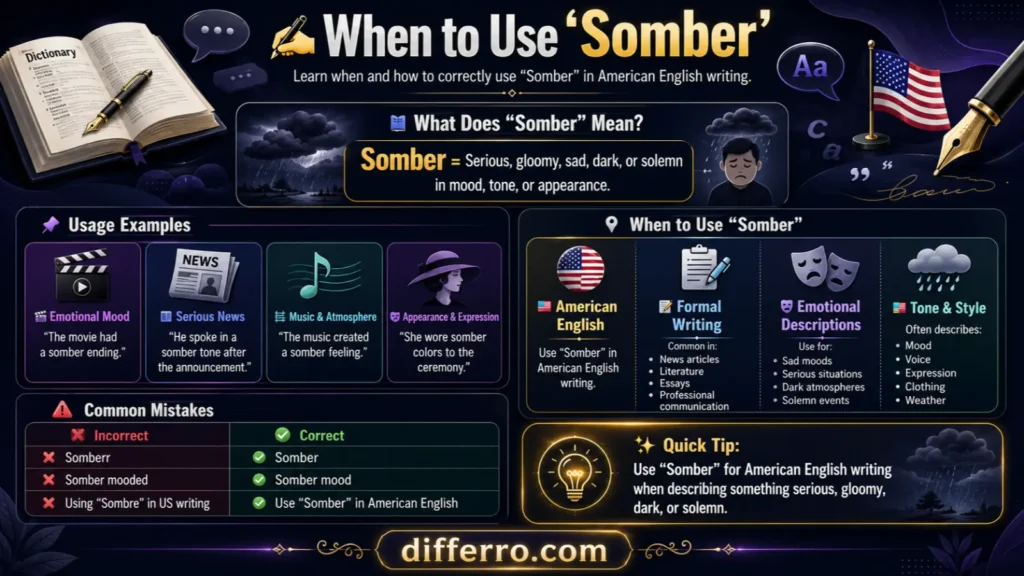
Use somber when writing for American readers.
Examples
- The speech had a somber tone.
- Everyone remained somber during the ceremony.
- The weather looked somber all day.
✍️ When to Use Sombre
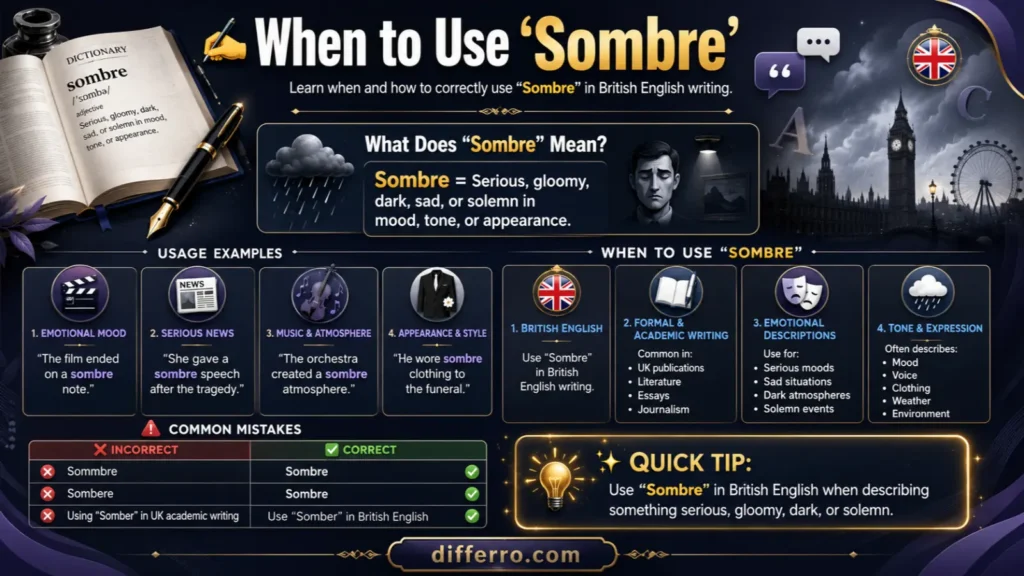
Use sombre when writing for British readers.
Examples
- The room felt sombre after the announcement.
- His sombre expression said everything.
- The painting created a sombre mood.
❌ Common Mistakes
Incorrect:
The British newspaper used somber spelling.
Correct:
The British newspaper used sombre spelling.
Incorrect:
The American novel used sombre throughout.
Correct:
The American novel used somber throughout.
Incorrect:
Somber and sombre have different meanings.
Correct:
They have the same meaning.
Incorrect:
One spelling is grammatically wrong.
Correct:
Both spellings are correct.
🧠 Easy Trick to Remember
- Somber = America (shorter spelling)
- Sombre = Britain (keeps the French-style spelling)
Think:
America likes simpler spellings. Britain keeps traditional spellings.
💬 Write 5 Examples
1. In School Writing
American students usually write somber, while British students write sombre.
2. In News Articles
US newspapers prefer somber. UK newspapers use sombre.
3. In Books
American novels often describe a somber mood. British novels describe a sombre atmosphere.
4. In Everyday Conversation
People pronounce both words almost the same. Only the spelling changes.
5. In Business Writing
Choose somber for American clients and sombre for British clients.
🔍 Related Keywords
- somber meaning
- sombre meaning
- somber vs sombre
- somber or sombre
- British vs American spelling
- gloomy meaning
- serious tone synonym
✅ Final Verdict
Neither spelling is better.
Use somber for American English.
Use sombre for British English.
The meaning never changes. Match the spelling to your audience for professional and consistent writing.
📈 Google Trends & Usage Data
Interest in somber is highest in the USA, where American English is standard. Sombre dominates searches in the UK and remains common in Australia. In India and Pakistan, both spellings appear because British English is widely taught, while American media also influences writing. Writers should choose the version that matches their target readers.
Comparison Table: Keyword Variations
| Keyword Variation | Common Region |
| Somber | USA |
| Sombre | UK |
| Somber meaning | USA |
| Sombre meaning | UK |
| Somber vs sombre | Worldwide |
| Somber or sombre | Worldwide |
| Difference between somber and sombre | Global |
❓ FAQs
1. Is somber correct?
Yes. It is the standard American English spelling.
2. Is sombre correct?
Yes. It is the standard British English spelling.
3. Which spelling is more common?
Globally, both are common. Somber dominates in the United States, while sombre is preferred in the United Kingdom and many Commonwealth countries.
4. Which spelling should I use in formal writing?
Use the spelling that matches your audience or your chosen style guide.
5. Why do people confuse somber and sombre?
Both words have identical meanings and pronunciation. Only the regional spelling differs.
📝 Conclusion
Somber or sombre is simply a spelling difference between American and British English. Both words describe something serious, dark, gloomy, or sad. If you write for an American audience, choose somber. If your readers use British English, write sombre. Keeping your spelling consistent throughout your document makes your writing look more professional. Once you know your audience, choosing the correct version becomes easy. Remember that the meaning never changes, only the spelling does. Whether you’re writing an essay, article, novel, or business email, using the appropriate spelling helps build trust and improves readability.

Sara Taylor is a passionate writer and language enthusiast. She specializes in creating simple and easy-to-understand articles about English grammar, spelling differences, and commonly confused words. Her writing style focuses on helping students, writers, and English learners improve their language skills with confidence. Through informative guides and practical examples, Sara makes complex grammar topics easier for everyday readers.