

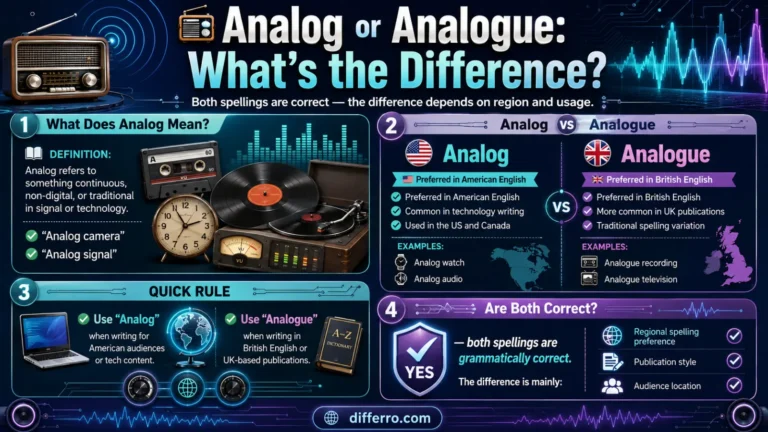
Analog or Analogue is a common spelling question that confuses many English writers. Both words have the same meaning, but their spelling changes depending on the type of English you use.
If you have ever wondered whether “analog” or “analogue” is correct, you’re not alone.
The good news is that both spellings are correct. The difference mainly comes from regional language preferences.
American English prefers analog, while British English usually uses analogue. Understanding when to use each spelling can help you write more accurately and professionally in different situations.
⭐ Quick Answer
Analog and analogue mean the same thing. The only difference is spelling.
- Analog is used in American English.
- Analogue is used in British English and other Commonwealth countries.
Example:
- American English: “I prefer an analog watch.”
- British English: “I prefer an analogue watch.”
Meaning of Analog
Analog is an American English spelling that refers to something comparable to another thing or a system that uses continuously varying signals.
Examples:
- My grandfather still uses an analog clock.
- This device uses analog technology instead of digital technology.
Meaning of Analogue
Analogue is the British English spelling of the same word. It carries the same meaning and usage.
Examples:
- She owns an analogue camera from the 1980s.
- The scientist found an analogue for the new chemical compound.
📊 Key Differences Between Analog and Analogue
| Feature | Analog | Analogue |
|---|---|---|
| Meaning | Same meaning | Same meaning |
| Tone | American English | British English |
| Usage | USA and some tech contexts | UK, Australia, Commonwealth countries |
| Popularity | More common globally online | Common in British publications |
| Correctness | Correct | Correct |
📜 Origin & History
The word comes from the Greek word “analogos,” meaning “proportionate” or “corresponding.”
Over time, English adopted two spellings:
- Analogue became standard in British English.
- Analog became the simplified American spelling.
Similar British vs American Spellings
- Colour → Color
- Favourite → Favorite
- Catalogue → Catalog
- Dialogue → Dialog
- Analogue → Analog
🇬🇧 British English vs American English Spelling
British English often keeps traditional spellings ending in -ogue. American English tends to simplify many words by removing unnecessary letters.
As a result, analogue remains common in the UK, while analog dominates in the United States. Both spellings are accepted when used in the appropriate regional context.
British vs American English Comparison Table
| British English | American English |
|---|---|
| Analogue | Analog |
| Dialogue | Dialog |
| Catalogue | Catalog |
| Favourite | Favorite |
| Colour | Color |
✅ When to Use Analog
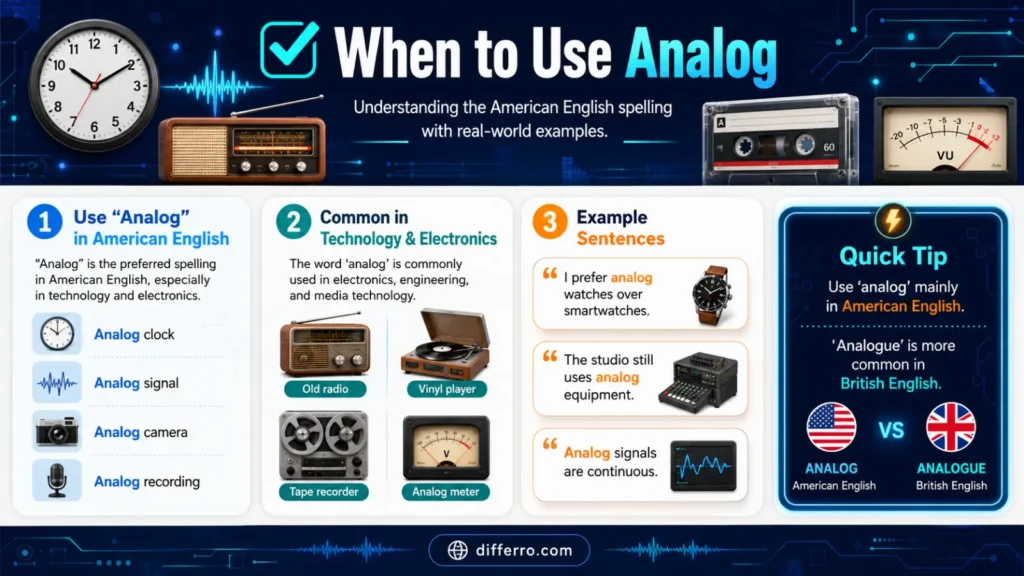
Use analog when writing for:
- American audiences
- US businesses
- American publications
- Technology-related content
Examples
- The company manufactures analog audio equipment.
- I bought an analog wristwatch yesterday.
✅ When to Use Analogue
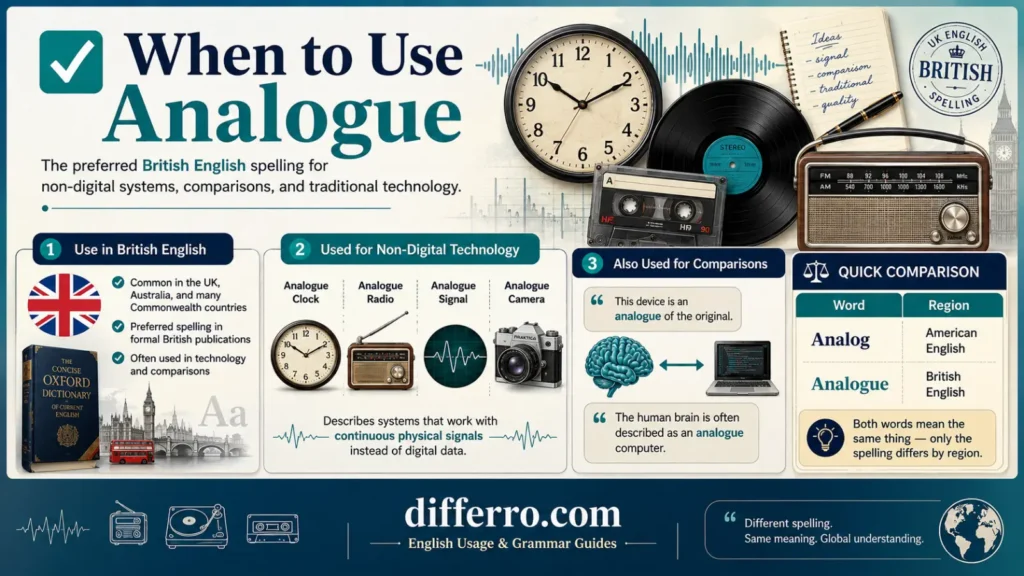
Use analogue when writing for:
- British audiences
- UK publications
- Australian readers
- Canadian and Commonwealth contexts
Examples
- The museum displays old analogue radios.
- Many photographers still enjoy analogue cameras.
❌ Common Mistakes
1. Mixing Both Spellings
Incorrect: The analogue device uses analog signals.
Correct: Use one style consistently.
2. Using Analogue in US Corporate Writing
Incorrect: Our company sells analogue electronics.
Correct: Our company sells analog electronics.
3. Assuming One Is Wrong
Incorrect: Analogue is incorrect.
Correct: Both spellings are correct.
4. Ignoring Audience Location
Incorrect: Using American spelling for a UK publication.
Correct: Match the spelling to the audience.
🧠 Easy Trick to Remember
Memory Tip
- Analog = America
- Analogue = United Kingdom and Commonwealth
If your audience is American, choose analog. If your audience is British, choose analogue.
✨ Write 5 Examples
1. Technology Example
American manuals often use analog, while British manuals use analogue.
2. Watches Example
An analog watch and an analogue watch are exactly the same product.
3. Photography Example
Many artists prefer analogue photography for its classic feel.
4. Audio Equipment Example
Some music producers still use analog recording equipment.
5. Education Example
Teachers explain that analog and analogue are regional spelling variations.
🔍 Related Keywords
- analog meaning
- analogue meaning
- analog vs analogue
- analogue spelling
- American vs British spelling
- analog technology
- analogue examples
🌎 Google Trends & Usage Data
Across global searches, analog receives higher search volume because of the large American audience and technology-related usage.
The spelling analogue remains strong in the United Kingdom, Australia, and other Commonwealth nations. India and Pakistan show mixed usage due to exposure to both British and American English.
Writers should choose the spelling that best matches their target audience and maintain consistency throughout their content.
Usage Comparison Table
| Country | More Popular Spelling |
|---|---|
| USA | Analog |
| UK | Analogue |
| Australia | Analogue |
| India | Mixed (slightly Analog) |
| Pakistan | Mixed (slightly Analogue) |
Insight
- USA strongly prefers analog.
- UK and Australia strongly prefer analogue.
- India and Pakistan commonly use both spellings.
- Tech industries often favor analog globally.
- Audience targeting matters more than strict rules.
🏆 Final Verdict
Neither spelling is better than the other.
- Use analog for American English.
- Use analogue for British English.
Both words have the same meaning, pronunciation, and usage. The correct choice depends entirely on your audience and writing style.
❓ FAQs
1. Is it correct to use analog?
Yes. Analog is the standard American English spelling.
2. What is the difference between analog and analogue?
There is no difference in meaning. The difference is only regional spelling.
3. Which is more common?
Globally, analog is slightly more common because of American English and technology usage.
4. Which spelling is more formal?
Neither is more formal. Both are equally correct in their respective regions.
5. Why does the confusion exist?
The confusion exists because British and American English adopted different spellings of the same word.
Conclusion
Analog or Analogue is a spelling variation rather than a difference in meaning. Both words describe the same concept and are pronounced the same way. The key distinction comes from regional language preferences. American English uses analog, while British English and many Commonwealth countries prefer analogue.
When writing content, always consider your audience. If your readers are in the United States, use analog. If your audience is in the United Kingdom, Australia, or similar regions, choose analogue. Consistency is important, so avoid mixing both spellings in the same document. By understanding this simple difference, you can write with greater clarity, professionalism, and confidence.

