
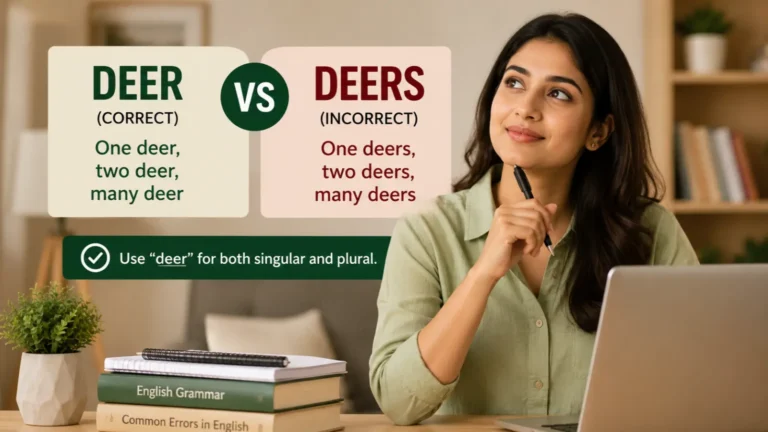
Deer or deers is a common grammar question that confuses many English learners and writers. At first glance, adding an “s” to make a noun plural seems correct because most English words follow that rule. However, some nouns behave differently.
People often wonder whether they should write one deer, two deer or one deer, two deers. This confusion appears in school assignments, blogs, social media posts, and everyday conversations.
English contains many irregular nouns that do not change in their plural form. Words like sheep and fish can create the same uncertainty. Understanding the correct plural form helps improve your writing and prevents common mistakes.
In this guide, you will learn the difference between deer and deers, their meanings, origins, usage rules, common mistakes, and the correct form to use in formal and informal English.
⭐ Quick Answer
The correct plural form of deer is usually deer, not deers.
✅ Correct: I saw three deer in the forest.
❌ Incorrect: I saw three deers in the forest.
The word deer remains the same whether it refers to one animal or many animals.
Meaning of Deer
Deer is a hoofed animal known for its graceful appearance and, in many species, antlers.
Examples:
- A deer crossed the road this morning.
- We spotted several deer near the river.
Meaning of Deers
Deers is a rare and specialized plural form sometimes used when referring to different species of deer in scientific or technical contexts.
Examples:
- Scientists studied several deers native to different regions.
- The museum displayed information about ancient deers.
Note: Most native English speakers rarely use deers.
📊 Key Differences Between Deer and Deers
| Feature | Deer | Deers |
|---|---|---|
| Meaning | One or multiple deer animals | Multiple species of deer |
| Tone | Standard English | Technical or scientific |
| Usage | Everyday writing and speech | Rare usage |
| Popularity | Extremely common | Very uncommon |
📜 Origin & History
The word deer comes from Old English dēor, which originally meant “animal” or “wild beast.” Over time, its meaning narrowed to the animal we know today.
Like several old English nouns, deer kept the same form for both singular and plural.
Similar Words:
- Sheep → Sheep
- Fish → Fish
- Moose → Moose
These words follow the same pattern as deer.
British English vs American English Spelling
Both British English and American English use deer as the standard singular and plural form. There is no spelling difference between the two varieties of English.
The rare word deers may appear in scientific writing in both regions, but it is uncommon.
Comparison Table: British vs American English
| Usage | British English | American English |
|---|---|---|
| Singular | Deer | Deer |
| Plural | Deer | Deer |
| Scientific Plural | Deers (rare) | Deers (rare) |
| Common Usage | Deer | Deer |
When to Use Deer
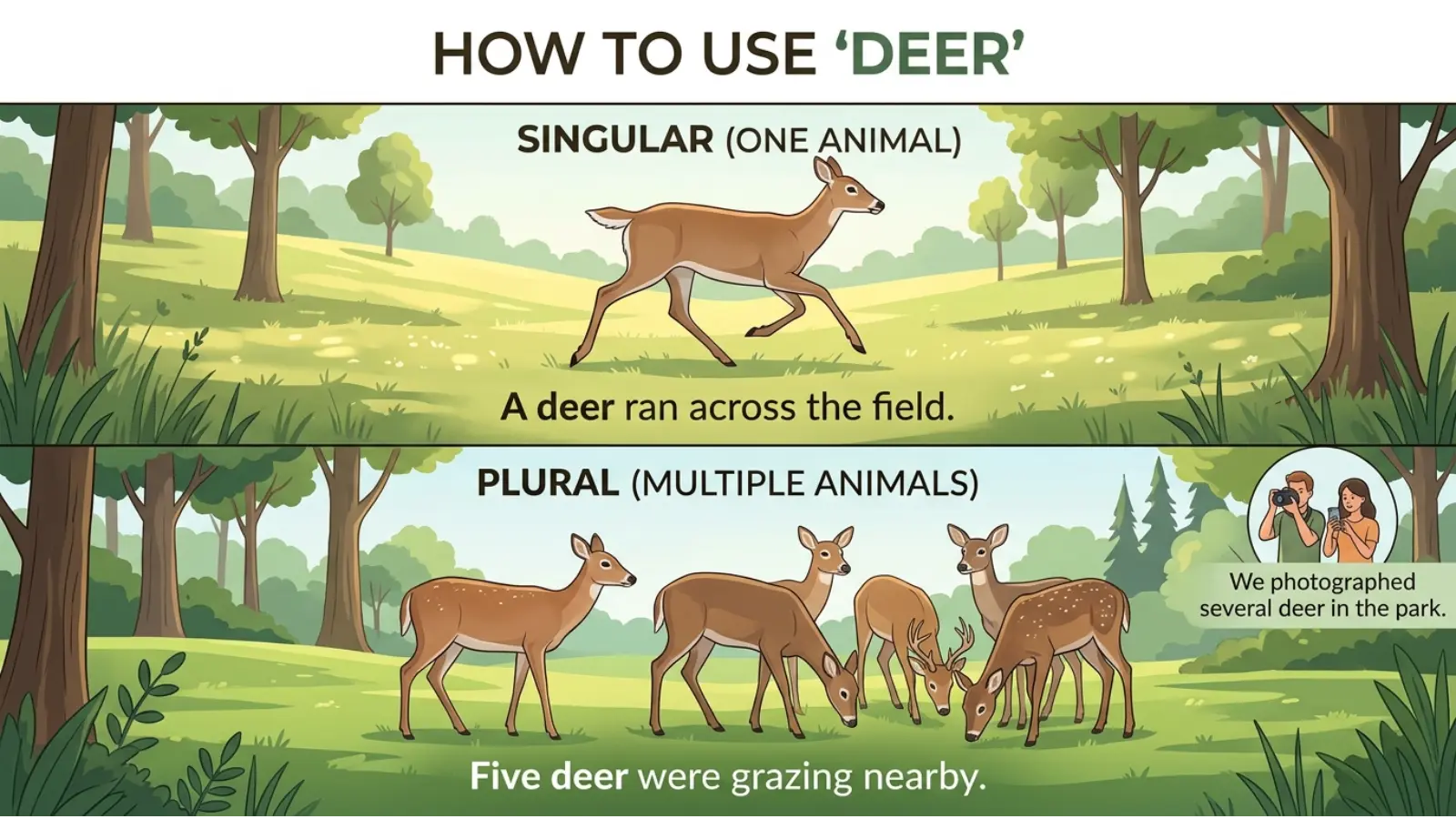
Use deer when referring to one animal or multiple animals in normal writing.
Examples:
- A deer ran across the field.
- Five deer were grazing nearby.
- We photographed several deer in the park.
When to Use Deers
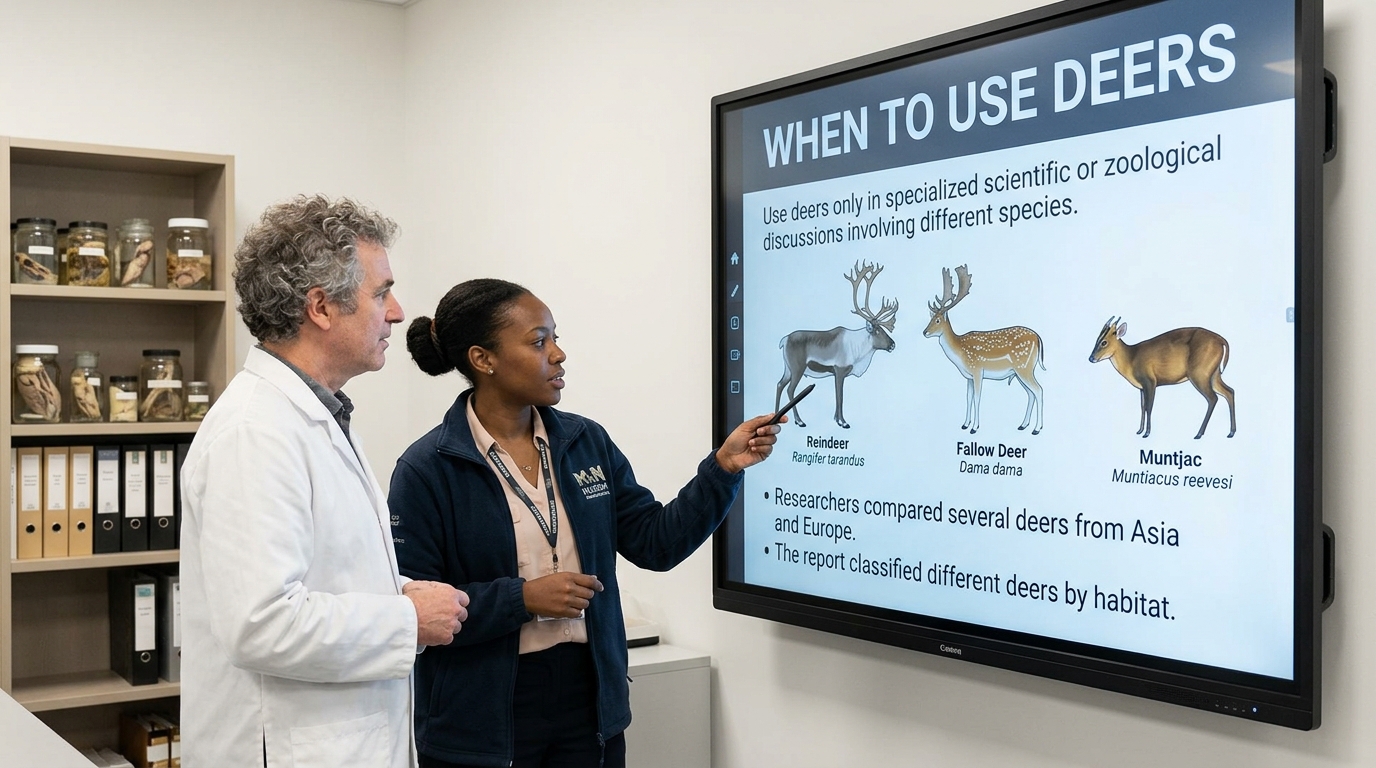
Use deers only in specialized scientific or zoological discussions involving different species.
Examples:
- Researchers compared several deers from Asia and Europe.
- The report classified different deers by habitat.
❌ Common Mistakes
Mistake 1
❌ I saw three deers yesterday.
✅ I saw three deer yesterday.
Mistake 2
❌ Many deers live in the forest.
✅ Many deer live in the forest.
Mistake 3
❌ Two deers crossed the road.
✅ Two deer crossed the road.
Mistake 4
❌ The hunter observed six deers.
✅ The hunter observed six deer.
🧠 Easy Trick to Remember
Think of this sentence:
“One sheep, two sheep. One deer, two deer.”
If sheep does not change in the plural form, neither does deer.
Write 5 Examples
1. In School Writing
The students learned about deer habitats in biology class.
2. In Nature Articles
Several deer were seen near the mountain trail.
3. In News Reports
Wild deer entered a residential area.
4. In Everyday Conversation
We spotted two deer while driving home.
5. In Wildlife Photography
The photographer captured a family of deer at sunrise.
🔍 Google Trends & Usage Data
Search data consistently shows that deer is overwhelmingly more popular than deers worldwide. Most users search for deer because it is the accepted singular and plural form.
Country Insights
| Country | Most Popular Form |
|---|---|
| USA | Deer |
| UK | Deer |
| Australia | Deer |
| India | Deer |
| Pakistan | Deer |
Insight
Across all major English-speaking countries, deer dominates usage. Searches for deers are usually related to grammar questions or scientific contexts.
📊 Comparison Table: Keyword Variations
| Variation | Usage |
|---|---|
| Deer or Deers | Grammar comparison |
| Deer plural | Common search |
| Is deers correct | Grammar question |
| Deer meaning | Definition search |
| Deer vs deers | Comparison query |
| Plural of deer | Educational search |
| Deer grammar rule | Learning query |
❓ FAQs
Is deers correct?
Usually no. The correct plural form is deer.
What is the difference between deer and deers?
Deer is the standard form, while deers is a rare scientific plural.
Which is more common?
Deer is far more common in everyday English.
Can I use deers in formal writing?
Only in specialized scientific contexts.
Why does this confusion exist?
Most English nouns add “s” for plurals, but deer is an irregular noun.
✅ Final Verdict
The correct word in almost every situation is deer. It serves as both the singular and plural form.
Use deers only in rare scientific discussions involving different species. For school work, professional writing, blogs, and everyday communication, choose deer.
Conclusion
The debate between deer or deers is easier to solve than many people think. In standard English, the word deer works for both one animal and many animals. This rule applies in schools, workplaces, books, and everyday conversations.
Although deers exists, it is rarely used outside scientific or zoological writing. Most native speakers never use it in daily communication. Remembering that deer follows the same pattern as sheep can help you avoid mistakes.
If you are unsure, always choose deer. It is the accepted, natural, and grammatically correct form in nearly every situation. Following this simple rule will make your writing clearer and more professional.

Sara Taylor is a passionate writer and language enthusiast. She specializes in creating simple and easy-to-understand articles about English grammar, spelling differences, and commonly confused words. Her writing style focuses on helping students, writers, and English learners improve their language skills with confidence. Through informative guides and practical examples, Sara makes complex grammar topics easier for everyday readers.