
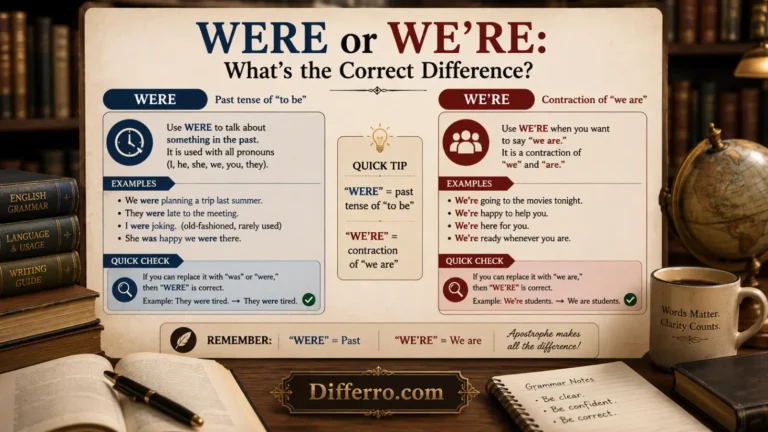
Were or Were is a common grammar confusion in English writing. Many people mix these two words because they sound almost the same in conversation. However, they have completely different meanings and uses.
“Were” is a past tense verb, while “were” is a contraction of “we are.” Using the wrong one can change the meaning of your sentence and make your writing look incorrect.
This confusion appears in emails, social media posts, school assignments, and even professional writing. The good news is that the difference is very easy to understand once you learn the basic rule.
In this guide, you will learn the meanings, differences, examples, mistakes, and memory tricks for using were and were correctly.
⭐ Quick Answer
“Were” is the past tense of “are.”
“Were” is the short form of “we are.”
Example:
- Were: They were happy yesterday.
- Were: We’re going to the park today.
📘 Meaning of Were
“Were” is the past tense form of the verb “to be.”
It talks about something that happened in the past.
Examples:
- They were late for school.
- We were tired after the trip.
📘 Meaning of We’re
“Were” is a contraction of “we are.”
It combines two words into one shorter form.
Examples:
- Were planning a family dinner.
- Were excited about the match.
📊 Key Differences Between Were and Were
| Feature | Were | We’re |
|---|---|---|
| Meaning | Past tense verb | Short form of “we are” |
| Usage | Talks about the past | Talks about the present |
| Tone | Formal and standard | Casual and conversational |
| Grammar Type | Verb | Contraction |
| Popularity | Common in writing | Common in speech and texting |
🕰️ Origin & History
The word were comes from Old English and has existed for centuries. It developed from older Germanic languages.
The contraction we’re became popular later as English speakers started shortening words in casual speech and writing.
Similar confusing word pairs include:
- Their vs There
- Your vs You’re
- Its vs It’s
- Were vs Where
🇬🇧 British English vs American English Spelling
Both British English and American English use were and we’re in the same way. There is no spelling difference between the two forms.
The only difference is writing style. British English often avoids contractions in formal writing, while American English uses them more freely.
Comparison Table: British vs American English
| Style | British English | American English |
|---|---|---|
| Formal Writing | Prefers “we are” | Accepts “we’re” |
| Casual Writing | Uses “we’re” | Uses “we’re” |
| Meaning of “were” | Same | Same |
| Grammar Rules | Same | Same |
✍️ When to Use “Were”
Use were when talking about the past.
Examples:
- We were neighbors in college.
- They were busy yesterday.
- The kids were playing outside.
Use “Were” For:
- Past events
- Past situations
- Imaginary conditions
Example:
- If I were rich, I would travel the world.
✍️ When to Use “We’re”
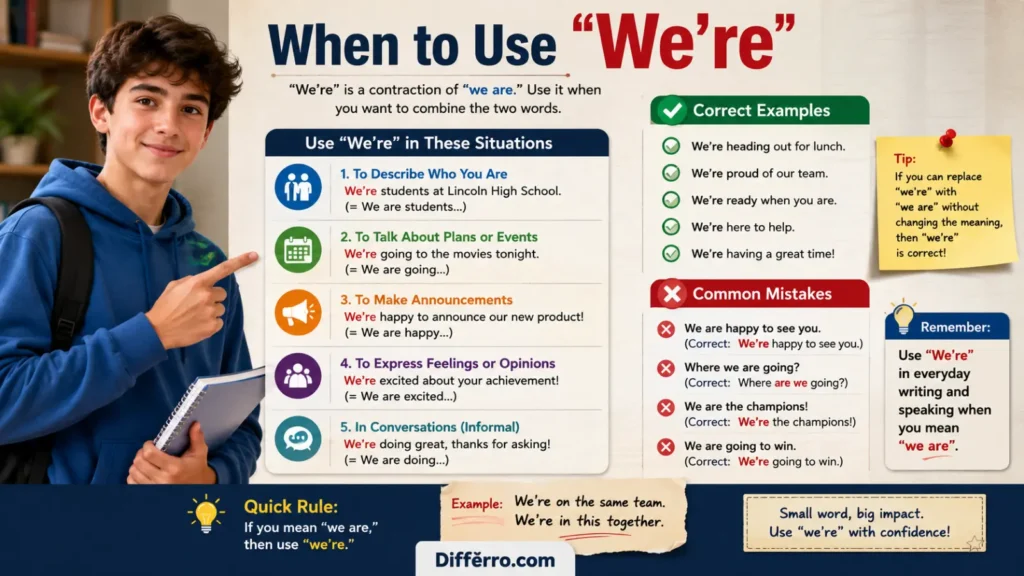
Use we’re when you mean “we are.”
Examples:
- We’re watching a movie tonight.
- We’re ready for the meeting.
- We’re learning English grammar.
Use “We’re” For:
- Present actions
- Current situations
- Informal writing
❌ Common Mistakes
| Incorrect | Correct |
|---|---|
| We’re happy yesterday. | We were happy yesterday. |
| Were going to the mall. | We’re going to the mall. |
| They we’re late. | They were late. |
| We were planning dinner now. | We’re planning dinner now. |
🧠 Easy Trick to Remember
Here’s a simple memory tip:
- We’re = We are
If you can replace the word with “we are,” then use we’re.
Example:
- We’re excited.
- We are excited. ✅
If the sentence talks about the past, use were.
Example:
- We were excited yesterday. ✅
📝 Write 5 Examples
1. School Conversation
- We’re studying for exams tonight.
- The students were nervous before the test.
2. Family Discussion
- We’re visiting our grandparents tomorrow.
- We were at their house last weekend.
3. Office Meeting
- We’re preparing a new report.
- We were busy during the conference.
4. Sports Activity
- We’re practicing football today.
- We were champions last year.
5. Travel Situation
- We’re leaving for Lahore tonight.
- We were in Karachi last month.
🔍 Related Keywords
- Were vs We’re
- Difference between were and we’re
- Were meaning
- We’re meaning
- Grammar mistakes in English
- Common English contractions
- Were or we re
⚖️ Final Verdict
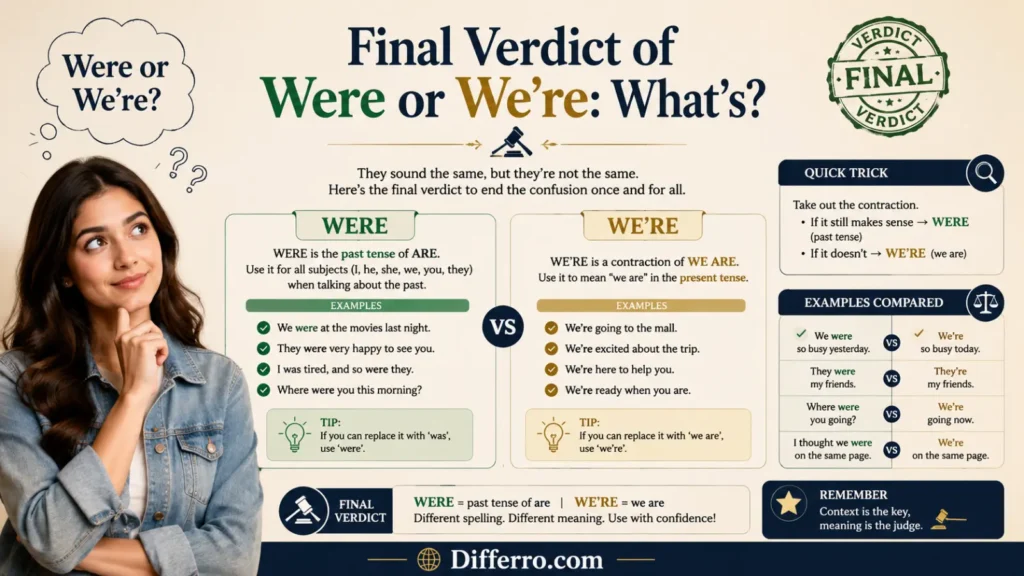
Both were and we’re are correct words, but they serve different purposes.
- Use were for past situations.
- Use we’re when saying “we are.”
Understanding this difference improves grammar, writing clarity, and communication skills.
📈 Google Trends & Usage Data
In countries like the USA, UK, Australia, India, and Pakistan, searches for “were or we’re” remain high because many learners confuse the two words.
Students and content writers search this keyword often for grammar help. Mobile typing and autocorrect also increase the confusion.
American users search more for contraction rules, while UK users focus on formal grammar usage.
Pakistan and India show growing search interest because English learning content is becoming more popular online.
Comparison Table: Keyword Variations
| Keyword Variation | Search Intent |
|---|---|
| Were or We’re | Grammar confusion |
| Difference between were and we’re | Comparison |
| Were meaning | Definition |
| We’re meaning | Contraction explanation |
| How to use were | Grammar learning |
| How to use we’re | Writing he |
FAQs ;
1. Is it correct to use “we’re” in formal writing?
Yes, but many formal documents prefer “we are” instead.
2. What is the main difference between were and we’re?
“Were” is past tense, while “we’re” means “we are.”
3. Which word is more common?
Both are common, but “were” appears more in formal writing.
4. Why do people confuse were and we’re?
They sound similar when spoken quickly.
5. Can “were” replace “we’re”?
No. They have different meanings and grammar functions.
🏁 Conclusion
Understanding the difference between were or we’re is important for clear English writing. Although these words sound alike, they have different meanings and uses.
Use were for past situations and events. Use we’re as a short form of “we are.” A simple replacement test can help you choose the correct word every time.
This grammar rule may seem small, but it improves your writing quality and prevents common mistakes. Whether you are writing emails, assignments, or social media posts, using these words correctly makes your English look more professional and natural.
Practice with daily examples, and the confusion will quickly disappear.
Discover More Post ;
Semrush Or Moz: Which SEO Tool Is Better in 2026?
Cum Or Come: Which Spelling Is Correct?
Karat Or Carat: What’s the Difference?

Sara Taylor is a passionate writer and language enthusiast. She specializes in creating simple and easy-to-understand articles about English grammar, spelling differences, and commonly confused words. Her writing style focuses on helping students, writers, and English learners improve their language skills with confidence. Through informative guides and practical examples, Sara makes complex grammar topics easier for everyday readers.