
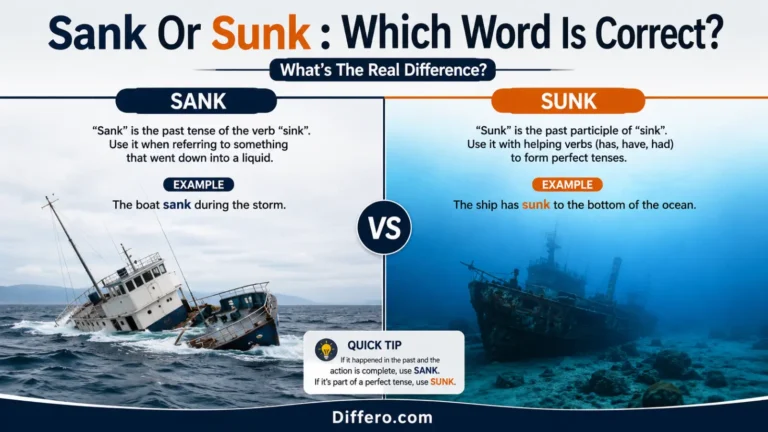
Sank Or Sunk is a common grammar confusion in English. Many people use these words interchangeably, but they do not mean the same thing in every sentence. Both words come from the verb “sink,” yet their grammar roles are different.
This confusion happens because English verbs often change forms in the past tense and past participle. If you say “The boat sank,” it sounds correct. But if you say “The boat has sank,” it becomes incorrect. In that case, you should use “sunk.”
Understanding the difference between “sank” and “sunk” helps improve your writing and speaking. It also makes your English sound more natural and professional. In this guide, you will learn the meanings, differences, history, examples, and simple tricks to remember the correct usage.
⭐ Quick Answer
“Sank” is the simple past tense of “sink.” “Sunk” is the past participle used with helping verbs like has, have, or had.
✅ Correct: The ship sank yesterday.
✅ Correct: The ship has sunk already.
📖 Meaning of Sank
“Sank” is the simple past tense of the verb “sink.” It describes something that went below the surface in the past.
Examples:
- The small boat sank during the storm.
- My heart sank after hearing the news.
📖 Meaning of Sunk
“Sunk” is the past participle form of “sink.” It is used with helping verbs such as has, have, and had.
Examples:
- The ship has sunk into the ocean.
- They had sunk all their savings into the project.
📊 Key Differences Table
| Feature | Sank | Sunk |
|---|---|---|
| Grammar Type | Simple past tense | Past participle |
| Meaning | Went below surface | Already gone below |
| Usage | Used alone | Used with helping verbs |
| Tone | Direct action | Completed action |
| Popularity | Common in speech | Common in formal writing |
🕰️ Origin & History
Both “sank” and “sunk” come from the Old English verb “sincan,” which meant “to go down.” Over time, English created different verb forms for tense changes.
“Sank” became the standard past tense form. “Sunk” developed as the past participle.
Similar examples include:
- Drink → Drank → Drunk
- Ring → Rang → Rung
- Sing → Sang → Sung
These irregular verb patterns are common in English grammar.
🇬🇧 British English vs American English Spelling
Both British and American English use “sank” and “sunk” in the same way. There is no spelling difference between the two versions of English.
However, informal speech in some regions may misuse the forms. Formal writing follows standard grammar rules everywhere.
Comparison Table: British vs American English
| Feature | British English | American English |
|---|---|---|
| Past tense | Sank | Sank |
| Past participle | Sunk | Sunk |
| Formal usage | Same | Same |
| Common confusion | Exists | Exists |
✍️ When to Use “Sank”
Use “sank” when describing an action completed in the past without a helping verb.
Examples:
- The Titanic sank in 1912.
- His mood sank quickly.
- The stone sank into the water.
✍️ When to Use “Sunk”
Use “sunk” with helping verbs like has, have, or had.
Examples:
- The submarine has sunk deep underwater.
- They had sunk too much money into repairs.
- The treasure has sunk to the ocean floor.
❌ Common Mistakes
| Incorrect | Correct |
|---|---|
| The ship has sank. | The ship has sunk. |
| He sunk yesterday. | He sank yesterday. |
| They have sank the boat. | They have sunk the boat. |
| My heart has sank. | My heart has sunk. |
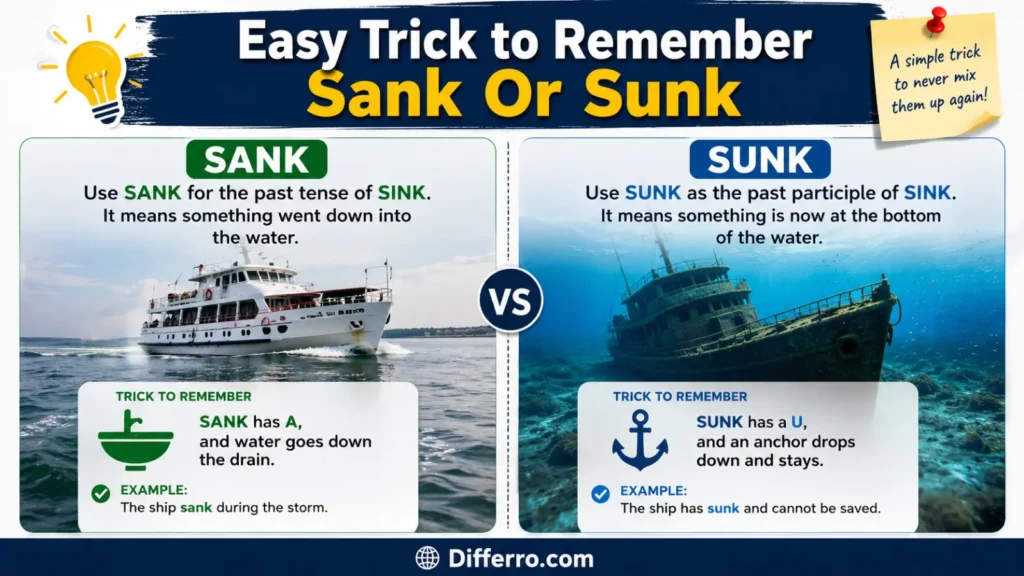
🧠 Easy Trick to Remember
Think of this pattern:
- Drink → Drank → Drunk
- Sink → Sank → Sunk
If you use has, have, or had, choose “sunk.”

🏡 Everyday Life Examples
1. Boat Accident Example
The fishing boat sank during heavy rain.
The boat has sunk near the harbor.
2. Emotional Situation Example
Her confidence sank after the interview.
His hopes had sunk completely.
3. Financial Example
The company sank millions into advertising.
They have sunk too much money already.
4. Sports Example
The team’s energy sank after halftime.
Their motivation had sunk by the final round.
5. Daily Conversation Example
My phone sank into the bathtub.
The keys have sunk in the muddy water.
🔍 Related Keywords
- Sink past tense
- Sank vs sunk difference
- Sank meaning
- Sunk meaning
- Sink grammar rules
- Past participle of sink
- English irregular verbs
✅ Final Verdict
“Sank” and “sunk” are both correct, but they serve different grammar purposes.
- Use sank as the simple past tense.
- Use sunk as the past participle with helping verbs.
If there is no helping verb, choose “sank.”
If the sentence includes has, have, or had, use “sunk.”
📈 Google Trends & Usage Data
In the USA, UK, Australia, India, and Pakistan, “sank” receives more search interest because people often learn past tense forms first. “Sunk” also gets strong traffic due to grammar confusion and writing checks.
Writers, students, and English learners frequently search both terms together. Educational websites show high engagement for this keyword pair.
Comparison Table: Keyword Variations
| Keyword Variation | Search Intent |
|---|---|
| Sank or sunk | Grammar confusion |
| Sank meaning | Definition |
| Sunk meaning | Definition |
| Sink past tense | Grammar learning |
| Sink past participle | Verb forms |
| Sank vs sunk | Comparison |
| Has sank or sunk | Correct usage |
FAQs ;
Is “sank” correct?
Yes. “Sank” is the correct simple past tense of “sink.”
What is the difference between sank and sunk?
“Sank” is simple past tense, while “sunk” is the past participle.
Which is more common: sank or sunk?
“Sank” appears more often in daily conversation. “Sunk” is common in formal grammar structures.
Is “has sank” correct?
No. The correct phrase is “has sunk.”
Why does this confusion exist?
English irregular verbs change forms differently, which causes confusion for learners.
📝 Conclusion
Understanding Sank Or Sunk becomes easy once you learn their grammar roles. “Sank” works as the simple past tense, while “sunk” functions as the past participle. The confusion happens because both words come from the same verb, “sink.” However, their usage changes depending on sentence structure.
A quick rule helps a lot. If your sentence includes helping verbs like has, have, or had, use “sunk.” Otherwise, use “sank.” Learning these patterns improves grammar, writing clarity, and speaking confidence.
These verb forms follow common English irregular patterns, just like “sing, sang, sung.” With regular practice and examples, choosing the correct word becomes natural and simple.
Discover More Post ;
Pepsi Or Coke : What’s the Real Difference?
Fare Or Fair : What’s the Correct Difference?
URL Or Keywords Explained for Beginners

Sara Taylor is a passionate writer and language enthusiast. She specializes in creating simple and easy-to-understand articles about English grammar, spelling differences, and commonly confused words. Her writing style focuses on helping students, writers, and English learners improve their language skills with confidence. Through informative guides and practical examples, Sara makes complex grammar topics easier for everyday readers.