
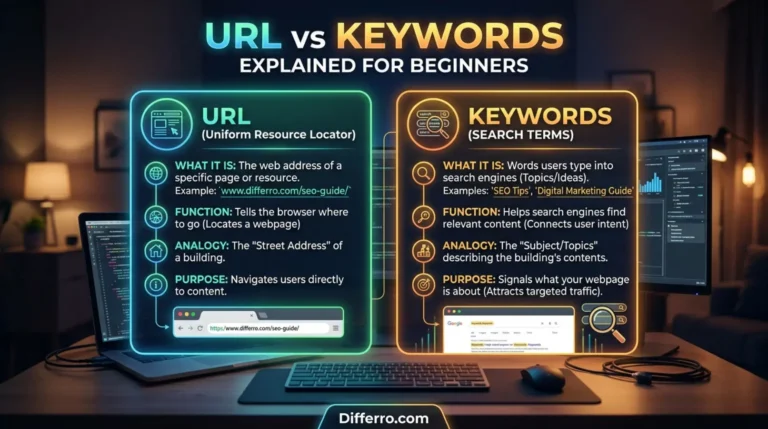
URL Or Keywords is a common SEO confusion for beginners and bloggers. Many people wonder whether URLs matter more than keywords when trying to rank on Google. Both are important, but they work in different ways.
A URL helps search engines and users understand your page structure. Keywords help search engines know what your content is about. If you ignore either one, your SEO performance may suffer.
Modern SEO focuses more on content quality and user intent. Still, optimized URLs and smart keyword usage improve rankings, clicks, and readability.
In this guide, you will learn the meaning of URLs and keywords, their differences, proper usage, common mistakes, and which one matters more in SEO today.
⭐ Quick Answer
URLs and keywords both matter for SEO, but keywords are more important for rankings. Keywords help Google understand your content, while URLs improve readability and structure.
Example:
- Good URL:
example.com/seo-keywords-guide - Keyword used in content: “SEO keywords”
Using both together gives the best SEO results.
Meaning of URL
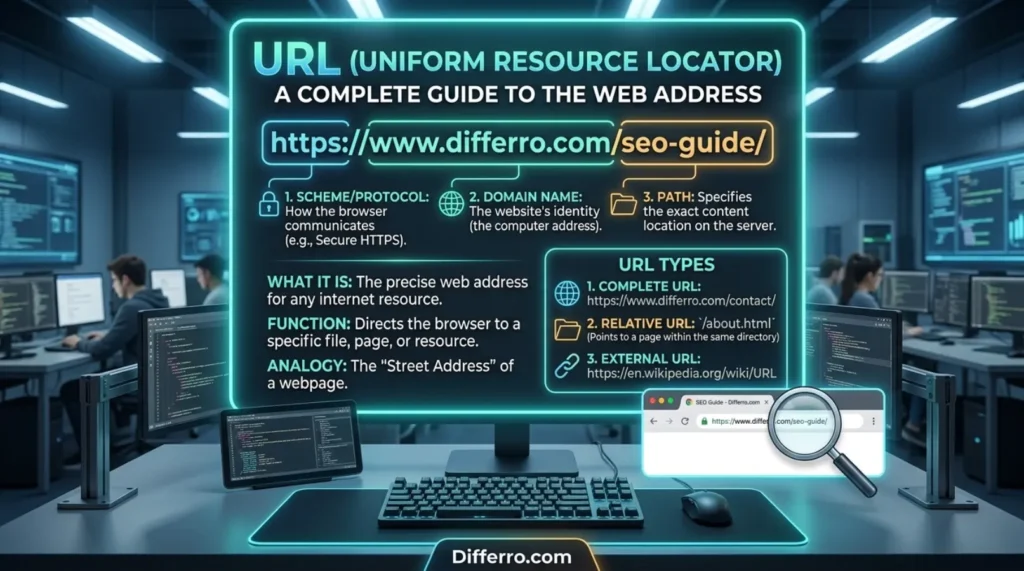
A URL stands for Uniform Resource Locator. It is the web address of a page on the internet.
Examples:
https://example.com/digital-marketinghttps://example.com/seo-tips
URLs help users and search engines find pages quickly.
Meaning of Keywords
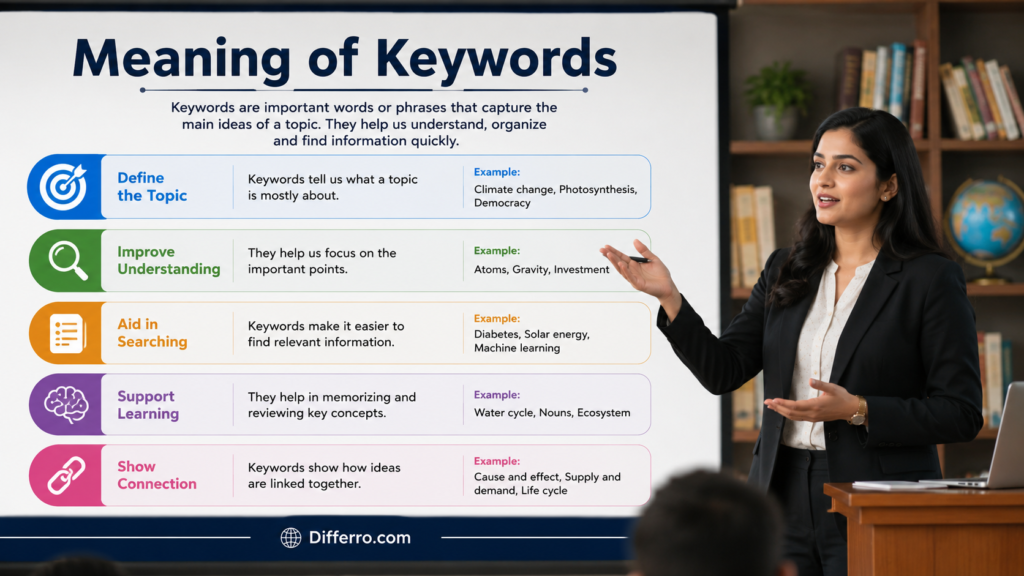
Keywords are words or phrases people type into search engines.
Examples:
- “best SEO tools”
- “how to rank on Google”
Keywords help search engines match content with user searches.
📊 Key Differences Between URL and Keywords
| Feature | URL | Keywords |
|---|---|---|
| Meaning | Web address of a page | Search terms users type |
| Purpose | Organizes content | Helps ranking in search |
| Tone | Technical | Search-focused |
| Usage | Appears in browser | Used in content |
| SEO Value | Medium | Very High |
| Popularity | Important for structure | Essential for ranking |
📜 Origin & History
The term URL became popular in the early internet era during the 1990s. It helped users locate web pages online.
The word keyword came from information retrieval systems and later became central in SEO and digital marketing.
Similar examples:
- URL vs URI
- Keyword vs Search Query
- Meta Tags vs Keywords
🇬🇧 British English vs American English Spelling
There is no spelling difference between URL and keywords in British and American English. Both use the same spelling worldwide.
However, SEO writing styles may differ slightly between regions. American SEO content often uses shorter URLs, while British sites may use more descriptive structures.
British vs American English Comparison
| Term | British English | American English |
|---|---|---|
| URL | URL | URL |
| Keywords | Keywords | Keywords |
| Optimization | Optimisation | Optimization |
| Analyze | Analyse | Analyze |
📝 When to Use URL
Use a URL when talking about:
- Website pages
- Web addresses
- SEO structure
- Navigation
Examples:
- “Keep your URL short and clean.”
- “Add keywords inside the URL.”
📝 When to Use Keywords
Use keywords when discussing:
- SEO content
- Search rankings
- User intent
- Google searches
Examples:
- “Use keywords naturally in headings.”
- “Research low-competition keywords.”
❌ Common Mistakes
| Incorrect Usage | Correct Usage |
|---|---|
| Stuffing keywords in URLs | Keep URLs short |
| Using random numbers in URLs | Use readable words |
| Repeating keywords too much | Write naturally |
| Ignoring search intent | Match user intent |
More mistakes:
- Writing very long URLs
- Using keywords without context
- Adding symbols in URLs
- Using unrelated keywords
🧠 Easy Trick to Remember
- URL = Location
- Keyword = Search Term
Think of a URL as a house address and keywords as directions people use to find that house.
✨ write 5 examples
1. Blog Writing Example
Use keywords inside content and a clean URL for better SEO.
Example:
- URL:
example.com/seo-guide - Keyword: “SEO guide”
2. E-commerce Example
Product pages need keywords to rank in shopping searches.
Example:
- URL:
store.com/running-shoes - Keyword: “best running shoes”
3. News Website Example
Short URLs improve readability and sharing.
Example:
- URL:
news.com/tech-update - Keyword: “latest tech update”
4. Local SEO Example
Local businesses should include location keywords.
Example:
- URL:
bakery.com/lahore-cakes - Keyword: “cakes in Lahore”
5. Educational Website Example
Educational content ranks better with question-based keywords.
Example:
- URL:
site.com/learn-seo - Keyword: “how to learn SEO”
🔍 Related Keywords
- URL vs keywords SEO
- SEO keywords guide
- URL optimization tips
- Keywords in URL
- SEO URL structure
- Keyword placement SEO
- SEO ranking factors
📈 Google Trends & Usage Data
In countries like the USA, UK, Australia, India, and Pakistan, searches for SEO keywords are much higher than searches for URLs alone.
SEO professionals focus more on keyword research because it directly affects rankings. However, optimized URLs still improve click-through rates and user experience.
India and Pakistan show growing interest in beginner SEO topics. The USA and UK focus more on advanced keyword strategies.
Australia shows balanced interest in both technical SEO and content optimization.
🌍 Comparison Table: Keyword Variations
| Country | Popular Search Variation |
|---|---|
| USA | SEO keywords |
| UK | URL structure SEO |
| AUS | Best SEO practices |
| IND | Keywords for SEO |
| PAK | SEO keyword guide |
🏆 Final Verdict
Keywords are more important than URLs for SEO rankings. Search engines rely heavily on keywords to understand content and match search intent.
However, URLs still matter. A clean and keyword-friendly URL improves readability, user trust, and SEO structure.
The best strategy is to use:
- Strong keywords in content
- Simple and readable URLs
- Natural optimization
Using both correctly gives the best SEO results.
FAQs ;
Is it correct to use keywords in URLs?
Yes. Adding relevant keywords in URLs improves SEO and readability.
What is the difference between URL and keywords?
A URL is a web address, while keywords are search terms users type into Google.
Which is more common in SEO discussions?
Keywords are discussed more because they directly affect rankings.
Are keywords more important than URLs?
Yes. Keywords have a stronger impact on search visibility.
Why does confusion exist between URL and keywords?
Both are SEO elements, so beginners often think they serve the same purpose.
Conclusion
URL Or Keywords is an important SEO topic for website owners and bloggers. Keywords help search engines understand your content and improve rankings. URLs organize your pages and make links easier to read.
Modern SEO requires balance. You should create helpful content with natural keywords and also keep your URLs clean and simple.
Avoid keyword stuffing and long URLs. Focus on user experience first. Search engines reward content that solves problems clearly.
If you want better rankings, prioritize keyword research. Then support your SEO strategy with optimized URLs. Together, they create a strong foundation for long-term search success.
Discover More Post ;
Blankey or Blankie : Which Spelling Is Correct?
Openned Or Opened: Which Spelling Is Correct?
Congradulations Or Congratulations: Which Spelling Is Correct?

Sara Taylor is a passionate writer and language enthusiast. She specializes in creating simple and easy-to-understand articles about English grammar, spelling differences, and commonly confused words. Her writing style focuses on helping students, writers, and English learners improve their language skills with confidence. Through informative guides and practical examples, Sara makes complex grammar topics easier for everyday readers.