
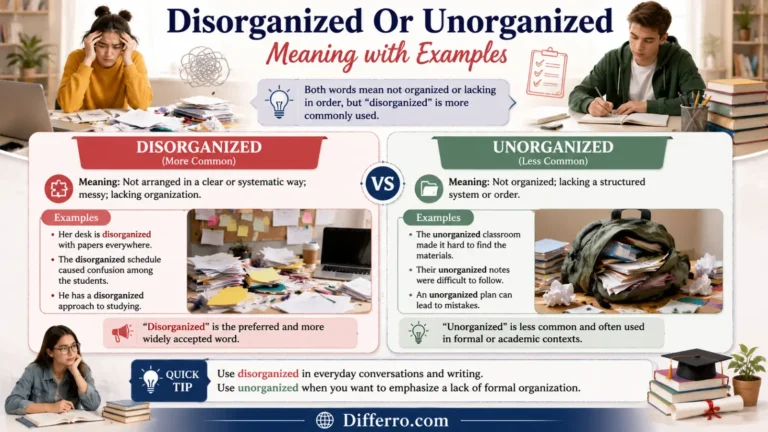
Disorganized or unorganized is a common word confusion in English. Many people think both words mean the same thing. While they are very close in meaning, there is a small difference in tone and usage.
Both words describe something messy, unordered, or lacking structure. However, one word sounds more natural in daily English. The other appears more in formal or technical writing.
This confusion happens because both words use the prefix “un-” or “dis-” before the word “organized.” These prefixes often create similar meanings in English grammar.
If you want to write clearly and sound natural, knowing the difference matters. In this guide, you will learn the meaning, usage, examples, history, and correct context for both words.
⭐ Quick Answer
Disorganized and unorganized both mean “not organized.” However, disorganized is more common in modern English and usually describes people, systems, or thoughts that are messy.
Example:
- ✅ “My desk is disorganized.”
- ✅ “The files are unorganized.”
📖 Meaning of Disorganized
Disorganized means lacking order, structure, or planning. It often describes confusion or messiness.
Examples:
- Her notes were completely disorganized before the exam.
- The company became disorganized after the manager left.
📖 Meaning of Unorganized
Unorganized means not arranged or not yet organized. It sounds more neutral and less emotional.
Examples:
- The documents are still unorganized.
- They worked with unorganized data.
📊 Key Differences Table
| Feature | Disorganized | Unorganized |
|---|---|---|
| Meaning | Messy or lacking structure | Not arranged or sorted |
| Tone | More negative | More neutral |
| Usage | Very common | Less common |
| Popularity | Widely used in daily English | Mostly formal or technical |
| Common Context | People, rooms, plans | Data, groups, files |
🕰️ Origin & History
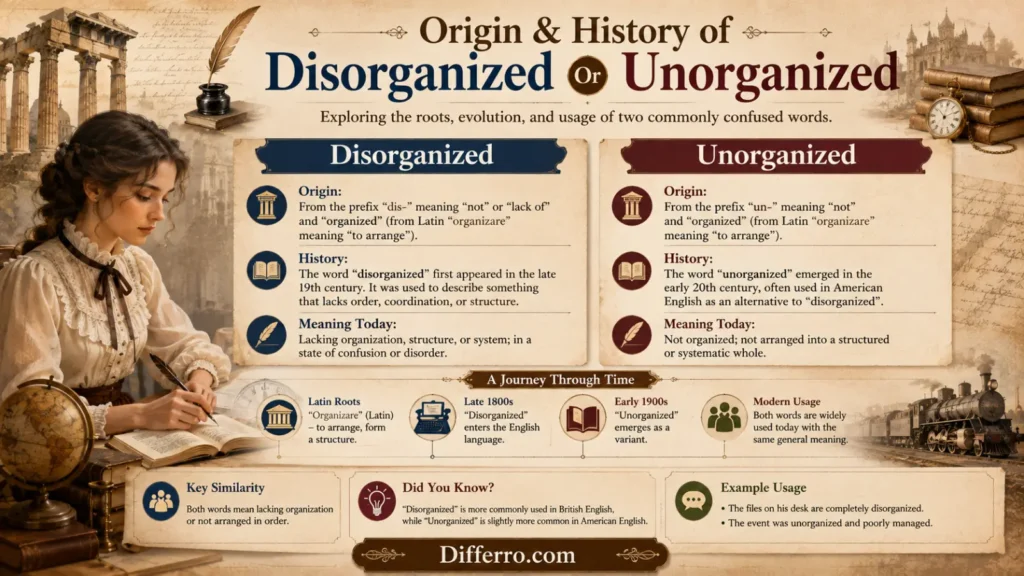
The word organized comes from the Greek word organon, meaning “tool” or “system.”
- Disorganized appeared later to describe confusion or disorder.
- Unorganized developed as a simpler opposite of organized.
English often creates opposites using prefixes like:
- Unhappy
- Disconnected
- Unclear
- Disordered
Both forms became accepted over time, but “disorganized” became more popular in everyday speech.
🇬🇧 British English vs American English Spelling
Both British and American English use disorganized and unorganized with the same spelling. There is no spelling difference between regions.
However, American English uses disorganized more often in conversation and writing.
British English sometimes prefers words like:
- untidy
- disorderly
- chaotic
Comparison Table: British vs American English
| Style | Preferred Word |
|---|---|
| American English | Disorganized |
| British English | Disorganized / Untidy |
| Formal Technical Writing | Unorganized |
✍️ When to Use Chaotic
Use disorganized when talking about:
- People
- Behavior
- Thoughts
- Work habits
- Messy situations
Examples:
- He is very disorganized at work.
- The event became disorganized quickly.
- My schedule looks disorganized this week.
✍️ When to Use Disorderly
Use unorganized when referring to:
- Files
- Data
- Information
- Groups not officially formed
Examples:
- The research used unorganized information.
- The folders remain unorganized.
- They belong to an unorganized community group.
❌ Common Mistakes
| Incorrect Usage | Correct Usage |
|---|---|
| She is unorganized person. | She is a disorganized person. |
| My brain feels unorganized. | My thoughts feel disorganized. |
| The messy room is unorganized. | The messy room is disorganized. |
| The raw files are disorganized. | The raw files are unorganized. |
🧠 Easy Trick to Remember
Simple Memory Tip:
- Disorganized = disorder and chaos
- Unorganized = not organized yet
Think like this:
“Disorganized feels messy. Unorganized feels unfinished.”
🏠 Write 5 Examples
1. 📚 School Work
My backpack looks disorganized after classes.
2. 💼 Office Files
The old reports are still unorganized.
3. 🛏️ Bedroom Cleaning
His room became disorganized within one day.
4. 📊 Business Data
The company stored unorganized customer information.
5. 🧠 Daily Planning
A disorganized routine causes stress and delays.
🔍 Related Keywords
- disorganized meaning
- unorganized meaning
- disorganized vs unorganized
- organized antonyms
- grammar confusion words
- English vocabulary differences
- disorganized synonym
⚖️ Final Verdict
Both words are correct, but disorganized is the better choice in most situations.
Use:
- Disorganized for messy behavior, people, and situations.
- Unorganized for things not yet sorted or officially arranged.
In modern English, “disorganized” sounds more natural and common.
🌍 Google Trends & Usage Data
Search interest shows that disorganized is more popular worldwide. People use it more in speaking and online writing.
In countries like the USA, UK, Australia, India, and Pakistan, “disorganized” receives higher search volume than “unorganized.”
“Unorganized” appears more in technical, legal, or data-related content.
The trend suggests users prefer simpler and more emotional language in daily communication.
Comparison Table: Keyword Variations
| Country | More Popular Keyword |
|---|---|
| USA | Disorganized |
| UK | Disorganized |
| Australia | Disorganized |
| India | Disorganized |
| Pakistan | Disorganized |
❓ FAQ Section
1. Is it correct to say unorganized?
Yes, “unorganized” is grammatically correct.
2. What is the difference between disorganized and unorganized?
Disorganized means messy or chaotic. Unorganized means not arranged yet.
3. Which word is more common?
Disorganized is far more common in modern English.
4. Which word is better for formal writing?
Unorganized works better in technical or formal contexts.
5. Why does the confusion exist?
Both words are opposites of “organized,” so their meanings overlap.
📝 Conclusion
Disorganized or unorganized may look similar, but they carry slightly different meanings. Disorganized usually describes confusion, messiness, or poor structure. Unorganized often means something has not been arranged yet.
In everyday English, disorganized is more natural and widely used. It sounds better when describing people, rooms, schedules, or work habits. Unorganized fits technical, official, or neutral situations better.
Understanding this small difference can improve your writing and communication. Choosing the right word also helps your content sound more professional and accurate.
When in doubt, use disorganized for general situations and unorganized for unfinished organization
Discover More Post ;
Lily Or Lilly: Which Spelling Is Correct? 🌸
Bareable Or Bearable Meaning, Examples & Differences
Doggy Or Doggie: Which Spelling Is Correct?

Sara Taylor is a passionate writer and language enthusiast. She specializes in creating simple and easy-to-understand articles about English grammar, spelling differences, and commonly confused words. Her writing style focuses on helping students, writers, and English learners improve their language skills with confidence. Through informative guides and practical examples, Sara makes complex grammar topics easier for everyday readers.