
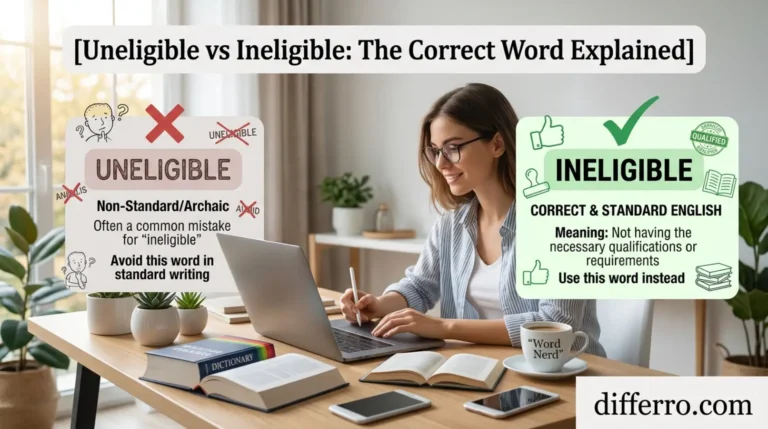
Uneligible vs Ineligible is a common spelling confusion in English. Many writers choose “uneligible” because “un-” often creates negative words. However, standard modern English normally uses ineligible for this meaning. Ineligible means not qualified, permitted, or entitled to something. You can use it for scholarships, jobs, elections, competitions, benefits, and applications. The form “uneligible” does exist in some dictionaries and historical sources, but it is uncommon in modern standard English. (Wiktionary) This guide explains the meaning, usage, history, spelling, and common mistakes. It also gives simple examples to help you remember the correct form. If you are writing an email, application, article, or official document, ineligible is the safer choice.
⭐ Quick Answer
Ineligible is the standard and preferred spelling in modern English. It means not qualified, allowed, or entitled to something.
Example: She is ineligible for the scholarship because she missed the deadline.
📖 Meaning of Uneligible
Uneligible means “not eligible.” Some dictionaries record it as a word, but it is uncommon in modern standard English. (Wiktionary)
Examples of Uneligible
- ❌ The applicant was uneligible for the grant.
- ❌ He became uneligible for the competition.
These sentences communicate the intended meaning, but ineligible is the preferred modern form.
📖 Meaning of Ineligible
Ineligible means someone or something does not meet the required conditions. It can also mean not permitted or not qualified. (Wiktionary)
Examples of Ineligible
- ✅ She is ineligible for the scholarship.
- ✅ The player is ineligible to participate.
The noun form is ineligibility.
🔎 Key Differences: Uneligible vs Ineligible
| Feature | Uneligible | Ineligible |
|---|---|---|
| Meaning | Not eligible | Not eligible |
| Tone | Uncommon | Standard and formal |
| Usage | Rare or historical | Modern everyday usage |
| Popularity | Very low | Much higher |
| Recommended | Generally avoid | Recommended |
Important: “Uneligible” has appeared in historical dictionaries. One 1828 dictionary even noted that “ineligible” was the form then being used. (M Shaffer)
📚 Origin & History
Ineligible developed through the negative prefix in- combined with eligible. The word has French and Latin roots. (Wiktionary)
English does not always create negative words with the simple un- prefix. Standard examples include:
- eligible → ineligible
- legal → illegal
- possible → impossible
- regular → irregular
- responsible → irresponsible
Historical dictionaries also recorded uneligible as a synonym for ineligible. Modern usage, however, strongly favors ineligible. (M Shaffer)
🇬🇧 British English vs American English Spelling
British and American English both use ineligible as the standard form.
The spelling does not change between the two major English varieties.
Uneligible is not the preferred modern spelling in either variety.
British vs American English Comparison
| English Variety | Preferred Spelling | Example |
|---|---|---|
| British English | Ineligible | He is ineligible to vote. |
| American English | Ineligible | She is ineligible for the loan. |
| Australian English | Ineligible | The applicant is ineligible. |
| Indian English | Ineligible | He is ineligible for admission. |
| Pakistani English | Ineligible | The candidate is ineligible for the post. |
✅ When to Use Ineligible
Use ineligible when a person fails to meet specific requirements.
Common situations include:
- Scholarship applications
- Job applications
- Government benefits
- Voting rights
- Competitions
- Sports participation
- Loans
- Insurance
- School admissions
- Promotions
Examples
- The student is ineligible for the scholarship.
- He is ineligible to vote.
- The player was declared ineligible for the match.
- Applicants without documents are ineligible.
⚠️ When to Use Uneligible
In most modern writing, you should avoid uneligible.
You may encounter “Uneligible vs Ineligible” it in older dictionaries, historical texts, or informal writing. Historical evidence confirms that the word has existed, but modern standard usage favors ineligible. (M Shaffer)
Better Choice
Instead of:
- ❌ The candidate is uneligible.
Write:
- ✅ The candidate is ineligible.
🚫 Common Mistakes
1. Adding “un-” Automatically
- ❌ She is uneligible for the program.
- ✅ She is ineligible for the program.
2. Using “Uneligible” in Formal Writing
- ❌ The applicant is uneligible for financial assistance.
- ✅ The applicant is ineligible for financial assistance.
3. Misspelling “Ineligible”
- ❌ Ineligable
- ❌ Inelligible
- ❌ Uneligable
- ✅ Ineligible
4. Using the Wrong Preposition
- ❌ She is ineligible of the scholarship.
- ✅ She is ineligible for the scholarship.
Use ineligible for + noun.
5. Using the Wrong Verb Pattern
- ❌ He is ineligible for participate.
- ✅ He is ineligible to participate.
Use ineligible to + verb.
🧠 Easy Trick to Remember
Remember this simple pattern:
Eligible → Ineligible
Think of “in-” as the official negative partner of “eligible.”
You can also remember:
Eligible = allowed.
Ineligible = not allowed.
Avoid automatically adding un- just because “un-” appears in many English words.
🌍 Everyday Life Examples
1. Scholarship Application
The student is ineligible for the scholarship because her grades are too low.
2. Job Application
The applicant is ineligible for the position without the required qualification.
3. Sports Competition
The player became ineligible to compete after breaking the rules.
4. Government Benefit
Some families may be ineligible for financial assistance.
5. Voting Rights
A person below the legal voting age is ineligible to vote.
These examples show the primary keyword ineligible in natural everyday contexts. The secondary keyword uneligible may appear in searches, but it should usually be replaced with ineligible.
📊 Google Trends & Usage Insight
Google Trends compares relative search interest rather than proving dictionary correctness.
For USA, UK, Australia, India, and Pakistan, the practical usage strongly favors ineligible.
Searchers may still type uneligible because the “un-” prefix seems natural.
The strongest SEO opportunity comes from answering the spelling confusion while recommending ineligible.
Keyword Variations Comparison
| Keyword Variation | Standard Usage | Search Intent |
|---|---|---|
| Uneligible or Ineligible | Comparison | Spelling confusion |
| Uneligible vs Ineligible | Comparison | Correct word |
| Is Uneligible a Word? | Question | Word validity |
| Is Ineligible Correct? | Question | Spelling check |
| Ineligible Meaning | Definition | Informational |
| Uneligible Meaning | Definition | Vocabulary |
| Correct Spelling of Ineligible | Spelling | Grammar |
⚖️ Final Verdict
Ineligible is the best choice for modern standard English.
Use ineligible in schoolwork, professional writing, websites, applications, reports, and official documents.
Uneligible has historical and dictionary evidence, so calling it completely nonexistent would be inaccurate. (Wiktionary)
Still, ineligible is much safer and more natural for modern readers.
Simple Rule
Eligible → Ineligible ✅
Eligible → Uneligible ❌ in most modern writing
❓ Frequently Asked Questions
Is “uneligible” correct?
“Uneligible” is recorded as a word in some dictionaries and historical sources. However, ineligible is the standard modern choice. (Wiktionary)
What is the difference between uneligible and ineligible?
Both can communicate the idea of being not eligible. Ineligible is the established modern form used in standard English.
Which is more common, uneligible or ineligible?
Ineligible is far more common in modern standard English. It is the recommended form for general and professional writing.
Is ineligible formal usage?
Yes. Ineligible works well in formal, academic, professional, legal, educational, and everyday contexts.
Why does the confusion between uneligible and ineligible exist?
The confusion comes from the common negative prefix un-. Words like “unable” and “unfair” make “uneligible” look logical. English uses ineligible instead.
📝 Conclusion
The Uneligible or Ineligible debate mainly concerns standard spelling and modern usage. Ineligible is the preferred word when someone does not meet required conditions. It works naturally with scholarships, jobs, benefits, competitions, voting, and many other situations. “Uneligible” has appeared in dictionaries and historical sources, so it is not simply an invented form. (Wiktionary) However, modern writers should normally choose ineligible for clarity and professionalism. Remember the simple pattern: eligible → ineligible. Use ineligible for before a noun and ineligible to before a verb. This small spelling choice can make your writing more accurate and polished.

Imran Lodhra is a comparison-focused content writer at Differro.com.
He specializes in creating clear, simple, and informative comparison articles.
His work helps readers understand key differences, pros and cons, and important details.
Imran focuses on accurate, practical, and easy-to-read content for everyday readers.
1 thought on “Uneligible vs Ineligible: The Correct Word Explained”