
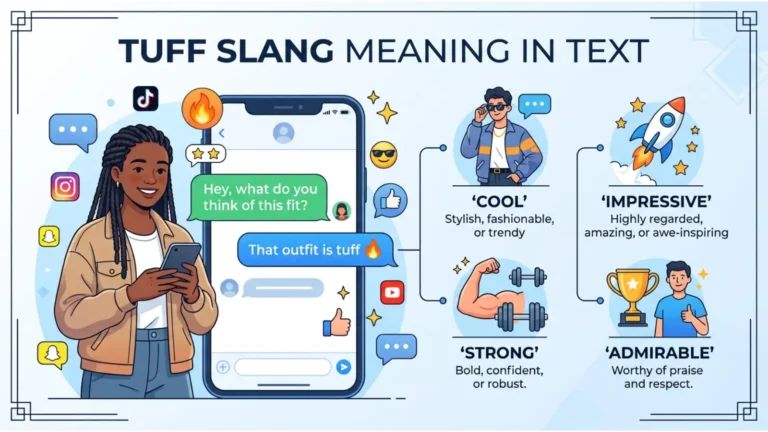
Tuff slang meaning is a common question among people who see this word in texts, TikTok comments, Instagram posts, gaming chats, or casual conversations. At first glance, “tuff” may look like a simple misspelling of “tough,” but online slang has given it its own style and uses.
Depending on the context, tuff can describe someone or something as impressive, strong, attractive, difficult, or emotionally intense.
Young people often use it as an informal way to praise something or show admiration. However, its meaning can change based on the sentence, tone, and situation.
If you have seen someone comment “That fit is tuff” or “Bro is tuff,” understanding the context is important.
Quick Answer:
In slang, “tuff” usually means cool, impressive, strong, or admirable. It is an informal spelling of “tough” that is especially common in online conversations and social media.
What Does Tuff Mean in Text?
In texting and online slang, tuff usually means cool, impressive, strong, or excellent.
For example:
“That new car is tuff.”
Here, “tuff” means the car looks really cool or impressive.
It can also describe a person’s appearance, personality, skills, clothing, music, artwork, or actions.
Examples:
- “Your new shoes are tuff.”
- “That haircut is tuff.”
- “Bro is tuff at basketball.”
- “This song is tuff.”
- “That design looks tuff.”
The exact meaning depends on the context.
Tuff Slang Meaning and Definition
The tuff slang meaning is closely related to the traditional word “tough.” However, online users often spell it as “tuff” to create a more casual, modern, or slang-like expression.
In many social media conversations, it can mean:
- Cool
- Impressive
- Strong
- Stylish
- Excellent
- Fearless
- Hard or difficult
- Admirable
The word does not always have one fixed definition.
For example:
“That jacket is tuff.”
Meaning: The jacket looks cool or stylish.
“That exam was tuff.”
Meaning: The exam was difficult.
“He is tuff.”
Meaning: He may be strong, confident, fearless, or impressive.
Is Tuff the Same as Tough?
Not exactly.
Tough is the standard English spelling. It can mean strong, difficult, or able to deal with problems.
Tuff is commonly used as an informal spelling or slang form online. It can carry the same basic idea but is often used to express admiration.
| Word | Meaning | Example |
|---|---|---|
| Tough | Strong or difficult | “This material is tough.” |
| Tuff | Cool, impressive, strong, or difficult in slang | “That outfit is tuff.” |
If you are writing a school assignment, formal email, application, or professional document, tough is normally the correct choice.
Tuff Meaning in Different Contexts
The meaning of “tuff” can change depending on where and how it is used.
Tuff Meaning in Texting
In texting, “tuff” often means cool or impressive.
Example:
“I just bought these sneakers.”
“Those are tuff 🔥.”
The second person is complimenting the sneakers.
Tuff Meaning on TikTok and Instagram
On social media, users may comment “tuff” under videos, photos, outfits, cars, artwork, sports clips, or music.
For example:
“That edit is tuff.”
This generally means the edit is very good, cool, or impressive.
Tuff Meaning in Gaming
Gamers may use “tuff” to describe impressive gameplay, a difficult opponent, or a powerful character.
“That boss fight was tuff.”
Here, it can mean difficult.
But:
“That player is tuff.”
could mean the player is skilled or difficult to beat.
Tuff Meaning in Fashion
When someone says:
“Your fit is tuff.”
“Fit” means outfit, and “tuff” is a compliment meaning the outfit looks really good or stylish.
Is Tuff Rude, Offensive, or Neutral?
Generally, tuff is not a rude or offensive word.
It is usually casual slang used between friends, online communities, and younger speakers. However, the tone can change its meaning.
For example:
“That car is tuff.”
This is normally positive.
But someone could use the word sarcastically:
“Yeah, that’s real tuff.”
In that situation, the speaker might actually be making fun of something.
So, context matters.
“Tuff” is generally safe in casual communication, but it is not the best choice for formal writing.
Where Is Tuff Commonly Used?
You may see “tuff” in:
- Text messages
- TikTok comments
- Instagram comments
- YouTube comments
- Snapchat
- Gaming chats
- Discord
- Memes
- Online communities
- Casual conversations
It is much less appropriate in formal situations such as:
- Academic essays
- Job applications
- Business reports
- Professional emails
- Official documents
Real-Life Tuff Slang Examples
Friendly Usage
Person 1: “Check out my new bike.”
Person 2: “That bike is tuff!”
Meaning: The bike looks really cool.
Casual Usage
Person 1: “I finally finished my gaming setup.”
Person 2: “Tuff setup 🔥.”
Meaning: The setup looks impressive.
Compliment
“Your new shoes are tuff.”
Meaning: Your shoes look stylish or cool.
Sports Context
“That dunk was tuff!”
Meaning: The dunk was impressive.
Music Context
“This beat is tuff.”
Meaning: The beat sounds really good.
Difficult Situation
“That final exam was tuff.”
Meaning: The exam was difficult.
Emotional and Psychological Meaning of Tuff
“Tuff” can sometimes communicate more than a simple compliment.
When someone describes another person as “tuff,” they may be suggesting that the person appears:
- Strong
- Confident
- Fearless
- Resilient
- Independent
- Impressive
For example:
“She went through all that and still kept going. She’s tuff.”
Here, “tuff” describes emotional strength or resilience rather than appearance.
This is different from saying something is simply “cool.”
Origin and Background of Tuff
The slang spelling tuff is strongly connected to the standard English word tough.
“Tough” has been part of English for centuries and has meanings related to strength, difficulty, and durability. Online communication often changes spelling to make words shorter, more distinctive, humorous, or culturally recognizable.
“Tuff” is therefore not necessarily a completely separate word. In modern internet slang, it can function as a stylized spelling of “tough” while also developing the additional sense of cool or impressive.
Its meaning can vary between online communities and generations.
Tuff Meaning Slang vs Similar Words
Several slang terms can have a meaning similar to “tuff,” especially when it is being used as a compliment.
| Slang | Common Meaning | Example |
|---|---|---|
| Tuff | Cool or impressive | “That outfit is tuff.” |
| Fire | Extremely good or exciting | “That song is fire.” |
| Sick | Very cool or impressive | “That trick was sick.” |
| Hard | Impressive or intense | “That beat goes hard.” |
| Dope | Cool or excellent | “Those shoes are dope.” |
| Lit | Exciting or energetic | “The party was lit.” |
These words are similar, but they are not always interchangeable. Context determines which expression sounds natural.
When Should You Use Tuff?
Use “tuff” when you’re having an informal conversation and want to sound casual.
It can work well when:
- Talking with friends
- Commenting on social media
- Messaging casually
- Discussing music or fashion
- Talking about gaming
- Complimenting someone’s work
- Reacting to sports or entertainment
For example:
“That artwork is tuff.”
This sounds natural in a casual online conversation.
When Should You Avoid Tuff?
Avoid “tuff” in formal or academic writing.
Instead of:
“Your presentation was tuff.”
A professional version would be:
“Your presentation was impressive.”
Instead of:
“That was a tuff assignment.”
In formal writing, use:
“That was a difficult assignment.”
Using the standard word tough may also be appropriate when you literally mean difficult or strong.
Common Misunderstandings About Tuff
1. Tuff Is Always a Misspelling
Not necessarily.
Someone may intentionally write tuff as slang.
2. Tuff Always Means Cool
Not always.
In some contexts, it means difficult or challenging, similar to “tough.”
3. Tuff Is a Formal English Word
“Tuff” can also have meanings outside internet slang, including a geological meaning related to volcanic rock. But when you see it in a social media comment, it is often slang.
4. Tuff Is Always a Compliment
Usually, it is positive when used to describe an outfit, song, car, skill, or performance. However, sarcasm can completely change the meaning.
Variations and Types of Tuff Usage
You may encounter several informal expressions:
- That’s tuff — That is cool or impressive.
- So tuff — Very cool or impressive.
- Bro is tuff — The person is impressive, strong, or confident.
- That goes tuff — Something is particularly impressive.
- Tuff 🔥 — A short social media compliment.
- That was tuff — Something was difficult or impressive depending on context.
The surrounding words and emojis often help explain the intended meaning.
How to Respond When Someone Says “Tuff”
If someone comments “tuff” on your post, they are probably complimenting you or what you shared.
You can respond casually with:
- “Thanks!”
- “Appreciate it!”
- “Haha, thanks bro!”
- “Glad you like it!”
- “For real 🔥”
- “Thanks, I appreciate that.”
You do not need a complicated response.
Regional and Cultural Usage
Slang changes quickly across countries, communities, and online platforms. “Tuff” is particularly visible in internet-based communication, where American English, youth slang, gaming culture, music culture, and social media influence vocabulary.
However, not every English speaker uses it in the same way.
Someone unfamiliar with current online slang may simply interpret “tuff” as a misspelling of “tough.” That is why context is especially important.
Is Tuff Safe for Social Media?
Yes, “tuff” is generally harmless slang when used in its common informal meanings.
It is often used as a positive reaction or compliment. Still, the appropriateness depends on the audience.
For a professional LinkedIn post, business communication, or formal announcement, words such as impressive, excellent, strong, or outstanding are clearer.
For a casual TikTok or Instagram comment, “tuff” can sound natural.
Why Do People Use Tuff?
People use slang like “tuff” because it can make communication feel:
- More casual
- More expressive
- Shorter
- More modern
- More connected to online culture
- More playful
Internet slang also allows people to communicate emotion quickly.
For example, simply writing:
“Tuff 🔥”
can communicate strong approval without requiring a complete sentence.
Impact of Tuff on Communication
Slang can make communication feel more natural among people who understand it. However, slang can also create confusion when the reader does not know the expression.
For clear communication, consider your audience.
With close friends, “That’s tuff” may be perfectly understandable.
With a teacher, employer, customer, or professional audience, “That’s impressive” is usually clearer.
FAQs About Tuff Slang Meaning
What does tuff mean in text?
In text messages, tuff commonly means cool, impressive, strong, or admirable. It can also mean difficult, depending on context.
What does tuff stand for?
“Tuff” does not usually stand for a longer phrase. It is commonly an informal spelling of “tough” used in modern slang.
Is tuff a compliment?
Yes, it is often a compliment. Saying “Your outfit is tuff” usually means the outfit looks cool or impressive.
Is tuff the correct spelling?
Tough is the standard spelling when you mean strong or difficult. Tuff is commonly used as informal slang or has other specialized meanings.
What does “that’s tuff” mean?
“That’s tuff” can mean that is cool or impressive, but it can also mean something is difficult. Tone and context determine the meaning.
Can I use tuff in formal writing?
Generally, no. In formal writing, use standard words such as tough, difficult, strong, impressive, or excellent, depending on what you mean.
Conclusion
The tuff slang meaning is usually cool, impressive, strong, or admirable in modern texting and social media conversations. It can describe an outfit, car, song, sports move, gaming skill, personality, or almost anything someone finds impressive.
However, “tuff” can also mean difficult, especially when it is being used as an informal spelling of “tough.” The sentence and tone tell you which meaning is intended.
For casual texts, comments, and conversations, tuff is generally fine. For school, work, business, and other formal situations, use standard English instead.
Understanding the context is the key to understanding tuff slang meaning correctly.

Ali Raza is an M.Phil. scholar and English language expert specializing in English grammar, slang meanings, vocabulary, and everyday expressions. He writes clear, practical, and easy-to-understand content that helps readers master confusing English words, phrases, spelling, and modern slang. His goal is to make English learning simple, useful, and accessible for students, beginners, and everyday readers.
2 thoughts on “Tuff Slang Meaning in Text: What Does “Tuff” Mean?”