

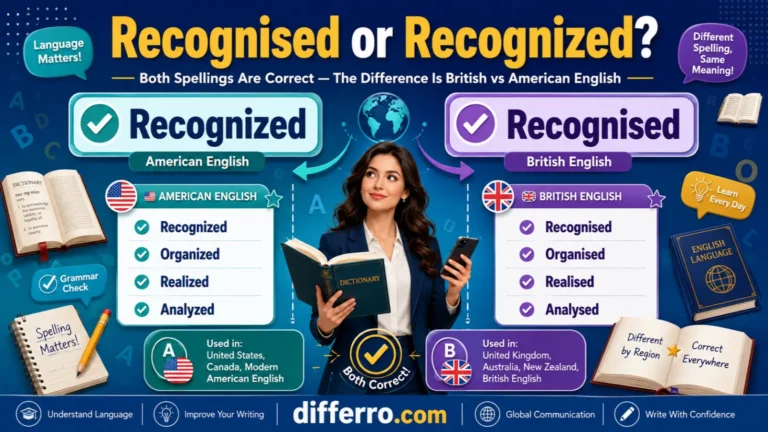
Recognised Or Recognized? This question confuses many English learners and writers. The good news is that both spellings are correct.
The difference depends on the type of English you use. Recognised is the preferred spelling in British English, while Recognized is the standard spelling in American English.
Many words ending in -ise and -ize follow the same pattern. Because both versions appear online, in books, and in official documents, people often wonder which one is right.
In this guide, you’ll learn the meaning of both spellings, their differences, history, usage examples, common mistakes, and when to use each one. By the end, you’ll know exactly which spelling fits your audience and writing style.
⭐ Quick Answer
Recognised and Recognized have the same meaning. The only difference is regional spelling.
- Recognised = British English
- Recognized = American English
Example:
- British English: She was recognised for her hard work.
- American English: She was recognized for her hard work.

📖 Meaning of Recognised
Recognised means identifying someone or something that you have seen before or giving official acknowledgment.
Examples
- She was recognised by her former teacher.
- The company was recognised for excellent customer service.

📖 Meaning of Recognized
Recognized means identifying someone or something or officially acknowledging achievements.
Examples
- He recognized his friend in the crowd.
- The organization was recognized for innovation.
📊 Key Differences Table
| Feature | Recognised | Recognized |
|---|---|---|
| Meaning | Identify or acknowledge | Identify or acknowledge |
| Tone | British English | American English |
| Usage | UK, Australia, New Zealand | USA, Canada |
| Popularity | Common in British publications | Common in American publications |
📜 Origin & History
The word comes from the Latin word recognoscere, meaning “to know again.”
Over time, English adopted different spelling conventions. British English often uses -ise, while American English generally prefers -ize.
Similar examples include:
- Organised / Organized
- Realised / Realized
- Authorised / Authorized
- Civilised / Civilized
🇬🇧 British English vs American English Spelling
British and American English often use different spellings for the same words. The meaning remains unchanged. The difference comes from historical spelling reforms and regional language preferences.
Comparison Table: British vs American English
| British English | American English |
|---|---|
| Recognised | Recognized |
| Organised | Organized |
| Realised | Realized |
| Authorised | Authorized |
| Civilised | Civilized |
✍️ When to Use Recognised
Use Recognised when writing for:
- UK audiences
- British publications
- Australian readers
- Academic content following British style guides
Examples
- The scientist was recognised for her research.
- He recognised the actor immediately.
- The charity was recognised nationally.
✍️ When to Use Recognized
Use Recognized when writing for:
- US audiences
- American businesses
- US-based websites
- American academic writing
Examples
- The organization recognized her as a leader.The award committee recognized the school for excellence.
- I recognized his voice instantly.
❌ Common Mistakes
Mistake 1
❌ The company was recogniszed for quality.
✅ The company was recognised for quality.
Mistake 2
❌ The company was reconized for quality.
✅ The company was recognized for quality.
Mistake 3
❌ Mixing both spellings in one article.
✅ Use one spelling consistently.
Mistake 4
❌ Assuming one spelling is wrong.
✅ Both spellings are correct.
🧠 Easy Trick to Remember
A simple memory tip:
- Recognised = British English = S
- Recognized = American English = Z
Think of Z as the preferred American spelling and S as the common British spelling.
📝 Write 5 Examples
Example 1: Workplace
The employee was recognised for outstanding performance in the UK office.
Example 2: Education
The student was recognized for academic excellence in the United States.
Example 3: Awards
The charity was recognised nationally for community service.
Example 4: Business
The brand became widely recognized across North America.
Example 5: Daily Life
I immediately recognized my childhood friend at the airport.
🔍 Related Keywords
- recognised vs recognized
- recognized or recognised
- recognise or recognize
- British vs American spelling
- recognised meaning
- recognized meaning
- spelling differences in English
📈 Google Trends & Usage Data
The popularity of Recognised and Recognized varies by country. American users overwhelmingly prefer Recognized, while British users favor Recognised. Australia generally follows British spelling. India and Pakistan show mixed usage because both British and American English influence education and media.
Usage Insight by Country
| Country | Preferred Form |
|---|---|
| USA | Recognized |
| UK | Recognised |
| Australia | Recognised |
| India | Mixed |
| Pakistan | Mixed |
Comparison Table: Keyword Variations
| Keyword Variation | Usage |
|---|---|
| Recognised | British English |
| Recognized | American English |
| Recognise | British English |
| Recognize | American English |
| Recognised vs Recognized | Comparison keyword |
| Recognized meaning | Informational keyword |
⚖️ Final Verdict
Both Recognised and Recognized are correct spellings.
Choose Recognised for British English audiences and Recognized for American English audiences. Neither spelling is more accurate than the other. The best choice depends on your target readers and style guide.
❓ FAQs
Is it correct to write recognised?
Yes. Recognised is correct in British English.
What is the difference between recognised and recognized?
The meaning is identical. Only the spelling differs.
Which is more common?
Recognized is more common globally because American English has a large online presence.
Which spelling should I use in formal writing?
Use the spelling that matches your audience or style guide.
Why does the confusion exist?
The confusion comes from differences between British and American English spelling conventions.
📝 Conclusion
Recognised Or Recognized? Both spellings are correct and have exactly the same meaning. The only difference is regional preference. British English typically uses recognised, while American English prefers recognized. Understanding this distinction helps you write more accurately for your audience. Whether you’re creating academic papers, business documents, blog posts, or everyday messages, consistency is important. Choose one spelling style and use it throughout your content. If your audience is in the UK or Australia, use recognised. If your readers are mainly in the United States, use recognized. Following this simple rule will make your writing look professional and polished.

