
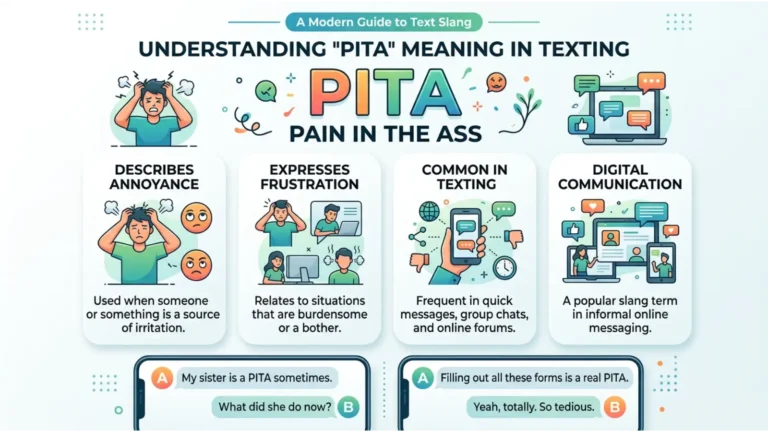
If you have seen pita meaning slang in a text, comment, social media post, or online conversation, you may wonder what this short word actually means.
At first, “pita” looks like the name of a type of flatbread. However, when written as PITA, it can have a completely different meaning in informal communication.
In slang and texting, PITA usually stands for “pain in the ass.” People use it to describe someone or something that is annoying, troublesome, frustrating, or difficult to deal with.
Dictionaries such as Cambridge and Dictionary.com recognize PITA as an informal abbreviation used especially in online communication.
Quick Answer:
PITA means “pain in the ass.” It describes a person, task, situation, or problem that is annoying or difficult to handle.
What Does PITA Mean in Text?
In text messages and online conversations, PITA is an acronym for “pain in the ass.” It is used when someone wants to complain about something frustrating or inconvenient without writing the entire phrase.
For example:
- “This paperwork is such a PITA.”
- “My internet connection is a PITA today.”
- “He can be a real PITA sometimes.”
The term can refer to a person, task, object, situation, or problem.
Cambridge Dictionary defines PITA as a very informal abbreviation for “pain in the ass” and notes that it is used on social media and in text messages to refer to someone or something annoying.
PITA Full Form
The common slang full form of PITA is:
P = Pain
I = In
T = The
A = Ass
So:
PITA = Pain In The Ass
The phrase is informal and mildly vulgar because it contains the word “ass.” That means PITA is generally more suitable for casual communication than formal or professional writing.
PITA Meaning Slang in Different Contexts
The meaning remains basically the same, but the context can change how strong or playful the expression sounds.
PITA for a Person
Someone may call another person a PITA when that person is irritating, difficult, demanding, or troublesome.
Example:
“My little brother is being a PITA today.”
This does not necessarily mean the speaker seriously dislikes their brother. It could simply be a casual complaint.
PITA for a Task
PITA can describe something that takes too much effort or causes unnecessary frustration.
Example:
“Filling out all these forms was a PITA.”
Here, the speaker is saying the forms were annoying or difficult to complete.
PITA for a Situation
A frustrating event can also be called a PITA.
Example:
“Getting stuck in traffic was a PITA.”
The phrase expresses annoyance with the situation.
PITA for Technology
People sometimes use PITA when technology refuses to work properly.
Example:
“Setting up this printer is a PITA.”
This means setting up the printer is frustrating or troublesome.
Is PITA Rude, Offensive, or Neutral?
PITA is informal and mildly rude, rather than completely neutral. The reason is that it abbreviates “pain in the ass.”
The abbreviation can make the expression feel less direct than saying the full phrase, but the underlying meaning is still somewhat crude.
For example:
Casual:
“This software is a PITA.”
More polite:
“This software is really frustrating.”
Professional:
“This software has been difficult to configure.”
The appropriate choice depends on who you are talking to and where you are writing.
Where Is PITA Commonly Used?
PITA is mainly associated with informal communication. It can appear in:
- Text messages
- Private chats
- Social media
- Online forums
- Casual emails
- Gaming conversations
- Informal workplace chats
- Everyday conversations
Dictionary.com also identifies PITA as an informal abbreviation for “pain in the ass,” particularly in online communication.
It is less appropriate in formal reports, academic assignments, business documents, job applications, or professional emails.
Real-Life PITA Conversation Examples
Friendly Example
Alex: How was your trip?
Sam: Great, but finding parking was a PITA.
Here, PITA expresses mild frustration.
Casual Example
Mia: Did you finish the project?
Jake: Finally! The last part was such a PITA.
The speaker is complaining casually about a difficult task.
Argumentative Example
Person 1: Why are you still complaining about this?
Person 2: Because dealing with this problem has been a PITA.
The expression sounds stronger because the conversation is already tense.
Workplace Example
Coworker 1: Is the new system easy to use?
Coworker 2: Not really. The setup is a PITA.
This may be understandable in an informal conversation between coworkers, but it would be better to use more professional wording in an official email.
Social Media Example
“Trying to assemble this furniture without instructions was a PITA.”
The writer is casually describing a frustrating experience.
Emotional and Psychological Meaning of PITA
PITA does not describe a specific psychological condition or emotion. Instead, it communicates a person’s frustration, irritation, inconvenience, or annoyance.
The emotional strength depends on context.
For example:
“This traffic is a PITA.”
This may simply express temporary irritation.
But:
“That guy is a PITA.”
This is a negative description of a person and may sound insulting.
Tone, relationship, and situation are therefore important when interpreting the expression.
Origin and Background of PITA
The phrase “pain in the ass” existed before modern texting and social media. PITA developed as a shortened form of that phrase.
The exact person or moment that created the acronym is not clearly established. However, acronym-based shorthand became increasingly common in computer communication, messaging, and online conversations.
Older slang references also document PITA as an abbreviation for “pain in the ass.” For example, The Free Dictionary describes PITA as an acronym for a person or thing that is particularly aggravating or troublesome.
So, PITA is best understood as shorthand rather than a newly invented social-media word.
PITA vs Similar Slang Terms
PITA has several related expressions, but they are not always interchangeable.
| Term | Meaning | Tone |
|---|---|---|
| PITA | Pain in the ass; annoying person or thing | Informal, mildly rude |
| Pain in the neck | Annoying or troublesome person or thing | More polite |
| Hassle | Something difficult or inconvenient | Neutral/informal |
| Annoying | Causing irritation | Neutral |
| Nuisance | Person or thing causing inconvenience | More formal |
| Headache | Something causing stress or difficulty | Informal |
If you want to express the same basic idea without profanity, hassle, headache, nuisance, or annoying can be better choices.
PITA vs Pita Bread: A Common Confusion
One of the most interesting things about PITA is that pita is also an ordinary English word.
Lowercase pita commonly refers to a type of round or oval flatbread. Cambridge Dictionary lists pita as a flat, hollow bread, while Dictionary.com also defines it as a type of round Middle Eastern flatbread.
Compare:
“I ordered pita with my meal.”
Here, pita means bread.
“This website is a PITA.”
Here, PITA means “pain in the ass.”
Capitalization can provide a clue, but context is usually more important.
When Should You Avoid Using PITA?
Avoid PITA when you need highly professional or respectful language.
For example, instead of writing:
“Your application process is a PITA.”
A professional version would be:
“Your application process is quite difficult to complete.”
Avoid the slang especially in:
- Formal business emails
- Academic writing
- Job applications
- Official complaints
- Professional reports
- Communication with people you do not know well
The full phrase contains a mild swear word, so the acronym may still be considered inappropriate in some settings.
When Is It Okay to Use PITA?
PITA can work naturally in casual conversations when everyone understands informal slang.
You might use it with:
- Close friends
- Family members
- Online friends
- Casual group chats
- Informal social media conversations
For example:
“Moving all this furniture was a PITA 😂”
The emoji and casual context can make the statement sound more humorous than aggressive.
Why Do People Use PITA?
People use PITA because it is short and convenient. Instead of typing “pain in the ass,” they can simply write four letters.
It can also soften the appearance of the phrase slightly while preserving its meaning.
For example:
“This update is a PITA.”
is shorter than:
“This update is a pain in the ass.”
The acronym is especially convenient in quick online communication.
Impact of PITA on Communication
Using slang can make a message sound relaxed, humorous, and conversational. However, slang can also cause misunderstandings.
Someone unfamiliar with the acronym might think you are talking about pita bread.
The word can also sound more offensive when used to describe a person rather than a task.
Compare:
“This assignment is a PITA.”
with:
“You are a PITA.”
The second statement directly labels a person and may be taken as an insult.
That is why context and tone matter.
Is PITA Safe for Social Media?
PITA is generally understandable in casual online communication, but it is not completely neutral. It abbreviates a phrase containing profanity.
If you are posting publicly, consider your audience before using it.
For a casual post:
“Moving house was a PITA!”
works as informal language.
For a professional account:
“Moving house was incredibly stressful.”
would be more appropriate.
Common Misunderstandings About PITA
1. PITA Always Means Bread
Not necessarily. In a food-related conversation, pita usually means bread. In a texting or slang context, PITA can mean “pain in the ass.”
2. PITA Is Always an Insult
Not always. It can describe a frustrating task or situation rather than a person.
3. PITA Is Formal English
No. It is informal slang and should generally be avoided in formal writing.
4. PITA Means Serious Anger
Not necessarily. It can describe mild frustration, irritation, or playful complaining.
5. PITA Is Only Used for People
No. A task, situation, process, device, or problem can also be called a PITA.
Variations and Related Forms
You may see PITA written in several ways:
- PITA
- pita
- P.I.T.A.
- a PITA
- such a PITA
- real PITA
The meaning generally comes from the context.
You may also encounter PIA, another abbreviation for “pain in the ass,” although PITA is a recognized form in dictionaries and slang references.
How to Respond When Someone Says PITA
Your response depends on the situation.
If someone says:
“This project is a PITA.”
You could reply:
“Yeah, it’s taking forever.”
Or:
“I know. The last part is especially frustrating.”
If someone says:
“You’re being a PITA.”
You can ask:
“What did I do?”
This helps determine whether the person is joking or genuinely annoyed.
Regional and Cultural Usage
PITA is primarily an informal English-language abbreviation. Dictionary sources specifically describe it as an abbreviation for “pain in the ass,” with Cambridge noting its use in social media and text messages.
The exact reaction to the term can vary between people, cultures, workplaces, and age groups. Some people may see it as harmless casual slang, while others may consider the underlying phrase too crude.
When communicating with an international or unfamiliar audience, a neutral alternative is safer.
Polite Alternatives to PITA
If you want to express frustration without using slang, try:
- Annoying
- Frustrating
- Difficult
- Troublesome
- Inconvenient
- A hassle
- A headache
- A nuisance
- Hard to deal with
For example:
Slang:
“This process is a PITA.”
Polite:
“This process is really frustrating.”
Both communicate a similar idea, but the second is more suitable for professional situations.
FAQs About Pita Meaning Slang
What does PITA stand for in texting?
PITA stands for “pain in the ass.” It is an informal abbreviation used to describe someone or something annoying, frustrating, or troublesome.
What does PITA mean in slang?
The PITA meaning slang is “pain in the ass.” It is commonly used when someone wants to complain about a frustrating person, task, problem, or situation.
Is PITA a bad word?
PITA itself is an abbreviation, but its full form contains the mildly vulgar word “ass.” Therefore, it is informal and may be inappropriate in professional or formal situations.
What does PITA mean over text?
Over text, PITA usually means “pain in the ass.” For example, “This homework is a PITA” means the homework is very annoying or difficult.
Is PITA the same as pita bread?
No. Pita can mean flatbread, while PITA in slang means “pain in the ass.” Context tells you which meaning is intended.
Can I use PITA at work?
It depends on the workplace and audience. It may be acceptable in a very casual private conversation, but it is better to avoid it in formal emails, reports, and professional documents.
Conclusion
The pita meaning slang is “pain in the ass.” It is an informal expression used to describe a person, task, situation, or problem that is annoying, frustrating, or difficult to deal with.
PITA is common in casual texts, online conversations, and social media, but it is not formal English. Because its full form contains a mildly vulgar word, consider your audience before using it.
Also remember that pita can simply mean flatbread. If someone writes “I ate pita for lunch,” they are talking about food. If they write “This assignment is a PITA,” they are expressing frustration.
Understanding the context, tone, and audience will help you know when PITA means slang and when it simply means bread.

Ali Raza is an M.Phil. scholar and English language expert specializing in English grammar, slang meanings, vocabulary, and everyday expressions. He writes clear, practical, and easy-to-understand content that helps readers master confusing English words, phrases, spelling, and modern slang. His goal is to make English learning simple, useful, and accessible for students, beginners, and everyday readers.
1 thought on “Pita Meaning Slang: What Does PITA Mean?”