

Nonresponsive vs Unresponsive often confuses writers because both words describe a lack of response. Both forms are correct, but they can fit different situations. Nonresponsive usually describes someone or something that does not respond. Unresponsive often describes a person, device, system, or situation that fails to respond normally. The difference is small, but context matters. You may see both words in everyday English, medical writing, technology, and formal communication. This guide explains Nonresponsive vs Unresponsive with clear meanings and practical examples. You will also learn when to use each word. Simple usage rules can help you avoid common mistakes. By the end, you will know which word sounds more natural in different situations.
⭐ Quick Answer
Nonresponsive and unresponsive both mean not responding. Unresponsive is more common in everyday English, while nonresponsive often sounds more formal or technical.
Example:
- The customer remained unresponsive to our messages.
- The patient was nonresponsive to verbal commands.
📖 Meaning of Nonresponsive
Nonresponsive means failing to respond or react to something.
It can describe a person, organization, device, system, or process. The word often appears in formal, professional, technical, and medical contexts.
Examples of Nonresponsive
- The patient was nonresponsive to verbal instructions.
- The website became nonresponsive after the update.
Nonresponsive focuses on the absence of a response. It can describe deliberate silence or a failure to react.
📖 Meaning of Unresponsive
Unresponsive means not reacting, answering, or responding as expected.
It commonly describes people, electronic devices, websites, applications, and systems.
Examples of Unresponsive
- The customer remained unresponsive after several emails.
- My phone became unresponsive during the call.
Unresponsive is highly natural in everyday English. It can also appear in medical and technical contexts.
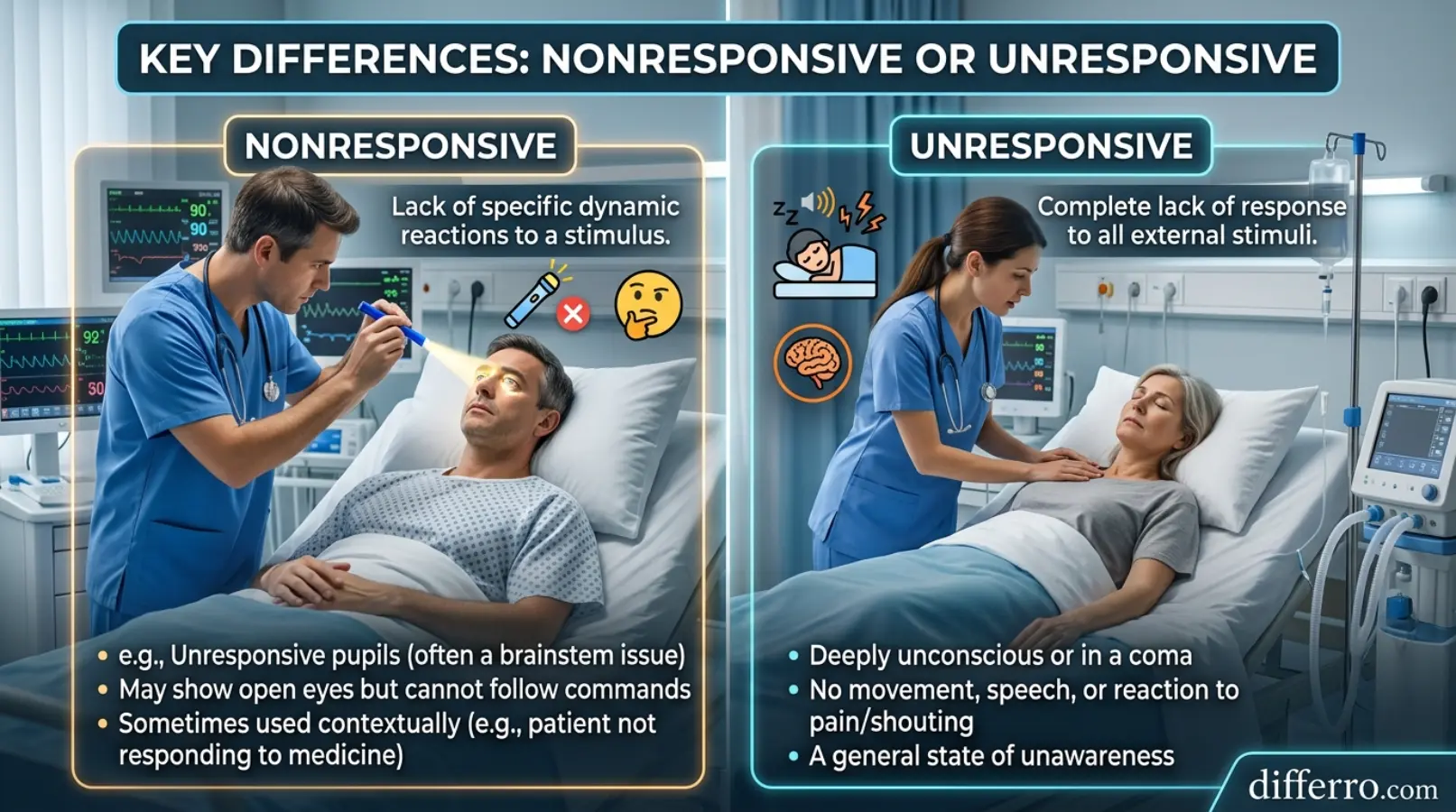
🔍 Key Differences: Nonresponsive or Unresponsive
| Feature | Nonresponsive | Unresponsive |
|---|---|---|
| Meaning | Failing to respond | Failing to respond or react |
| Tone | Formal or technical | Common and natural |
| Usage | Medical, technical, professional | Everyday, medical, technical |
| Popularity | Less common | More common |
| Typical phrase | Nonresponsive system | Unresponsive phone |
| Person usage | Formal or clinical | Very common |
Both words can be correct in many situations. Your choice depends mainly on context and tone.
📚 Origin & History
The word responsive comes from the idea of responding or reacting. The prefix non- means “not,” while un- can express the opposite condition.
Therefore, nonresponsive literally suggests “not responsive.” Unresponsive suggests a lack of response or reaction.
English often creates similar pairs Nonresponsive vs Unresponsive with these prefixes.
Examples include:
- Nonverbal and unspoken
- Nonactive and inactive
- Nonofficial and unofficial
- Nonstable and unstable
These pairs do not always have identical meanings. English usage depends on context and established patterns.
British English vs American English Spelling
British and American English generally spell Nonresponsive vs Unresponsive the same way. Neither word has a major British-American spelling difference. Usage and preferred style may vary more than spelling.
| English Variety | Nonresponsive | Unresponsive |
|---|---|---|
| British English | Correct | Correct |
| American English | Correct | Correct |
| Canadian English | Correct | Correct |
| Australian English | Correct | Correct |
📝 When to Use Nonresponsive
Use nonresponsive when you want a formal, technical, or clinical tone.
It works well when describing a failure to respond to a specific stimulus, request, or command.
Examples
- The patient was nonresponsive to treatment.
- The device remained nonresponsive after restarting.
- The employee became nonresponsive to repeated requests.
In professional writing, nonresponsive can sound precise and objective.
When Nonresponsive Sounds Better
Choose nonresponsive when the sentence focuses on a specific response that did not occur.
For example:
- The patient was nonresponsive to verbal commands.
- The system was nonresponsive to user input.
These phrases sound natural in formal writing.
💬 When to Use Unresponsive
Use unresponsive when you want natural, general English.
It works especially well for people, phones, computers, websites, applications, and customer communication.
Examples
- My laptop is unresponsive.
- She remained unresponsive to my messages.
- The website became unresponsive during checkout.
Unresponsive is usually the safer choice for everyday conversations.
When Unresponsive Sounds Better
Use unresponsive when describing something that normally reacts but suddenly stops reacting.
For example:
- My phone screen is unresponsive.
- The computer became unresponsive.
- He was unresponsive when we called his name.
⚠️ Common Mistakes
Mistake 1: Treating Them as Different Spellings
Incorrect idea:
- Unresponsive is the correct spelling.
- Nonresponsive is incorrect.
Correct understanding:
- Both nonresponsive and unresponsive are correct words.
Mistake 2: Using a Hyphen Without Need
Less standard:
- The computer was non-responsive.
Preferred:
- The computer was nonresponsive.
Modern general usage usually favors the closed form nonresponsive.
Mistake 3: Choosing Nonresponsive in Casual Speech
Awkward:
- My phone is nonresponsive, bro.
More natural:
- My phone is unresponsive.
The second sentence sounds more conversational.
Mistake 4: Assuming Unresponsive Only Describes People
Incorrect idea:
- Unresponsive can only describe a person.
Correct:
- The unresponsive website needs maintenance.
- The unresponsive screen needs repair.
The word can describe people, devices, systems, and other things.
🧠 Easy Trick to Remember
Think of unresponsive as the everyday choice.
Think of nonresponsive as the more formal or technical choice.
A simple memory rule is:
Everyday = Unresponsive
Formal or technical = Nonresponsive
For example:
- My phone is unresponsive.
- The device was nonresponsive to input.
This trick will help you choose the natural word quickly.
🌎 Everyday Life Examples
1. Unresponsive Phone
My phone became unresponsive after I opened several applications.
Here, unresponsive sounds natural because the sentence describes everyday technology.
2. Nonresponsive Website
The website became nonresponsive after the server experienced heavy traffic.
Here, nonresponsive suits a technical context.
3. Unresponsive Customer
The customer remained unresponsive after receiving several messages.
This example uses the primary keyword naturally in communication.
4. Nonresponsive Patient
The medical team found the patient nonresponsive to verbal commands.
This formal example fits clinical language.
5. Unresponsive Computer
The computer became unresponsive while I was editing the document.
This everyday example shows why unresponsive is common in casual English.
📈 Google Trends & Usage Data
Search interest can change by country, topic, and search intent. Unresponsive generally has broader everyday usage across English-speaking searches. Nonresponsive appears more often in medical, technical, legal, and professional contexts. Exact Google Trends scores change over time, so relative interest should guide strategy rather than fixed numbers.
| Country | More Common Search Term | Usage Insight |
|---|---|---|
| USA | Unresponsive | Strong everyday and technical usage |
| UK | Unresponsive | Common in general English |
| Australia | Unresponsive | Natural in everyday communication |
| India | Unresponsive | Common in general and professional English |
| Pakistan | Unresponsive | Common in education, technology, and communication |
Keyword Variation Comparison
| Keyword Variation | Search Intent | Best Content Angle |
|---|---|---|
| Nonresponsive or Unresponsive | Comparison | Difference and usage |
| Nonresponsive vs Unresponsive | Comparison | Grammar and examples |
| Nonresponsive meaning | Definition | Word meaning |
| Unresponsive meaning | Definition | Word meaning |
| Is Nonresponsive a Word? | Spelling | Correctness |
| Is Unresponsive a Word? | Spelling | Correctness |
| Nonresponsive definition | Definition | Formal usage |
⚖️ Final Verdict
Both nonresponsive and unresponsive are correct.
Choose unresponsive for everyday English, casual communication, and general descriptions. It is usually the more natural and common choice.
Choose nonresponsive when you need a formal, clinical, technical, or professional tone.
For most general writing, unresponsive is the safer choice. For specific technical or medical contexts, nonresponsive may sound more precise.
The best word depends on the sentence, audience, and intended tone.
❓ FAQ
Is “nonresponsive” correct?
Yes. Nonresponsive is a correct English word. It means failing to respond or react.
What is the difference between nonresponsive and unresponsive?
Both mean a lack of response. Unresponsive sounds more common in everyday English. Nonresponsive often sounds more formal or technical.
Which is more common, nonresponsive or unresponsive?
Unresponsive is generally more common in everyday English. People frequently use it for phones, computers, people, and messages.
Is nonresponsive formal?
Yes. Nonresponsive can sound more formal, clinical, or technical. It often appears in professional and medical writing.
Why does confusion exist between these words?
Both words contain responsive and describe a lack of response. Their meanings overlap heavily, so writers often wonder which form sounds better.
Can I use unresponsive for a computer?
Yes. Unresponsive is very common for computers, phones, websites, and applications.
Can I use nonresponsive for a person?
Yes. Nonresponsive can describe a person who does not react or answer. It often appears in formal or medical contexts.
🏁 Conclusion
Nonresponsive or Unresponsive is a common English word-choice question. Both words are correct and share a similar meaning. Unresponsive usually works better in everyday English and general communication. Nonresponsive often suits formal, technical, professional, and clinical writing. You can use either word when the context supports it. However, choosing the more natural option can make your writing clearer. Remember this simple rule: everyday situations usually favor unresponsive, while formal contexts may favor nonresponsive. Examples can also help you recognize the difference quickly. When writing for a general audience, unresponsive is usually the safest choice. When describing a specific response failure in technical writing, nonresponsive may sound more precise.

Imran Lodhra is a comparison-focused content writer at Differro.com.
He specializes in creating clear, simple, and informative comparison articles.
His work helps readers understand key differences, pros and cons, and important details.
Imran focuses on accurate, practical, and easy-to-read content for everyday readers.